


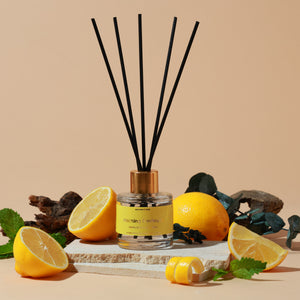
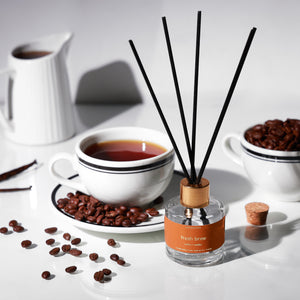
Why useful means consumable here: a durable object at this price is permanent, and permanence in a small new flat is an obligation to find space. A consumable has a stated end and leaves nothing behind.
The consumables under ₹500: jar candles ₹379 (roughly 15–18 hours), the Sandalwood jar ₹449, wax melts ₹474 — which need a burner the household may not own. The ₹474 mug is the durable exception, and it is the right answer for some homes.
The catch: a consumable only counts if it gets consumed. A candle needs someone who lights candles. A reed diffuser — a glass bottle of fragrance oil with six fibre reeds, no flame and no electricity — consumes itself over 6–8 weeks with nobody participating, and that starts at ₹749.
2. At this price, useful and consumable are the same word. Durable goods under ₹500 are not more useful — they are more permanent, and permanence is the expensive part in a flat where nothing has a place yet. A gift that must be kept forever is a small obligation. A gift with a stated end is not.
3. So the answer is a jar candle at ₹379 or the Sandalwood jar at ₹449 — roughly 15–18 hours each, complete in themselves, requiring nothing else to be bought, and leaving an empty glass rather than a possession when they are done.
4. But a consumable is only useful if it is consumed. That is the whole catch of this band and the thing most lists skip. A candle needs a household where somebody lights candles; if nobody does, it stops being a consumable and becomes an ornament. Wax melts at ₹474 are worse in this respect, because they need a burner the household may simply not own.
5. The durable exception is real, and I would not talk you out of it. If they have just moved with two mugs between them, an Everyday Beautiful mug at ₹474 is the most useful thing on this page, full stop. Buy it knowing it is permanent and commonly duplicated.
6. The only format that consumes itself starts at ₹749. A reed diffuser runs continuously without anybody remembering anything — the oil climbs six fibre reeds and evaporates into the room for six to eight weeks, then it is over. No habit is required, which means its usage rate does not depend on the household at all.
7. Then measure the cost against the use, not against the label. Free shipping begins at ₹499, so a ₹379 candle arrives with a courier charge on top and a ₹749 bottle does not. Divide each by the weeks it is actually in use and the cheaper gift stops looking as much cheaper as it did.
Everything is composed and handmade in small batches in Pune, and a portion of every order supports girl-child education through Nanhi Kali.

Part one — why "useful" collapses into "consumable" at this price
Usefulness sounds like a property of an object, and above a certain price it more or less is. Below ₹500 it becomes a property of the household instead — of whether they have the space, the habit and the occasion to use the thing you bought. That shift is what catches people out. You buy something practical, you hand it over, and it is genuinely practical, and it still ends up in a carton in November. Nothing went wrong with the object. What went wrong is that at this price you cannot buy something so good that it displaces what the household already owns, and you cannot buy something so large that it fills a gap they actually have. What you can buy is something that gets used up, which is a different and more reliable kind of useful.
 Sandalwood jar₹449 · 15–18 hrsA consumable answers the storage question before it is asked: it lives wherever it is convenient, and then it is gone. Fifteen to eighteen hours for a jar candle at ₹379, six to eight weeks for a 50ml reed diffuser at ₹749 — in both cases the household knows the gift has an end, and knowing that removes the low-grade obligation that permanent objects carry. It also removes the taste risk almost entirely. If a decorative piece is not to their taste, it is on their wall for years or it is an awkward conversation. If a candle is not quite to their taste, it is finished in a month and nobody had to say anything. Being wrong about a consumable is temporary, and that is a genuinely underrated feature when you are buying for a home you have never been inside.
Part two — used up, or stored
Every gift in and around the band, judged only on whether it actually gets consumed. The fourth column is the one that decides everything: not whether the thing can be used up, but what has to be true about the household before it is. No prices are given for any category outside the SOSA range, because this is a comparison of behaviour rather than of cost.
| The gift | Consumable or durable | Stated life | What has to be true for it to be used | Where it is in six weeks |
|---|---|---|---|---|
| 50ml reed diffuser ₹749 ★ | Consumable | 6–8 weeks, continuous | Nothing — it runs unattended | Roughly two-thirds gone, still running |
| Jar candle ₹379 | Consumable | Roughly 15–18 hours of burning | Somebody lights candles, and remembers to | Anywhere from finished to barely started |
| Sandalwood jar candle ₹449 | Consumable | The same, in the least polarising scent we make | The same habit — the scent is the safer part | Usually a little further along, because it gets lit more |
| Forest Walk wax melts ₹474 | Consumable in theory | Several sessions, if there are sessions | They own a wax burner. Without it the rate is zero | Unopened, in a drawer, in most households |
| Everyday Beautiful mug ₹474 | Durable | Indefinite | They are short of mugs — genuinely short, not notionally | In daily use, or third in a stack of five |
| Cloud ceramic trinket dish ₹664 | Durable | Indefinite | There is a console or bedside it suits | On that surface, or in a cupboard, permanently either way |
| The honest caveat: in a household that lights a candle most evenings, the ₹379 jar has the highest usage rate of anything on this table and is the better gift by a clear margin — cheaper, more used, and finished sooner. The reed diffuser only wins the top row because most households do not have that habit and you usually cannot tell which sort you are buying for. Where you have real information, follow the information. | ||||
 Sandalwood jar · the safest scent₹449Shop →
  Wax melts · only with a burner₹474Shop →
 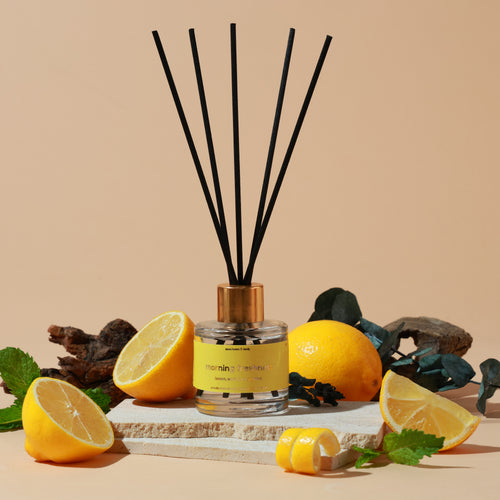 Morning Freshness · runs unattended₹749Shop →
Part three — the gap this band cannot close
Here is the thing I cannot solve for you inside ₹500, stated without a workaround. Every consumable in this band requires a person to participate — to strike a match, to find a safe surface, to own a burner, to remember. That is not a flaw in candles; it is what a candle is, and for the households that enjoy that participation it is the point of the object rather than a cost of it. But it does mean that the usefulness of your gift is being decided by somebody else's habits, in a home you probably have not lived in, during the busiest month of their year. If they are the sort of household that lights candles, you have given a genuinely excellent gift. If they are not, you have given a jar of scented wax that will be moved twice and then stored, and you will never find out which happened.
The format that removes that uncertainty is a reed diffuser, and it removes it completely rather than partly. Six fibre reeds stand in a bottle of fragrance oil; the oil climbs the fibre and evaporates off the exposed length into the room, continuously, from the moment it is put down until the bottle is empty six to eight weeks later. There is no habit to depend on and nothing to remember — even the weekly flip is optional in the sense that skipping it does not break anything, it just makes the room quieter than it could be. The gift is being used while the household is at work, which is when most of a flat's hours actually happen. That is what ₹749 buys and it is why the price sits above this band rather than in it: the vessel, the reeds and 50ml of alcohol-free, phthalate-free oil on a heat-stable carrier is what the format costs, and a cheaper version would be a lighter bottle holding less.
Then run the arithmetic properly before you decide, because most people run it wrong. Free shipping on the store begins at ₹499, so a ₹379 candle arrives with a delivery charge attached to it while a ₹749 bottle arrives at its label price. Now divide each by the weeks it is genuinely in use. A candle burned twice a month is being used at a very different rate from one burned nightly, and a diffuser is in use every hour of every week regardless. Per week of actual use, the cheap gift is very rarely as cheap as it looked, and the expensive one is rarely as expensive. I am not saying this to move you upwards — for the right household the candle wins that sum outright. I am saying it because it is the sum worth doing, and almost nobody does it.
Part four — the most useful gift, by household
Arranged by what you know about the home rather than by product, because usefulness at this price is a property of the household rather than of the object. The last column is the honest answer to "when is this gone", which is the question the whole page has been building towards.
| The household | The most useful gift for them | Price | When it is gone |
|---|---|---|---|
| You do not know their habits at all ★ | Morning Freshness 50ml reed diffuser | ₹749 | In 6–8 weeks, whatever they do |
| Somebody lights a candle most evenings | Cozy Corner or Misty Mornings jar candle | ₹379 | Within weeks — and it is the better gift here |
| They light candles occasionally, and you want the safest scent | Sandalwood jar candle | ₹449 | Over a few months, at their pace |
| You have seen a wax burner in their home | Forest Walk wax melts | ₹474 | Across several sessions — but only with the burner |
| They moved with almost nothing and are genuinely short | Everyday Beautiful mug | ₹474 | Never — and here that is the correct answer |
| A couple with two rooms, and several of you are pooling | Day & Night duo, two 50ml bottles | ₹1,498 | Both bottles in 6–8 weeks, one room each |
| Somebody in the house dislikes scented things | The mug, or nothing from this category at all | ₹474 | Not a fragrance decision — do not talk them round |

Versailles
For a long time I thought the strongest argument for what we make was that it is beautiful, and I was wrong in a way that took me a while to see. The strongest argument is that it ends. A customer told me once that the diffuser her sister had given her was the only housewarming gift she had not had to find a place for, because the place it needed was temporary and it took itself away afterwards. That is a small observation and I have thought about it more than almost anything else anyone has written to me.
It is also why I am relaxed about selling candles at ₹379 to people who would otherwise not buy from us at all. A candle in a house that lights candles is a better gift than anything I could argue you into — used more often, finished sooner, and cheaper. My only real caution is the one that runs through this page: check that the habit exists before you buy the object that depends on it, and never buy wax melts without having seen the burner.
What ₹749 buys is not a better fragrance. It is independence from the habit — a gift whose usefulness does not depend on anybody remembering anything, in the month when a household is least able to remember anything. That is the whole of the difference, and I would rather state it in one sentence than dress it up. Everything is composed and handmade in Pune, in small batches, and a part of every order funds a girl's classroom through Nanhi Kali.
Frequently asked questions
- Housewarming gifts under ₹500 — the band in full, and what the next step buys.
- Premium-looking gifts under ₹500 — the tells that give a cheap gift away.
- Gifts under ₹300 and Griha Pravesh gifts under ₹500 — the neighbouring bands.
- The complete under-₹500 guide — every rung, with the shipping arithmetic in full.
- Brand: the SOSA founder story.
SOSA range & prices used in this guide (verified from the live store, August 2026): Reed diffusers — alcohol-free, phthalate-free, paraben-free, IFRA-compliant compositions on a heat-stable coconut-derived (CCT) carrier, supplied in a refillable glass bottle with six fibre reeds; 50ml lasts 6–8 weeks, 130ml lasts 14–18 weeks. Morning Freshness 50ml ₹749 · 130ml ₹1,249; Garden Bloom 50ml ₹799 · 130ml ₹1,299; Evening Calm 50ml ₹799 · 130ml ₹1,299; Fresh Brew 50ml ₹849 · 130ml ₹1,349; Mountain Breeze 50ml ₹849 · 130ml ₹1,349. Duo sets: Day & Night ₹1,498, Fresh & Grounded ₹1,548, Warmth & Bloom ₹1,598 (2 × 50ml); ₹2,498–₹2,598 (2 × 130ml). Oil-only refills 300ml ₹2,399 · 500ml ₹3,499 (the glass vessel and reeds are not included). The least expensive SOSA reed diffuser is ₹749, so no reed diffuser exists below that price in any format. Below it SOSA sells scented candles from ₹379 (roughly 15–18 hours), a Sandalwood jar candle ₹449, wax melts ₹474, ceramic mugs ₹474, ribbed and face mugs ₹569, bubble and taper candles ₹474–₹569, a ceramic trinket dish ₹664 and candle duos ₹664 (roughly 30–36 hours). The store runs an automatic discount, so several prices display with a .05 tail (₹379.05, ₹474.05); whole rupees are quoted here. Machines: Boond 300ml ₹899 · Sukoon 500ml ₹1,899 · Megh 6L ₹3,499 · waterless Vaayu ₹11,999. The water-based Hotel Collection (15ml ₹299 · 100ml ₹999 · 300ml ₹1,799) is a fragrance for an ultrasonic machine and is not a standalone gift. SOSA does not sell a gift card, a gift hamper, a gift box or a curated reed gift set, and gift wrapping, gift notes, direct-to-recipient shipping and any bulk or corporate terms are unconfirmed — check at checkout or with SOSA rather than assuming them. Composed and handmade in small batches in Pune, India; tested through 45°C summer heat and 85% monsoon humidity. Free shipping above ₹499. A portion of every order supports girl-child education through Nanhi Kali. Prices subject to change — see the live product pages.