

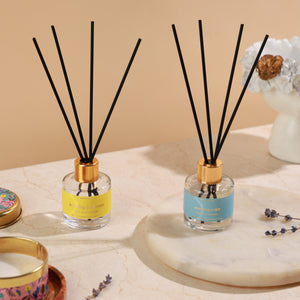

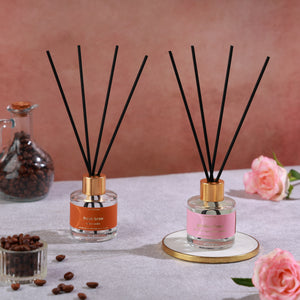

A door between them: two different blends. The change at the threshold is one of the genuine pleasures of a scented home.
The constraint nobody mentions: there are only five reed blends, so a whole-home scheme is working from five colours. Three is the sensible ceiling.
2. In one air space, two scents become a third one. This is not an aesthetic objection, it is arithmetic. Both bottles are evaporating into the same volume, so the mixture at the midpoint is roughly half of each — an accord that neither perfumer composed and that shifts as you move around the room. Morning Freshness over Fresh Brew reads as citrus and coffee at the sofa and as coffee and citrus at the table, and neither position is the thing you bought.
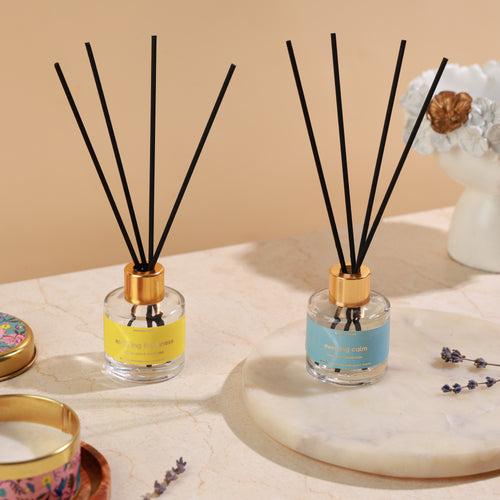
3. Behind a door, two different scents are actively better. A house with one scent everywhere reads as a hotel corridor. The moment of change at a threshold — bright and green in the hall, soft and herbal in the bedroom — is one of the few genuine pleasures of scenting a home, and it costs nothing extra to arrange. Morning Freshness in the living room and Evening Calm in the bedroom is the standard answer, and it is standard because it works.
4. The palette is five blends, and that is a real limit. Morning Freshness, Evening Calm, Garden Bloom, Mountain Breeze and Fresh Brew. That is the range. Somebody scenting five rooms with five different blends has used every colour available, and will have a house that changes character at every threshold in a way that reads as busy rather than considered. Three is the practical ceiling: one for the public rooms, one for the sleeping rooms, one for wet rooms if you want it.
5. The money barely moves either way. Two 130ml of the same blend is ₹2,498; the cheapest different pair is ₹2,548; the dearest is ₹2,698. There is no variety premium — the ₹200 spread across the range is simply that Mountain Breeze and Fresh Brew are ₹100 dearer per 130ml than Morning Freshness. Choose on layout, not on price.
Made in India, composed by an ISIPCA Versailles-trained perfumer — and a portion of every order supports girl-child education through Nanhi Kali.
What actually happens when two scents share a volume of air
A reed diffuser is a passive evaporative source. It puts fragrance into the air at the reed tips and then stops having any say in the matter — the room's own air currents distribute it, and in a home with an ordinary amount of movement that distribution is thorough. Put two different blends into one continuous volume and you have not created two zones. You have created one zone with a gradient across it, strongest of each near its own bottle and roughly half-and-half in between. The half-and-half is where people stand. A living-dining room is entered from one end and used at both, so the accord in the middle is not an edge case; it is the dominant experience of the room.
Whether that mixture is pleasant is a lottery, because nobody composed it. Fragrances are built as balanced structures — the Malabar lemon and peppermint in Morning Freshness are pitched against eucalyptus in a proportion that was decided deliberately, and so is the Coorg coffee and Kerala vanilla in Fresh Brew. Averaging two finished compositions does not give you a third finished composition; it gives you a muddle in which the loudest materials from each survive and the quiet ones that made them coherent disappear. The blends that survive being mixed are the ones that were close to begin with — Morning Freshness beside Mountain Breeze, both dry and green, or Evening Calm beside Garden Bloom, both soft and floral. Which is a roundabout way of saying that if two open spaces really must have different bottles, make them nearly the same.
Three houses, three answers
 Same blend, twice₹2,498A living-dining room, or a hall that runs into a living space with no door anywhere. This is one air space however many names it has on the plan, so buy the same blend twice. The second bottle is not buying you a second scent; it is buying a second starting point in a long or L-shaped volume, which is the one genuinely good reason to own two bottles in one room. Two 130ml of Morning Freshness is ₹2,498. Two 130ml of Evening Calm is ₹2,598. Pick the one you want to live with and buy it twice.
Which pairing for which layout
Find your layout in the left-hand column. Note that the answer to two of these is that the second room does not want a bottle at all, which settles the question rather neatly.
| Space | What it needs | How many | Cost |
|---|---|---|---|
| Living and dining in one open volume, no door ★ | One blend, two bottles — a second starting point rather than a second scent. Six reeds each | Two of the same | ₹2,498 in 130ml |
| Living room and bedroom, door shut at night | Two blends, chosen by job: bright and waking where people arrive, soft and settling where they sleep | Two different | ₹2,548 in 130ml |
| Two bedrooms used by the same family | One blend in both. A house that changes scent between bedrooms reads as busy, not considered | Two of the same | ₹2,598 in 130ml |
| Bedroom and its attached bathroom | Two blends only if the door is genuinely kept shut. Otherwise one blend, six reeds in the bedroom and two in the bathroom | Usually one blend | ₹1,249 + ₹799 |
| Living room with an open passage running off it | Nothing in the passage. It is a transit space, and it is already served by whatever is in the room it opens off | None for the passage | ₹0 |
| A fifth room, once you already run three blends | Buy no new blend. Repeat one you already have — the palette is five deep and a five-scent house is a shop floor | Repeat, do not add | ₹0 extra on scent |
| A note on all of the above: all of this assumes doors that are actually closed. A 900 sq ft flat with five shut doors is five air spaces and can carry three blends comfortably; the same flat with every door open is one space and wants one. Count the doors you actually close, not the ones on the plan. | |||
 One room · the unitFrom ₹749Shop → Two rooms · better value₹1,498Shop →
  Large room · a switch₹1,899Shop →
Pairing the five blends without making a mess of it
Start by deciding how many blends the house gets, before you decide which. Two is a complete answer for most homes: one for the public half and one for the sleeping half. Three is the ceiling I would defend — public, sleeping, and wet rooms. Beyond that you are using the range because it exists rather than because the house needs it. With five blends available, the temptation to give every room its own is strong and it produces a home that never settles into a character, because you are re-introduced to a new fragrance every time you cross a threshold.
Then pair by distance, not by preference. Two blends that must share air should be neighbours: Morning Freshness and Mountain Breeze are both dry and green and will tolerate a semi-open plan; Evening Calm and Garden Bloom are both soft and floral and do the same. Two blends separated by a door can be as far apart as you like, and the further the better — Morning Freshness in the hall against Fresh Brew in the study is a real change of room. The pairing I would avoid in any shared volume is coffee against citrus: Fresh Brew and Morning Freshness are both assertive and they do not average into anything good.
Then use reed count to referee the boundary. If two open spaces genuinely need different bottles — a studio where the sleeping corner wants something quieter than the rest — run the second bottle at two or three reeds rather than six. Reed count is the volume control, so a quiet bottle sits underneath the dominant one instead of arguing with it. The three duo sets exist for exactly this problem: Day & Night at ₹1,498, Fresh & Grounded at ₹1,548 and Warmth & Bloom at ₹1,598 are pairs chosen to sit beside each other rather than compete.
What to buy
Two bottles, and the only real decision is whether they hold the same liquid. The table is what each route costs.
| Buy | What it covers | Lasts | Price |
|---|---|---|---|
| One 50ml | A single reed diffuser — trying a second blend cheaply before committing a 130ml to a room that has a door | 6–8 weeks | from ₹749 |
| One 130ml | The value size — the size for either answer — two of these is ₹2,498 the same or ₹2,548 different | 14–18 weeks | from ₹1,249 |
| The duo ★ | Day & Night duo — the ready-made different pair: two 50ml chosen to sit beside each other rather than compete | 6–8 weeks each | ₹1,498 |
| Sukoon | 500ml ultrasonic — a large open volume where you were about to solve a mixing problem by adding a third bottle | Runs when you switch it on | ₹1,899 |
| 300ml refill | The running cost — the cheapest way to run two bottles of the same blend — one refill feeds both | Roughly 2 × 130ml fills | ₹2,399 |
Versailles
I will be straight about the constraint before I give the advice: there are five reed blends and there is no sixth. If you are planning a five-room scheme with a different fragrance in every room, you are planning to use my entire range at once, and I would talk you out of it even if I made fifty. A house is not a sampling counter. It should have a character, and two blends is usually enough to give it one.
The technical part is simpler than people expect. Fragrance does not pass a closed door and it passes an open arch as though the arch were not there. So the door is your boundary, and if there is no door there is no boundary — two bottles of different blends in one open living-dining will meet in the middle and average into something I did not compose and would not sell. That is not fussiness. It is what happens.
So: same blend where the air is shared, different blends where a door is shut, and when in doubt buy the second bottle of something you already own. Morning Freshness in the public half and Evening Calm in the sleeping half is the pairing I would give most homes, and I have given it to my own. A portion of every order supports girl-child education through Nanhi Kali.
Frequently asked questions
- Is the Day & Night duo better value? — the ready-made pair, priced.
- Why doors beat square feet — the boundary that actually holds.
- Open-plan living-dining-kitchen — one volume, however many names.
- A second bottle of the same scent — when repeating beats adding.
- Brand: the SOSA founder story.
SOSA products & prices (verified August 2026): Hotel Collection water-based ultrasonic diffuser fragrance 15ml ₹299 · 100ml ₹999 · 300ml ₹1,799 · Pack of 7 (15ml, all fragrances) ₹1,799; refills 100ml from ₹999. Seven scents: The Ritz-Carlton-inspired (white tea · bergamot · cedar), Westin-inspired (white tea · aloe · cedar), 1 Hotels-inspired (cedarwood · vetiver · green leaves), The St. Regis-inspired (amber · violet · woods), Shangri-La-inspired (jasmine · green tea · white tea), Four Seasons-inspired (citrus · floral · sandalwood), W Hotels-inspired (citrus · pepper · amber). Diffusers: Boond 300ml ₹899 · Sukoon 500ml ₹1,899 · Megh 6L ₹3,499. Water-based, phthalate-free, composed to IFRA standards for home diffusion; 3–6 drops per tank. Made in India, Pune. The Hotel Collection scents are SOSA's own interpretations inspired by the world's finest hotels; all hotel names are trademarks of their respective owners and are used only to describe the scent style — SOSA is an independent Indian fragrance house, not affiliated with or endorsed by any hotel brand. Prices and availability subject to change — see the live product pages.