


2. The method is four steps, done in order. Choose the family before you choose a bottle. Test it against your flat at 8pm — cooking smells, closed windows, the day's accumulation — not against a shop's neutral air. Hold it through two full bottles, roughly 20–28 weeks at three reeds, before deciding it has failed. Dose it low, at three reeds, from the very first day.
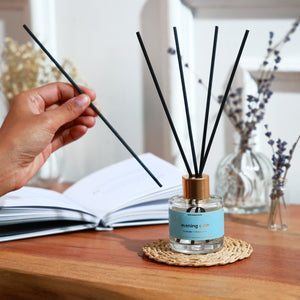
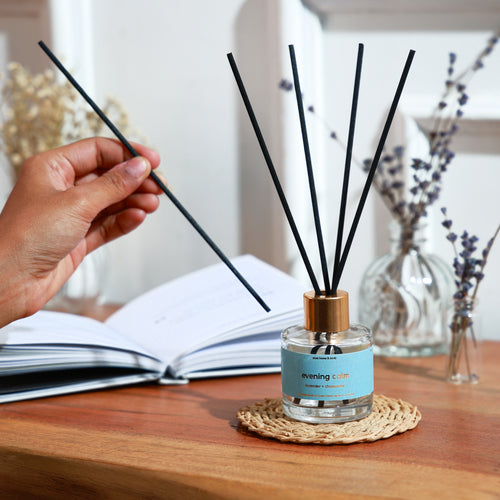
3. For a single room, start with Evening Calm. Lavender and chamomile at ₹799 is the safest true signature in the range — it never fights food smells, never reads as a cleaning product and rarely tires anyone out, which matters more than novelty when you are asking a scent to last half a year.
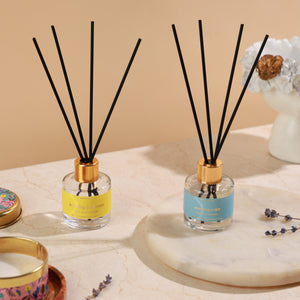
4. For a 1BHK, the Day & Night duo at ₹1,498 gives the flat two coordinated registers instead of forcing one bottle to do a living room and a bedroom equally badly. It still counts as a signature provided both halves stay fixed rather than getting swapped out at the next sale.
5. It moves with you, which is the whole argument. Cap the bottle, pull the reeds and bin them, pack it upright in its original box, buy fresh reeds at the next address. A signature built this way survives a house move; a scent baked into a landlord's paint never could.
Alcohol-free, IFRA-compliant, composed by an ISIPCA Versailles-trained perfumer and handmade in small batches in Pune — and every purchase funds a girl's education through Nanhi Kali.
What a signature actually is — and what it is not
A signature is not a bottle. It is the outcome of repetition: the same register, in the same spot, for long enough that your nose stops flagging it as new information. Smell adapts fast — most people stop consciously registering a steady scent within days — which sounds like a design flaw until you notice what it produces. The scent does not vanish. It becomes the baseline your whole flat is measured against, the thing a visitor's nose catches in the first three seconds and yours has long since filed away. That gap, between what you no longer notice and what everyone else does, is the entire mechanism. A shelf of five bottles rotated by mood never creates it, because nothing sits still long enough to become baseline.
A rented room complicates this in a way a homeowner's never does. You are not the only person whose smell has been in that air. A previous tenant's cooking oil is in the walls, a landlord's sofa arrived with its own history, a PG mess or a flatmate's incense adds its own layer on top of yours. None of that shows up when you sniff a diffuser in a shop, which is precisely why testing it at home rather than in a store matters more here than it would for someone building a signature into a house they will own for a decade. You are not asking whether you like a fragrance in isolation. You are asking whether it can win an argument with a specific room's specific baseline air, at 8pm, on a Tuesday.
The second complication is that you may not keep the room. A flatmate rotates out, a lease ends after eleven months, a landlord decides to sell. A homeowner can afford to let a scent become part of a house over years, absorbed slowly into curtains and cushions that never leave. A renter cannot rely on the room to hold anything for them — so the signature has to live in something portable instead, which in practice means one format: a reed diffuser, capped and carried, rather than anything built into fixtures you will not own next year. That constraint, oddly, is what makes the choice easier rather than harder. Fewer formats means one clear decision instead of a dozen half-hearted ones.
The four-step method, folded into three decisions
 Garden Bloom 50ml₹799Most people choose a scent by sniffing bottles in a shop and picking whichever one is most likeable in that moment. A signature needs the opposite order: decide first whether you want fresh, floral, calm, woody or gourmand as your register, and only then go looking for the bottle that carries it. The reason is that "likeable for thirty seconds in a shop" and "wearable in your own flat for six months" select for almost opposite qualities — the first rewards whatever is loudest, the second rewards whatever recedes fastest into background.
The family-to-bottle map — all five, verdicted
Every SOSA 50ml reed diffuser can, in principle, become someone's signature. In practice each carries a different risk, and the honest version of this guide says so rather than pretending all five are interchangeable.
| Family | Scent · 50ml | Best as a signature for | Verdict |
|---|---|---|---|
| Fresh / citrus | Morning Freshness ₹749 | Kitchen-adjacent studios | Reads as "clean" before it reads as "you" — good first test since it is the cheapest entry, rarely the bottle people keep as the final signature. |
| Calm / aromatic | Evening Calm ₹799 | Single rooms, PG rooms, bedrooms | The safest true signature in the range — low sillage, never competes with food, rarely fatigues anyone. |
| Floral | Garden Bloom ₹799 | Living rooms, 1BHKs | The most "you"-coded register on offer — but only at three reeds. At six it stops receding and starts announcing itself, which defeats the point. |
| Woody | Mountain Breeze ₹849 | Your own room in a shared flat | Does not leak into common areas, which flatmates will thank you for — but reads more seasonal (monsoon, winter) than year-round, so expect it to feel different in April. |
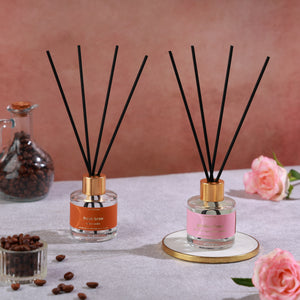
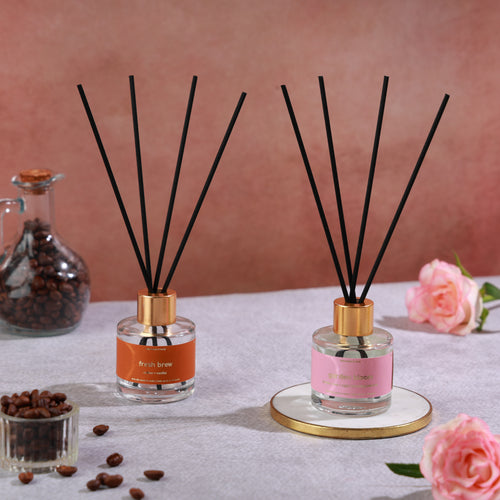
| Gourmand | Fresh Brew ₹849 | Bedrooms well away from the kitchen | Warm and genuinely long-wearing — but never place it near an actual kitchen, where real coffee and diffused coffee will confuse each other within a week. |
| Duo system | Day & Night duo ₹1,498 | 1BHKs | Two registers rather than one — still a single identity, provided neither half gets swapped out on a whim. |
| Note: a family bought on impulse and abandoned after two weeks tells you nothing except that six reeds is too many reeds. Before ruling any of the five out, run it again at three, and give it the full 20–28 weeks. | |||
Evening Calm · a single room50ml ₹799Shop → 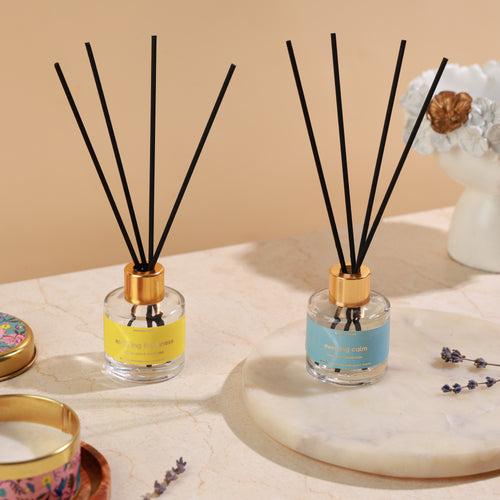 Day & Night duo · a 1BHK₹1,498Shop →
 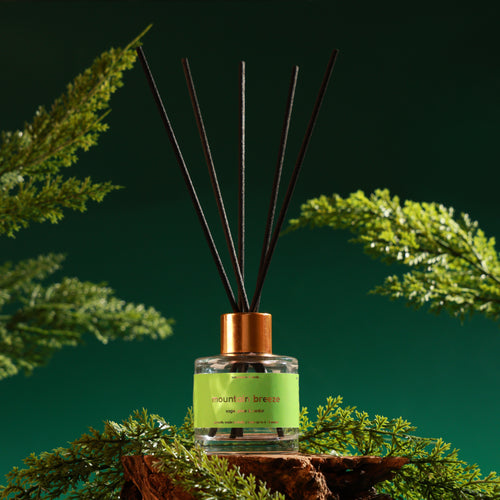 Mountain Breeze · your room, shared flat50ml ₹849Shop →
Reeds, placement and the deposit rules that matter more than the fragrance
Three reeds, not six, is the dose for a signature — this is worth repeating separately from the method above because it is also the rule most often broken in week one, out of impatience. Six reeds ships in every box because SOSA's fibre reeds wick faster than the rattan most of the market uses, and six is genuinely strong. For a signature you are building over months, not an evening, three gives a softer throw, roughly 10–14 weeks per bottle instead of 6–8, and — more importantly — a register calm enough that living with it for twenty weeks feels easy rather than eventually grating. You can always add a reed later. Pulling three back out after a fortnight of over-scenting is the annoying direction, and it also resets the room's baseline, undoing part of what those two weeks were meant to build.
Placement is a smaller decision but it is not a free one. Stand the bottle roughly a metre off the floor, on open air rather than tucked into a shelf of books that will absorb the throw before it reaches you. Keep it out of the direct path of a ceiling fan or a split AC vent, which strips the top notes off within days and leaves a duller base note doing all the work. Away from a stove or hob if the room opens onto a kitchen, and away from direct sun, which heats the oil and shortens the bottle's working life regardless of family.
The deposit rule matters more than any of the above. Reed oil will mark polished wood, laminate flooring and painted sills if it wicks down the glass or spills during a flip. Stand every bottle on a saucer, coaster or small tray — never directly on a landlord's dresser, a laminate desk or a windowsill you will be inspected against when you leave. This single habit, repeated for the entire twenty-odd weeks a signature takes to form, is worth more to a renter's deposit than any fragrance decision in this guide, and it costs nothing to follow from day one.
What a signature costs — year one, and every year after
The arithmetic below is checked by hand, route by route, because the honest number here is not the sticker price of a bottle but the cost of holding one long enough for it to actually become a signature — and then the far lower cost of keeping it once it has.
| Route | What you get | Timeline | Total |
|---|---|---|---|
| The test | One Evening Calm 50ml, three reeds | Proves or kills the idea in 10–14 weeks | ₹799 |
| The confirmed signature | A second Evening Calm 50ml, bought only once the first held | Two full bottles — 20–28 weeks, the method's own threshold | ₹1,598 |
| The 1BHK ★ | Day & Night duo, 2 × 50ml — ₹50 cheaper than buying both singly | Both rooms, one identity, run concurrently | ₹1,498 |
| The shared flat | One Mountain Breeze 50ml, three reeds, your room only | 10–14 weeks, contained to your door | ₹849 |
| Cost per week, once committed | A 300ml refill ₹2,399 — six 50ml-equivalent fills, oil only, no new glass | 60–84 weeks from one refill | ≈ ₹29–₹40/week |
Versailles
People ask me for "a signature scent" the way they might ask for a good haircut — something to be handed over, finished, in a single visit. It does not work that way, and I would rather say so than sell someone a bottle that promises otherwise. A signature is not chosen. It is earned, by the same fragrance showing up in the same place for months, until your own nose stops filing it as news.
What I like about that mechanism is that it does not care whether you own the flat. It only cares whether you kept your side of the bargain — one family, dosed low, left alone. I have had more renters build a real signature in eleven months of a lease than homeowners manage in five years of a house, because a renter usually makes the decision on purpose, knowing they may need to carry it out the door, while an owner drifts into whatever candle was on sale.
That is the part I want a first-time renter to hear clearly: the scent is yours, not the flat's. Cap it, empty the reeds, pack the bottle upright, and it starts again in the next room exactly where it left off. Every purchase funds a girl's education through Nanhi Kali — not a percentage, not a quarterly cheque. Every one.
Frequently asked questions
- How to create a signature scent for your first apartment — the same method, aimed at a first move-in.
- How to give your rented home its own signature fragrance with SOSA — matching a family to a whole flat.
- Best room fragrance for a PG room — building a signature behind one door, not a flat.
- Is a reed diffuser worth buying if I move houses often? — the moving protocol in full.
- Brand: the SOSA founder story.
SOSA products & prices (verified August 2026): Scented candles from ₹379 (small, ~15–18 hrs) · candle duos ₹664 (~30–36 hrs) · wax melts ₹474 · woodenwick and ceramic jar candles ₹949. Reed diffusers: Morning Freshness 50ml ₹749 · 130ml ₹1,249 · Evening Calm 50ml ₹799 · 130ml ₹1,299 · Garden Bloom 50ml ₹799 · 130ml ₹1,299 · Fresh Brew 50ml ₹849 · 130ml ₹1,349 · Mountain Breeze 50ml ₹849 · 130ml ₹1,349; six fibre reeds and refillable glass with every bottle, 50ml lasts 6–8 weeks at six reeds and 10–14 weeks at three, 130ml 14–18 weeks. Reed duo sets 2 × 50ml ₹1,498–₹1,598 · 2 × 130ml ₹2,498–₹2,598. Reed refills 300ml ₹2,399 · 500ml ₹3,499. Ultrasonic diffusers: Boond ₹899 (USB) · Sukoon ₹1,899 (ships with three 15ml fragrances) · Megh ₹3,499; Hotel Collection water-based fragrance 15ml ₹299 · 100ml ₹999 · 300ml ₹1,799 — a fragrance for a machine, not a standalone product. Reed oil and the water-based Hotel Collection are not interchangeable. Alcohol-free, phthalate-free, paraben-free, IFRA-compliant; composed and handmade in small batches in Pune. Every purchase funds a girl's education through Nanhi Kali. Prices and availability subject to change — see the live product pages.