
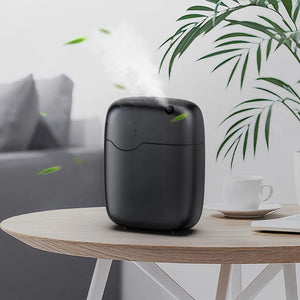

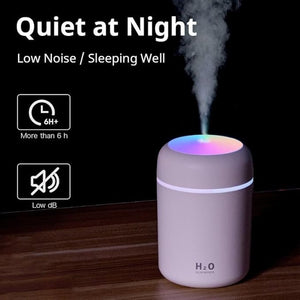
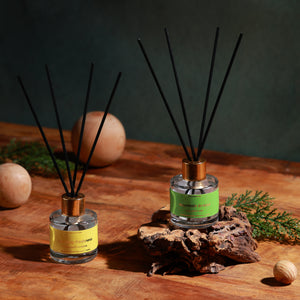
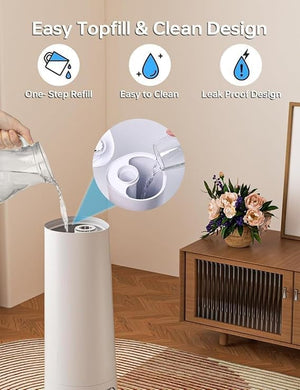
The honest ceiling of each format: reed diffuser, one small room · Boond ~150 sq ft · Sukoon 270–320 sq ft · Vaayu up to 1000m³.
The inversion nobody explains: for a passive source a draught is the enemy; for a nebulised cold-air mist the room's airflow is the delivery system.
Two honest gaps: a shut door is a wall no coverage rating crosses, and SOSA does not currently sell a separate Vaayu refill oil — the 400ml in the box is today's whole supply.
- The straight answer
- Part one — the three compounding problems
- Part two — diagnosing what is actually wrong
- Part three — airflow, AC and the inversion
- Part four — height, stratification and placement
- Part five — every format, with its honest ceiling
- Part six — the SOSA edit, and who should not buy
- A note from Sonal
- FAQs
2. Count the closed doors separately. A shut door is a wall, and no coverage figure crosses it. Every room that stays closed needs its own source; a reed diffuser from ₹749 with six fibre reeds is usually enough and needs no electricity.
3. Spend the free fixes first. Move a passive source out of dead corners and out of AC jets, into the traffic path at waist to chest height. Stop exchanging air during the hour that matters. Flip all six reeds weekly. A good share of "I need a bigger machine" emails end here.
4. Understand that airflow changes sign between formats. A draught destroys a reed diffuser — it empties the bottle early and leaves the room quiet. The same moving air is what a cold-air nebuliser uses to reach the far end of a large room. Do not carry advice about one format across to the other.
5. Do not buy size expecting reach. A 130ml reed diffuser lasts 14–18 weeks against 6–8; at six reeds it projects the same. A Megh at ₹3,499 holds 6L and runs ~100 hours but covers only ~215 sq ft — less than the ₹1,899 Sukoon. Both are duration and runtime purchases, never coverage ones.
6. Change category only when the volume genuinely demands it. Between roughly 100 and 1000m³ of connected volume, the Vaayu at ₹11,999 is doing something no passive format can — nebulising undiluted oil into a dry mist with its own propulsion, from a 400ml tank rated at 90+ days.
7. Ask about refills before you spend. SOSA does not currently sell a separate Vaayu refill oil. The 400ml in the box is the whole cold-air supply available today, and the water-based Hotel Collection for ultrasonic machines is a different product that does not go in it.
8. Keep the boundary honest. A scent machine adds fragrance. It does not clean air, filter anything or remove any smell. Ventilate first, then scent.
Everything is composed and handmade in small batches in Pune, and a portion of every order supports girl-child education through Nanhi Kali.
Part one — the three compounding problems
A large open space is not a bedroom with more square feet in it. Three separate things go wrong at once, and each of them is modest on its own — which is exactly why people misdiagnose the situation and buy a slightly bigger version of the thing that failed. Taken together they defeat every passive format, and they do it long before the space looks large on a floor plan. Here they are, in the order they usually bite.
 Sukoon₹1,899 · 270–320 sq ftA closed bedroom holds its air for a long time; an open-plan floor with balcony doors, a stairwell and a kitchen extractor replaces its air constantly. Air movement distributes fragrance; air exchange removes it, and an open plan does far more of the second than people realise. This is why a reed diffuser that scents a study perfectly reads as nothing at all in a sea-facing living room. It is also why the free fix that works best in a large space costs nothing: close up for the hour that matters, let the space establish, and open again afterwards. Nothing on this page can outrun a genuine cross-breeze, and no product should claim to. Note too that exchange and movement are separate variables — a ceiling fan stirs without replacing, an open window does both, and telling them apart is most of the diagnosis.
Part two — diagnosing what is actually wrong, before you spend
Find the symptom you actually have in the first column. Most people arrive convinced they have a strength problem; in my correspondence, three out of four have a placement, airflow or expectation problem instead, and those are free to fix. Work every free row before you consider a paid one.
| What you notice | What it usually is | Free thing to try first | If that does not fix it |
|---|---|---|---|
| Strong at the bottle, nothing at the sofa ★ | Dead air — the room is not distributing | Move into the traffic path, waist to chest height | A second source at the far end, from ₹1,548 |
| Bottle empties weeks early, room still quiet | A draught — AC jet, fan path or open window | Move several feet clear of the jet and out of direct sun | A format with its own propulsion |
| Lovely for twenty minutes, then gone | Air exchange, not weakness | Close up for the hour that matters; open afterwards | A schedulable machine — timers, not strength |
| Fine near the ceiling, empty where you stand | Stratification in a double-height room | Lower the source; aim output into the traffic zone | A wall-mounted machine placed low, not high |
| Two zones smell different in the middle | A seam between two sources or two compositions | Match the scents, or make them share a note | One source instead of several |
| Guests smell it, you do not | Olfactory adaptation — your nose stops reporting a constant | Leave for twenty minutes and walk back in | Nothing. This is not a product problem |
| Fine everywhere except behind closed doors | A shut door is a wall | Nothing — this is architecture | A reed diffuser per closed room, from ₹749 |
| Reads as fragrance layered over cooking | A competing source, not a weak one | Extractor on, window ten minutes, then close up and wait | Sequencing, and a drier composition |
| The honest caveat: if you have worked every free row and the space still reads empty at head height, the format is the limit rather than the fragrance — and that is a genuine reason to change category. But note what is not on this list: nothing here is fixed by a bigger bottle or a bigger tank. Duration and runtime are different purchases from reach, and confusing them is the most expensive mistake in this category. | |||
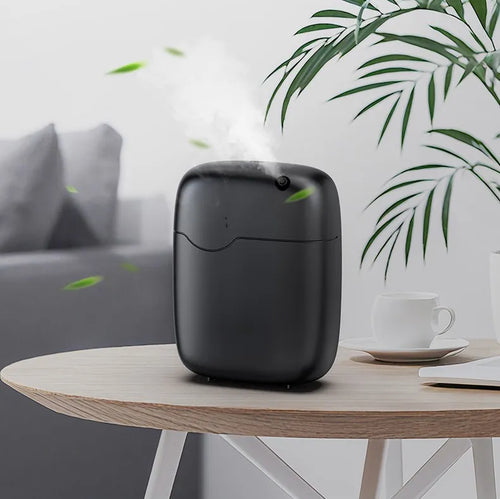
Vaayu · up to 1000m³₹11,999Shop →  Sukoon · 270–320 sq ft₹1,899Shop →
 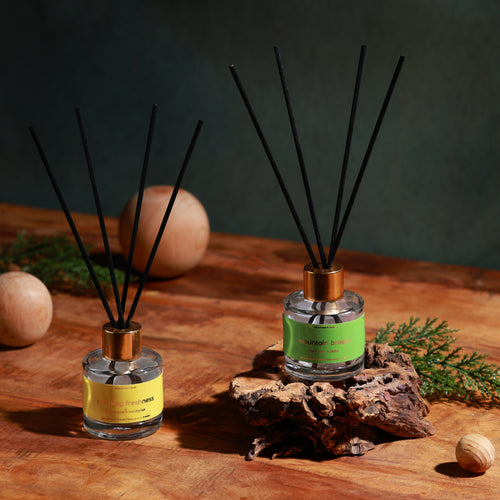 Reed duo · two ends, not one middlefrom ₹1,548Shop →
Part three — airflow, air conditioning, and the inversion
This is the part of the guide that contradicts the rest of our own writing, deliberately. Every piece of advice we publish about reed diffusers treats moving air as a hazard: keep the bottle away from the split unit, the fan and the open window, because a draught strips the reeds, empties the bottle early and leaves the room quiet. That advice is correct and I stand by it. But it is advice about a source with no propulsion, and it does not transfer to a source that has some. A cold-air nebuliser atomises undiluted oil into particles fine enough to stay suspended and pushes them out under pressure; the room's currents then carry them, which is exactly what you want. Villa owners who switch off every fan before running a cold-air machine — because our blog told them draughts ruin fragrance — are following the right rule in the wrong place, and getting a worse result for their diligence. The full argument is in the airflow guide; the short version is that air is a thief when the source is passive and a courier when it is not.
Air conditioning is the same inversion with an extra wrinkle, and the wrinkle is that not all air conditioning is the same kind of thing. A wall-mounted split unit is a jet: a narrow, fast throw that recirculates the air of one room and moves essentially nothing between rooms. It is a hazard to any passive source in its path and no help at all to your hallway. A ducted or VRF system is the opposite — a genuine supply-and-return loop that keeps a whole floor's air in circulation while the fan runs, which is why the Vaayu offers a wall or HVAC mount as well as freestanding use. Put a dry nano-mist into that loop and you are scenting a circuit rather than a room. The honest footnote for Indian readers is that most of our homes, including large ones, run on splits and cassettes rather than ducts, so the HVAC-mount advantage is simply unavailable to most people — which does not make the machine wrong for those houses, only means the reason to buy it is its own propulsion and volume rating. Watch the compressor cycle too: a fixed-speed system stops moving air at setpoint, and distribution stops with it, so a fan-only or circulate mode is worth using where you have one. All of that is set out in the air-conditioning guide.
One more physical point that matters more in India than anywhere else. An ultrasonic machine works by putting water vapour into the room; the fragrance rides on it. Cold-air nebulisation adds no water at all. In a sealed, air-conditioned flat on a humid coast in August, that is a real difference in what ends up in your room — and it is a physical observation rather than any sort of wellness claim. Let me be exact about the boundary while I am here, because it applies to every product on this page: a scent machine adds fragrance and does nothing else. It does not purify, filter, sanitise or remove any smell. If a space smells of something you would rather it did not, the extractor and the windows do that job, and fragrance goes on afterwards. We never diffuse over live cooking either — extractor on, window open ten minutes, close up, wait half an hour — because fragrance layered onto cooking makes a third smell nobody designed.
Part four — height, stratification and where the machine actually goes
Placement in a large space is worth more than the difference between two machines, and the reason is stratification. Warm air rises, and scented air is generally slightly warmer than the room it entered — so in a double-height living room the fragrance collects near the ceiling, in the gallery, above the chandelier, in the one part of the room where nobody is standing. The room reads empty at head height while being perfectly well scented six metres up. Owners of double-height rooms describe this as the machine being weak; it is not weak, it is aiming at the wrong stratum. The correction is counter-intuitive and free: mount or stand the source low, at roughly waist to chest height, and aim its output horizontally into the zone where people move rather than upwards into the void. If you are wall-mounting, resist the instinct to put the unit high where it is out of sight. High is where the fragrance was already going on its own.
The second placement principle is to scent junctions rather than rooms. In an open plan the space that feeds everywhere else is not the middle of the living room; it is the point where the entry hall, the passage and the living-dining meet, or the foot of the stairs, or wherever the household's traffic actually converges. A source placed at a junction is picked up by every current in the house. A source placed on the prettiest console in the far corner is in a backwater. The same instinct applies to ducted homes, where the best non-mounted position is near a return — the air there is on its way back into the system and will take the mist with it. Where a kitchen is part of the open plan, keep the source away from the extractor's pull and sequence around cooking rather than competing with it; a drier composition reads better across a cooking zone than a sweet one.
Third, respect the doors. This guide repeats it because it is the thing people most want not to be true: no coverage rating crosses a shut door. A machine rated for 1000m³ will not put anything into a bedroom that is closed, and the honest architecture for most large Indian homes is a hybrid — one machine handling the connected common volume, and an inexpensive reed diffuser from ₹749 in each closed room, chosen for that room rather than for the house. Where two scents will meet at an open threshold, make them share a note: Mountain Breeze and Morning Freshness meet on green eucalyptus, Fresh Brew and Garden Bloom on warmth. Two unrelated compositions meeting in a corridor is the commonest self-inflicted problem in a big house, and it costs nothing to avoid.
Part five — every format, with its honest ceiling
This is the whole ladder in one place, with the specification that matters for a large space and the point at which each rung stops. Read the "where it stops" column first; it is more useful than the coverage figure.
| Format | How it moves fragrance | Rated for | Adds water? | Upkeep | Where it stops | Price |
|---|---|---|---|---|---|---|
| Vaayu cold-air ★ | Pressurised air atomises undiluted oil into a dry nano-mist | Up to 1000m³ | No | One fill per 90+ days | Above 1000m³, and at any shut door | ₹11,999 |
| Sukoon ultrasonic | Small fan plus a water-diluted visible plume | 270–320 sq ft | Yes | Top up every 16–18 hrs on low | Beyond one normal room | ₹1,899 |
| Boond ultrasonic | The same, smaller — 300ml, USB, night light | ~150 sq ft | Yes | ~6 hrs a fill | Beyond a bedroom or a desk | ₹899 |
| Megh 6L ultrasonic | The same again, with a very large tank | ~215 sq ft — less than the Sukoon | Yes, a great deal of it | ~100 hrs a fill | It is a runtime and humidity machine, never a coverage upgrade | ₹3,499 |
| Reed diffuser 50ml | Capillary wicking and surface evaporation — no propulsion | One small room | No | Flip six reeds weekly · 6–8 weeks | The moment the room has a draught or real size | From ₹749 |
| Reed diffuser 130ml | Identical mechanism, more oil in the vessel | One small room — duration, not reach | No | Flip six reeds weekly · 14–18 weeks | Exactly where the 50ml stops | From ₹1,249 |
| Aangan HVAC nebulising | Commercial cold-air, ducted | ~8,000–10,000 sq ft | No | Commercial servicing | Overkill in any home | ₹25,999 |
| The honest caveat: every rung is a different job rather than a better version of the one below. The reed range's own gaps stand too — no oud, no musk-forward scent, no aquatic, and replacement reeds are not sold separately. On the machine side, SOSA does not currently sell a separate Vaayu refill oil; the 400ml supplied in the box is the whole cold-air supply today. The water-based Hotel Collection at ₹299 / ₹999 / ₹1,799 is for ultrasonic machines only and must not go in a Vaayu despite sharing scent names; reed oil goes in no machine at all. | ||||||
Part six — the SOSA edit, and who should not buy the expensive answer
Here is the product edit, written as what each thing is honestly for rather than as a range walk. Note how many rows cost under ₹2,000 — for the great majority of people who arrive at this guide, the answer is somewhere in the first four.
| Product | Honestly for | What it will not do | Price |
|---|---|---|---|
| Fresh & Grounded duo ★ | Two sources at opposite ends of an open living-dining, sharing green eucalyptus | Cover a villa, or survive a draught | ₹1,548 / 2 × 50ml · ₹2,548 / 2 × 130ml |
| Mountain Breeze 50ml | A closed room off the open plan — dry, woody, no sweetness | Reach past its own room | ₹849 · 6–8 weeks |
| Boond 300ml | A study, a desk, a bedside — on demand, USB, night light | Anything past ~150 sq ft | ₹899 |
| Sukoon 500ml | One normal room on demand, with timers and a remote | Cover a connected open floor | ₹1,899 · 270–320 sq ft |
| Reed oil refill | Running several reed vessels affordably — oil only, reuse your glass | Include reeds, or go in any machine | ₹2,399 / 300ml · ₹3,499 / 500ml |
| Megh 6L | Long unattended runtime — ~100 hrs — and humidity in one room | Cover more than ~215 sq ft; it covers less than the Sukoon | ₹3,499 |
| Vaayu cold-air | A genuinely connected volume up to 1000m³, scheduled and locked | Cross a shut door, or refill from any oil currently on sale | ₹11,999 · 400ml in the box |
| Aangan HVAC | Commercial ducted scenting, 8,000–10,000 sq ft | Make sense in a house | ₹25,999 |
Versailles
The nine guides this page gathers were written over about a year, and the thing that surprised me while writing them was how rarely the answer turned out to be "buy the expensive machine." I had assumed, starting out, that a cluster about large-space scenting would be a cluster about the Vaayu. In practice, most of the letters that reach me describe a normal-sized room with a fragrance source in the wrong part of it, and the honest reply costs the reader nothing at all.
What large open spaces really punish is unexamined assumptions. That square feet is the relevant unit — it is not, cubic metres is. That a bigger bottle or a bigger tank means a bigger room — it does not, and the Megh is the clearest example of a product that is excellent at its actual job and constantly bought for a different one. That air is uniformly the enemy of fragrance — it is, right up until the moment your source has propulsion, and then it becomes the thing carrying the scent to the far end of the room. Every one of those assumptions is reasonable. Every one of them costs people money.
So the shape of this guide is deliberate: three problems, a diagnostic you can run for free, the physics of air, the placement rules, and only then a product table. If you reach the product table and the answer is a ₹1,899 Sukoon, that is a good outcome and I would rather you had it than a machine you resent. If it is a Vaayu, ask us about refill availability on the day you buy — we ship 400ml and we do not currently sell a separate cold-air refill, and you should make that decision with the gap in front of you rather than behind you. Everything we make is composed and handmade in small batches in Pune, and a part of every order funds a girl's classroom through Nanhi Kali.
Frequently asked questions
- Why are large open rooms difficult to fragrance? and why fragrance disappears in a double-height room — the two diagnostic pages.
- Best diffuser for a large open living and dining area and best machine for high-ceiling living rooms — the two buying pages.
- How to scent an open kitchen, dining and living room together — sequencing around a competing source.
- How airflow affects fragrance in large open spaces and how air conditioning affects large-space scenting — the inversion, and the delivery network.
- One powerful diffuser vs several small ones and can the Vaayu scent a large open-plan home? — evenness against resilience, and the measuring method.
- Brand: the SOSA founder story.
SOSA Vaayu specifications (verified from the live product page, August 2026): ₹11,999 (the product page displays a rounded ₹12,000). Waterless cold-air nebulisation — pressurised air atomises undiluted fragrance oil into a dry nano-mist; no water, no heat, residue-free. Coverage up to 1000m³, about 2,000–3,000 sq ft. 400ml refillable tank, 90+ days per fill at a mid intensity setting. Bluetooth app plus onboard buttons, 1h / 4h / 8h / 24h timers, adjustable mist intensity, auto-stop and key-lock. Under 38 dB. DC 12V / 1A, 5W. 165 × 80.5 × 215 mm, 0.9 kg, black or white. Freestanding or wall / HVAC mount. CE, RoHS and SGS certified. Ships with four SOSA Hotel Collection fragrances at 100ml each (400ml in total) in one of three combos chosen at checkout. SOSA does not currently sell a separate Vaayu refill oil; the 400ml supplied in the box is the fragrance available at the time of writing, and buyers who need long-term supply should confirm current refill availability with SOSA before purchasing. The cold-air oil supplied with the Vaayu is a different product from the water-based Hotel Collection sold for ultrasonic machines (15ml ₹299 · 100ml ₹999 · 300ml ₹1,799), which must not be used in a Vaayu despite sharing scent names. Other SOSA machines: Boond 300ml ₹899 (~150 sq ft) · Sukoon 500ml ₹1,899 (270–320 sq ft) · Megh 6L ₹3,499 (~215 sq ft — a runtime and humidity machine, not a coverage upgrade) · Aangan ₹25,999 (~8,000–10,000 sq ft) · Meenar ₹38,500 (12,000–18,000 sq ft) · Safar car diffuser ₹3,999. Reed diffusers 50ml ₹749–₹849 (6–8 weeks) · 130ml ₹1,249–₹1,349 (14–18 weeks) · duo sets ₹1,498–₹1,598 · oil-only refills 300ml ₹2,399 / 500ml ₹3,499. Runtime, consumption and coverage figures are manufacturer specifications and vary with intensity setting, run hours, ceiling height, ventilation and season; any per-month or per-day figure in this guide is arithmetic on those specifications, not a measurement. Electricity costs vary by state tariff. No claim is made that scenting affects ratings, reviews, bookings, occupancy, revenue, health, mood or air quality. Free shipping above ₹499. A portion of every order supports girl-child education through Nanhi Kali. Prices subject to change — see the live product pages.