
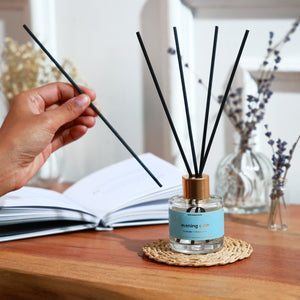
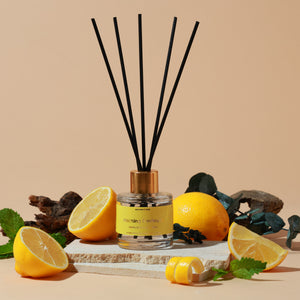
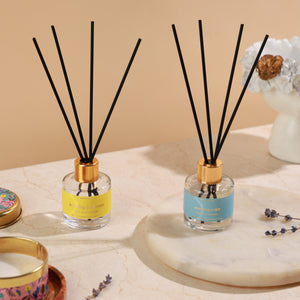
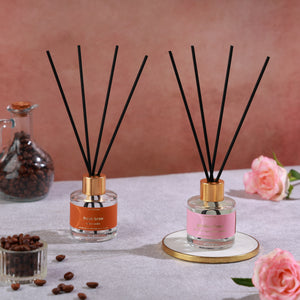

Two placement corrections: not on the door — a doorway is the most turbulent point in a home. Put it a step or two inside, on a surface, out of the swing of the door and out of the draught. And beside the bed, use three reeds rather than six; three is a soft bedside level and roughly doubles the life of the bottle.
What it still will not do: the middle of the room, and any sense of constant fragrance while you lie still. Neither is a fault in the bottles.
Free before you buy the second one: ceiling fan on low with the door shut — the only free change that supplies transport rather than more output, and the best advice on this page.
2. Give the two bottles different doses, because they have different jobs. At the door, use all six reeds — you are there for two seconds and you want a clear arrival. At the bed, use three; three is a soft bedside level and roughly doubles the life of the bottle, and a loud bottle beside a pillow is the commonest cause of somebody deciding a fragrance is “too much” when the composition was never the problem.
3. Not on the door itself. A doorway is the most turbulent point in a home — air is pushed and pulled through it every time it swings, and a bottle sitting there is being flushed rather than diffusing. Place it a step or two inside the room, on a surface at or slightly below nose height, out of the door’s swing and out of the draught, but not squeezed into a dead corner where nothing moves at all.
4. Know the two things it will not do. The middle of the room will remain the lowest part; two passive sources make two hills with a valley between them, and neither bottle moves air. And you will not smell the bed bottle continuously while lying still, however strong it is, because receptors adapt to a constant stimulus within minutes. Both are normal. Neither is a defect.
5. Do the free things first, because a good share of people need nothing more. Ceiling fan on low with the door closed is the one change that supplies transport instead of more output, and it does more for the middle of a bedroom than any second bottle; it will also shorten the bottle, which is a fair trade made knowingly. Then halve the distance to your pillow, put the bottle at nose height on a surface, keep it out of the air-conditioner blast, and close the door for the hours that matter.
Alcohol-free, phthalate-free, paraben-free, IFRA-compliant, 0 ppm formaldehyde, six fibre reeds in a refillable glass bottle, composed in Pune. Free shipping above ₹499, and a portion of every order supports girl-child education through Nanhi Kali. SOSA is an independent Indian fragrance house and is not affiliated with any hotel brand.
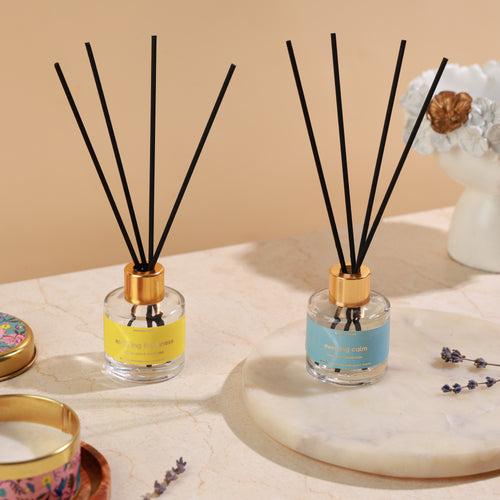
Two bottles, two entirely different jobs
Most two-diffuser plans fail because both bottles are asked to do the same thing in two places. This one succeeds because the two positions correspond to two genuinely different ways of perceiving fragrance, and once you see that, the dosing decides itself.
The door bottle works on movement. Coming in from a corridor, you go from essentially no fragrance to the peak of a zone in one or two paces. That is a steep crossing of a gradient, and your nose is built to report change far more sensitively than it reports level — you are an excellent detector of differences and a rather poor meter of absolutes. This is why a diffuser you can barely notice while sitting down can produce a distinct impression as you walk past it, and why an arrival can feel generous from a bottle that is not working especially hard. A door bottle is buying you two seconds of contrast, and contrast is cheap.
The bed bottle works on proximity, and it is fighting adaptation rather than distance. Lie still for ten minutes and the stimulus becomes constant; receptors adapt, the signal keeps arriving and the brain stops forwarding it. You can lie in a properly scented room and correctly report smelling nothing. The mistake is to treat that as under-dosing and answer it with more reeds and a bigger bottle, which raises output and defeats nothing, because adaptation is not a shortage. What actually helps is being close — halving the distance from bottle to pillow does more than any change of scent — and accepting that home fragrance is meant to be noticed at arrivals and transitions rather than continuously. A diffuser you smell every second of the night is set too strong for the room.
There is a diagnostic worth running before you conclude anything about either bottle. Leave the room for fifteen minutes and walk back in. Or better still, ask somebody who does not live there. A visitor is a far better instrument than a resident, because they have not adapted to your home. A remarkable number of these questions resolve at that point, with the room turning out to be exactly right and the resident’s nose simply having stopped mentioning it.
Where each one actually goes
The arrangement is only as good as the two spots, and the door end is the one people get wrong. Here is how I would place both.
 Morning Freshness₹749An entrance is the most turbulent point in any home. Every time the door swings, a slug of air is pushed one way and pulled the other, and a bottle standing in that path is being ventilated rather than allowed to build a zone. So do not put it on the door: put it a pace or two inside, on a chest of drawers, a console or a shelf at or slightly below nose height, clear of the swing. Use all six reeds here, because you want the crossing to be unambiguous and you are only in this spot for a moment. And check what else is nearby — a windowsill will empty the bottle into the street, since air that leaves takes the fragrance with it, and the blast of a split air conditioner strips the reeds within days and throws everything at one wall.
 Evening Calm₹799On the bedside table, and that is not a compromise — it is the correct use of a point source. Concentration falls away steeply with distance, so a metre is worth more than any amount of reformulation. At that range, three reeds is right: it gives a soft, present level rather than a loud one, and it roughly doubles how long the bottle lasts, which turns 6–8 weeks into something closer to three or four months. Six reeds at thirty centimetres from a pillow is the single most common reason somebody decides a fragrance is cloying. Reed count is a volume dial and it works in both directions, which almost nobody uses before deciding they dislike a scent.
 Mountain Breeze₹849Before or alongside either bottle, turn the ceiling fan on to its lowest setting and close the bedroom door. A fan is exactly the transport a reed structurally lacks, and this single change does more to join the two ends of a long bedroom together than a third bottle ever would. Keep the bottles out of the direct downdraught at full speed, which strips reeds fast; low and steady is the setting. The cost is honest and worth stating: more air moving over the reeds means faster evaporation, so the bottle empties sooner. You are trading weeks for reach. A running air conditioner in a closed room does something similar — it recirculates and distributes well, which is why bedrooms often smell strongest at night, while drying the air and shortening the bottle.
What this arrangement still will not do
Having recommended it, I owe you the limits, because the second-purchase decision is exactly where an honest answer is worth more than a sale. It will not make the room even. Two passive sources produce two concentration peaks with a valley between them; the midpoint of the room is the single position farthest from both at once, and neither bottle moves any air to close that gap. If your bedroom is long, that middle stretch is usually the walkway between the wardrobe and the bed, and nobody stands in it, which is why the arrangement works anyway. If your bedroom is square and the middle is where you actually sit, this plan is not for you and a third bottle will not rescue it.
It will not produce a continuous sensation while you are in bed either, and I would rather set that expectation than let you buy a bigger bottle chasing it. Adaptation is a property of your nose, not of the product. Nor does it make the room smell of anything at a distance in a way you can rely on — there is no published figure for how far a reed diffuser projects, and any brand that quotes one in feet is quoting a number for a room it has never seen. What we can honestly say is the sizing: 50ml for a room up to about 150 sq ft, running 6–8 weeks; 130ml above that, running 14–18 weeks. And note that the bigger bottle is a longer bottle, not a further one. Volume is a duration specification, not a coverage specification.
The setup, room by room
The same two-bottle plan judged against the shape of the room it is going into, with the free alternative in the first row because it costs nothing and often wins. The last row is the honest gap in our own range.
| Your bedroom | Does bed-plus-door work? | What I would actually do | Cost |
|---|---|---|---|
| Long or L-shaped, used at both ends ★ | Yes — the arrangement it was made for | Six reeds a step inside the door, three at the pillow, two different scents | ₹1,498–₹1,598 as a duo |
| Square, around 100–120 sq ft, bed in the middle of one wall | Not really — there is one place you occupy | Move the single bottle to the bedside, three reeds, and keep the ₹799 | Free |
| Bedroom opening into a dressing area with no door | Yes — two rooms behaving as one volume | One bottle per space, dosed for its own distance | ₹1,498–₹1,598 |
| Above 150 sq ft, one bottle only | Partly — but this is a sizing question first | 130ml at ₹1,249–₹1,349, 14–18 weeks. Longer, not further | ₹1,249–₹1,349 |
| Any bedroom where the middle must read the same as the ends | No — that is a transport requirement | Fan on low first, free. Then Sukoon ₹1,899, 270–320 sq ft, moves air | Free, then ₹1,899 |
| The honest gap: nothing waterless sized for a bedroom | Between Safar ₹3,999 — named and sold as a car and travel diffuser, with no published room coverage figure, a 1/2/3-hour timer and a battery to recharge — and Vaayu ₹11,999 at 1000 m³, roughly 2,000–3,000 sq ft, SOSA has nothing built for one bedroom. Vaayu in a bedroom is nine-tenths wasted | ||
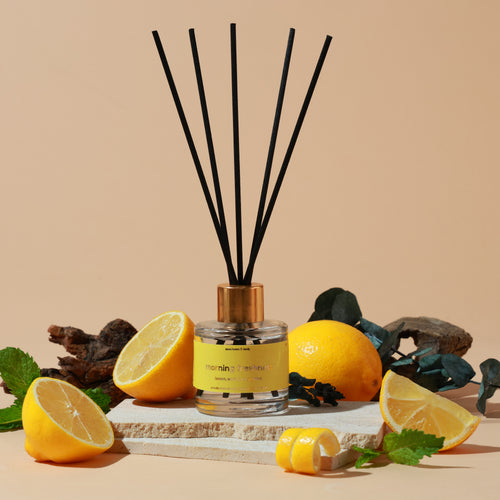 The door · Morning Freshness₹749Shop →
 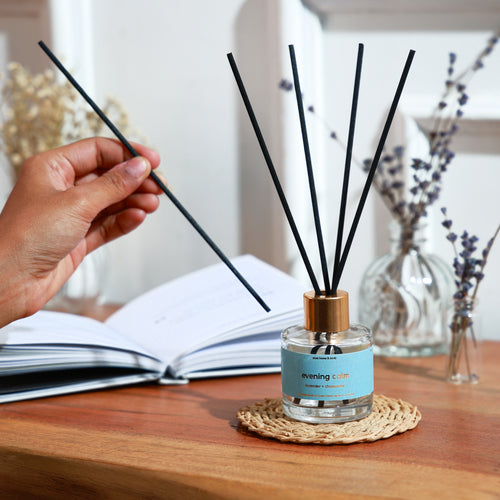 The bed · Evening Calm₹799Shop → Both · Day & Night duo₹1,498Shop →
The cost, and the things only a reed does
A 50ml SOSA reed is ₹749 to ₹849 and runs six to eight weeks, which is roughly ₹13 to ₹15 a day — a fairer way to see it than the sticker price, because a bottle that runs two months is a different purchase from an object costing the same. Two bottles is twice that, though this particular arrangement softens the arithmetic in a way most two-bottle plans do not: the bedside bottle at three reeds lasts roughly twice as long as the door bottle at six. You are not simply doubling your consumption; you are doubling your placements and increasing consumption by rather less. If repurchasing is your real objection, a 300ml refill at ₹2,399 is roughly six 50ml fills for a bottle and reeds you already own — oil alone, so never a first purchase, and the single item on our shelf most often bought by mistake.
And the reed’s own column, which I will not shrink in order to point you at a machine. It is silent, which matters beside a bed more than anywhere else in a home. It needs no socket, and bedroom sockets are usually already spoken for. It works right through a power cut. There is nothing to fill, nothing to charge, nothing to switch on and nothing to remember beyond flipping the reeds every three to five days — and a flip restores output for a few hours without adding any range. It never breaks, because there is nothing in it that can, and two of them have no single point of failure. It is an object on a table rather than an appliance in a room. Those are real virtues; they are simply not the virtue of evenness, and that is the whole of what this page is separating.
What to buy, in what order
Free options first, as always, then the two-bottle plan, then the mechanism if evenness turns out to be the real requirement. The last row names the gap rather than working around it.
| Step | What it is | When it is the right answer | Price |
|---|---|---|---|
| 1. Ceiling fan on low, door shut ★ | The one free change that supplies transport rather than more output. Bottles in the circulation, not under the blades at full speed | Before any purchase. It joins the two ends of a long room better than a third bottle, and shortens bottle life — a fair trade made knowingly | Free |
| 2. Re-place and re-reed what you own | Bottle a step inside the door rather than on it; bedside bottle within arm’s reach at nose height; six reeds at the door, three at the pillow | Immediately, and for many people this is the whole answer | Free |
| 3. The second bottle — a duo | Two separate 50ml bottles. Day & Night ₹1,498, Fresh & Grounded ₹1,548, Warmth & Bloom ₹1,598; 130ml duos ₹2,498–₹2,598 | A long or L-shaped bedroom used at both ends, or a bedroom running into a dressing area | ₹1,498–₹1,598 |
| 4. Sukoon ultrasonic | 500ml, 270–320 sq ft, 16–18 hours on low, three 15ml Hotel Collection scents included. Moves air. Water-diluted, adds humidity, needs filling and a socket | If the middle of the room is genuinely the requirement. Very often the right bedroom answer, and never to be skipped on the way to something dearer | ₹1,899 |
| 5. A 300ml refill | Roughly six 50ml fills, oil only, for a bottle and reeds you already own | Once you know which two scents you keep coming back to. Never a first purchase | ₹2,399 |
| The honest gap: two good ends are not an even room | No passive arrangement produces evenness. And between Safar ₹3,999, named and sold as a car and travel diffuser with no published room coverage figure, and Vaayu ₹11,999 at roughly 2,000–3,000 sq ft, SOSA has no mid-sized waterless bedroom machine | Said plainly. Vaayu is the wrong purchase for one bedroom | ₹1,899 |
Versailles
I like this question, because the person asking it has already worked out something most people miss: that a bedroom is not one experience but two. There is the moment you come in, and there are the hours you spend not moving. Most of the disappointment in home fragrance comes from designing for one of those and expecting the other for free.
So my answer is yes, with a small refinement that costs nothing. Do not treat the two bottles as one purchase repeated. Give the door bottle all six reeds and something with lift, because you will be there for two seconds and you want the crossing to register. Give the bedside bottle three reeds and something quiet, because you will be there all night and your nose will adapt within minutes regardless of how loud it is. Three reeds also roughly doubles the life of that bottle, so the arrangement costs less to run than people expect.
What I will not tell you is that this makes the room even, because it does not. Two bottles that do not move air make two good ends and leave the middle as it was. In a long bedroom that is fine, since the middle is a walkway. In a square one it is not, and the honest answer there is a fan on low first — free, and the only change that supplies the transport a reed has never had — and after that a machine that moves air, at ₹1,899, rather than a third bottle at ₹799. Everything is composed in Pune, and a part of every order funds a girl’s classroom through Nanhi Kali.
Frequently asked questions
- Should I buy two if one isn’t filling my bedroom? — the four cases where two is right.
- Another one on the opposite side? — the geometry, walked step by step.
- Two smaller reeds or one active diffuser? — strong at a point against strong everywhere.
- Better coverage, or two strong corners? — two corners, stated plainly.
- I keep buying more to make it stronger — a rational response to a wrong diagnosis.
- Cheaper long-term: several reeds or a waterless diffuser? — the arithmetic and the counterweights.
- Two reeds against Safar — head-to-head, with the car-and-travel disclosure.
- How many reeds before a machine makes more sense? — a real decision rule.
- About to buy a third for one room? — the kindest version of the answer.
- Brand: the SOSA founder story.
SOSA facts verified August 2026: Reed diffusers in 50ml and 130ml only — Morning Freshness ₹749 / ₹1,249, Evening Calm ₹799 / ₹1,299, Garden Bloom ₹799 / ₹1,299, Mountain Breeze ₹849 / ₹1,349, Fresh Brew ₹849 / ₹1,349. 50ml suits rooms up to about 150 sq ft and runs 6–8 weeks; 130ml suits above 150 sq ft and runs 14–18 weeks; roughly ₹13–₹15 a day. Strength scale, measuring perceived intensity rather than quality: Evening Calm 8.9, Garden Bloom 8.9, Morning Freshness 9.0, Mountain Breeze 9.4, Fresh Brew 9.5. Six fibre reeds rather than rattan, refillable glass bottle, heat-stable CCT carrier rather than DPG, alcohol-free, phthalate-free, paraben-free, IFRA-compliant, 0 ppm formaldehyde, tested at 45°C and 85% RH, composed in Pune. Six reeds is full output; three is a soft bedside level and roughly doubles the life; flip every 3–5 days; 2–3 reeds in a 50 sq ft bathroom can make a 50ml last nearly three months. Duos are two separate 50ml bottles: Day & Night ₹1,498, Fresh & Grounded ₹1,548, Warmth & Bloom ₹1,598; 130ml duos ₹2,498 / ₹2,548 / ₹2,598. Refills 300ml ₹2,399, roughly six 50ml fills, and 500ml ₹3,499 — oil only, never a first purchase. Machines: Boond ₹899, Sukoon ₹1,899 (500ml, 270–320 sq ft, 16–18 hours on low, three 15ml Hotel Collection scents included), Megh ₹3,499 (6 litres, about 100 hours runtime, only about 215 sq ft), Safar ₹3,999 (waterless cold diffusion of undiluted oil, 20ml, three speeds, 1/2/3-hour timer — named and sold as a car and travel diffuser, with no published room coverage figure and a battery that needs recharging), Vaayu ₹11,999 (up to 1000 m³, roughly 2,000–3,000 sq ft). Between Safar and Vaayu SOSA has no mid-sized waterless bedroom machine. Reed oil and the water-based Hotel Collection are separate products and are not interchangeable in either direction; there is no hotel-inspired reed diffuser, and the ₹299 Hotel Collection 15ml is a machine refill rather than a first purchase. No health, air-quality, allergy or sleep claims are made for any SOSA product, and fragrance does not remove an unwanted smell — deal with the source, then ventilate, then fragrance. Free shipping above ₹499. A portion of every order supports girl-child education through Nanhi Kali. SOSA is an independent Indian fragrance house; the Hotel Collection is SOSA’s own interpretation inspired by the world’s finest hotels, and SOSA is not affiliated with or endorsed by any hotel brand. Prices subject to change — see the live product pages.