
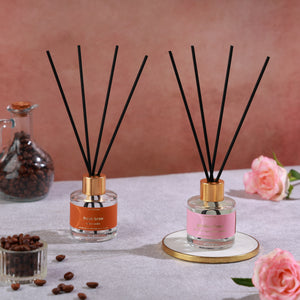
For the puja: no, and this is not a product we sell. SOSA has no ritual line, makes no claim of purity, auspiciousness or suitability, and a diffuser is never an offering or a substitute for incense.
Nearby, in the room you actually sit in: yes, and it is an ordinary decision. Evening Calm at ₹799 is the softest scent we make at 8.9, which is usually the right instinct for a small adjoining space. Mountain Breeze at ₹849 suits a larger adjoining living room.
The honest gap: for many readers the correct answer here is to buy nothing for that corner of the flat. A small, mostly empty room where something is burnt every morning is the least rewarding place in a house to run a continuous fragrance, and the money does more in the room the family sits in.
2. The flame reason is not negotiable. Fragrance oil is flammable, and a reed diffuser is an open bottle of it with six fibre reeds standing in the neck acting as wicks. A scented candle is the same material with a flame already applied. Where a diya burns, where an agarbatti stands, and anywhere ash can fall, none of these belong — not on the same shelf, not on the shelf below, not tucked to one side.
3. The physics reason is the one nobody mentions. A puja space is usually small, entered briefly, and dominated for part of the morning by combustion that no diffuser can be heard over. A reed diffuser has no off switch: it releases oil steadily whether anyone is in the room or not. Oil evaporating into a room nobody is in is the single largest waste in home fragrance, and that describes this room for most of the day.
4. Nearby is an ordinary room decision, so make it like one. If the puja space opens onto a hall or a living room where the family actually sits, scent that room on its own merits: room volume decides the bottle size, occupancy hours decide whether it is worth it at all, and airflow decides where it stands. Keep it out of the direct line between the doorway and the nearest window, because a draught path strips reeds quickly and carries fragrance towards the space you were deliberately leaving alone.
5. Dose down, especially here. Three reeds instead of six gives a soft level and roughly doubles the life of the bottle. In a small hall or corridor, six reeds is nearly always too many, and a fragrance that follows you into every part of the flat is a dose error rather than a scent error.
Alcohol-free, phthalate-free, composed in Pune. A portion of every order supports girl-child education through Nanhi Kali.
Three reasons, all pointing the same way
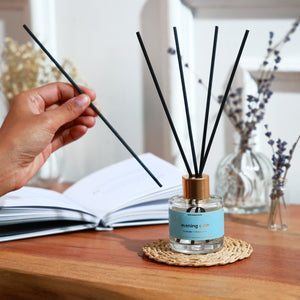
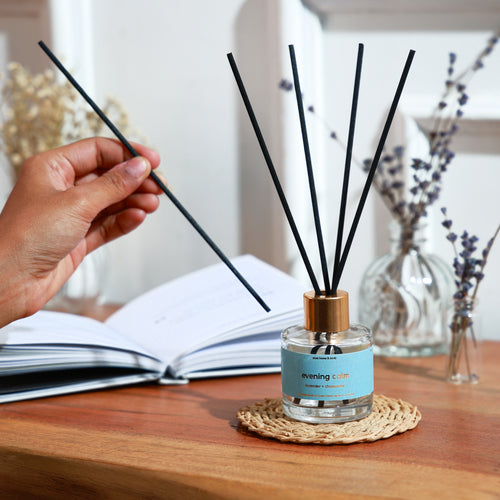
 Evening Calm₹799SOSA is a fragrance house. We compose reed diffusers, candles and machines for ordinary rooms, and we have no ritual line, no ceremonial product and no claim of purity or auspiciousness attached to anything we sell. What belongs in a puja space is decided by your family and your practice, not by a perfumer in Pune. I would rather be plain about that than write a page that quietly implies our bottle has a place there. Every genuinely useful thing I can tell you about this question concerns the room next to it: how big it is, when people sit in it, and where the air goes.
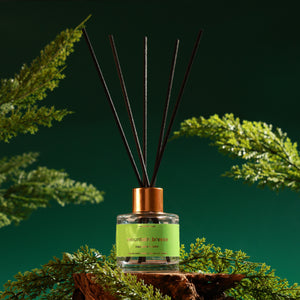
 Mountain Breeze₹849This is the reason I would give even if the first one did not exist. A reed diffuser holds fragrance oil in a glass bottle with six fibre reeds standing in the neck, and those reeds are doing precisely what a wick does — drawing flammable liquid upward and presenting it to the air. A puja space typically contains a lit diya, a burning agarbatti, occasionally a camphor flame, and ash that travels. Fragrance oil, an open flame and falling ash do not belong on the same surface, in the same alcove, or within reach of each other. The same applies with more force to a scented candle, which we would not recommend for that space at all. Put anything of ours across the room, on a different piece of furniture, well clear of the flame path.
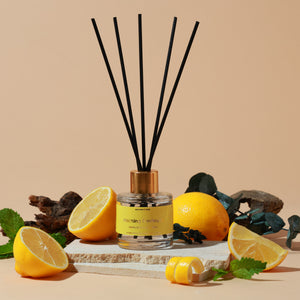
 Morning Freshness₹749Set both of the above aside and the arithmetic still argues against it. A reed diffuser cannot be switched off; it evaporates continuously, and it does not know whether anybody is present. During the puja the room belongs entirely to the incense, which is combustion and therefore far louder than anything a diffuser releases. For the rest of the day the room is largely empty. So the bottle would spend its life releasing oil into either an unoccupied room or an unwinnable contest. Meanwhile the living room, where the family sits for four or five hours every evening, has nothing in it. Move the money one doorway across and it does perhaps ten times the work.
What "nearby" actually means in an Indian flat
In most homes the puja space is not a separate room at all. It is an alcove in a hall, a wall-mounted mandir in the living room, a shelf in the kitchen or a corner of a bedroom, and "nearby" therefore means the same room with a few feet of distance. That changes nothing about the flame rule and everything about the practical layout. The workable arrangement is the far side of the room, on a different piece of furniture, out of any line where a draught runs between the mandir and a window or a door. Distance is not only a safety matter here; a diffuser sitting directly in a draught path loses its lighter materials quickly and empties faster, and it also pushes fragrance in exactly the direction you had decided to leave alone.
Where the puja space is a genuine separate room, the useful question becomes which adjoining space you spend time in. If it opens onto a hall you only walk through, that hall is a passage rather than a destination, and passages are poor investments in fragrance because nobody is there long enough to register anything. If it opens onto the living room, scent the living room on its own terms — for its own volume, its own hours and its own furniture — and simply accept that the two will meet at the doorway in the morning. They will, and that is not a failure of either. It is two things happening in one flat.
One more point that applies here more than anywhere else in the house. Closing the door of the puja space while the incense burns, if it has a door, does more for the rest of the flat than any product decision, because the airborne fraction stays where it is produced instead of travelling. And a fragrance cannot undo travel that has already happened: adding a pleasant odour to a persistent one gives you a mixture, not a cancellation. Source, then ventilation, then fragrance — and in this house the source is something you are keeping on purpose, which simply means the ventilation step carries more weight than usual.
Placement by placement, honestly judged
Every place a reader might consider putting a diffuser in relation to a puja space, with a plain verdict on each. Two of these are good, two are mediocre value, and two are answers I would refuse to give.
| Placement | What happens there | Verdict | What to use |
|---|---|---|---|
| On or beside the mandir shelf | Open fragrance oil, wicking fibres, a lit diya and falling ash sharing one surface | No — flame proximity, and not a space we advise on | Nothing |
| Inside a separate puja room, away from the flame | Small room, occupied briefly, dominated by combustion while in use | No — poor value and still the wrong room for us to furnish | Nothing |
| The doorway between the puja space and the hall | A draught line; reeds strip fast and fragrance is pushed the wrong way | Avoid — the worst placement physically as well as the least tactful | Move it off the line |
| A passage or corridor nearby | Nobody stays long enough to register it; adaptation does the rest | Low value, but harmless at a low dose | Evening Calm ₹799, three reeds |
| The adjoining living room, far wall | Where the family actually sits for hours — real occupancy, real volume | Yes — the best use of the money in this house | Mountain Breeze ₹849, or 130ml ₹1,349 above 150 sq ft |
| A bedroom the incense does not reach | Closed for long stretches, low air exchange, high occupancy at night | Yes — the most efficient room in most flats | Evening Calm ₹799, three reeds |
Softest · Evening Calm₹799Shop → 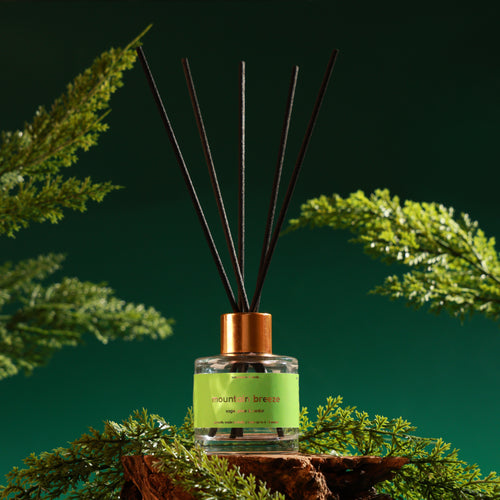 Living room · Mountain Breeze₹849Shop →
 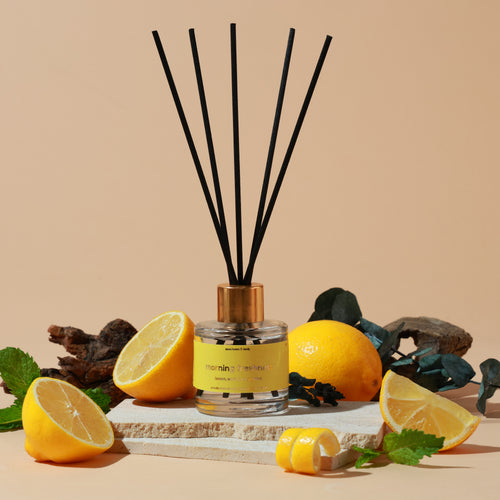 Bright · Morning Freshness₹749Shop →
Dose, draught and the empty-room problem
If you have decided to scent the adjoining room, three practical things will decide whether you are happy with it. The first is dose. Six reeds is full projection and three is a soft level that roughly doubles how long the bottle lasts, and near a space you are consciously trying not to intrude on, restraint is not a compromise — it is the correct setting. The common complaint about a fragrance being cloying is far more often a description of over-dosing than of the composition, and the fix costs nothing: pull three reeds out and put them aside.
The second is draught. A reed diffuser has no fan and depends entirely on the room's own air movement, which makes placement more consequential than it is for a machine. Put it in the room's natural airflow path — a metre or so from a doorway, on a stable surface, at or slightly below nose height — but never in a direct draught, and specifically not in the line running from the puja space towards the nearest window. Direct sun is the other thing to avoid, because heat accelerates evaporation and shortens the bottle without making the room smell any better.
The third is your own nose, which is unreliable in your own home. Receptors adapt to a constant stimulus within minutes, so within a week you will stop noticing the diffuser entirely while visitors notice it immediately. That is normal and it is not a fault in the bottle. The test is to leave the flat for fifteen minutes and walk back in. It is also the reason people in incense households routinely over-buy: they judge strength during the one part of the day when combustion is drowning everything else, conclude the diffuser is too weak, and buy upward. It was never going to win that comparison, and it does not need to.
What to buy — and when the answer is nothing
In buying order, for the rooms around a puja space rather than the space itself. Read the first line seriously: if the only room you were considering is the small one with the mandir in it, the honest recommendation is to spend nothing and put a bottle in your living room or bedroom instead, where it will be perceived by somebody for several hours a day.
| Buy | What it is | When it is the right answer | Price |
|---|---|---|---|
| 0. Nothing for that room | No purchase at all for a small, briefly used space | If the puja space is the only room you were considering — spend it elsewhere in the flat | ₹0 |
| 1. Evening Calm 50ml ★ | Kashmir lavender and chamomile at 8.9, the softest in the range | A small adjoining hall or bedroom, at three reeds rather than six | ₹799 |
| 2. Mountain Breeze 50ml | Himalayan pine, sage and Indian cedar — dry and resinous at 9.4 | An adjoining living room where a woody residue already carries through | ₹849 |
| 3. Mountain Breeze 130ml | The same scent sized for a room above about 150 sq ft, 14–18 weeks | Open-plan living rooms, or where the 50ml has read as thin | ₹1,349 |
| 4. Morning Freshness 50ml | Malabar lemon, peppermint and eucalyptus at 9.0 | A kitchen or bathroom elsewhere in the flat, well away from all of this | ₹749 |
| No ritual product, no sandalwood reed: the honest gap | SOSA makes nothing for worship and claims no purity or auspiciousness. There is also no sandalwood, oud, vetiver or amber reed diffuser in the range, and no product that removes smoke or purifies air | Stated plainly rather than implied by omission | — |
Versailles
I get asked this often enough that I have thought carefully about how to answer it, and the answer has two halves that are easy to confuse. The first half is that a puja space is not a room a fragrance brand should be selling into. We make no ritual product, we claim nothing about purity or auspiciousness, and I would not want a page of ours to leave the impression that a bottle of ours has a place there. That decision belongs to your household.
The second half is more practical and I would say it about any room with a flame in it. Fragrance oil is flammable. A reed diffuser is an open bottle of it with six wicking fibres in the neck, and a candle is that material already alight. Beside a diya or an agarbatti, on a shelf where ash falls, that is a combination I would not have in my own home. Different surface, across the room, and no candle in that space at all.
What is left is a genuinely useful question, which is what to do with the hall or the living room next door — and there the answer is the same as it would be for any other room in India. How big is it, how many hours is anyone in it, where does the air go. If the honest answer is that nobody sits there, buy nothing and put the money into the room where the family actually spends its evenings. That is the recommendation I would make to a friend, so it is the one I will make here. Everything is composed in Pune, and a part of every order funds a girl's classroom through Nanhi Kali.
Frequently asked questions
- Agarbatti every morning — what will not clash, and why timing beats register.
- Strong incense after the morning — what works later in the day.
- Notes that pair with sandalwood agarbatti — and why there is no sandalwood reed.
- Jasmine incense — should the diffuser also be floral?
- Hotel-inspired scents in an incense house — yes, by time separation.
- Traditional versus modern taste — one fragrance for a divided household.
- The best reed for a daily-agarbatti home — both answers, and when each applies.
- Morning incense to a fresh evening — the practical daily sequence.
- Sukoon and incense in one home — the machine question, answered honestly.
- Brand: the SOSA founder story.
SOSA reed diffusers — facts verified August 2026: Five scents, all alcohol-free, on a heat-stable CCT (caprylic/capric triglyceride) base rather than DPG, phthalate-free, paraben-free, IFRA-compliant, 0 ppm formaldehyde, six fibre reeds in a refillable glass bottle, composed and made in Pune, India, and climate-tested through 45°C heat and 85% RH monsoon humidity. Morning Freshness (Malabar lemon · peppermint · eucalyptus globulus) 50ml ₹749 · 130ml ₹1,249 · 9.0 on the SOSA strength scale. Evening Calm (Kashmir lavender · chamomile · soft musk) 50ml ₹799 · 130ml ₹1,299 · 8.9, the softest in the range. Garden Bloom (British rose · night-blooming jasmine) 50ml ₹799 · 130ml ₹1,299 · 8.9. Mountain Breeze (Himalayan pine · sage · Indian cedar) 50ml ₹849 · 130ml ₹1,349 · 9.4. Fresh Brew (Coorg coffee · Kerala vanilla · caramel) 50ml ₹849 · 130ml ₹1,349 · 9.5. Longevity 6–8 weeks on 50ml and 14–18 weeks on 130ml; six reeds give full projection and three give a soft level at roughly double the life. 50ml suits rooms up to about 150 sq ft and 130ml above that. Duos: Day & Night ₹1,498, Fresh & Grounded ₹1,548, Warmth & Bloom ₹1,598. Refills 300ml ₹2,399 · 500ml ₹3,499, oil only. The reed line contains no oud, no sandalwood, no vetiver and no amber. SOSA sells no room spray — every SOSA spray is a car perfume — and no air purifier, dehumidifier or odour eliminator. Reed oil and the water-based Hotel Collection are separate systems and are not interchangeable. Fragrance oil is flammable: keep all diffusers, candles and oils away from lit agarbatti, diyas and open flame. Free shipping above ₹499. SOSA is an independent Indian fragrance house and is not affiliated with or endorsed by any hotel brand. Prices subject to change — see the live product pages.