




The arrival effect you want at the door is already yours, for nothing. Someone walking in from outside is unadapted, so they register the room most strongly in the first few seconds and progressively less after that. The gradient exists in the person, not in the air — which is why a stronger dose at the entrance is not only unachievable but unnecessary.
The one real exception is a sealed vestibule — a lobby with a second door that actually stays shut. That is two zones rather than a gradient, and even then I would use one composition at two levels rather than two compositions.
What this page will not claim: fragrance does not calm anyone, shorten a wait, improve comfort or affect footfall, reviews or revenue. Nothing here is medical, clinical or safety advice. Some people are sensitive to airborne fragrance, which is why the clinical pathway stays clear, why a fragrance-free seat should always exist, and why the practice, not SOSA, sets its own policy.
2. What you get instead of a gradient is a seam. Somewhere between the two sources there is a zone where both are present and neither dominates. It is the least pleasant part of the room and it is exactly where people stand while they are being checked in.
3. The arrival effect is already built in. A person coming in from the street is unadapted; the same air that registers clearly at the door registers less four minutes later, because a nose stops reporting a constant. You already have the entrance emphasis you are trying to buy, and it costs nothing. Adding a second source at the door does not sharpen it; it raises the whole room.
4. Two compositions is the worse version of the same mistake. Two fragrances in one air path become one fragrance nobody composed. If two scents must coexist they need to share a note — but that is a discussion for genuinely separate rooms, and an entrance and a waiting area are not that.
5. The exception is a real vestibule with a real door. If your entrance is a sealed lobby whose inner door is kept shut, that is a separate volume and can carry a separate setting. Even then I would use one composition at two levels rather than two compositions, because the door opens fifty times a day and people carry air on their clothing.
6. Everything past the consultation door stays clear, and a fragrance-free seat always exists. Examination rooms, refraction and diagnostics, consultation cabins, dilation bays, the procedure suite and post-operative areas get nothing. A single source also makes that boundary easier to hold, because there is one thing to place well rather than two. Ventilation, cleaning protocol and patient suitability remain matters for you and your clinicians.
Everything SOSA makes is composed and made in small batches in Pune, and a portion of every order supports girl-child education through Nanhi Kali.

Part one — why a gradient cannot be held
The wish behind this question is a good one: an entrance that announces itself and a seating area that recedes. It is a sound instinct about how a building should be sequenced, and it is achievable in light, in materials and in sightlines. It is not achievable in scent, for three reasons.
 Mountain Breeze₹849 · one source, one levelHere is the part that makes the question dissolve. A nose stops reporting a constant within a few minutes, whether the constant is strong or faint. So a person entering from the street perceives the room most acutely in the first seconds and progressively less as they sit — precisely the gradient you were trying to build, delivered by perception rather than by concentration. A second source at the door cannot sharpen that curve; it raises the flat part of it, so the seating gets stronger while the entrance impression barely changes. The second machine spends its whole output on the one place you wanted quiet. It is also why the door is the wrong place to judge from: what you smell walking in is not what anybody experiences for the next forty minutes.
Part two — six versions of the idea, and what each produces
Practices arrive at this question having half-designed a solution already. Here are the six I hear most, with what each would need and what each does.
| The scheme | What it would need to work | What happens in a real clinic | Verdict |
|---|---|---|---|
| One source, one scent, one level ★ | Nothing beyond sensible placement | A consistent zone; the entrance still reads strongest, because arrivals are unadapted | The recommendation for every practice in this family |
| Same scent, stronger at the door | A pressure difference or ten-plus metres of separation | Both areas rise together; the seating gets the increase you did not want | No. You are paying to raise the wrong end |
| A different scent at the entrance | A sealed door between the two, kept shut | A composite in the middle that neither composition intended | No. Two scents in one air path become one muddled scent |
| Warm at the entrance, neutral in the seating | The same sealed door, plus separate extraction | Warm materials travel and settle; the seating carries them all afternoon | No — and warmth is the wrong register for a clinic anyway |
| A source right at the doorway only | An airlock; the door itself works against you | Every door cycle pushes the output inward and strips it outward | No. The worst placement in the room, and it empties a reed bottle early |
| A sealed vestibule with an inner door that stays shut | A genuine second door, and staff who close it | Two real volumes — this one can hold a difference | The only yes, and even then use one composition at two levels |
| The honest caveat: this table describes how air and fragrance behave in a room, not how anybody feels in one. No claim is made that fragrance affects comfort, anxiety, perceived waiting time, recovery, footfall, reviews or revenue, and no SOSA product is described as safe or unsuitable for any patient group. Whether fragrance belongs in your arrival zone at all is a judgement for you and your clinicians, and a practice that reads this and scents nothing has read it correctly. | |||
 Mountain Breeze · under ~150 sq ft₹849Shop → Sukoon · 150–320 sq ft, one unit₹1,899Shop →
 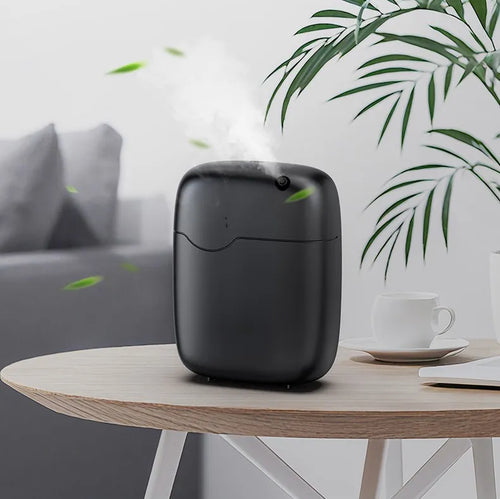 Vaayu · one unit past ~320 sq ft₹11,999Shop →
Part three — when a clinic should not do this at all
The first case is the building where the entrance is not a zone at all — the door opens into what is really a wide piece of corridor, desk on one side, the way to consultation directly ahead. Nothing can be scented there without also scenting the route to the clinical rooms, and no placement rescues it. The honest recommendation is to leave the air alone until a refit gives you a genuine arrival room.
The second is an entrance opening straight onto a busy road. Street air, dust and traffic come through with every cycle, and a composition at a clinic-appropriate level is not in that argument — you would have to run it high enough to be objectionable indoors to register near the door. Accept the entrance as a transition and let the scent belong to the seating area, sited well inside. The third is a children's eye clinic or a large paediatric caseload, which I would decline outright; the fourth is a practice whose front-desk team would rather work without it, and their answer settles it.
The fifth is about supply, and it matters here because a one-source design is a commitment to that source. SOSA does not currently sell a separate cold-air refill oil for the Vaayu. The 400ml in the box lasts roughly ninety days or more at a mid setting and is the whole supply available at the time of writing. For a home that is an inconvenience; for a practice whose entire arrival zone depends on a single machine, or which is repeating the design across branches, it is a business problem. The water-based Hotel Collection is not a substitute — it is made for ultrasonic machines and must not be used in a Vaayu. Confirm current refill availability through the contact page before committing.
Part four — what your layout actually allows
Find your floor plan in the first column. Only one row permits a difference between entrance and seating, and it is the one with a real door in it.
| Your layout | Can it hold a difference? | What to do instead | Cost |
|---|---|---|---|
| Open entrance, desk and seating in one room ★ | No — one volume | One Sukoon midway between door and seating, lowest setting | ₹1,899 |
| Small clinic, entrance and six seats, under ~150 sq ft | No, and it is too small to want one | One reed diffuser, four reeds, on a tray away from the door | ₹1,349 · 14–18 weeks |
| Entrance leading past an optical display into seating | Not reliably — usually one air path | One composition throughout; treat optical as part of the same zone | ₹1,899 |
| Sealed vestibule with an inner door kept shut | Yes — two genuine volumes | One composition, lower in the vestibule. Never two fragrances | ₹1,899 + ₹749 if you must |
| Large open reception hall, 320+ sq ft, one volume | No — the bigger the room, the more thoroughly it mixes | One freestanding Vaayu, well back from the corridor, key-lock on | ₹11,999 |
| Entrance is really the head of the clinical corridor | No, and nothing should be placed there | Nothing, until a refit gives you an arrival room | ₹0 |
Versailles
An architect sent me a scheme for a new vision centre with two diffusers marked on it — a warmer note at the entrance, something quieter over the seating. A thoughtful drawing, and the intention behind it was right. I asked him to mark where he expected the two to meet, and that was the end of the scheme. The answer was the check-in desk, where every patient stands for two minutes with their file open.
What we did instead cost a third as much. One machine, sited between the door and the chairs rather than at either end, on the lowest setting, with the entrance left to do its own work. The entrance still reads as the strongest moment in that building, because everybody arriving from outside is meeting the air for the first time — and no product I sell could have improved on that.
I say the unprofitable half out loud here more readily than usual, because this is a question where the honest answer sells one item instead of two. If your entrance is really a corridor head, or it opens onto a main road, or your front-desk team would rather have nothing, the right outcome of this page is that you buy less than you came for. Made in Pune in small batches, and a part of every order funds a girl's classroom through Nanhi Kali.
Frequently asked questions
- Where the single source should stand — the placement rules for a clinic reception.
- Which composition suits a waiting room — chosen for the fortieth minute.
- How strong the level should be and what a busy reception changes.
- Should patients notice the fragrance at all — the intensity doctrine.
- Brand: the SOSA founder story.
SOSA range, specifications and prices used in this guide (verified August 2026): Vaayu ₹11,999 — waterless cold-air nebulisation of undiluted fragrance oil; no water, no heat, no added humidity, no white mineral dust. Coverage up to 1000 m³, about 2,000–3,000 sq ft. 400ml refillable tank lasting roughly 90+ days at a mid setting. Bluetooth app plus onboard controls, 1h / 4h / 8h / 24h run windows, day selection, adjustable intensity, auto-stop and key-lock. Under 38 dB. DC 12V / 1A, 5W. Freestanding or wall / HVAC mount. CE, RoHS and SGS certified. SOSA does not currently sell a separate Vaayu cold-air refill oil; the 400ml supplied in the box is the fragrance available at the time of writing, so a practice planning continuous or multi-site use should confirm current refill availability with SOSA before committing. The water-based Hotel Collection is made for ultrasonic machines and must not be used in a Vaayu. Other machines: Boond 300ml ₹899 (~150 sq ft, ultrasonic) · Sukoon 500ml ₹1,899 (270–320 sq ft, 16–18 hours on low, remote and steady/2H/4H timers, three 15ml fragrances included, ultrasonic) · Megh 6L ₹3,499 (~215 sq ft — a runtime and humidity machine that covers less than a Sukoon, never a coverage upgrade) · Safar ₹3,999 (waterless cold diffusion, cordless, 20ml, about 6.9cm, three speeds, 1/2/3-hour auto-off — sold as a car and travel diffuser, personal-scale only; SOSA publishes no coverage figure for it) · Aangan ₹25,999 (HVAC nebulising, ~8,000–10,000 sq ft) · Meenar ₹38,500 (commercial HVAC, 12,000–18,000 sq ft). Water-based Hotel Collection for ultrasonic machines: 15ml ₹299 · 100ml ₹999 · 300ml ₹1,799 · pack of seven ₹1,799; scents are inspired by the atmosphere of well-known hotels — SOSA is an independent Indian brand and is not affiliated with, endorsed by or supplying any hotel group. Reed diffusers ₹749–₹1,349 (50ml 6–8 weeks, 130ml 14–18 weeks, six fibre reeds, no 100ml size; replacement reeds are not sold separately). Reed oil cannot be used in an ultrasonic machine and Hotel Collection oil cannot be used in reeds. SOSA sells no room spray or home spray — every SOSA spray is a car perfume. Nothing in this guide is medical, clinical or safety advice. A fragrance diffuser adds a scent to the air. It does not clean, purify, filter, sanitise or disinfect air, does not remove or neutralise disinfectant, damp or occupancy smells, and has no effect on comfort, anxiety, waiting time, recovery or any clinical outcome. Some people are sensitive to airborne fragrance, which is why this guide recommends that examination rooms, diagnostic areas, consultation cabins, procedure suites and post-operative areas remain fragrance-free, that a fragrance-free seating option always exist, and that a diffuser is never mounted into shared HVAC in a clinical building. Decisions about clinical policy, ventilation standards, infection control and patient suitability rest entirely with the practice and its clinicians. A persistent stale, damp or disinfectant smell is a ventilation, moisture or cleaning problem — SOSA sells no dehumidifier and no air purifier, and fragrance should never be used to cover one. Coverage, runtime and longevity figures are manufacturer specifications and typical ranges, not guarantees, and vary with room volume, ceiling height, air exchange, occupancy and season. SOSA publishes no commercial or bulk pricing, no corporate account, no annual maintenance contract, no installation service, no stated warranty term and no multi-location programme; warranty length, spare parts, servicing and app platform availability are unconfirmed, and larger or multi-site enquiries should go through the contact page before any commitment. Composed and made in small batches in Pune, India. Free shipping above ₹499. A portion of every order supports girl-child education through Nanhi Kali. Prices subject to change — see the live product pages.