

Should a Multi-Speciality Medical Centre Have a Signature Scent?

Should a Multi-Speciality Medical Centre Have a Signature Scent?

★ ★ For the ten seconds a patient spends deciding what kind of place this isVaayu ₹11,999 · Aangan ₹25,999 · free shipping above ₹499A portion funds girl-child education
★ SOSA · clinics, polyclinics & medical centres
A clinic should not smell of a fragrance. It should smell of nothing in particular, which is a harder and much better result than smelling of something
★ ★ ★ ★ ★
★★★★★
"We were choosing between things that smelled expensive. The advice was the opposite: pick the one nobody in a waiting room could object to, and run it lower than you think."
Dr Meera Raghavan Multi-speciality clinic, Chennai
White Tea · low
★★★★★
"I asked which scent for our reception and was asked back whether the toilets had been checked for dry traps. They had not. That call saved us buying the wrong thing."
Ashwin Pillai Centre head, Kochi
Sent to the traps first
★★★★★
"No water tank was the point for us. Our housekeeping lead had already refused an ultrasonic on principle and she was right."
Sunita Marathe Facility manager, Pune
Vaayu · no reservoir
★★★★★
"What I appreciated was being told plainly that fragrance does nothing clinical. Every other vendor had a wellness story. We did not want a wellness story."
Dr Imran Sayyed Polyclinic, Hyderabad
No claims made
★★★★★
"A patient once asked our receptionist what the fragrance was. We took it as a compliment until it was explained that it means it is too strong. Nobody asks now."
Rekha Nambiar Operations, Bengaluru
Turned it down
★★★★★
"Four scents came with the machine, so we tried them in the lobby over four weeks before deciding what our centre smells like."
Vivek Chaturvedi Medical centre, Indore
Vaayu · four scents
★★★★★
"We were choosing between things that smelled expensive. The advice was the opposite: pick the one nobody in a waiting room could object to, and run it lower than you think."
Dr Meera Raghavan Multi-speciality clinic, Chennai
White Tea · low
★★★★★
"I asked which scent for our reception and was asked back whether the toilets had been checked for dry traps. They had not. That call saved us buying the wrong thing."
Ashwin Pillai Centre head, Kochi
Sent to the traps first
★★★★★
"No water tank was the point for us. Our housekeeping lead had already refused an ultrasonic on principle and she was right."
Sunita Marathe Facility manager, Pune
Vaayu · no reservoir
★★★★★
"What I appreciated was being told plainly that fragrance does nothing clinical. Every other vendor had a wellness story. We did not want a wellness story."
Dr Imran Sayyed Polyclinic, Hyderabad
No claims made
★★★★★
"A patient once asked our receptionist what the fragrance was. We took it as a compliment until it was explained that it means it is too strong. Nobody asks now."
Rekha Nambiar Operations, Bengaluru
Turned it down
★★★★★
"Four scents came with the machine, so we tried them in the lobby over four weeks before deciding what our centre smells like."
Vivek Chaturvedi Medical centre, Indore
Vaayu · four scents
✓ Vaayu: waterless cold-air nebulisation · no standing water tank · under 38 dB ✓ 1000 m³ (≈2,000–3,000 sq ft) · 400ml tank ≈75 days · app + 1h/4h/8h/24h timers ✓ Key-lock and auto-stop — safe in a public waiting area the whole day


Founder Diaries · Clinics, Polyclinics & Medical Centres
By Sonal Sahani · ISIPCA Versailles 11 min read Updated September 2026
Yes, with one condition that turns out to be the whole answer. A signature scent in a multi-speciality centre means one fragrance, at one intensity, in every public volume of the building — not six departments each choosing something that suits their speciality. I get the second version proposed to me at least once a month, usually with the best intentions: something bright for paediatrics, something expensive-smelling for the dermatology and cosmetology wing, something sharp for dental, something restful for the physiotherapy corridor. It does not work, and the reason is not aesthetic. It is that a building has one air and a patient has one visit. This page covers what a signature can honestly be, the arithmetic of running it across six departments, and the sentence a centre must never attach to it.
Quick answers — read this first
The answer: yes — if the signature is one scent at one setting across every public area, and no if it means six departments choosing six fragrances. A multi-speciality centre shares lifts, corridors and return air; departmental scents meet in those and read as inconsistency.

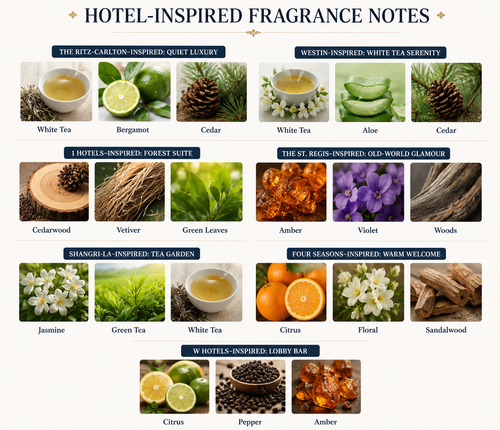
The pick for a signature: the Westin-inspired White Tea Serenity (white tea, aloe, cedar, ₹299) or the Ritz-Carlton-inspired Quiet Luxury (white tea, bergamot, cedar, ₹299) at a single locked intensity, through one or more Vaayu units at ₹11,999 each.

What a signature may claim: consistency and housekeeping. Nothing else. It does not affect anxiety, recovery, sleep or any condition, a diffuser is not an air purifier, and a medical centre should describe it internally in exactly those terms. The clinical rooms inside every one of those departments stay fragrance-free.
The short answer
Short answer: yes, provided signature means one scent, one intensity, every public area. A multi-speciality centre is six businesses sharing a lift lobby, and departmental fragrances collide in the corridor between them. One scent is also the only version a patient walking from radiology to the pharmacy counter can perceive as deliberate.
The pick: the Westin-inspired White Tea Serenity (₹299) as the default signature, or the Ritz-Carlton-inspired Quiet Luxury (₹299) if your entrance is large and needs a little more lift. Use the 1 Hotels-inspired Forest Suite (₹299) only if it is the single choice for the whole building, never as the café floor's separate scent.
Shop: one Vaayu at ₹11,999 per public volume up to 1000 m³, or an Aangan at ₹25,999 for up to 3,000 m³ and an HVAC tie-in. A 400ml fill lasts about 75 days, so four refills a year per unit. Hotel Collection scents from ₹299. Free shipping above ₹499.
Straight answer
Should a multi-speciality medical centre have a signature scent?
1. Yes, if signature means one scent at one setting everywhere the public goes. Entrance, reception, shared and departmental waiting areas, the corridors between departments, the lift and stair lobbies, administration and the café corner. One fragrance, one intensity, one schedule.

2. No, if it means six departments choosing six fragrances. The departments in a multi-speciality centre are separated by doors and corridors, not by airtight seals, and their air meets in the lift lobby. Six scents produce a building that smells slightly different every fifteen metres, which reads as nobody being in charge rather than as attention to detail.

3. The patient's visit is the unit, not the department. Somebody attending a multi-speciality centre typically touches three or four of its departments in ninety minutes — registration, a cabin, the sample-collection counter, the pharmacy. They experience the building as one journey, and a signature is only coherent at that scale.

4. Choose the least memorable scent you are willing to live with. The Westin-inspired White Tea Serenity at ₹299 is the default. A signature in a medical centre is not supposed to be recognised by patients; it is supposed to be uniform for staff and management.

5. Exclude the clinical rooms inside every department, without exception. The consultation cabins, treatment and procedure rooms, laboratory, sample collection, pharmacy dispensing, imaging and paediatric clinical areas are outside the signature. The signature is a property of the public building, not of the practice.

6. And write down what it is for before anybody else writes it down for you. A signature scent is consistency and housekeeping. It has no clinical, therapeutic or air-cleaning effect of any kind, and a medical director will be right to strike out any sentence suggesting it does.

A portion of every order supports girl-child education through Nanhi Kali.
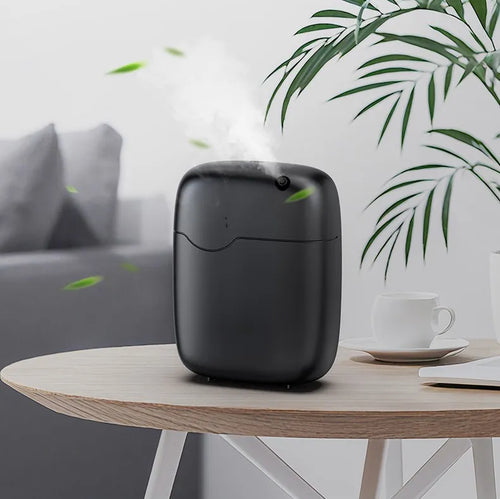
TL;DR: yes — as long as a signature means one scent at one locked setting in every public volume of the building, rather than six departments choosing six. The Westin-inspired White Tea Serenity at ₹299 through as many Vaayu units at ₹11,999 as the public volume needs. Clinical rooms are outside the signature entirely.
SOSA Vaayu
The unit a signature is actually built from
SOSA Vaayu ₹11,999
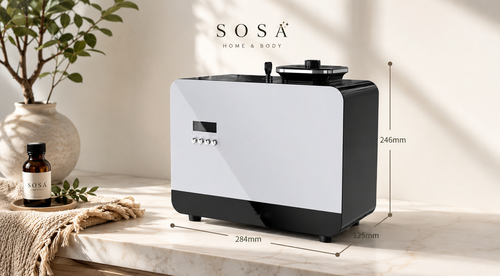
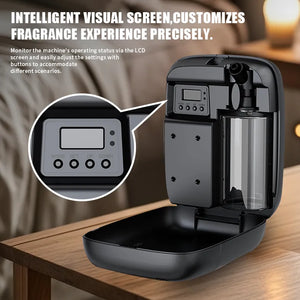
One machine per public volume up to 1000 m³ — not one per floor plan and not one per department. Identical machines running identical oil at an identical locked intensity is what makes a signature a signature; everything else is a coincidence of taste. Waterless, so nothing stands in a reservoir in a building open twelve hours. 400ml lasts about 75 days, so four refills a year per unit and a consumable line procurement can model in ten minutes. Under 38 dB, 1h/4h/8h/24h timers with Bluetooth app control so every unit in the building runs the same schedule, auto-stop, key-lock, CE, RoHS and SGS certified. Freestanding, wall- or HVAC-mounted, 0.9 kg.

Six departments, one building, one air

The instinct behind departmental scents is a good one and I want to give it credit before I take it apart. A multi-speciality centre really is several different businesses sharing a staircase: the dermatology and cosmetology wing has a retail feel, paediatrics has a family feel, physiotherapy runs like a gym, and the diagnostic side runs like a laboratory because it is one. A centre head who wants each to feel like itself is thinking about the patient, not about the brochure. The trouble is that the thing they are proposing to vary is the one building system that does not respect the partitions. Light stops at a wall. Sound mostly stops at a wall. Air does not, and a corridor with six doors off it is a mixing chamber, not a boundary. So before deciding whether to have a signature, it is worth being precise about what actually happens to fragrance in a building like yours.

1
THE PHYSICS
A corridor is a mixing chamber, not a boundary
Three mechanisms, all of them unglamorous. First, doors. A consultation cabin door opens and closes perhaps sixty times a session, and each swing moves a slug of air both ways. A department with its own fragrance does not keep it; it donates it to the corridor and borrows whatever the corridor has. Second, the return air. Most multi-speciality centres are served by a small number of air handling units or a bank of ducted splits, and the return path frequently runs above a false ceiling that crosses departmental walls as though they were not there. Whatever radiology is producing arrives at the lift lobby via the plenum, and the lift lobby serves everybody. Third, the lift and stair shafts, which are vertical chimneys with pressure differences across them all day. In a three-floor centre the ground-floor lobby smell reaches the top floor by four in the afternoon whether anybody planned it or not. So departmental fragrances do not coexist. They average. And the average of six carefully chosen scents is not a seventh scent — it is a vague, slightly sweet, unplaceable smell that a patient reads as a building nobody is managing. One scent, on the other hand, averages with itself and stays what it is, which is the only technically robust argument for a signature in a building of this kind.
2
THE VISIT
The patient's unit is the journey, not the department
Then the experience side, which is where the commercial argument actually lives. A patient attending a multi-speciality centre does not visit a department. They visit a building, usually touching three or four parts of it in ninety minutes. Registration on the ground floor, a wait, a cabin on the first, back down to the sample-collection counter, twenty minutes in a different set of chairs, then the pharmacy on the way out. That is the unit of experience, and it is why the departmental version of a signature fails even when the physics is kind to it. If the paediatric corridor smells noticeably different from the radiology corridor, the patient does not think about paediatrics. They notice that the building changed, and a change they cannot explain in a medical setting is a small, unnecessary question at a moment when they already have questions. Consistency is the entire product here. Four branches of the same group should smell the same as each other for exactly the same reason and that is a conversation worth having separately. A signature in a medical centre is not there to be recognised and remembered by patients. If they are recognising it, it is too strong. It is there so that the building is the same on Tuesday as it was on Friday, in the east wing as in the west, which is a housekeeping standard expressed in air.
3
THE SENTENCE
What a signature may claim, and the one it must never be given
And then the part I care about most, because it is where this category does damage. A signature scent in a medical centre is a presentation and housekeeping standard. That is the whole of what it may be said to do, internally or to a patient. It does not reduce anybody's anxiety, it does not help anybody sleep or recover, it has no effect on any condition and it is not a form of care. A diffuser is not an air purifier: it does not clean air, remove pathogens or sterilise anything, and any supplier who lets you believe otherwise has handed you a liability rather than a feature. I am not being cautious for legal reasons alone. A multi-speciality centre earns trust by being precise about what it claims, and a reception wall that says something untrue about a fragrance quietly undermines the notice next to it that says something true about a treatment protocol. So the internal line I would write is short: we run a consistent, very low background fragrance in public areas as part of our housekeeping standard; clinical areas are fragrance-free; it is not a health measure and we do not describe it as one. Give that sentence to the front desk, put it in the SOP, and have a written answer ready for the patient who asks.
The test for whether your signature is at the right level: ask your own medical director to walk the building and tell you where the fragrance is. If they can map it, turn it down. If they have to think, it is correct.

Department by department: what gets the signature and what does not

A signature is defined as much by its exclusions as by its scent, and in a multi-speciality centre the exclusion list is longer than the inclusion list. This table runs through a typical six-department facility and says which volumes carry the signature, which are left alone and why. The reasons are not squeamishness. They are the ordinary working reasons a clinician would give you if you asked them before you asked a fragrance supplier.

The signature map
Which volumes in a six-department centre carry the signature
Area Public or clinical Signature? The reason
Entrance, reception, shared waiting ★ Public Yes — the primary volume Where the standard is set and where one machine usually does the whole job
Inter-departmental corridors, lift and stair lobbies Public Yes, from the same machine They are the mixing chambers, so they are already carrying it. Do not add a second unit unless the sum says so
Departmental waiting areas, administration, the café corner Public Yes, same scent, same setting Same oil and the same locked intensity, or the consistency argument collapses
Consultation and examination rooms, treatment and procedure rooms, dressing rooms Clinical No A clinician is trained to notice what a room and a patient smell of, and a patient may need to describe a symptom involving smell
Sample collection, laboratory, pharmacy dispensing, sterile stores, imaging Clinical No People faint and feel unwell in collection rooms, and added airborne anything is a contamination discussion with your own quality lead
Paediatric clinical areas and oncology day-care Clinical No, and not negotiable Children cannot consent and their parents did not choose it. Aversion to smells during treatment is real and every oncology nurse knows it
Shop this guide
A signature across a whole centre
The SOSA principle
A signature in a medical centre is not there for the patient to recognise. If they recognise it, it is too strong. It is there so the building is the same on Tuesday as it was on Friday.
Consistency is the product. One scent, one intensity, one schedule, identical machines, and a written line about what it is and is not for.

One setting, three floors, and what it costs a year

Start with the sum, because a signature across several departments is where clinics most often buy too many machines. Cubic metres are square feet divided by 10.76, multiplied by ceiling height in metres, and clinical rooms come out of the calculation entirely — they are fragrance-free and their doors are shut. Take a 5,000 sq ft centre with six departments and one shared waiting hall. On the drawing that looks like a two- or three-machine job. In practice the consultation cabins, the two procedure rooms, the dressing room, sample collection, the small laboratory, the pharmacy store and the imaging room might account for 2,900 sq ft of it, leaving about 2,100 sq ft of entrance, reception, waiting, corridor and administration. At a 3.2-metre ceiling that is roughly 625 m³ — comfortably inside one Vaayu at ₹11,999. Count the volumes a door closes, not the square feet on the brochure. Where a centre genuinely is large — a double-height atrium, a whole floor on one air handling unit, 8,000 sq ft and up — the Aangan at ₹25,999 covers up to 3,000 m³ and ties into the HVAC, and a facility-wide walkthrough is the sensible way to reach the number rather than a rule of thumb.

Then the discipline that actually delivers a signature, which is duller than choosing the scent. Same oil in every machine, same intensity step on every machine, same start and stop time on every machine, and the key-lock engaged on all of them. A signature fails in practice not because somebody picks a different fragrance but because the second-floor unit has been nudged up by a departmental supervisor who thought their corridor was underperforming — and by month three the building has a loud floor and a quiet one again. The Bluetooth app matters here in a way it does not in a single-room installation: a facilities manager can hold the schedule centrally rather than relying on six people to remember it. Set the schedule once: on thirty minutes before the first appointment, off with the last. Nobody adjusts it at midday because a floor got busy, because busy is an air-change problem and fragrance added to it makes the room worse. And one named person owns the refill round: a 400ml fill runs about 75 days on clinic hours, so four visits a year per unit, which for a three-machine centre is twelve short jobs across a year and nothing else.

Then the money, which in a multi-department centre is easier to defend than most facility spends. One Vaayu is ₹11,999 as a fixed asset, and the oil is a small recurring line at four fills a year per machine. A three-machine building is a one-time ₹35,997 plus a consumable, which sits in the facilities budget alongside housekeeping rather than in marketing, and which budget line it belongs in is worth settling before the first purchase order rather than after. Two things to know before you commit. The Vaayu and the Aangan run their own undiluted oil, not the water-based Hotel Collection bottles, which are for ultrasonic machines only — the Sukoon at ₹1,899, the Boond at ₹899 and the Megh at ₹3,499. Those three hold standing water and put 30 to 50 millilitres of it into the air per hour, which in a twelve-hour building means a tank that somebody empties, rinses and dries every evening by name; they are honest for a single administrative cabin and wrong for public clinical property. And the things that cannot carry a signature at all: an alcohol-free reed diffuser from ₹749 needs 24 to 72 hours to settle and fades past a metre, so it cannot hold a level across a building; SOSA does not make a room spray, and the sprays in our range are car perfumes; and candles, which we make from ₹379, have no place in a healthcare facility at all because an open flame is a fire-safety and insurance matter rather than a design choice.

Six departments can have six personalities. They cannot have six atmospheres, because they are all breathing the same building.
— Sonal Sahani, SOSA

The SOSA edit

In buying order for a multi-speciality centre committing to one signature across its public areas. The first row is a decision rather than a purchase, and it is the one that determines whether the rest works.

The SOSA edit
A signature across a multi-department centre, in order
Step What it is Why it comes here Cost
1. The zone map ★ A floor plan with every public volume marked and every clinical room struck out It decides the machine count and it usually halves it. Clinical rooms leave the sum entirely ₹0
2. White Tea Serenity 15ml White tea, aloe and cedar — the least memorable of the seven, which is the qualification here The signature itself. Buy one 15ml, live with it in the main lobby for a month, then standardise ₹299
3. Vaayu × the public volumes Up to 1000 m³ each, waterless, under 38 dB, app-scheduled, key-locked, four scents included Identical machines at an identical locked setting are what makes a signature rather than a coincidence ₹11,999 each
4. Aangan Up to 3,000 m³, 800ml, HVAC-connected or standalone, under 42 dB, programmable Only where the sum runs past 1000 m³ — an atrium, a whole floor on one AHU, 8,000 sq ft and up ₹25,999
5. Oil for the year One 400ml fill per machine lasts about 75 days on clinic hours Four refills a year per unit, one named owner, one line in the facilities budget recurring
Outside the signature: candles, sprays and reeds Candles from ₹379 are an open flame; SOSA makes no room spray; reeds fade past about a metre None of the three can hold one level across a building, and the first should not be in a clinic at all —
Honest notes for buyers: fragrance in a medical facility is housekeeping and presentation, never treatment. Nothing on this page claims that a fragrance reduces anxiety, aids recovery, improves sleep, cleans or disinfects air, or has any clinical effect whatsoever, because it does not and a diffuser is not an air purifier. Scenting belongs to the entrance, reception, shared waiting areas, inter-departmental corridors and administrative rooms. Consultation and examination rooms, treatment and procedure rooms, day-care surgery, dressing rooms, blood- and sample-collection rooms, laboratories, pharmacy dispensing, sterile stores, imaging rooms, oncology day-care and paediatric clinical areas should be left fragrance-free. A persistent smell is information about a dry drain trap, a bin, a soiled-linen route or an air-conditioning drain pan: find it and fix it rather than covering it. On the machines: the Vaayu at ₹11,999 is waterless cold-air nebulisation with no standing water tank, covering up to 1000m³ or roughly 2,000–3,000 sq ft, with a 400ml tank lasting about 75 days, Bluetooth app control, 1h/4h/8h/24h timers, under-38dB running, auto-stop and a key-lock for public areas. The Aangan at ₹25,999 covers up to 3,000m³ and connects to HVAC for a whole floor or an atrium. The ultrasonic Sukoon, Boond and Megh are water-based, hold standing water and add 30–50 ml of water an hour to the air, which makes them suitable for a single administrative cabin with a named person emptying and drying the tank daily, and unsuitable for public clinical property. An alcohol-free reed diffuser needs 24–72 hours to establish and suits a small lobby rather than a large waiting hall. Candles are not appropriate in a healthcare facility because an open flame is a fire-safety matter. SOSA does not make a room spray. The Hotel Collection scents are SOSA's own interpretations inspired by the world's finest hotels; SOSA is an independent Indian fragrance house, not affiliated with or endorsed by any hotel brand. A portion of every order supports girl-child education through Nanhi Kali.
SOSA Aangan
Where the volume is genuinely large
SOSA Aangan ₹25,999
Up to 3,000 m³, roughly 8,000 to 10,000 sq ft, with an 800ml reservoir, a metal body, programmable schedules and under-42 dB running, connected to an air handling unit or standalone. This is an integrated medical centre with a double-height atrium reception, or a whole floor served by one AHU — not a 2,500 sq ft polyclinic, where specifying it would be overselling and I would say so. The honest test is the sum: if the public volume of the floor comes out above 1000 m³ and there is an AHU to tie into, this is the machine. If it comes out at 400 m³, it is not. The full comparison is here.
SS
ISIPCA
Versailles
A note from Sonal

The most persuasive version of the departmental idea I have been shown came from a centre in Coimbatore with six specialities on three floors, and it was a genuinely thoughtful document. Each department had a scent chosen to suit its patients, with a paragraph explaining the reasoning, and the reasoning was better than most of what I read in this industry. I asked one question: where does the paediatric corridor end and the physiotherapy corridor begin. The answer was a fire door that is propped open all day because the trolleys need it. That was the end of the proposal, and it took about four seconds.

What I suggested instead was duller and cheaper. One scent, the quietest one we make, at one locked setting, in the entrance, the shared waiting hall, the two corridors and the lift lobby — and nothing at all in any room where a patient is examined, undressed, sampled or treated. Two machines, not five. The part the centre head liked, in the end, was not the smell. It was that the building became predictable: the same on a Monday morning as on a Saturday afternoon, the same on the third floor as at the door. That is what a signature is in a medical building. It is not a memory and it is certainly not a benefit. It is a standard that happens to be expressed in air, and it should be described in exactly those words to staff, to patients and to your own medical director.

Everything is made and supported from Pune, and a part of every order funds girl-child education through Nanhi Kali. You get a space that smells like somewhere looked after; a girl gets a classroom. That equation has always felt right to me.

Frequently asked questions

Should a multi-speciality medical centre have a signature scent?
Yes, if signature means one scent at one intensity in every public area — entrance, reception, shared and departmental waiting, corridors, lift lobbies, administration and the café corner. No, if it means six departments choosing six fragrances, because the departments share doors, corridors, lift shafts and return air, and the six average into something nobody chose.
Can different departments in a clinic have different scents?
In practice they cannot keep them. A consultation door swings sixty times a session, the return-air path usually crosses departmental walls above the false ceiling, and lift shafts move air between floors all day. Departmental scents do not coexist, they average, and the average reads as a building nobody is managing.
What can a clinic honestly say a signature scent does?
That it is part of the housekeeping and presentation standard, and that public areas carry a consistent, very low background while clinical areas are fragrance-free. Nothing beyond that. It has no effect on anxiety, recovery, sleep or any condition, and a diffuser is not an air purifier — it does not clean or sterilise air.
How many diffusers does a six-department medical centre need?
Fewer than the floor plan suggests. Work in cubic metres — square feet divided by 10.76 times ceiling height — and remove every clinical room, because they are fragrance-free with their doors shut. A 5,000 sq ft centre often has only about 2,100 sq ft of public area, which at 3.2 metres is roughly 625 m³ and well inside one Vaayu at ₹11,999.
What does a signature fragrance cost a medical centre per year?
The machine is a fixed cost and the oil is a small recurring one. A 400ml fill in a Vaayu lasts about 75 days on clinic opening hours, so four refills a year per unit. A three-machine building is a one-time ₹35,997 plus that consumable, and it belongs in the facilities budget beside housekeeping rather than in marketing.
One scent, one setting, one building
A signature is consistency — not a claim
The Vaayu is ₹11,999 per public volume up to 1000 m³: waterless, under 38 dB, 1h/4h/8h/24h timers with Bluetooth app scheduling, auto-stop, key-lock and four hotel-inspired scents included, with a 400ml fill lasting about 75 days. The Aangan is ₹25,999 for up to 3,000 m³ and an HVAC tie-in. Hotel Collection scents are ₹299 for 15ml, ₹1,799 for 300ml. Free shipping above ₹499, and a portion of every order supports girl-child education through Nanhi Kali.
See the Vaayu · ₹11,999 See the Aangan · ₹25,999
Continue the read
More from SOSA
Editorial standards & sources
About this guide: Written by Sonal Sahani, ISIPCA Versailles-trained founder and perfumer at SOSA Home & Body, on why a signature scent in a multi-speciality medical centre must mean one fragrance at one intensity across every public volume rather than six departments choosing six, how doors, return-air paths and lift shafts average departmental scents into something nobody selected, which volumes carry a signature and which are excluded, how to size the machine count from public volume rather than plan area, what a signature costs a year, and the precise limits of what a medical centre may claim for it.

Facts verified August 2026: Product facts used in this guide. SOSA Vaayu ₹11,999: waterless cold-air nebulising diffuser, atomises undiluted fragrance oil to a dry residue-free nano-mist with no water reservoir, coverage up to 1000m³ (approximately 2,000–3,000 sq ft), 400ml refillable tank lasting up to about 75 days per fill, Bluetooth app plus onboard control, 1h/4h/8h/24h timer scheduling, adjustable intensity, under 38 dB, DC 12V/1A at 5W, 165 × 80.5 × 215 mm and 0.9 kg, freestanding or wall or HVAC mounted, auto-stop and key-lock, CE, RoHS and SGS certified, supplied with four hotel-inspired fragrances. SOSA Aangan ₹25,999: HVAC-connected or standalone commercial nebulising diffuser, coverage up to 3,000m³ (roughly 8,000–10,000 sq ft), 800ml reservoir, metal body, programmable schedules, under 42 dB. Ultrasonic machines are water-based, hold standing water and consume 30–50 ml of water an hour: Sukoon ₹1,899 (500ml, 270–320 sq ft, 16–18 hours on low, 3–6 drops per tank, steady/2H/4H timers, three 15ml Hotel Collection scents included), Boond ₹899 (300ml), Megh ₹3,499 (6 litres). Hotel Collection water-based fragrance 15ml ₹299, 100ml ₹999, 300ml ₹1,799, Pack of 7 at 15ml ₹1,799 against ₹2,093 bought singly; the Vaayu and Aangan take their own undiluted oil rather than these water-based bottles. Alcohol-free reed diffusers from ₹749, requiring 24–72 hours to reach their working level. Free shipping above ₹499. Coverage arithmetic: cubic metres equal floor area in square feet divided by 10.76 and multiplied by ceiling height in metres, counting only the volumes that are actually scented. This guide makes no medical, therapeutic or clinical claim of any kind for fragrance: a diffuser does not purify, disinfect or clean air, and does not treat, calm or affect any patient or condition. Fragrance is housekeeping and presentation. Clinical areas should be left fragrance-free, and a persistent odour should be traced to its source and corrected rather than covered. SOSA is not affiliated with or endorsed by any hotel brand. Prices subject to change — see the live product pages.
Zurück zum Blog