
If you do scent it: far lower than every other zone, dry rather than sweet, run before the demonstration rather than during it, with the door opened between sessions. A short 1h window on the schedule does this properly.
The trap: your staff have adapted within minutes of setting the level, so they will judge the room quiet when a visitor finds it heavy. In a low-exchange room that error compounds all day instead of clearing.
The specification that decides it: under 38 dB. In a reference listening room, a device with an audible cycle is a defect rather than a detail, and that figure should be checked against the noise floor you have engineered before anything else is discussed.
2. The audience is seated and still, which removes the moment fragrance is good at. The nose reports change far better than steady state. Everywhere else on a circuit you are dosing for a person crossing a threshold, which is the most perceptible thing a fragrance can do and needs very little material. In a theatre the visitor sits down and stops moving, receptors adapt within minutes, and the fragrance disappears from their awareness while the concentration in the room continues to rise.
3. Anything sweet becomes cloying here faster than anywhere in the building. Cloying is not a description of a fragrance; it is a description of a dose. Warm gourmand and rich floral materials are heavy, they linger on fabric, and in a small sealed volume they reach the point of being too much within minutes. If this room is scented at all it should be dry and transparent, and it should be the same accord as the rest of the circuit at a markedly lower level.
4. The people who set the level are the people least able to judge it. Your team walk in, adjust, wait, decide it is barely there and raise it. They are adapted. In a room with low air exchange that mistake does not clear itself between demonstrations the way it would in a ventilated space — it accumulates through the day and is inherited by the next visitor. This is precisely what the key-lock exists to prevent, and this is the room where it earns its place.
5. Where it is scented, run it before the session, not through it. A short 1h window ahead of opening, with the door left open between demonstrations, gives you a room that smells considered when the client walks in and then stops adding anything while they sit. That single scheduling decision solves most of the problem the room creates.
Where a Vaayu is specified it is ₹11,999, waterless, covers up to 1000 m³ of connected volume, runs under 38 dB, draws 5W at DC 12V / 1A, holds a 400ml sealed residue-free tank, and is CE, RoHS and SGS certified. Free shipping above ₹499, and a portion of every order supports girl-child education through Nanhi Kali.
Five conditions, and all of them point the same way
What makes this room interesting is that its virtues as a theatre are precisely its problems as a fragrance environment. Every decision a good cinema designer makes — seal it, darken it, absorb the reflections, keep the ventilation inaudible — moves the room further from the conditions in which scent behaves well. It is the only space on a demonstration circuit where I would start from the assumption of no and require the room to argue its way to yes.
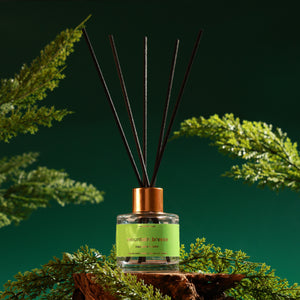
 Vaayu₹11,999Everywhere else, some of what you release leaves. Doors open, corridors carry it away, conditioned air exchanges. That loss is not waste; it is the mechanism that keeps a room at a stable level instead of an ever-rising one. A theatre is deliberately built to lose as little as possible, and it is frequently ventilated at low velocity so that the supply is inaudible. So the same machine, at the same setting, produces a materially higher concentration in a theatre than in a living demonstration of the same volume, and it holds that concentration longer. Add the fact that a small sealed room has very little air to charge in the first place and the arithmetic is unforgiving. This is not an argument against the machine. It is an argument for a much lower setting and a much shorter window in this particular room.
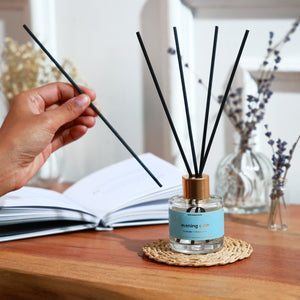
 Evening Calm₹799Fragrance in a room does not exist only in the air. Heavier materials condense onto soft surfaces and release slowly for hours, which is the same mechanism that brings cooking smells back an hour after a kitchen has been aired. A theatre is essentially a box lined with the most absorbent surfaces in the building: deep seating, carpet, curtains, acoustic panels. What that means practically is that a theatre carries a residue of every session into the next one, so the level you experience at four in the afternoon is not the level you set at ten in the morning, even if the machine has behaved perfectly. Ventilating between demonstrations clears the airborne fraction within minutes; the fabric fraction takes considerably longer and is the reason a slightly-too-high setting in this room is so much worse than a slightly-too-high setting anywhere else.
Ask before specifyingContactAn integrator who has spent a serious budget on room treatment and quiet ventilation is entitled to be sceptical about adding any powered device at all, and I think that scepticism is correct. Vaayu is stated at under 38 dB, which SOSA describes as quiet enough for a bedroom, a clinic or an office. That is a genuinely low figure for a machine of this type and it is enough for most rooms — but a reference listening room is not most rooms, and the honest instruction is to check it against the noise floor you have engineered rather than take it on faith. Where it does go in, mount it away from the seating and away from the microphone position, use the low-voltage supply at DC 12V / 1A and 5W at that exact point rather than trailing a cable, and consider running the window when the room is empty so the machine is not cycling during the demonstration at all.
Evening Calm₹799Fragrance in a room does not exist only in the air. Heavier materials condense onto soft surfaces and release slowly for hours, which is the same mechanism that brings cooking smells back an hour after a kitchen has been aired. A theatre is essentially a box lined with the most absorbent surfaces in the building: deep seating, carpet, curtains, acoustic panels. What that means practically is that a theatre carries a residue of every session into the next one, so the level you experience at four in the afternoon is not the level you set at ten in the morning, even if the machine has behaved perfectly. Ventilating between demonstrations clears the airborne fraction within minutes; the fabric fraction takes considerably longer and is the reason a slightly-too-high setting in this room is so much worse than a slightly-too-high setting anywhere else.
Ask before specifyingContactAn integrator who has spent a serious budget on room treatment and quiet ventilation is entitled to be sceptical about adding any powered device at all, and I think that scepticism is correct. Vaayu is stated at under 38 dB, which SOSA describes as quiet enough for a bedroom, a clinic or an office. That is a genuinely low figure for a machine of this type and it is enough for most rooms — but a reference listening room is not most rooms, and the honest instruction is to check it against the noise floor you have engineered rather than take it on faith. Where it does go in, mount it away from the seating and away from the microphone position, use the low-voltage supply at DC 12V / 1A and 5W at that exact point rather than trailing a cable, and consider running the window when the room is empty so the machine is not cycling during the demonstration at all.
The adaptation trap, and why this room punishes it hardest
I have written about receptor adaptation on most pages in this cluster because it explains almost every complaint we receive, but the theatre is where it does real damage. Receptors stop reporting a constant stimulus within minutes. Not hours — minutes. So the sequence in a demonstration room goes like this: somebody sets the level, waits five minutes to judge it, cannot smell very much, and raises it. They wait again, cannot smell very much, and raise it again. They have not been measuring the room; they have been measuring their own adaptation, and it moves faster than they do. A visitor who has just come in from the corridor is a completely different instrument, and they will find that room heavy the moment they open the door.
In most rooms the mistake is self-limiting, because air exchange, open doors and the passage of people flush some of it away and somebody eventually complains. A theatre has none of those correctives. The room holds what it is given, the fabric stores a fraction of it, and the only people in the building who spend long enough inside to form an opinion are the staff who set it. That combination is why I regard this room as the single sharpest test of whether a showroom’s scenting has been designed or merely installed. If the level in the theatre is the same as the level in the entrance, it has been installed.
The remedies are procedural and they cost nothing. Set the level from outside the room by walking in from the corridor, never from a seat. Have the person who sets it leave the building for a quarter of an hour first, so their nose is closer to a visitor’s than to a member of staff’s. Then key-lock the machine and give the key to somebody who is not on the floor all day, because the drift is not one dramatic decision — it is three small ones over a fortnight, each of them entirely reasonable to the person making it. Restraint here is not caution; it is the only setting that survives contact with the people who work in the room.
The conditions under which a very low setting works
If you want a defensible rule rather than an opinion, here it is as a checklist. A theatre that satisfies all five can carry a low, dry accord and be better for it. A theatre that fails two or more should be left unscented, and the specification should record that as a decision with the reason beside it.
| Condition | What it looks like when satisfied | What it looks like when it is not | If it fails |
|---|---|---|---|
| 1. Real air exchange | Mechanical ventilation or a conditioned supply that genuinely turns the room’s air over | A sealed box with a split unit recirculating the same air all day | Leave it unscented — concentration will climb through the day and nobody inside will notice |
| 2. The door is opened between sessions | Written into the demonstration routine, not left to memory | Door kept shut all day for light control | Leave it unscented, or run only a short pre-opening window |
| 3. A dry, transparent accord | The same clean woody-fresh composition as the rest of the circuit | Anything gourmand, vanillic, ambered or richly floral | Change the accord before you change the setting |
| 4. Scheduled before the session, not during it | A 1h window ahead of opening, then nothing while people are seated | An 8h window running through every demonstration | Fix the schedule — run time is the strongest control in a low-exchange room |
| 5. Set from the doorway and key-locked | Level judged by somebody entering from outside, then locked, key held off the floor | Level judged from a seat by whoever is in the room | Assume the setting is already too high, and start again from the lowest step |
Vaayu · waterless, under 38 dB₹11,999See specification → Dry, never sweet₹1,799Shop → 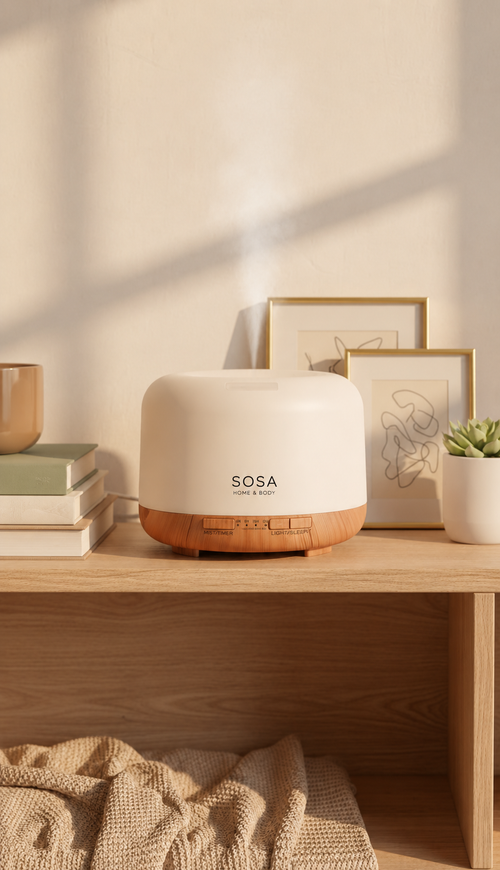 Or the honest answer: noneAsk usContact →
If you do scent it: the register, the level and the schedule
Assume the room passes the test. What goes in it should be the same accord running everywhere else on the circuit — dry, woody-fresh, transparent — because a visitor walking a circuit accumulates what they pass through and a second composition here would meet the first in the doorway and read as a mixture. What must not go in it is anything sweet. Warm gourmand and rich floral materials are heavy, they cling to fabric, and in a small sealed volume they cross from pleasant to cloying faster than anything else in perfumery. The word people reach for — cloying — almost always describes a dose rather than a composition, and this room reaches that dose sooner than any other.
On level, take whatever you have set in the main living volume and go well below it. I will not publish a number, because the correct absolute setting depends on the connected volume, the ceiling height, the ventilation and the hours the room is occupied, and a number here would be a number invented here. What I will give you is a relationship: this should be the lowest running zone in the building, lower even than the bedroom demonstration, because the bedroom at least has a door that opens onto a scented corridor while the theatre is closed on purpose. If the theatre and the living volume are set to anything like the same intensity, the theatre is wrong.
On schedule, use the run windows the way they were designed. A 1h window before opening charges the room; the machine then stops, auto-stop confirms it, and the fabric holds enough of a trace to make the room feel considered for the rest of the morning. Deselect closed days entirely rather than fragrancing an empty building, and remember that a 400ml tank runs up to about 90+ days depending on intensity and hours — a theatre on a short daily window will be at the long end of that, which is a small but real operational benefit. And if the room is used for evening demonstrations only, do not chase that with a complicated schedule; set the ordinary week and have somebody start a window manually before the appointment, which takes a few seconds standing next to the unit.
What I would specify for a theatre — and the honest gap
The decisions in order, with the last row stating what no product on our shelf can do about this room. A specifier who is told the limitation at drawing stage designs around it comfortably; one who discovers it during a client demonstration does not forget.
| Decision | What to specify | Why | Reference |
|---|---|---|---|
| 1. Whether to scent it at all | Default no; yes only where all five conditions above are satisfied, recorded in writing either way | So that an unscented theatre reads as a decision rather than an oversight in year two | The theatre test |
| 2. Mechanism | Waterless cold-air only — no water, no added humidity, no residue near projectors, amplifiers, screens or acoustic fabric | An ultrasonic machine throws a wet mist and can leave a fine mineral deposit; it does not belong in a reference room | Vaayu ₹11,999, sealed residue-free tank |
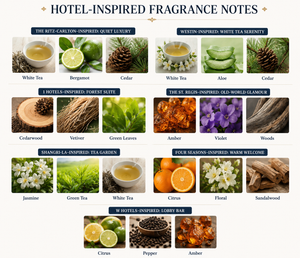
| 3. Accord | The circuit’s own dry woody-fresh composition; nothing gourmand, vanillic, ambered or richly floral | Heavy materials cling to fabric and cross into cloying within minutes in a sealed volume | Cold-air oils, 300ml ₹1,799 |
| 4. Level | The lowest running zone in the building, set by somebody walking in from the corridor, then key-locked | Staff adapt in minutes; in a low-exchange room the resulting drift accumulates instead of clearing | Adjustable intensity, key-lock |
| 5. Schedule | A 1h window before opening rather than an 8h window through the day; closed days deselected | Run time is a stronger control than intensity in a room that does not exchange air | 1h / 4h / 8h / 24h, auto-stop |
| 6. Acoustic and position | Under 38 dB checked against the engineered noise floor; mounted away from seating and the measurement position, with the low-voltage point there | In a reference room an audible device is a defect, not a detail | Under 38 dB · DC 12V / 1A, 5W |
| No sensor, no trigger: the honest gap | The machine cannot be told that a demonstration has started or that the room is occupied. It holds its own Bluetooth schedule and runs alongside the automation rather than inside it, so a theatre that would ideally scent only when someone is about to enter has to be handled with a manual window or a fixed one | Say it to the client before commissioning; in this room the limitation genuinely shapes the design and it deserves to be on the table early | Ask us first |
Versailles
This is the page in the cluster where I most expect to lose a sale, and I would rather lose it here than anywhere. A theatre is the room a showroom is proudest of, and it is the room where a fragrance mistake is most visible to exactly the client you most want to impress. They sit down. They stay for twenty minutes. If the level is wrong they will not say anything, and you will never find out why the conversation cooled.
What I find persuasive about leaving it alone is that the room does not need help. It has darkness, silence, a very good picture and a considered piece of engineering to demonstrate. Fragrance earns its place in spaces where somebody crosses a threshold and the air changes, and this room deliberately removes the threshold moment by seating everyone. Adding scent to it is solving a problem the room does not have, using the one variable that accumulates when nobody is watching.
Where a client insists, I ask for two things and I ask for them in writing. The accord stays dry, and the window runs before the session rather than through it. Get those two right and a theatre can carry a very quiet trace that reads as a well-kept building. Get them wrong and you have built a beautiful sealed box and filled it with somebody’s idea of luxury. Everything is composed in Pune, and a portion of every order funds a girl’s classroom through Nanhi Kali.
Frequently asked questions
- Scenting a multi-room demonstration suite — closed doors make separate zones.
- The living-room demonstration zone — the largest volume, and a dry register.
- The bedroom experience zone — softest accord, lowest dose, smaller machine.
- The smart-kitchen display — a clean-air room pretending to cook.
- A different fragrance in every room? — why a circuit accumulates.
- One signature scent or multiple zones — the decision page.
- The arrival fragrance — threshold and the un-adapted nose.
- Fragrance inside a demonstration — what can honestly be shown.
- Light, sound, climate and fragrance together — run as a timetable.
- Brand: the SOSA founder story.
SOSA Vaayu — facts verified August 2026: ₹11,999. Waterless cold-air nebulising diffuser; pressurised air shatters undiluted oil into a dry nano-mist, with no water, no dilution, no added humidity and no residue. Coverage up to 1000 m³, approximately 2,000–3,000 sq ft at standard ceiling height, read as connected volume rather than floor area. Control: Bluetooth app plus onboard buttons, run windows of 1h / 4h / 8h / 24h, day selection, adjustable mist intensity, auto-stop and key-lock; each unit holds one schedule and one intensity, stored in that unit. SOSA publishes no Wi-Fi, Alexa, Google Assistant, Matter, Zigbee, Z-Wave, KNX, Crestron, Control4, RS-232, dry-contact or API integration of any kind; Vaayu units cannot be grouped, zoned, addressed, triggered by occupancy or a scene, or monitored by any home-automation control system, voice assistant, hub or sensor, and there is no central app across units. Mounting: freestanding, wall-mounted or into an HVAC return — a mechanical integration, not a digital one. Power DC 12V / 1A, 5W at the mounting position. Under 38 dB, which SOSA states is quiet enough for a bedroom, clinic or office. 400ml sealed, residue-free, refillable tank lasting up to about 90+ days depending on intensity and scheduled hours; SOSA publishes no millilitres-per-hour consumption rate and none is estimated here. CE, RoHS and SGS certified. Black and white finishes. Oils must be alcohol-free, water-free fragrance oils formulated for cold-air diffusion, such as the SOSA Hotel Collection (100ml ₹999 · 300ml ₹1,799 · pack of seven ₹1,799); thick undiluted essential oils are not recommended as they clog the fine nozzle. Other SOSA machines: Sukoon ₹1,899 ultrasonic (500ml, 270–320 sq ft, 16–18h on low, three 15ml scents included), Boond ₹899 (up to about 150 sq ft), Megh ₹3,499 (six-litre tank, about 100 hours runtime, only about 215 sq ft — a runtime and humidity machine, never a coverage upgrade over Sukoon), Aangan ₹25,999 (~8,000–10,000 sq ft), Meenar ₹38,500 (12,000–18,000 sq ft). Ultrasonic machines dilute oil in water, add humidity and can leave a fine white mineral deposit, and are not recommended in a reference listening room. SOSA reed diffusers named here as register references are alcohol-free, phthalate-free, paraben-free, IFRA-compliant and 0 ppm formaldehyde, with six fibre reeds in a refillable glass bottle, composed in Pune; reed oil and cold-air oil are separate systems and are not interchangeable. A scent machine adds fragrance; it does not clean, purify or deodorise air, and SOSA makes no health or air-quality claim. SOSA publishes no dealer programme, reseller margin, trade price, territory, minimum order, lead time, installation charge or maintenance contract; commercial enquiries are welcome at https://sosahomeandbody.com/pages/contact. Free shipping above ₹499. A portion of every order supports girl-child education through Nanhi Kali. SOSA is an independent Indian fragrance house; the Hotel Collection scents are SOSA’s own interpretations inspired by the world’s finest hotels, and SOSA is not affiliated with or endorsed by any hotel brand or any home-automation manufacturer. Prices subject to change — see the live product pages.