
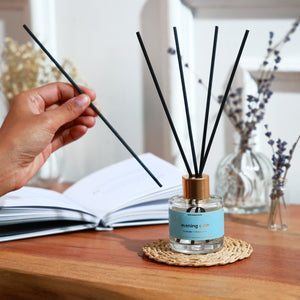
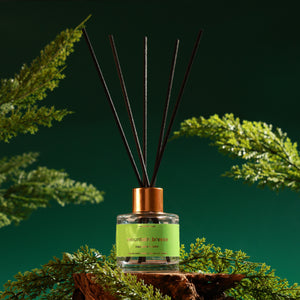
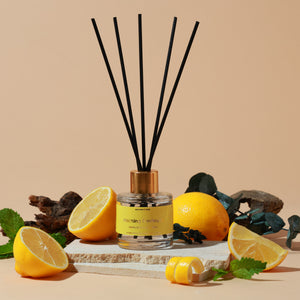

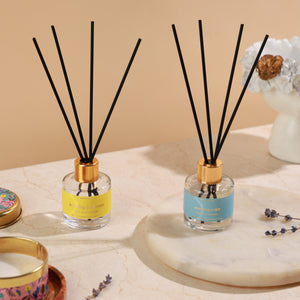
What to send: Evening Calm ₹799 for a household you do not know well; Mountain Breeze ₹849 for someone hard to buy for; Morning Freshness ₹749 when you are buying several at once.
The duplication problem: dry fruits are one of the two default Diwali gifts, which means the same category arrives through the same door several times in the same week from different senders. The fifth box is worth very little to the household and everybody knows it.
The honest gap: dry fruits are the better gift where you are one of few givers and the family cooks with them, where a food gift is the expected form — domestic staff, workers, elders — and in any household that is fragrance-averse, where a diffuser is simply the wrong object.
2. Duration is measured differently on each side. A tray of dry fruits is decanted, distributed and finished — or, more often than anyone admits, sits sealed in a cupboard until somebody re-gifts it. A 50ml reed at ₹749–₹849 runs 6–8 weeks and a 130ml at ₹1,249–₹1,349 runs 14–18. The gift you sent is still doing something in December.
3. Dietary exposure is a real risk and it is almost never disclosed to a gift-giver. Nut allergy, diabetes, a household member on a restricted diet, a small child, a family currently fasting — none of that is information you have, and all of it makes a food gift either useless or unusable. A reed diffuser is eaten by nobody and excludes nobody.
4. Effort is a hidden cost of the box. Dry fruits arrive in packaging that has to be opened, sorted, decanted into jars and given cupboard space, and the packaging then has to be disposed of during the week when the house is fullest. Six fibre reeds go into a bottle once and the recipient is finished.
5. Send dry fruits anyway when you are one of few givers, or when food is the expected form. A household receiving two gifts is not duplicating anything. A family that cooks with almonds and cashews weekly will use them properly. And for domestic staff, for workers, and in families whose gifting grammar is edible, a food gift is the correct courtesy and a diffuser is a substitution nobody asked for.
Alcohol-free, phthalate-free, IFRA-compliant, composed in Pune. Free shipping above ₹499, and a portion of every order supports girl-child education through Nanhi Kali.
Duplication, duration, diet and effort — the four axes
I have deliberately not compared these two gifts on price, and I will not, because a category argument settled on price is settled badly and because the price of a tray of dry fruits tells you nothing about what happens to it after it is handed over. The four things that actually determine whether a Diwali gift succeeds are how often it arrives, how long it lasts, who in the household is able to use it, and how much work it makes for them. Dry fruits and a reed diffuser sit at opposite ends of three of those four, and it is worth being precise about each.
 Morning Freshness₹749The single most useful thing to understand about Diwali gifting is that your gift is not evaluated on its own merits but against everything else that came through the same door in the same week. Dry fruits are one of the two categories that everybody defaults to, which means that in a household with a reasonable circle — extended family, neighbours, two workplaces, a couple of long-standing friendships — the same category arrives repeatedly from people who each believed they were making a considerate choice. Nobody is wrong individually. Collectively the outcome is a cupboard the family has to manage. A reed diffuser is essentially never the second one to arrive.
 Mountain Breeze₹849A box of dry fruits does not arrive finished. Somebody has to open it, sort it, decant it into airtight jars so that it does not go stale or attract insects, find cupboard space that is already contested in the festive week, and then dispose of a large amount of packaging. None of that is difficult and all of it is work, arriving on the busiest days of the household's year, repeated once for every box that comes in. A gift that generates a task is not the same as a gift that generates pleasure, and the difference is most visible precisely when the house is fullest. A reed diffuser costs the recipient about ninety seconds, once.
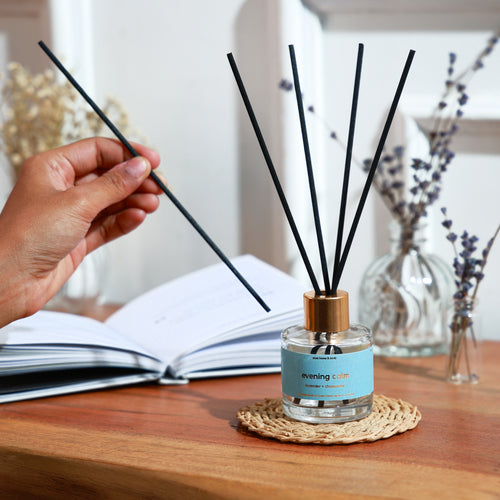
 Evening Calm₹799This is the axis people underweight most, because the relevant facts are exactly the ones a gift-giver is never told. Nut allergy in a child. A diabetic parent. Somebody in the house on a restricted diet after an illness, or fasting, or simply avoiding rich food during a week that is already full of it. None of this is disclosed, and none of it is your fault — but the result is a gift that a portion of the household cannot touch, and a family that now has to decide politely what to do with it. A home fragrance is used by the whole household without asking anyone's permission or checking anyone's chart.
Where dry fruits are genuinely the better gift
I would be arguing dishonestly if I let the four axes above stand as the whole picture, because there are households where a tray of dry fruits is not merely acceptable but correct, and the reed diffuser is the wrong object. The first is where you are one of only a few givers. Every argument on this page rests on abundance — on several gifts arriving at one door in one week. A household that receives two or three gifts is not duplicating anything, and in that setting a good box of dry fruits is a generous, useful, immediately shareable thing that the whole family enjoys the same evening. Duplication is a property of the recipient's circle, not of the gift.
The second is a kitchen that actually cooks with them. Some households genuinely go through almonds, cashews and pistachios weekly — in cooking, in milk, in the children's tiffin — and for those families a good box is not a decorative object but a restocking of something they buy anyway. That is a real and unglamorous form of usefulness, and a diffuser cannot match it. If you know the kitchen, you know whether this applies.
The third is where a food gift is the expected form. For domestic staff, for the people who work in and around the building, and in a great many families where the elders' gifting grammar is edible, the food gift is the courtesy itself. Sending a home fragrance into that relationship instead is not more thoughtful; it substitutes an object of your taste for a gesture that already had a settled meaning. And the fourth is the fragrance-averse household — someone migraine-prone, someone asthmatic, someone who simply does not want the air to smell of anything. There the dry fruits win outright, and I would rather you sent them than sent a bottle of something I composed to a house where it will sit unopened.
Reed diffuser against dry fruits, row by row
Scored on the axes that decide a Diwali gift, with no price quoted for the alternative — because the interesting differences here are not financial and pretending otherwise would make this a worse guide. Dry fruits take three rows outright and share a fourth, which is why the verdict at the bottom of this page is conditional rather than absolute.
| Axis | Reed diffuser | Dry fruits | Winner |
|---|---|---|---|
| Duplication in a full festive week | Very low — rarely arrives twice | Very high — one of the two defaults | Reed |
| How long it lasts | 6–8 weeks on 50ml · 14–18 weeks on 130ml | Days to weeks, if decanted and stored properly | Reed |
| Dietary exposure | None — nothing is eaten | Nuts, sugar; excludes allergy, diabetes, restricted diets | Reed |
| Effort asked of the recipient | Six reeds into a bottle, once | Open, sort, decant, store, dispose of packaging | Reed |
| Enjoyed by the whole household at once | Whoever is in that room | Everyone, the same evening | Dry fruits |
| Taste risk | Real — a fragrance can be wrong for a person | None to speak of | Dry fruits |
| Correct for staff, workers and elders' custom | Reads as a substitution where food is expected | The expected and settled form of the courtesy | Dry fruits |
| Works in a fragrance-averse home | No — this is the one house we do not belong in | Yes | Dry fruits |
| Still present in December | Yes, on 50ml and certainly on 130ml | Rarely | Reed |
Safest · Evening Calm₹799Shop → 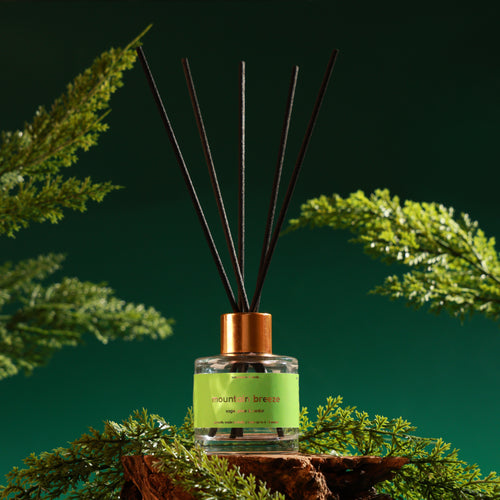 Difficult recipient · Mountain Breeze₹849Shop →
 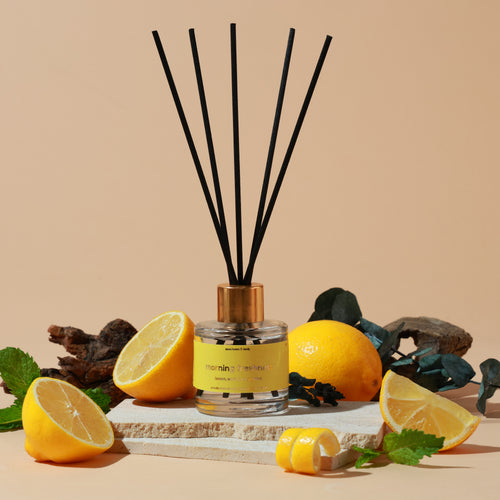 Several at once · Morning Freshness₹749Shop →
Which reed to send, and in what size
If the verdict has landed, the remaining decision is about polarisation rather than beauty, because a gift is judged on how unlikely it is to be wrong. Evening Calm at ₹799 is the safest send — Kashmir lavender, chamomile and a soft musk drydown, 8.9 on our strength scale and the gentlest thing we make. Lavender is also the register that arrives in an Indian home unattached: rose, jasmine, coffee and pine all carry associations before the bottle is opened, and lavender does not. Mountain Breeze at ₹849 is the answer for the person nobody can buy for, and Morning Freshness at ₹749 is the one to use when you are buying the same gift for several households, because bright citrus is the lowest-polarisation register in the line.
Two I would not send blind. Garden Bloom at ₹799 is our most-gifted floral, but anti-floral is a common and firmly held position — send it when you know, not when you hope. Fresh Brew at ₹849 is the deepest scent in the range at 9.5, superb for a coffee drinker and the least safe guess for anyone else.
On size and on the money: the 50ml suits any room up to about 150 sq ft and runs 6–8 weeks; the 130ml at ₹1,249–₹1,349 suits a living room or kitchen and runs 14–18 weeks, which makes it the better choice when the gift is addressed to a household rather than a person. For a couple, a duo at ₹1,498 is two 50ml bottles and hedges two sets of taste. And if your figure is below ₹749 there is no reed to buy at all — a ₹379 jar candle or a ₹449 Sandalwood is the honest answer, with the note that a single ₹379 candle does not clear the ₹499 free-shipping line while a ₹749 reed does.
What to send instead, in buying order
The recommendation in the order I would work through it, with the last row kept for the households where the box of dry fruits is the right gift and this page's verdict does not apply.
| Send | What it is | When it is the right answer | Price |
|---|---|---|---|
| 1. Evening Calm 50ml ★ | Kashmir lavender and chamomile, 8.9 — the softest in the range | The default. Any household whose tastes you do not know | ₹799 |
| 2. Mountain Breeze 50ml | Himalayan pine, sage, Indian cedar — 9.4, dry and unsweet | The recipient everybody finds impossible; a study; a shared room | ₹849 |
| 3. Morning Freshness 50ml | Malabar lemon, peppermint, eucalyptus — the cheapest reed | Several households at once, where low polarisation matters | ₹749 |
| 4. Evening Calm 130ml | The same scent, 14–18 weeks instead of 6–8 | A gift addressed to a household rather than a person | ₹1,299 |
| 5. Day & Night duo | Two 50ml bottles — two bottles, not a boxed set | A couple, or a household with two different tastes in it | ₹1,498 |
| The honest gap: send the dry fruits | Where you are one of only a few givers, where the kitchen genuinely cooks with them, where food is the expected form of the courtesy — staff, workers, elders — and in any fragrance-averse household, dry fruits are the better gift and a diffuser is the wrong object | Said plainly, because duplication is a property of their circle, not of the box | — |
Versailles
I grew up in a house where the dry fruit boxes were stacked in the corner of the dining room by the third day, and where my mother kept a running mental list of which ones could be sent onward and to whom. Nobody was ungrateful. It was simply arithmetic: five households had solved the same problem in the same way, and one family could not use five of anything.
That is the whole of my argument, and it is not an argument against dry fruits. It is an argument about abundance. In a week when the same two categories arrive over and over, the value of a gift depends far more on how rare it is at that particular door than on how good it is in itself. A reed diffuser is rare at that door. It also happens to exclude nobody, which matters more than people expect in a household with a diabetic grandparent or a child with a nut allergy.
Where I would send the box without hesitating: to the people who work in and around our building, where a food gift is the expected and correct form; and to any home where somebody does not want the air to smell of anything. Everything we make is composed in Pune, alcohol-free, phthalate- and paraben-free, IFRA-compliant and tested at 0 ppm formaldehyde. A portion of every order funds a girl's classroom through Nanhi Kali.
Frequently asked questions
- Are reed diffusers good Diwali gifts? — the definitive yes, and the four households where it is no.
- Versus a candle — an event against an ambience, and we make both.
- Versus a chocolate hamper and versus home decor.
- The safest fragrance to gift — why lavender and not rose.
- How many to order and the best SOSA gift under ₹1,000.
- Buying in quantity and the complete Diwali 2026 buying guide.
- Brand: the SOSA founder story.
SOSA reed diffusers — facts verified August 2026: Five scents, all alcohol-free, on a heat-stable CCT (caprylic/capric triglyceride) base, phthalate-free, paraben-free, IFRA-compliant, 0 ppm formaldehyde, six fibre reeds in a refillable glass bottle, composed in Pune, India. Morning Freshness 50ml ₹749 · 130ml ₹1,249 · 9.0. Evening Calm 50ml ₹799 · 130ml ₹1,299 · 8.9, the softest in the range. Garden Bloom 50ml ₹799 · 130ml ₹1,299 · 8.9. Mountain Breeze 50ml ₹849 · 130ml ₹1,349 · 9.4. Fresh Brew 50ml ₹849 · 130ml ₹1,349 · 9.5, the deepest in the range. Longevity 6–8 weeks on 50ml, 14–18 weeks on 130ml. Duos of two 50ml bottles: Day & Night ₹1,498, Fresh & Grounded ₹1,548, Warmth & Bloom ₹1,598. Climate-tested through 45°C heat and 85% RH monsoon humidity. The cheapest SOSA reed diffuser is ₹749 and the cheapest machine is ₹899. SOSA does not sell a gift set, gift box, gift hamper, gift card, gift wrap or personalisation, and does not sell a room spray — every SOSA spray is a car perfume. The reed line contains no oud, sandalwood, vetiver or amber, although the Smoked Oudh and Sandalwood jar candles at ₹449 do exist. Jar candles ₹379 single and ₹664 two-pack. Free shipping above ₹499. A portion of every order supports girl-child education through Nanhi Kali. SOSA is an independent Indian fragrance house and is not affiliated with or endorsed by any hotel brand. Prices subject to change — see the live product pages.