


My Room Spray Smells Strong When I Arrive but Fades Before the Buyer Does — What Should I Use?

My Room Spray Smells Strong When I Arrive but Fades Before the Buyer Does — What Should I Use?

★ You are spraying before every viewing · here is what a spray can and cannot doVaayu ₹11,999 · Aangan ₹25,999 · Sukoon ₹1,899 · free shipping above ₹499A portion funds girl-child education
★ SOSA · property viewings & premium presentation
A spray peaks in a minute and is gone in thirty. A reed takes two days to arrive. Neither is built for a scheduled appointment in a large empty flat
★ ★ ★ ★ ★
★★★★★
"Sprayed before every viewing for three years. Strong at the door, gone by the time we reached the bedrooms. That gap was the whole problem and I had never named it."
Kunal Marwah Premium resale, Mumbai
Spray → machine
★★★★★
"Reeds in a 3,000 sq ft flat did nothing and I assumed they were bad reeds. They were the wrong format for the volume."
Sarita Pillai Large apartments, Chennai
Format, not quality
★★★★★
"Asked for a SOSA room spray and was told they do not make one for the home, and why. I respected that more than a sale."
Vivek Sharma Luxury broker, Delhi
Told plainly
★★★★★
"Back-to-back viewings on a Saturday. The machine holds a level for six hours; a spray needed redoing between each one."
Ishita Chaudhary Weekend viewings, Gurgaon
Six viewings, one setting
★★★★★
"Waterless was the deciding factor. No tank to empty, nothing to spill in somebody else's flat, no residue on stone."
Prakash Nambiar Marble interiors, Kochi
Nothing to spill
★★★★★
"I still keep reeds in the two listings that are shown constantly. Different job, and that was explained rather than upsold."
Rhea Kapadia Long-running listings, Pune
Reeds still have a role
★★★★★
"Sprayed before every viewing for three years. Strong at the door, gone by the time we reached the bedrooms. That gap was the whole problem and I had never named it."
Kunal Marwah Premium resale, Mumbai
Spray → machine
★★★★★
"Reeds in a 3,000 sq ft flat did nothing and I assumed they were bad reeds. They were the wrong format for the volume."
Sarita Pillai Large apartments, Chennai
Format, not quality
★★★★★
"Asked for a SOSA room spray and was told they do not make one for the home, and why. I respected that more than a sale."
Vivek Sharma Luxury broker, Delhi
Told plainly
★★★★★
"Back-to-back viewings on a Saturday. The machine holds a level for six hours; a spray needed redoing between each one."
Ishita Chaudhary Weekend viewings, Gurgaon
Six viewings, one setting
★★★★★
"Waterless was the deciding factor. No tank to empty, nothing to spill in somebody else's flat, no residue on stone."
Prakash Nambiar Marble interiors, Kochi
Nothing to spill
★★★★★
"I still keep reeds in the two listings that are shown constantly. Different job, and that was explained rather than upsold."
Rhea Kapadia Long-running listings, Pune
Reeds still have a role
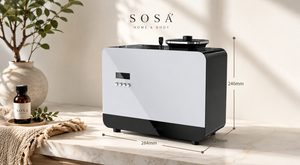
Vaayu: waterless cold-air nebulisation · no water, no heat, no dampness · under 38 dB 1000 m³ (≈2,000–3,000 sq ft) · 400ml tank ≈75 days · app + 1h/4h/8h/24h timers · key-lock 0.9 kg and smaller than a shoebox — one machine can serve a whole portfolio of listings


Founder Diaries · Property Viewings · Sprays, Reeds & Professional Machines
By Sonal Sahani · ISIPCA Versailles 11 min read Updated September 2026
Of all the ways this problem gets described to me, yours is the most accurate, and I want to start by saying so. Strong on arrival and gone before the buyer is the exact behaviour of a single dose of a conventionally composed fragrance, and you have identified it by observation rather than by being told, which means the rest of this page is confirmation rather than instruction. What you are smelling when you walk back in is not the whole fragrance at full strength. It is the lightest third of it, at the highest concentration it will ever reach, doing the job it was designed to do — and the reason it disappears is the same reason it was impressive in the first place.
Quick answers — read this first
What the strong smell is: the top notes at peak concentration. Top notes are, by definition, the most volatile materials in the composition — chosen precisely because they announce themselves immediately, which is the same property that makes them leave first.

What is left after twenty minutes: a small residue of heavier material and fixatives. In an inexpensive composition that residue is often the least attractive part of it, which is why the fade can smell duller than the arrival rather than simply quieter.

So it is not a bad spray: it is what a single dose does. No dose of any size changes the shape of that curve.

The fix: a source that replaces what leaves, at a rate you set — the Vaayu at ₹11,999 on low, with the 4h timer covering a viewing and a buffer either side.
The short answer
Short answer: because the strong arrival smell is the top note at peak concentration, and top notes are the most volatile materials in perfumery by definition. They are chosen for immediate impact and they are the first to leave, so twenty minutes later you have the heavier residue rather than the composition. A single dose cannot avoid that shape. A continuous source can, because it keeps replacing what has gone.
The pick: the Vaayu at ₹11,999 on the low setting — waterless cold-air nebulisation of undiluted oil, up to 1000 m³, reaching a working level within minutes and a settled viewing level well inside two hours, with the 4h timer covering an appointment plus a buffer; running a quiet register such as the Ritz-Carlton-inspired direction of white tea, bergamot and cedar.
Shop: the Vaayu at ₹11,999 — 400ml tank lasting about 75 days, Bluetooth app plus onboard buttons, 1h/4h/8h/24h timers, adjustable intensity, under 38 dB, auto-stop, key-lock, 0.9 kg, four hotel-inspired scents supplied. The Sukoon is ₹1,899 for a single occupied room. SOSA does not make a room spray for the home. Free shipping above ₹499.
Straight answer
My room spray smells strong when I arrive but fades before the buyer does — what should I use instead?
1. First, you are not imagining it and you have described it correctly. The strong smell at the moment of spraying and the near-absence twenty minutes later are the same event seen at two points on one curve. Nothing has gone wrong with the product and you have not become nose-blind in the space of half an hour.

2. What you smell on arrival is the top note at peak concentration. A fragrance is built in layers ordered by volatility, and the top is made of the lightest, fastest-evaporating materials there are — citrus, light green and aromatic notes, plus whatever carrier the spray uses. They are selected precisely because they announce themselves in the first seconds.

3. The property that makes them impressive is the property that makes them leave. High volatility means a material moves into air quickly and out of the room quickly. You cannot have the immediate impact without the short life; they are the same physical fact described twice.

4. What remains after twenty minutes is a small residue of the heavy end. In a well-made composition that residue is a quiet base. In an inexpensive one it is often the least pleasant material in the bottle — the fixative and the solvent trace — which is why the fade can read as dull rather than merely faint.

5. The fix is not a stronger dose. It is a source. Something that keeps putting the whole composition into the air at a rate you choose, so what leaves is continuously replaced and the balance you smell at minute five is the balance the buyer meets at minute ninety.

6. In practice: the Vaayu at ₹11,999 on low, started two hours before. It reaches a working level within minutes and a settled viewing level well inside two hours, and the 4h timer covers the appointment with a buffer at both ends. SOSA does not make a room spray for the home, so this is not a swap I am offering you at the same price.

A portion of every order supports girl-child education through Nanhi Kali.
TL;DR: the strong smell on arrival is the top note at peak concentration, and top notes are the most volatile materials in a composition by definition — chosen for immediate impact, which is the same property that makes them leave first. What is left after twenty minutes is the heavy residue. The fix is a source rather than a dose: the Vaayu at ₹11,999 on low, on the 4h timer, from two hours before.
SOSA Vaayu · continuous cold-air nebulisation
Why the top of the composition is still there at minute ninety
SOSA Vaayu · continuous cold-air nebulisation ₹11,999
A dose loses its lightest materials first and cannot replace them. A running source replaces them continuously, which is why a nebulised composition reads the same at minute five and at minute ninety instead of collapsing towards its heaviest residue. Undiluted oil, atomised cold, no water and no heat to distort the balance the fragrance was composed at. On low it reaches a working level within minutes and a stated viewing level well inside two hours; the 4h timer covers an appointment and a buffer either side. Under 38 dB, auto-stop, key-lock, 0.9 kg, four hotel-inspired scents supplied.

Why the best part leaves first

Perfumery organises a composition by volatility, and once you know that, your complaint stops being a mystery and becomes a specification. The top notes are the most volatile materials in the formula, the heart is the middle band, and the base is made of the heaviest and slowest materials, which are the ones still present hours later. That ordering is not a stylistic convention. It is a physical fact about how quickly different molecules leave a surface and enter air, and every perfumer works with it because nobody can work against it. What it means for a spray is simple and unavoidable: the part that gives a room its immediate impact is the part with the shortest life in that room, and the two cannot be separated.

1
THE TOP NOTE
Chosen for the first ten seconds, and physically incapable of lasting longer
Start with what is actually in the burst. The materials that make a spray impressive on application are the lightest in the palette — citrus oils, light green and aromatic notes, bright fresh accords — and they are chosen for exactly one property, which is that they move into air faster than anything else in the bottle. That is what makes a hall smell transformed three seconds after you press the nozzle. It is also, unavoidably, what empties them out of the hall first. A material that evaporates readily from the surface of an aerosol droplet also disperses readily through a large volume and leaves readily through the gap under a door. There is no version of that material which arrives fast and stays; the arriving and the leaving are the same behaviour observed at two moments. So the sensation you have described — impressive at the door, thin at the second bedroom — is the composition performing exactly as it was designed to perform, at a scale it was not designed for. In a car, or in a bathroom you are standing in, the whole life of the top note happens while you are there and the product is judged a success. In a 900 cubic metre apartment with a viewing forty minutes away, the same performance happens entirely in your absence and in the buyer's absence, which means nobody who matters ever experiences it. This is not a fault in the spray. It is the most predictable thing in perfumery, applied to a room too big and a timescale too long.
2
WHAT IS LEFT AT TWENTY MINUTES
The heavy residue, and why it can smell worse than nothing
Now the second half, which is the part that makes agents feel the product has actively let them down rather than merely faded. What remains twenty or thirty minutes after a spray is a small quantity of the heaviest material in the composition — the base, the fixatives, whatever was there to hold the structure together — sitting on cold surfaces and drifting slowly. In a well-composed fragrance that residue is a quiet, agreeable base and the room simply reads as calm. In an inexpensive one, and most room sprays are built to a price, the heavy end is frequently the least interesting part of the formula: a flat musk, a solvent trace, the woody-amber materials that are cheap by the kilogram and are there to give the composition weight rather than character. The result is a room that does not smell of nothing. It smells of the dregs, which is a worse outcome than nothing, and it is why the fade often reads as dull or faintly chemical rather than as simply quieter. Your buyer, arriving at the point on the curve, meets that residue as their first impression of the property. There is a further problem stacked on top: you are adapted and they are not. You have been in and out of the flat, your nose has discounted everything constant in it, and the thing you can still detect is the thing that has changed — which by then is the residue rather than the fragrance. You are, in effect, monitoring the wrong signal with a miscalibrated instrument.
3
THE FIX IS A SOURCE
Replacement rather than a bigger dose, at a rate you choose
Which points at the answer, and the answer is a change of category rather than a change of product. If the problem is that the light end leaves and nothing replaces it, then the solution is something that keeps replacing it — a source emitting continuously rather than a dose delivered once. That is what a nebulising machine is. The Vaayu at ₹11,999 atomises undiluted fragrance oil with cold air into a dry nano-mist and keeps doing it for as long as you leave it running, which means the top notes leaving the room are being resupplied at the same moment. The composition therefore reads as itself at minute five and at minute ninety, instead of collapsing progressively towards its heavy end. There is no water and no heat involved, which matters twice over: nothing damp is added to a closed flat, and nothing is warmed to a temperature that would distort the balance the fragrance was composed at. The practical numbers are the ones to hold on to. On low it reaches a working level within minutes and a settled viewing level well inside two hours, and it holds that level for as long as the timer runs — the 4h setting covers a viewing with a comfortable buffer either side, and the 8h covers a day of them. Coverage is up to 1000 m³, roughly 2,000–3,000 sq ft, and the 400ml tank runs about 75 days. And, to be plain about it once more: SOSA does not make a room spray for the home, so I am not offering you a better version of the thing that disappointed you. I am telling you that the format cannot do what you need and pointing at a different one.
The sentence that settles it, if you only keep one from this page: you cannot fix a fade by increasing the dose, because the fade is not caused by the dose being small. It is caused by there being no source.

What is actually in the air, at five points on the curve

One spray, one property, five moments — and what a running source is doing at each of the same moments. The point of the table is the last column, because it is the only one where the third row looks like the first. Read it as a description of materials rather than of impressions; the impressions follow from the materials rather than the other way round.

The decay curve, material by material
Why the fade smells duller rather than merely quieter
Point on the curve What you perceive Which materials are producing it From a single spray From a running source
The first thirty seconds ★ Strong, bright, transformative — the reason the method felt like it worked Top notes at peak concentration: citrus, light green and aromatic materials, plus the carrier flashing off Present in full, and assessed by you from inside the peak Present, at the level you set rather than at a peak, and unchanged for hours
Two to ten minutes Softer, rounder, still clearly there The heart of the composition, as the top thins out above it Falling steadily as air exchanges and surfaces adsorb Held, because what leaves is being replaced at the same rate
Twenty minutes Thin, and often duller than expected The base and fixatives, which in an inexpensive composition are the least attractive materials in it This is where most buyers arrive Indistinguishable from minute five
Forty minutes Traces, mostly on cold surfaces Heavy residue settled on marble, glass and stone rather than suspended in air Effectively gone in a large or empty flat Still at level, with the 4h timer barely a third through
Ninety minutes — a full viewing Nothing attributable to the fragrance Whatever the property smells of on its own The buyer's whole visit has happened past the useful part of the curve The whole viewing has taken place at one consistent level
Shop this guide
What to run instead, in three products
The SOSA principle
You cannot fix a fade by increasing the dose. The fade is not caused by the dose being smallit is caused by there being no source.
Top notes are chosen because they arrive first, and they leave first for exactly the same reason. The only way to keep them in a room is to keep making them.

Low, two hours ahead, and the 4h timer

Start with the setting, because moving to a machine tempts people into the same error at higher cost. Run it low. A source does not need to be strong, it needs to be continuous, and those are entirely different requirements. The instinct built by years of spraying is to aim for the impressive arrival, and that instinct is the one thing worth unlearning here: with a dose, the peak was the only opportunity you had, so it made sense to make it big. With a source, the level is available for the whole appointment, so the correct level is the low one — the one a buyer registers as the property being pleasant rather than as a fragrance being present. On the Vaayu that means low intensity, started two hours ahead, on the 4h timer for a single appointment. The machine reaches a working level within minutes and a settled viewing level well inside those two hours; the reason for the lead time is not that it is slow but that you want the buyer to meet a level rather than a climb, and you want a thirty-minute window to check it before they arrive. Check it from the corridor, not from the kitchen — walk out of the front door, wait two minutes, walk back in as a stranger, and adjust down if you notice the fragrance as an object. Never up. The 400ml tank runs roughly 75 days at these settings and four hotel-inspired scents come with the machine.

Then the composition, which changes when the delivery changes and almost nobody adjusts for it. A fragrance chosen to be impressive in a three-second burst is the wrong choice for a source that will run for four hours, because the qualities that make a spray memorable are precisely the ones that become tiring at a constant level. What works held steady is quiet, cool and structurally simple: the Ritz-Carlton-inspired Quiet Luxury direction of white tea, bergamot and cedar is the default for a viewing, the Westin-inspired White Tea Serenity is the lighter option for a smaller flat, and the 1 Hotels-inspired Forest Suite — cedarwood, vetiver and green leaves — is the dry one for a property that runs warm or where the kitchen has no door. Avoid anything heavily floral and anything a buyer might recognise as a perfume they know, because a fragrance somebody can name stops being the property and starts being a person. The Hotel Collection bottles at ₹299 for 15ml are water-based and belong in the ultrasonic Sukoon at ₹1,899, which is the right machine for a single occupied air-conditioned room and the wrong one for a closed vacant flat, since it adds 30 to 50 ml of water an hour. The Vaayu takes its own undiluted oil.

Then the two things that come before the machine and one that comes after. Before: the property has to be sound and it has to be aired. Twenty-four hours ahead, open it up with two openings on opposite walls and run water down every drain trap in the building, because a dry trap is an open pipe to a sewer and it is the most common cause of a smell that agents spray at repeatedly and never fix. If the property has damp, a leak, smoke damage or anything with a structural cause, that is a material fact about the property and no source of any kind is the answer: find it, fix it or disclose it, and scent only a listing that is genuinely sound. This is not a footnote on this page. It is the reason I am comfortable writing the rest of it. After: stop monitoring the room with your own nose. The reason your spray habit escalated over time is that adaptation always pushes in one direction, and a machine makes that worse rather than better because there is no burst to remind you the level exists. Set it once, use the timer, and take your reading from outside the front door or from an honest colleague. And the principle underneath the whole cluster: the buyer should walk out able to describe the property in detail and unable to describe the smell. A fade is a failure of duration; a fragrance somebody remembers instead of the flat is a failure of judgement, and the second is harder to undo.

The arriving and the leaving are the same behaviour seen at two moments. A top note that lasts would not have impressed you at the door in the first place.
— Sonal Sahani, SOSA

The SOSA edit

In buying order for an agent whose spray fades before the buyer arrives. The list is short because the diagnosis is precise, and the last row is the product we do not make — printed here so that nothing above reads as a manufacturer running down a rival format it also sells.

The SOSA edit
From a fading dose to a held level, in buying order
Buy What it is When it earns its place Price
1. SOSA Vaayu Waterless cold-air nebulisation of undiluted oil, up to 1000 m³, adjustable intensity, 1h/4h/8h/24h timers, 400ml for about 75 days, key-lock, 0.9 kg First. On low, two hours before, on the 4h timer, and then not touched again ₹11,999
2. A quiet viewing register White tea, bergamot and cedar; or cedarwood, vetiver and green leaves for a warm property. Four hotel-inspired scents ship with the Vaayu Immediately. A composition built for a three-second burst is the wrong one to hold steady for four hours included / ₹299
3. SOSA Sukoon 500ml ultrasonic for 270–320 sq ft, 16–18 hours on low, steady/2H/4H timers, three 15ml Hotel Collection scents included One occupied, air-conditioned room. It adds 30–50 ml of water an hour, so not a closed vacant flat ₹1,899
4. Reed diffusers Unpowered, silent, months per bottle, 24 to 72 hours to reach working level Bathrooms and halls, and the listing you show at four hours' notice. Not for tomorrow morning from ₹749
5. SOSA Aangan Up to 3,000 m³, 800ml, HVAC-connected or standalone, under 42 dB Only past 1000 m³ — a sales gallery or a clubhouse rather than an apartment ₹25,999
Not made by SOSA: a room spray for the home The sprays in the range are car perfumes, where a single dose in a sealed cabin is the correct format Stated plainly, because a diagnosis of a fading spray is worth less coming from somebody selling a spray
Honest notes for buyers: fragrance is the last step in preparing a property, never the first, and it must never be used to cover a defect. Damp, a leak, drains, smoke or anything structural is a material fact about a property: find it, fix it or disclose it. Scent a listing that is genuinely sound. On the machines: the Vaayu at ₹11,999 is waterless cold-air nebulisation — no water, no heat and no dampness — covering up to 1000m³ or roughly 2,000–3,000 sq ft, with a 400ml tank lasting about 75 days, Bluetooth app control, 1h/4h/8h/24h timers, under-38dB running, auto-stop and a key-lock, at 0.9 kg and smaller than a shoebox, so one machine can serve a whole portfolio. The Aangan at ₹25,999 covers up to 3,000m³ for sales galleries and clubhouses. The ultrasonic Sukoon, Boond and Megh are water-based and add 30–50 ml of water an hour to the air, which makes them the wrong choice for a closed or humid vacant property. A reed diffuser needs 24–72 hours to establish, so it suits a listing shown over months rather than a viewing tomorrow. A candle must be attended and put out, which rules it out of an unoccupied property. SOSA does not make a room spray for the home; the sprays in the range are car perfumes. The Hotel Collection scents are SOSA's own interpretations inspired by the world's finest hotels; SOSA is an independent Indian fragrance house, not affiliated with or endorsed by any hotel brand. A portion of every order supports girl-child education through Nanhi Kali.
The Ritz-Carlton-inspired · Quiet Luxury
The composition to run when nobody should notice the fragrance
The Ritz-Carlton-inspired · Quiet Luxury ₹299 / 15ml
White tea, bergamot and cedar — cool, polished and almost impossible to dislike, which is the entire brief for a property somebody else is going to buy. A viewing scent is not chosen to impress. It is chosen so that the buyer walks out able to describe the flat and unable to describe the smell. The Westin-inspired White Tea Serenity is the lighter option for a smaller flat, and the 1 Hotels-inspired Forest Suite — cedarwood, vetiver and green leaves — is the dry one for a property that runs warm. These water-based bottles are for the ultrasonic machines; the Vaayu takes its own undiluted oil.
SS
ISIPCA
Versailles
A note from Sonal

I have had this exact conversation at trade stands more times than any other, and it always begins with an apology, as though the agent thinks they have been doing something amateurish. They have not. The person describing a spray as strong on arrival and gone before the buyer has just given me a competent account of a volatility curve, which is more than most people in fragrance retail could manage. The only thing missing is the vocabulary, and the vocabulary is this: top notes are chosen because they are the fastest materials in the palette, and being fastest is a single property with two consequences, one of which you liked and one of which you did not.

What I say next is that the answer is not a more expensive spray, and that if I made one I would be saying the same thing. Nothing you can buy in a single-dose format will hold a level for ninety minutes, because a dose has no way of replacing what leaves. A machine does, and the odd part is that the correct machine setting is lower than the spray you were using, not higher. You are no longer buying a peak to hide behind. You are buying a level, and a level that is barely noticeable at minute one is exactly right at minute ninety. That inversion catches everybody who moves across, and once it has clicked, most agents never touch the intensity control again.

Everything is made and supported from Pune, and a part of every order funds girl-child education through Nanhi Kali. You get a space that smells like somewhere considered; a girl gets a classroom. That equation has always felt right to me.

Frequently asked questions

Why does my room spray smell strong and then disappear within twenty minutes?
Because what you smell on application is the top note at peak concentration, and top notes are the most volatile materials in a composition by definition. They are chosen to give a spray its immediate impact, and the same volatility that produces the impact is what empties them out of the room first.
Is it a sign that I bought a cheap room spray?
Not necessarily. Every fragrance has the same volatility ordering, so every single dose behaves this way. Price shows up in the second half of the story: in an inexpensive composition the heavy residue left after twenty minutes is often the least attractive material in the bottle, which is why the fade can read as dull rather than simply faint.
Would spraying more, or spraying closer to the viewing, fix it?
No. More raises the peak without changing the shape of the decline, and spraying as the buyer arrives puts them inside the peak, which is the most recognisable way to make a property smell as though something has just been done to it. The problem is the absence of a source, not the size of the dose.
What holds a fragrance level for a whole viewing?
A continuous source. The Vaayu at ₹11,999 nebulises undiluted oil with cold air and keeps emitting for as long as it runs, so the light materials leaving the room are replaced at the same rate. On low it reaches a working level in minutes and a settled viewing level well inside two hours.
Which timer setting should I use for a single appointment?
The 4h timer, started two hours before the buyer is due. That covers the lead time, the appointment itself and a buffer if they are late, and it stops the machine without you having to remember. For a day of back-to-back viewings, use the 8h instead.
A held level, not a bigger burst
The part that impressed you leaves firstbecause those are the same fact
The Vaayu is ₹11,999: waterless cold-air nebulisation of undiluted fragrance oil, up to 1000 m³ or roughly 2,000–3,000 sq ft, a 400ml tank lasting about 75 days, Bluetooth app with 1h/4h/8h/24h timers, adjustable intensity, under 38 dB, auto-stop, key-lock, 0.9 kg, supplied with four hotel-inspired scents. The Sukoon is ₹1,899 for one occupied room and reed diffusers start at ₹749. SOSA does not make a room spray for the home. Free shipping above ₹499, and a portion of every order supports girl-child education through Nanhi Kali.
See the Vaayu · ₹11,999 See the Hotel Collection →
Continue the read
More from SOSA
Editorial standards & sources
About this guide: Written by Sonal Sahani, ISIPCA Versailles-trained founder and perfumer at SOSA Home & Body, for realtors whose room spray is strong on arrival and gone before the buyer — why the impressive part of a spray is the top note at peak concentration, why the volatility that produces immediate impact is the same volatility that empties it from a room first, what the heavy residue left at twenty minutes actually consists of, and why the fix is a continuous source at a low setting rather than a larger dose.

Facts verified August 2026: Product facts used in this guide. SOSA Vaayu ₹11,999: waterless cold-air nebulising diffuser, atomises undiluted fragrance oil to a dry residue-free nano-mist, coverage up to 1000m³ (approximately 2,000–3,000 sq ft), 400ml refillable tank lasting up to about 75 days per fill, Bluetooth app plus onboard control, 1h/4h/8h/24h timer scheduling, adjustable intensity, under 38 dB, DC 12V/1A at 5W, 165 × 80.5 × 215 mm and 0.9 kg, freestanding or wall/HVAC mounted, auto-stop and key-lock, CE, RoHS and SGS certified, supplied with four hotel-inspired fragrances. SOSA Aangan ₹25,999: HVAC-connected or standalone commercial nebulising diffuser, coverage up to 3,000m³ (roughly 8,000–10,000 sq ft), 800ml reservoir, metal body, programmable schedules, under 42 dB. Ultrasonic machines are water-based and consume 30–50 ml of water an hour: Sukoon ₹1,899 (500ml, 270–320 sq ft, 16–18 hours on low, 3–6 drops per tank, steady/2H/4H timers, three 15ml Hotel Collection scents included), Boond ₹899 (300ml), Megh ₹3,499 (6 litres). Hotel Collection water-based fragrance 15ml ₹299, 100ml ₹999, 300ml ₹1,799, Pack of 7 at 15ml ₹1,799 against ₹2,093 bought singly; the Vaayu and Aangan take their own undiluted oil rather than these water-based bottles. Reed diffusers (separate alcohol-free line) from ₹749, requiring 24–72 hours to reach their working level. Scented candles from ₹379, scenting a room in roughly 15–20 minutes but requiring attendance. Free shipping above ₹499. Timings: a nebulising diffuser reaches a working level within minutes and a stated viewing level well inside two hours. This guide makes no claim that fragrance affects a property's price, offer level or time on market; it is presentation, in the same category as photography, styling and lighting. Fragrance must never be used to conceal a material defect. SOSA is not affiliated with or endorsed by any hotel brand. Prices subject to change — see the live product pages.
Zurück zum Blog

