



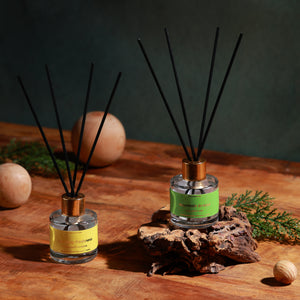

Where it does not go: the sill, the threshold, the floor beside the track, a console immediately inside the doors, or anywhere the afternoon sun lands. Those are the five most instinctive spots and all five are wrong for the same two reasons.
Why height matters here: wind speed rises with height, so a high-floor balcony door is a more aggressive exchange than the same door low down, and a floor-to-ceiling opening is an enormous aperture when it is open. Nothing about the diffuser changes; the room simply turns its air over more often.
The honest gap: no placement makes a diffuser noticeable in a room whose glazed wall stands open through every hour you are in it. Placement protects the bottle and improves the closed hours. It does not overrule the air, and anybody telling you otherwise is selling something.
2. At or slightly below nose height, and not on the floor. A diffuser works by letting the room's own gentle air movement carry what the reeds release, and it should be delivering at roughly the height of a seated or standing person. On the floor beside a glazed wall it is also in the coolest, most disturbed layer of air and in the path of every foot, every mop and every chair leg.
3. Out of the sun, always. Full-height glazing means direct light lands deep into the room at certain hours, and glass concentrates heat against the plane it occupies. Heat accelerates evaporation, so a sunlit bottle empties faster for no gain. Our reeds use a heat-stable CCT carrier rather than the industry-standard DPG, which can crack and turn bitter above about 40°C — that is why a SOSA bottle in a hot Indian room still smells like itself. It is not a licence to stand it in the light.
4. Somewhere it can stay for weeks without being moved. A diffuser that is picked up and repositioned every few days performs worse and eventually spills; the reeds want a settled position and the room wants a consistent source. Choose a surface nobody needs to clean around daily, away from the door swing or slide, and away from anything that would be damaged by an accidental drip.
5. And never on the sill or the threshold. This is the placement everybody tries first, because the sill is a shelf and it is right there. It is the single most expensive shelf in the flat: the air at that line is on its way out, and the fragrance goes with it. Move the same bottle four or five metres inward and it will read as a different product without a rupee spent. Keep it away from any open flame as well — fragrance oil is flammable, and a curtain moving in a balcony draught near a diya or an agarbatti is a hazard in its own right.
Alcohol-free, phthalate-free, paraben-free, IFRA-compliant, 0 ppm formaldehyde, six fibre reeds in a refillable glass bottle, composed in Pune. Free shipping above ₹499, and a portion of every order supports girl-child education through Nanhi Kali.
Three things a floor-to-ceiling glazed wall does to a room
The reason this page exists as a separate question from ordinary window placement is that a full-height door changes the room in ways a window does not, and two of the three are true even when it is shut. Understand the geometry and the placement decides itself; guess at it and you will end up with the bottle on the sill, which is where almost everybody starts.
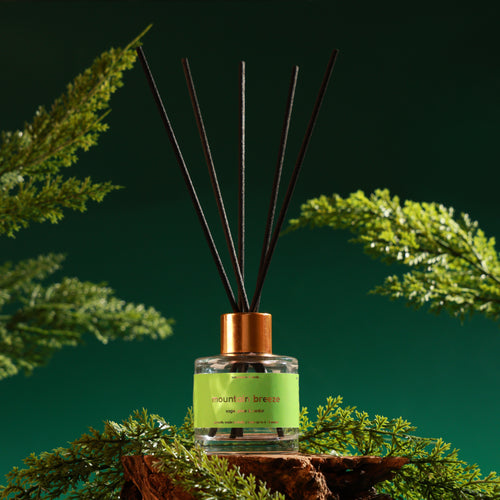
 Mountain Breeze₹849With a normal window, a certain amount of the room is sheltered simply by being below the opening or above it, and a diffuser can be tucked into that shadow. A floor-to-ceiling door offers none of that: when it slides open, the aperture runs from the floor to the ceiling and across a substantial part of one wall, so the moving air occupies the full height of that side of the room. Height compounds it, because wind speed rises the further you get from the ground — a glazed wall opened on a high floor is a far more aggressive exchange than the identical door two storeys up, and residents notice it as doors that slam and curtains that stand out horizontally. The practical consequence is simple and slightly disappointing: near the doors, there is nowhere good. What you have instead is the rest of the room, and in most flats the wall opposite the glazing is solid, which is exactly what you want.
 Morning Freshness₹749This is the half of the answer people miss, because closing the doors feels like solving the problem. A large area of glass admits a great deal of light and heat, and the air immediately against it moves on its own through the day — warmed and rising, or cooled and sinking — even with everything shut. A bottle standing in that plane sits in the fastest-changing, warmest air in the room. Heat accelerates evaporation, which is unavoidable physics: a bottle in a hot sunlit spot will empty sooner than the same bottle four metres inward, and you get nothing for the difference. What heat must not do is change the smell, and that is a formulation question rather than a placement one. Most reed diffusers sit on DPG, which can crack and turn bitter above about 40°C — an ordinary afternoon behind Indian glazing. Ours sit on a heat-stable CCT carrier and are tested at a 45°C heat soak and 85% relative humidity, so the composition stays the composition. The carrier is the part you cannot smell and the reason what you can smell survives.
 Evening Calm₹799A reed diffuser has no fan. It relies entirely on the room's own gentle circulation, which means the useful question is not only where the air is calm but where the people are. A console or sideboard on the far wall, a shelf at about chest height, or the end of a bookcase near the seating are all better than a coffee table in the middle of the floor, and far better than the floor itself. Aim for at or slightly below nose height for a seated person if the room is used for sitting, and standing height if it is a room people move through. Choose somewhere permanent, too: a bottle that is lifted and shifted during cleaning is repeatedly disturbed and eventually knocked, and reed diffusers reward being left alone. And keep it clear of anything with a flame. Fragrance oil is flammable, and in a room with a balcony draught, curtains, a diya or a lit agarbatti can move in ways nobody plans for.
The five tempting spots, and what is wrong with each
Every flat with a glazed wall offers the same handful of obvious surfaces, and they are obvious because they are convenient rather than because they work. The sill is the worst of them and the one almost everybody tries. It is a shelf, it is at the right height, and it is directly at the point where the room's air leaves — so the bottle spends its life scenting the balcony. The threshold and the floor beside the track are the same mistake at ankle level, with the additional problem that they are in the traffic path and in the way of the door. A console immediately inside the doors is better but still inside the turbulent zone; the same console moved to the opposite wall is a different placement entirely. A low coffee table in the middle of the room is neutral rather than bad, though it puts the bottle below seated nose height, in the path of the sun at some hours, and within reach of anybody putting a glass down.
The spot that works, in almost every flat of this shape, is a sideboard, console or shelf against the solid wall furthest from the glazing, ideally with a sofa back, a partition or a return wall between it and the doors. If your living room is open-plan and the dining end is deepest, that end is usually the right end. If there is a passage or a nook off the main volume, that is better still, because a slightly protected sub-space holds fragrance in a way an exposed one cannot. The improvement from moving a bottle from the sill to the far wall is the largest free change available in this room, and it is worth doing before spending anything at all.
One expectation to set while we are talking about noticing things. You are not supposed to smell a home fragrance continuously — a diffuser you perceive non-stop in your own home has usually overshot the room, and the fix for that is fewer reeds rather than a different scent. A home fragrance is designed to register on arrival and at transitions: walking in, coming back from the balcony, sitting down after the doors are closed for the evening. In a room with a glazed wall that pattern is especially pronounced, because the level genuinely rises once the doors shut. Judge the placement on those moments, not on a continuous background you were never meant to have.
| Placement | Air exposure | Sun and heat | Verdict |
|---|---|---|---|
| Far wall — console, sideboard or shelf at chest height | Lowest in the room | Usually out of the light path | The right answer. Distance plus something solid in between |
| A nook, passage or dining end off the main volume | Low — a partly protected sub-space | Generally shaded | Better still if the room offers one, because a smaller volume holds more |
| Low coffee table in the centre of the room | Moderate | In the light path at some hours | Workable, not ideal — below seated nose height and easily knocked |
| Console immediately inside the balcony doors | High — still within the turbulent zone | Often sunlit | The same furniture on the opposite wall is a far better placement |
| The sill, the threshold or the floor beside the track | Highest — the air is leaving there | Direct sun against the glass | The costliest shelf in the flat. The bottle scents the balcony and empties faster |
Deep woody · Mountain Breeze₹849Shop →  Bright · Morning Freshness₹749Shop →
 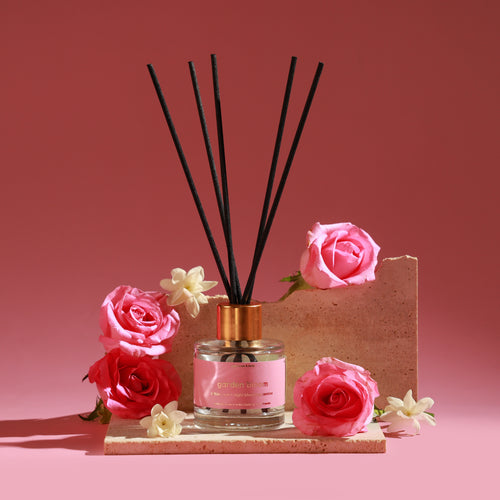 Floral · Garden Bloom₹799Shop →
Size, dose and what to expect once it is in the right place
A living room with a full-height glazed wall is nearly always above 150 sq ft, which puts it in 130ml territory rather than 50ml — 14 to 18 weeks against 6 to 8, for roughly ₹500 more. That is better value per week, but only because the room warrants it; in a smaller room the honest recommendation is a 50ml with fewer reeds, and I would rather say that than sell the larger bottle to somebody who does not need it. Then use the reed count as the dial. Six reeds is full projection and is right here for the closed evening hours. Three is a soft bedside level that roughly doubles the life of the bottle, which is a reasonable setting for a room whose doors stand open through most of the day and which you would rather not be feeding into the sky.
On scent, register does more work than strength in a room that keeps flushing. Mountain Breeze at 9.4 — Himalayan pine, sage and Indian cedar — is my first choice, because dry resinous materials are less eager to leave than light ones and so remain present longer at the same dose. Morning Freshness at 9.0 is the answer if you want the room to read bright rather than grounded, and its eucalyptus globulus base slows the lemon's evaporation three to four times, which is what turns the usual ten-to-fourteen-day citrus fade into six to eight weeks. Garden Bloom at 8.9 is the floral option for a formal drawing room, with the indole held below the threshold at which jasmine starts to read animalic in heat — a relevant decision behind glass in an Indian afternoon.
And one sequencing point, because a living room next to a kitchen usually needs it. Fragrance does not remove an odour; it sits alongside one, and the mixture is often less pleasant than either component. If the room smells of last night's cooking, the order is to deal with the source, then ventilate — and a glazed wall on a high floor is an outstanding ventilation device, which is the one place where all this airflow is entirely on your side — and only then to let the diffuser do its work in a room that is already clean and aired. Reverse that order and you get scented cooking, which nobody wants and everybody can identify.
What to buy for a glazed living room — and the honest gap
Assuming the bottle is now going on the far wall. In the order I would buy it, with a last row that is not a product and is the line I would most like a reader to take away.
| Buy | What it is | Where it goes and when it is right | Price |
|---|---|---|---|
| 1. Mountain Breeze 130ml ★ | Pine, sage and cedar at 9.4 — dry resinous materials hold a flushing room best | Far wall, chest height, six reeds for the closed hours. 14–18 weeks | ₹1,349 |
| 2. Morning Freshness 130ml | Malabar lemon, peppermint, eucalyptus at 9.0 — the bright register | Same wall, if you want the room to read light rather than grounded | ₹1,249 |
| 3. Garden Bloom 50ml | British rose and night-blooming jasmine at 8.9, indole held below the animalic threshold | A formal drawing room under 150 sq ft, or a second register in a nook | ₹799 |
| 4. Sukoon | 500ml tank, 270–320 sq ft, 16–18 hours on low, three 15ml Hotel Collection scents included | If the doors are open all day and the room only closes for a short evening block | ₹1,899 |
| 5. 300ml refill | Oil alone, for the bottle and reeds you already own | Once the far-wall placement is settled and one scent is clearly the keeper. Never a first purchase | ₹2,399 |
| The honest gap: what placement cannot do | No position in the room makes a diffuser noticeable while a full-height glazed wall stands open through every occupied hour. Placement protects the bottle and makes the closed hours worth having; it does not overrule the air. A bigger machine is not the way round it either — the Megh at ₹3,499 covers about 215 sq ft, which is less than the Sukoon at ₹1,899, because it is a runtime and humidity machine rather than a coverage upgrade | Move the bottle, then buy the hours the doors are shut | ₹0 |
Versailles
Glazed living rooms are the ones people are proudest of, and the ones where I most often find a diffuser standing on the sill in the sun. It is a completely reasonable instinct — the sill is a shelf, the light is beautiful, and the bottle looks its best there. It is also the one spot in the room where the fragrance is being handed straight to the balcony and the heat is emptying the glass faster. I would rather write that sentence than have somebody conclude the product is weak.
The other thing worth saying is about the carrier, because it is the invisible decision behind every hot, sunny Indian room. Most reed diffusers are built on DPG, which is cheap and which can crack and go bitter above about forty degrees — an ordinary afternoon behind a wall of glass. We use a heat-stable CCT base and test the range through a heat soak and high humidity, so the composition in a hot month smells like the composition in a mild one. You cannot smell the carrier. It is the entire reason you can smell everything else.
My honest summary for a room like yours is that placement is worth doing carefully and is not a substitute for the hours. Put the bottle on the far wall out of the light, use six reeds when the doors are shut and three when they are not, and understand that the room becomes a fragrance environment in the evening rather than at four in the afternoon. That is not a limitation of the product; it is what a wall that opens means. Everything is composed in Pune, and a part of every order funds a girl's classroom through Nanhi Kali.
Frequently asked questions
- The 20th floor and a cross-breeze — the mechanism page for the whole family.
- Should I close the balcony door? — yes, and it is a way to use the product rather than a workaround.
- 800 sq ft, reeds or Sukoon? — the honest comparison, including what a machine wastes.
- A balcony attached to the bedroom — the bedside version of this placement question.
- Does a higher floor shorten bottle life? — yes, through airflow rather than altitude.
- A breezy Mumbai high-rise and a Bengaluru one with an open balcony — two cities, two different answers.
- Fresh air by day, fragrance at night — the split setup, in full.
- Sukoon only in the evening — exactly the case a machine exists for.
- Brand: the SOSA founder story.
SOSA facts verified August 2026: Five reed scents, all alcohol-free on a heat-stable CCT (caprylic/capric triglyceride) carrier rather than DPG, phthalate-free, paraben-free, IFRA-compliant, 0 ppm formaldehyde, six fibre reeds in a refillable glass bottle, composed in Pune, India, and tested at a 45°C heat soak and 85% relative humidity. Morning Freshness 50ml ₹749 · 130ml ₹1,249 · 9.0, with a eucalyptus globulus base that slows lemon evaporation three to four times. Evening Calm 50ml ₹799 · 130ml ₹1,299 · 8.9, the softest in the range. Garden Bloom 50ml ₹799 · 130ml ₹1,299 · 8.9, with indole held below the threshold at which jasmine reads animalic above 30°C. Mountain Breeze 50ml ₹849 · 130ml ₹1,349 · 9.4. Fresh Brew 50ml ₹849 · 130ml ₹1,349 · 9.5, the deepest. 50ml suits rooms up to about 150 sq ft and lasts 6–8 weeks; 130ml suits rooms above that and lasts 14–18 weeks; six reeds give full projection and three a soft level that roughly doubles the life; two or three reeds in a 50 sq ft bathroom can make a 50ml last close to three months. Cost per day approximately ₹13–₹15 on a 50ml. Duos: Day & Night ₹1,498, Fresh & Grounded ₹1,548, Warmth & Bloom ₹1,598, each two 50ml bottles. Refills 300ml ₹2,399 · 500ml ₹3,499, oil only and not a first purchase. Machines: Boond ₹899 (300ml, up to about 150 sq ft, around 6 hours), Sukoon ₹1,899 (500ml, 270–320 sq ft, 16–18 hours on low, three 15ml Hotel Collection scents included), Megh ₹3,499 (six-litre tank, around 100 hours of runtime, about 215 sq ft — a runtime and humidity machine, never a coverage upgrade). Hotel Collection oils are water-based and ultrasonic-only; reed oil and Hotel Collection oil are not interchangeable in either direction and there is no hotel-inspired reed diffuser. SOSA sells no room spray, air purifier, dehumidifier, odour eliminator, plug-in, timer or subscription; every SOSA spray is a car perfume. Free shipping above ₹499. A portion of every order supports girl-child education through Nanhi Kali. SOSA is an independent Indian fragrance house and is not affiliated with or endorsed by any hotel brand. Prices subject to change — see the live product pages.