Founder Diaries · Eye Clinic Scenting · Solo or Large Centre
Is Professional Scenting Worth It for a Solo Ophthalmologist or Mainly for Large Eye Centres?
By Sonal Sahani · ISIPCA Versailles
9 min read
Updated August 2026
Mainly for large centres, and I would rather write that in the first line than build a case toward it. For a solo ophthalmologist with a small reception, the honest answer is a reed diffuser at ₹749–₹849 or nothing at all — because everything the expensive machine offers is a solution to a problem a solo practice does not have. That is the whole argument and the rest of this page is its working. A large centre buys an active machine for three things: a public volume too large for a passive source, a level that must not drift when several people work a desk across a week, and running hours that must be fixed because a cleaning shift overlaps opening. A solo practice typically has a reception of 100–180 sq ft, one or two people who touch anything, and a cleaning routine that happens when the doctor is not there. None of the three conditions is present, so the machine is not a scaled-down version of the right decision; it is a different decision that does not apply. What is genuinely worth having at solo scale is small: one bottle, three reeds, at the far end of the waiting area. And the constraints do not scale down either — the clinical pathway stays fragrance-free in a two-room practice exactly as it does in an eye hospital, a fragrance-free seat must genuinely exist, and no claim is made anywhere here that scenting affects footfall, enquiries, ratings, patient numbers or revenue at any size of practice.
Quick answers — read this first
Mainly for large centres. For a solo practice: a bottle, or nothing. Mountain Breeze ₹849 at three of six reeds covers a typical solo reception, and the running cost is a refill once or twice a year.
Three questions decide it, and all three are about your building rather than your billing. How many square feet is the arrival zone alone? How many people touch the setting in a week? Does the cleaning shift overlap opening hours?
A machine solves governance problems, and a solo practice has none. The key-lock, the scheduled run windows and the app exist to hold a decision across several people and several shifts. One or two people do not need a lock.
Size to the arrival zone, never to the practice. Under ~150 sq ft: a reed diffuser. 150–320 sq ft:
Sukoon ₹1,899. Above ~320 sq ft on one connected path: a Vaayu, and only then.
The short answer
Short answer: a solo ophthalmologist with a reception under about 150 sq ft should buy one reed diffuser at ₹749–₹849 and run it at three of six reeds, or buy nothing. A large centre with a 350 sq ft connected public zone, four people on the desk and an overlapping cleaning shift has a genuine case for an active machine — and the case rests on control and silence rather than on reach.
Why it is not a scale question: the expensive machine's features are answers to operational problems — level drift across several staff, hours that must be fixed, a room quiet enough that noise decides it. A solo practice has one or two people, a simple day and a small room. Buying the machine buys solutions to problems you do not have.
Is professional scenting worth it for a solo practice?
Straight answer
1. Usually not, if by professional scenting you mean an active machine. For a solo ophthalmologist with a reception of 100–180 sq ft, one reed diffuser at ₹749–₹849 at three of six reeds does the job, and the difference in outcome between that and an ₹11,999 machine in the same room is nothing a patient could detect. Buy the bottle, or buy nothing.
2. The machine's features are governance features, and governance is what a solo practice does not need. A key-lock exists so that a level set in week one is still running in month nine across three or four people on a desk. Scheduled run windows exist so a machine is off during a cleaning shift the owner never sees. A remote exists so somebody at a busy counter can drop the level without leaving it. In a practice with one or two people, all three of those problems are solved by the person simply doing the thing.
3. Ask three questions and stop at the first no. Is your arrival zone — reception plus waiting, with every clinical room deleted from the calculation — above about 150 sq ft? Do three or more people touch the setting across a week? Does your cleaning shift overlap opening hours? Three noes means a bottle. One yes moves you to a
Sukoon at ₹1,899. All three yeses, plus an arrival zone above 320 sq ft on one connected path, is where the tier above starts being defensible.
4. Size to the arrival zone, never to the practice. This correction matters as much downward as upward. A solo practitioner in a 900 sq ft suite still has a 150 sq ft reception, because the rest is clinical space that takes nothing from us — workup, refraction, imaging, the consultation cabin, any post-operative area, sterilisation and stores.
5. The large-centre case is real, and I will make it properly. A centre with a 350–450 sq ft connected public zone, four or five people rotating on a desk, and a housekeeping shift that starts before closing has three genuine operational problems, and an active machine at ₹11,999 solves all three — under 38 dB so it is inaudible in a room where people wait an hour, a key-lock so the level holds, and 1h/4h/8h/24h run windows with day selection. Freestanding in reception only;
never HVAC-mounted in a clinic.6. Nothing about size changes the constraints. The clinical pathway stays fragrance-free in a two-room practice exactly as in an eye hospital. A fragrance-free seat must genuinely exist somewhere a person would ordinarily sit — which is
harder in a small practice, not easier, and is often the reason a solo clinic should run nothing. The correct intensity in a clinic is lower than in any retail or hospitality space, and if a patient can name the fragrance it is too strong.
7. Nobody publishes what a small practice would want to ask about. SOSA publishes no bulk or commercial pricing, no B2B or corporate page, no annual maintenance contract, no installation service, no stated warranty term, no lead time and no multi-location programme; warranty length, spare parts, servicing and whether the Bluetooth app is iOS or Android are unverified. And
there is no separate Vaayu cold-air refill oil on sale at the time of writing. Ask through
the contact page before committing to anything at the top of the range.
8. And no claim about what any of it returns. No effect on footfall, patient numbers, enquiries, ratings, reviews, conversion or revenue is claimed at any practice size, and nothing here is medical, clinical, ventilation, infection-control, accreditation or regulatory advice. Composed and made in small batches in Pune, and a portion of every order supports girl-child education through Nanhi Kali.
TL;DR: mainly for large centres. A solo practice with a reception under about 150 sq ft should run one bottle at three of six reeds, or nothing. The machine's key-lock, schedules and remote are governance features, and a one or two-person practice has no governance problem. Three questions decide it — arrival-zone size, how many people touch the setting, whether the cleaning shift overlaps. Three noes means a bottle. And the constraints do not scale down: the clinical pathway stays fragrance-free and a real fragrance-free seat is harder to find in a small practice, not easier.

The solo practice answer, and why it is not the modest version of a better one
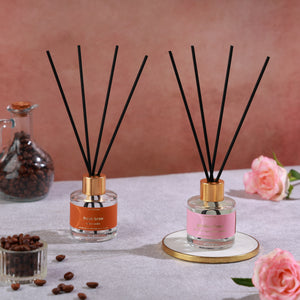
SOSA Mountain Breeze · Himalayan pine, sage & Indian cedar ₹849 / 50ml
Dry pine and sage over Indian cedar — no sweetness, no gourmand warmth, no floral weight.
In a reception of 100–180 sq ft this is not a compromise on a machine; it is the correct product, and the two would be indistinguishable to anybody sitting in the room. A passive reed diffuser makes a fragrant zone rather than a fragranced floor, which in a small arrival zone is exactly the right shape: present where people wait, absent by the time you reach the corridor. It is silent, needs no power, has nothing anybody can turn up, and can be removed from the room in ten seconds — which in a practice with one or two staff is a better set of properties than any control panel. It sits at 9.4 on SOSA's own internal strength scale, measured
at six reeds, not an industry standard, not a concentration and not a quality ranking; in a small clinic reception I would run three of the six supplied and often two. Alcohol-free, phthalate-free, paraben-free, low-VOC, on a heat-stable coconut-derived carrier; refillable glass bottle, six fibre reeds rather than rattan, because rattan's pores clog in Indian humidity; tested through 45°C heat and 85% monsoon humidity. A 50ml lasts 6–8 weeks at six reeds and the
130ml at ₹1,349 lasts 14–18 weeks, projecting identically — for a solo practice the larger bottle simply means reordering three times a year instead of seven. Stand it on a tray, out of sunlight, at the far end of the waiting area from the corridor to consultation.
Part one — the three questions that decide it
Not practice size, not turnover, not how the reception looks. Three questions about how the building and the day actually work, asked in order, stopping at the first no.
1
HOW BIG IS THE ARRIVAL ZONE, ON ITS OWN
A solo practitioner in a 900 sq ft suite still has a 150 sq ft reception, because the rest is clinical space
Take a tape to reception plus waiting, on a working morning, with the doors in the position they hold during a clinic session. Delete every clinical room from the calculation first: workup, refraction, imaging, the visual field room, the consultation cabin, any procedure or post-operative area, sterilisation, records and stores all take nothing from us in any format, at any level, at any hour. Count only what shares unbroken air with reception — a doorless connection makes two spaces one, and a door propped open through every session is not a boundary whatever the drawing says. For a solo ophthalmologist that figure is typically 100–180 sq ft, and for a two or three-doctor practice 150–250. Under about 150 sq ft, a passive reed source covers the zone properly and there is nothing a machine adds in terms of reach. Between 150 and 320 sq ft, a Sukoon at ₹1,899 becomes the sized product — still not because of reach alone, but because at that size a schedule and an off switch start being genuinely useful. Above 320 sq ft on one connected public path you are into a different conversation altogether, and it is one most solo practices never reach. This is the same correction the sizing family in this cluster makes upward, applied downward: do not size to the clinic; size to the arrival zone, and be as honest about it when the answer is small as when it is large.
The measurement: reception plus waiting, tape, working morning, clinical rooms deleted. Under 150 sq ft, stop here and buy a bottle.
2
HOW MANY PEOPLE TOUCH THE SETTING
The lock, the app and the schedule are governance features, and one or two people are not a governance problem
 Sukoon 500ml₹1,899 · remote, 2H / 4H
This is the question that decides more of these cases than square footage, and it is almost never asked.
Everything expensive about an active scent machine is a mechanism for holding a decision in place across people and time. A key-lock stops a level being raised by whoever is on the desk on a Thursday. Scheduled run windows stop the machine running in an empty building on a Sunday. A remote lets a busy counter drop the level without somebody leaving the counter. Those are real operational features, and in a centre with four or five people rotating across a week they are worth paying for — because everyone in a building adapts to a constant within minutes and adapts hardest where they spend the day, so without a lock the level drifts upward across a season by a series of sincere individual judgements. Now count the people in a solo practice. One doctor, one or two staff, the same faces every day, the same person opening and closing. The judgement that a machine's lock is designed to constrain is being made by the person who chose the level in the first place. There is no drift mechanism because there is no committee. So the honest position is that a solo practice buying a locked, scheduled machine is buying a control system for a decision it makes once and then simply keeps.
The test: if fewer than three people would ever touch the setting, you are not buying control — you are buying a control panel.
3
DOES THE CLEANING SHIFT OVERLAP OPENING HOURS
The one genuinely operational reason a small practice sometimes does need a schedule
This is the question that occasionally overturns the answer for a small practice, which is why it is here rather than in a footnote.
Fragrance layered over cleaning chemistry produces a third smell that is worse than either component, and no product removes, masks or neutralises anything — fragrance adds a scent alongside what is already in the air, and that is all it does. A practice whose housekeeping happens before opening and after closing has no problem: the reed bottle sits there all day and nothing collides. A practice whose cleaning shift starts at five while the last patients are still waiting, or whose floors are mopped mid-morning, has a genuine sequencing issue — and a reed diffuser cannot solve it, because a passive source has no schedule, no timer and no off switch short of somebody carrying it out of the room. That is the one circumstance in which I would put a small practice on a
Sukoon at ₹1,899 despite a reception under 150 sq ft: the timer modes, used deliberately, let the arrival zone be genuinely unscented for the stretches when cleaning happens. Even then the cheaper answer is worth trying first, and it is free — move the cleaning. If your housekeeping can be shifted wholly outside opening hours, you have solved the problem without buying anything, and you should. What your cleaning protocol ought to be is a matter for your own clinicians and not for me; I am only describing what collides with what in the air.
Part two — five practice shapes and the honest answer for each
Five configurations I meet repeatedly, with the arrival-zone figure that decides each and what I would actually specify. Two of the five end in buying nothing at all.
Practice shape by practice shape
The shape, its arrival zone, the honest recommendation, and what a machine would add
| Practice shape |
Typical arrival zone |
What I would specify |
What an active machine would add |
Honest verdict |
| Solo ophthalmologist, one consulting room ★ |
100–150 sq ft of reception and waiting |
One reed bottle at three of six reeds, far end of the waiting area |
Nothing a patient could detect. Control features for a decision one person makes once |
A bottle. The machine argument does not begin at this size |
| Solo practitioner with an optical counter |
150–200 sq ft including the frame display |
One bottle, or two of 50ml at opposite ends if the zone is L-shaped |
A schedule, which is only useful if cleaning overlaps opening |
A bottle, unless the cleaning shift genuinely collides |
| Two or three doctors, shared waiting bank |
180–280 sq ft, often one connected volume |
Sukoon ₹1,899 on its lowest mode with a light dose |
Genuinely useful: a remote at a busier desk, and 2H/4H stretches |
The first shape where a machine earns its place |
| Large centre, several patient zones on one path |
320–500 sq ft of connected public floor |
Vaayu ₹11,999, freestanding, at the entrance end |
Under 38 dB, a key-lock across several staff, fixed run windows |
Yes — but confirm refill supply before committing |
| Any practice with a small sealed reception that cannot ventilate |
Any size; the constraint is air exchange, not area |
Nothing. Fix the air, the seating and the cleaning first |
It would deliver the wrong outcome more efficiently |
Buy nothing. Revisit in a quarter |
|
The honest caveat: every row concerns the arrival zone — reception and waiting — only. Examination rooms, diagnostics, consultation cabins, the procedure suite, any post-operative area, sterilisation and stores take nothing at any practice size, in any format, at any level, at any hour. Nothing on this page is medical, clinical, ventilation, air-handling, infection-control, accreditation or regulatory advice. No SOSA product or setting is described as safe or unsafe for any patient or staff group; some people are sensitive to airborne fragrance, which is exactly why the clinical pathway stays fragrance-free and why a fragrance-free seat must genuinely exist somewhere a person would ordinarily sit — a requirement that is harder to satisfy in a small practice than a large one. No claim is made, at any practice size, that scenting affects footfall, patient numbers, enquiries, ratings, reviews, conversion to any procedure, or revenue. Fragrance adds a scent alongside what is already in the air; it removes, masks, neutralises or purifies nothing. Coverage figures are manufacturer specifications and vary with ceiling height, air exchange and occupancy. |
Shop this guide
The three honest answers, in the order small practices actually land on them
The SOSA principle
A machine is bought to hold a decision in place across people and shifts. A solo practice has neither, so the honest recommendation is the bottle — and the difference between an ₹849 bottle and an ₹11,999 machine in a 130 sq ft reception is nothing anybody sitting in that room could detect.
Which is why most solo enquiries about professional scenting should end with a smaller order than the one that prompted them, and no sense of having settled.
Part three — the solo practice that should buy nothing
There is a common solo configuration where the honest answer is not a smaller purchase but no purchase, and it is worth setting out properly because a small practice is the case where it applies most often. If your only waiting area is under about 150 square feet, sealed and air-conditioned, opens onto an internal corridor rather than the street, is served by one recirculating system and does not deliberately exchange air with outside between opening and closing, then anything added accumulates and very little leaves. In that room a continuous source settles at a higher level than you intended and holds there, which is experienced as weight rather than as fragrance — heavier, not fresher — and the effect is worse in a small volume than a large one. The correct project costs nothing and takes a fortnight: two openings on opposite sides of the arrival zone held open together for ten to fifteen minutes, mid-morning and mid-afternoon, daily, with somebody stepping outside for a quarter of an hour and re-entering through the patient door at four o'clock to write one sentence before speaking to anybody. If that four o'clock sentence changes across the fortnight, ventilation was the answer and it was free. What your air handling ought to be doing instead belongs entirely to your own contractor and clinicians, and I will not offer a view on it.
The second reason a solo practice should often buy nothing is the one people find counter-intuitive, because it works against size. A fragrance-free seat is harder to produce in a small practice than in a large one, and it is a requirement rather than a courtesy. A practice that scents its reception should be able to seat somebody where the fragrance does not meaningfully reach: not a chair in a corner, but a genuine seat, far enough from the source that the difference is real, and reachable without crossing the room or being singled out. In a single small waiting area of one air volume there is frequently nowhere that qualifies, because a chair four feet from the bottle is not meaningfully different from one eight feet away. A large centre with several bays, an optical area and a second run of seating can nearly always produce that seat; a solo practice with one bench often cannot. If you cannot produce it, you do not have a design, you have a hope — and the honest response is to run nothing until the plan can offer somewhere real. That constraint has nothing to do with budget, which is why it catches practices that would happily have spent more.
The third case is about who is in the room all day, and in a solo practice the answer is very few people, which cuts both ways. Your one or two reception staff are in that air for eight or nine hours while a patient is in it for anything from ten minutes to two hours, and they have the least ability to leave it. In a large centre a person on the desk can be rotated; in a solo practice they cannot, so their preference carries even more weight than usual. Ask properly — not "is this bothering you", which invites a polite no, but an open question: if you could change one thing about this room, what would it be. Ask again a fortnight later, because the first answer is about novelty and the second is about living with it. If they would rather have nothing, that is a complete answer and it needs no further justification. And they must have unconditional authority to stop it on any day without asking, which in a solo practice means the doctor saying so once and meaning it. There is one more thing worth remembering at this scale, because a small practice has fewer signals to spend. A clinic is judged on competence, and ambience must never compete with that; a small waiting room that smells noticeably of fragrance reads as a practice trying to be something it is not far faster than a large foyer does. The target is considered, never scented.
The expensive machine is not the strong one; it is the one that holds a level across several people over a season. A solo practice has one person and one decision, which is why the honest answer at that scale is a bottle, and why nobody sitting in the room would know the difference.
— Sonal Sahani, SOSA
Part four — what each answer costs over a year
The arithmetic for each route, shown rather than asserted, with what you get and what you do not. Read the last column before the first.
A year of each answer, costed
Start cost, a year of running, and what the money buys and does not buy
| Route |
Cost to start |
Roughly a year, with the arithmetic |
What it buys |
What it does not buy |
| One 130ml bottle, refilled ★ |
₹1,249–₹1,349; free shipping above ₹499 |
One 300ml refill at ₹2,399 covers roughly 8–11 months — ₹2,399 ÷ 300 = ₹8.00 a millilitre |
A silent, powerless fragrant zone nobody can turn up |
Any schedule, remote or off switch short of removing it |
| One 50ml bottle, replaced |
₹749–₹849 |
6–8 weeks a bottle at six reeds, so several bottles a year |
The cheapest possible way to find out whether you want this at all |
Value per millilitre — ₹749 ÷ 50 = ₹14.98 against ₹8.00 refilled |
| Two 50ml bottles at opposite ends |
₹749 + ₹849 = ₹1,598, or ₹1,498–₹1,598 as a duo set |
Two bottles to maintain rather than one |
Two zones in an L-shaped arrival area |
Reach — it raises total output, it does not extend one zone |
| Boond ₹899 |
₹899 + a 15ml at ₹299 = ₹1,198 |
100ml ₹999 ÷ 100 = ₹9.99 a millilitre |
An off switch, and a run that ends by itself after roughly six hours a fill |
Coverage above ~150 sq ft, a remote, and a dry room — it adds humidity |
| Sukoon ₹1,899 |
₹1,899 with three 15ml scents in the box; with a 300ml, ₹1,899 + ₹1,799 = ₹3,698 |
300ml ₹1,799 ÷ 300 = ₹6.00 a millilitre |
270–320 sq ft, a remote, and steady/2H/4H run stretches |
A key-lock, and a dry room — it is ultrasonic and adds humidity |
| Vaayu ₹11,999 |
₹11,999, with 4 × 100ml = 400ml of cold-air oil supplied |
400ml lasts roughly 90+ days: 400 ÷ 90 = 4.4ml a day at a mid setting |
Under 38 dB, a key-lock, and 1h/4h/8h/24h windows with day selection |
A published refill line, a warranty term, an installation visit or a lead time — none is published |
Honest notes for buyers: nothing on this page is medical, clinical, ventilation, air-handling, building, infection-control, accreditation or regulatory advice, and
no clinical outcome, patient response, safety property or business result — including any effect on footfall, patient numbers, enquiries, ratings, reviews, conversion to any procedure, or revenue — is claimed for any product, setting or placement at any practice size. No SOSA product or setting is described as safe or unsafe for any patient or staff group; some people are sensitive to airborne fragrance, which is exactly why the clinical pathway stays fragrance-free and why a fragrance-free seat must genuinely exist somewhere a patient would ordinarily sit. Fragrance adds a scent alongside what is already in the air — it removes, neutralises, masks or purifies nothing — and SOSA sells no air purifier, no dehumidifier and no room spray; every SOSA spray is a car perfume. Coverage figures are manufacturer specifications and vary with ceiling height, air exchange, occupancy and intensity: Boond ₹899 ~150 sq ft, Sukoon ₹1,899 270–320 sq ft,
Megh ₹3,499 only ~215 sq ft, less than a Sukoon — a runtime and humidity machine, never a coverage upgrade, Safar ₹3,999 with
no published coverage figure at all, Vaayu ₹11,999 up to 1000 m³ ≈ 2,000–3,000 sq ft, Aangan ₹25,999 ~8,000–10,000 sq ft, Meenar ₹38,500 12,000–18,000 sq ft. Boond, Sukoon and Megh are ultrasonic and add humidity; reeds and the Vaayu add none. Reed strength positions are on SOSA's own internal scale
at six reeds, not an industry standard, a concentration or a quality ranking, and no bottle-life figure is published below six reeds; replacement reeds are not sold separately, and the reed range has no oud, no musk-forward composition and no aquatic. A 50ml lasts 6–8 weeks and a 130ml 14–18 weeks, and both project the same — size buys duration, never reach. Reed oil cannot go in an ultrasonic machine, water-based Hotel Collection cannot go in a reed bottle, and neither goes in a Vaayu. Oil-only reed refills are 300ml ₹2,399, which is ₹2,399 ÷ 300 = ₹8.00 a millilitre, and 500ml ₹3,499, which is ₹3,499 ÷ 500 = ₹7.00, against ₹749 ÷ 50 = ₹14.98 for the smallest bottle. Hotel Collection water-based fragrance is for ultrasonic machines only: 15ml ₹299 (₹299 ÷ 15 = ₹19.93 a millilitre), 100ml ₹999 (₹999 ÷ 100 = ₹9.99), 300ml ₹1,799 (₹1,799 ÷ 300 = ₹6.00), and a pack of seven 15ml at ₹1,799, which is 7 × 15ml = 105ml, so ₹1,799 ÷ 105 = ₹17.13 a millilitre — variety, not value.
SOSA does not currently sell a separate Vaayu cold-air refill oil; the 400ml supplied lasts roughly 90+ days and is the whole supply at the time of writing, so any practice planning continuous or multi-site use must confirm current refill availability with SOSA before committing, and the water-based Hotel Collection is never a substitute.
SOSA publishes no bulk or commercial pricing, no B2B or corporate page, no annual maintenance contract, no installation service, no stated warranty term, no lead time and no multi-location programme, and warranty length, spare parts, servicing and whether the Bluetooth app is iOS or Android are all unverified — nothing here implies a discount, a slab, an invoice arrangement, an installation visit, a service contract, a warranty period or a delivery window. Ask through
the contact page before committing.
Never mount a Vaayu, or any diffuser, into a clinic's shared HVAC. Hotel Collection scents are inspired by hotel styles only; SOSA is independent and unaffiliated, and no hotel group is a SOSA customer, partner or reference. Free shipping above ₹499.
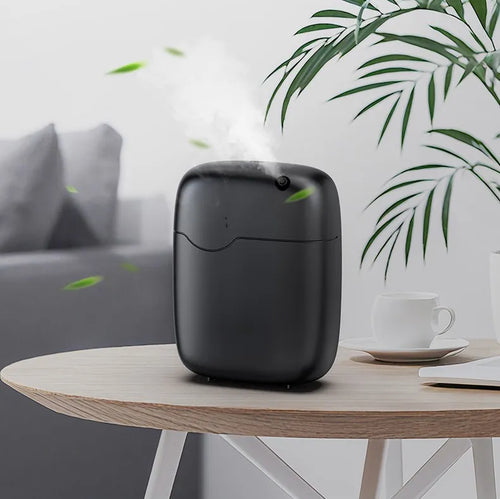
The large-centre case, made properly
SOSA Vaayu · waterless cold-air nebulisation, key-lock, scheduled run windows ₹11,999
I would be arguing dishonestly if I only made the small case, so here is the large one at full strength. A centre with 320–500 sq ft of connected public floor, four or five people rotating across a desk, and a housekeeping shift that begins before closing has three genuine operational problems, and this machine solves all three. Under 38 dB is the first and the one I would put at the top of any clinic specification: patients in an eye practice wait a long time, often with dilated pupils and little to distract them, and a waiting room where a machine is audible is worse than one with no fragrance at all. A key-lock is the second — it holds the level chosen in week one through month nine, across staff whose noses have all adapted and who will all, at some point, sincerely conclude the room has gone flat. Run windows of 1h, 4h, 8h or 24h with day selection are the third, so the machine works clinic hours and is absent overnight and during cleaning. Rated up to 1000 m³ ≈ 2,000–3,000 sq ft, which already exceeds any clinic reception and is therefore not the reason to buy it. 400ml refillable tank, DC 12V/1A at 5W, 165 × 80.5 × 215 mm, 0.9 kg, CE, RoHS and SGS certified. Two conditions in writing: freestanding in reception, away from the corridor to consultation and every return grille — never HVAC-mounted in a clinic — and confirm refill supply first, because there is no separate Vaayu cold-air refill oil on sale at the time of writing and the water-based Hotel Collection is never a substitute.
A note from Sonal
A solo ophthalmologist wrote to me with a quotation he had been sent by somebody else — a scenting system, a monthly figure, and a paragraph about creating a premium patient experience. He wanted to know whether ours was better. It was the wrong question and I said so, which is not a comfortable thing to write to somebody who has taken the trouble to ask.
What I asked instead was for one number: the square footage of his reception and waiting area, measured with a tape, with the consulting room, the workup room and the dark room excluded. He came back with a hundred and twenty-six square feet, one receptionist, and cleaning done at seven in the morning before anybody arrived. At that point the recommendation writes itself. One reed bottle at ₹849, three of six reeds, at the far end of the bench away from the corridor to his consulting room. Nothing with a plug on it, nothing with a schedule, nothing with a lock — because he had no drift to prevent, no shift to schedule around, and no volume that a passive source could not cover.
He asked, fairly, whether I was talking myself out of a larger order. I was, and the reason is that the alternative is worse for both of us: an eleven-thousand-rupee machine running at the bottom of its range in a room a fraction of its rated size, doing nothing a patient could detect, in a practice that would have been right to feel misled. What a solo practice should buy is the small thing, and what a large centre should buy is the machine that holds a level across five people and a cleaning shift. Both of those are honest recommendations. Only one of them is a big order, and the size of the order is not what decides which one I give. Composed and made in small batches in Pune, and a part of every order funds a girl's classroom through Nanhi Kali.
Frequently asked questions
Will a reed diffuser look less professional than a machine?
To a patient sitting in a 130 sq ft waiting area, the two are indistinguishable, because what they encounter is the air rather than the object — and in a clinic the object should be out of the entrance sightline in either case. If the concern is how the practice presents to a visitor who notices equipment, I would say the opposite: a clinic is judged on competence, and a visible fragrance system in a small reception reads as effort spent in a place that did not need it. A bottle on a tray at the end of the bench, run at three of six reeds, is the more considered answer at that scale as well as the cheaper one.
Our reception is small but we have a long waiting time. Does that change the answer?
It changes the level rather than the product. Longer waits mean the dose has to be set for forty minutes or two hours rather than for the first ten seconds, so judge it from the furthest chair at the end of a long wait, not from the doorway on the way in. In practice that usually means running two of six reeds instead of three, not buying a bigger machine — a passive source in a small room is already covering the volume, and adding output to a room people sit in for a long time is the commonest way a waiting area ends up uncomfortable. Have somebody from your team sit in the furthest chair for a full forty minutes at your busiest hour and report at the end.
Is there a discount or a small-practice package?
None is published, and I would rather say so than let you assume. SOSA publishes no bulk or commercial pricing, no B2B or corporate page, no annual maintenance contract, no installation service, no stated warranty term, no lead time and no multi-location programme; warranty length, spare parts, servicing and whether the Vaayu's Bluetooth app is iOS or Android are unverified. What exists is the published shop price and free shipping above ₹499, which covers almost any order a solo practice would place. If a commercial term matters to you, ask through the contact page and get the answer before committing. At the prices involved for a small practice — ₹749 to ₹1,899 — this rarely arises, which is another argument for the smaller answer.
When does a growing practice cross into needing a machine?
At the point where one of three things becomes true. The arrival zone passes about 150 sq ft, measured with a tape and with every clinical room deleted from the calculation. Three or more people start touching the setting across a week, which introduces level drift that a single person's judgement no longer controls. Or the cleaning shift begins to overlap opening hours, which needs a schedule that a passive source cannot provide. Any one of those puts you on a Sukoon at ₹1,899. All three, plus a connected public zone above about 320 sq ft, is where the tier above becomes defensible — and there the case rests on under 38 dB, a key-lock and fixed run windows rather than on reach.
Would scenting help a small practice compete with a larger centre?
I am not going to claim that, and you should treat any supplier who does with scepticism. No effect on footfall, patient numbers, enquiries, ratings, reviews, conversion to any procedure, or revenue is claimed anywhere in this cluster, at any practice size, and I have no evidence that would support one. What ambient scent does is make an arrival zone slightly more deliberate, consistently rather than occasionally — the same category as fresh flowers or a well-kept desk. At solo scale that is worth ₹849 if you want it and worth nothing if you do not. Sound, seating, light temperature and a clear counter all change more, and all four cost less.
Eye clinics · the owner's decisions · practice size
A bottle for a solo practice — the machine starts later
Three questions decide it: is the arrival zone above about 150 sq ft, do three or more people touch the setting, and does the cleaning shift overlap opening hours. Three noes means one reed diffuser at ₹749–₹849, run at three of six reeds at the far end of the waiting area. One yes moves you to a Sukoon at ₹1,899. All three, plus a connected public zone above 320 sq ft, is where a Vaayu becomes defensible — on silence and control rather than reach, freestanding, never ducted, and only with refill supply confirmed. A small sealed reception that cannot ventilate, or one with nowhere a fragrance-free seat could genuinely exist, should run nothing. Free shipping above ₹499.
Mountain Breeze ₹849 →
Sukoon ₹1,899
Continue the read
More for the practice owner
Editorial standards & sources
About this guide: Written by Sonal Sahani, ISIPCA Versailles-trained founder and perfumer at SOSA Home & Body. It answers whether active scenting is worth it for a solo ophthalmologist — usually not, because the machine's key-lock, schedules and remote are governance features that a one or two-person practice does not need — and makes the large-centre case properly on silence, level control and fixed run windows. Every route is costed with the arithmetic shown.
No claim is made, at any practice size, that scenting affects footfall, patient numbers, enquiries, ratings, reviews, conversion to any procedure, or revenue. Nothing in it is medical, clinical, ventilation, air-handling, infection-control, accreditation or regulatory advice. Prices and specifications were verified from the live SOSA store in August 2026; coverage figures are manufacturer specifications. SOSA publishes no bulk pricing, corporate account, maintenance contract, installation service, warranty term, lead time or multi-location programme, and no separate Vaayu cold-air refill oil is currently sold. No competitor is named or rated, and no hotel group is a SOSA customer, partner or reference.
SOSA range, specifications and prices used in this guide (verified August 2026): Vaayu ₹11,999 — waterless cold-air nebulisation of undiluted fragrance oil; no water, no heat, no added humidity, no white mineral dust. Coverage up to 1000 m³, about 2,000–3,000 sq ft. 400ml refillable tank lasting roughly 90+ days at a mid setting. Bluetooth app plus onboard controls, 1h / 4h / 8h / 24h run windows, day selection, adjustable intensity, auto-stop and key-lock.
Under 38 dB. DC 12V / 1A, 5W. Freestanding or wall / HVAC mount. CE, RoHS and SGS certified.
SOSA does not currently sell a separate Vaayu cold-air refill oil; the 400ml supplied in the box is the fragrance available at the time of writing, so a practice planning continuous or multi-site use should confirm current refill availability with SOSA before committing. The water-based Hotel Collection is made for ultrasonic machines and must not be used in a Vaayu. Other machines: Boond 300ml ₹899 (~150 sq ft, ultrasonic) · Sukoon 500ml ₹1,899 (270–320 sq ft, 16–18 hours on low, remote and steady/2H/4H timers, three 15ml fragrances included, ultrasonic) · Megh 6L ₹3,499 (
~215 sq ft — a runtime and humidity machine that covers less than a Sukoon, never a coverage upgrade) · Safar ₹3,999 (waterless cold diffusion, cordless, 20ml, about 6.9cm, three speeds, 1/2/3-hour auto-off — sold as a car and travel diffuser, personal-scale only;
SOSA publishes no coverage figure for it) · Aangan ₹25,999 (HVAC nebulising, ~8,000–10,000 sq ft) · Meenar ₹38,500 (commercial HVAC, 12,000–18,000 sq ft). Water-based Hotel Collection for ultrasonic machines: 15ml ₹299 · 100ml ₹999 · 300ml ₹1,799 · pack of seven ₹1,799; scents are
inspired by the atmosphere of well-known hotels — SOSA is an independent Indian brand and is not affiliated with, endorsed by or supplying any hotel group. Reed diffusers ₹749–₹1,349 (50ml 6–8 weeks, 130ml 14–18 weeks, six fibre reeds, no 100ml size; replacement reeds are not sold separately). Reed oil cannot be used in an ultrasonic machine and Hotel Collection oil cannot be used in reeds.
SOSA sells no room spray or home spray — every SOSA spray is a car perfume. Nothing in this guide is medical, clinical or safety advice. A fragrance diffuser adds a scent to the air. It does not clean, purify, filter, sanitise or disinfect air, does not remove or neutralise disinfectant, damp or occupancy smells, and has no effect on comfort, anxiety, waiting time, recovery or any clinical outcome. Some people are sensitive to airborne fragrance, which is why this guide recommends that examination rooms, diagnostic areas, consultation cabins, procedure suites and post-operative areas remain fragrance-free, that a fragrance-free seating option always exist, and that a diffuser is never mounted into shared HVAC in a clinical building. Decisions about clinical policy, ventilation standards, infection control and patient suitability rest entirely with the practice and its clinicians. A persistent stale, damp or disinfectant smell is a ventilation, moisture or cleaning problem — SOSA sells no dehumidifier and no air purifier, and fragrance should never be used to cover one. Coverage, runtime and longevity figures are manufacturer specifications and typical ranges, not guarantees, and vary with room volume, ceiling height, air exchange, occupancy and season.
SOSA publishes no commercial or bulk pricing, no corporate account, no annual maintenance contract, no installation service, no stated warranty term and no multi-location programme; warranty length, spare parts, servicing and app platform availability are unconfirmed, and larger or multi-site enquiries should go through
the contact page before any commitment. Composed and made in small batches in Pune, India. Free shipping above ₹499. A portion of every order supports girl-child education through Nanhi Kali. Prices subject to change — see the live product pages.




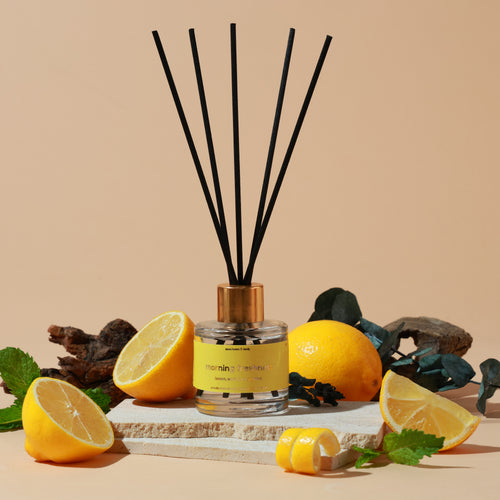 Morning Freshness · the lowest entry₹749Shop →
 Sukoon · from 150 sq ft, or a schedule₹1,899Shop →