
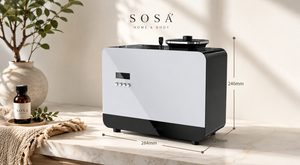
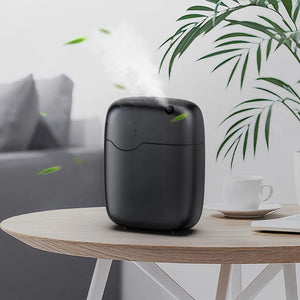
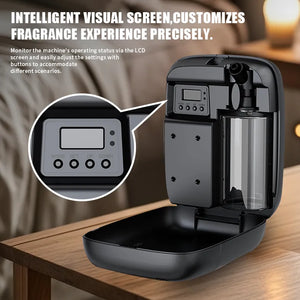

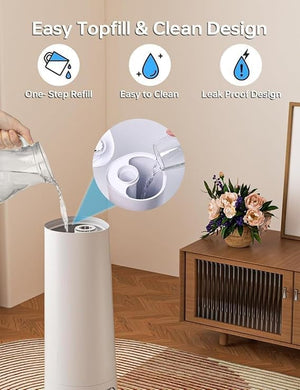
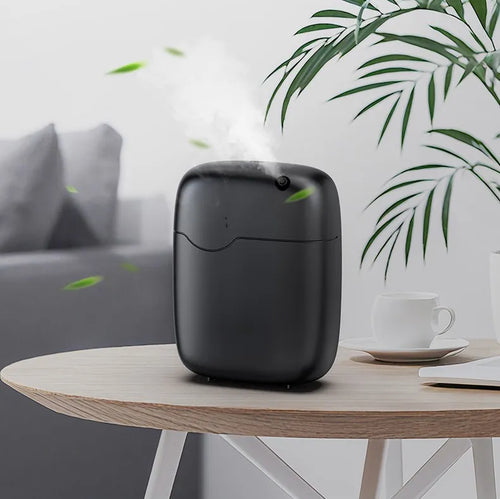
The specification: 0.9 kg, 165 × 80.5 × 215 mm, 5W into any socket, sealed undiluted oil with no water to spill in a client's property, key-lock, auto-stop, 1h/4h/8h/24h timers, under 38 dB.
Before you buy: check whether your listings are vacant or furnished, whether they have power, their typical volume, how often two viewings overlap, and whether a ₹1,899 Sukoon or ₹749 reeds would do the job instead.
2. Check whether your listings are vacant or furnished, because it changes the machine. Vacant properties rule out the water-based ultrasonics in our own range: they add 30 to 50 ml of water an hour to a closed flat with cold stone floors. A waterless nebuliser adds nothing, which is why it is the portfolio machine rather than the cheap one.
3. Check that the properties have power, and carry an extension lead regardless. The unit draws 5W through a DC 12V/1A adapter, so no socket anywhere is unsuitable. The obstacle in a vacant flat is never the current, it is that the only live socket is in the kitchen and the machine belongs near the entrance.
4. Check your typical volume, in cubic metres rather than square feet. Up to 1000 m³ is roughly 2,000 to 3,000 sq ft at normal ceilings, which covers the large majority of a premium residential portfolio. A villa with double-height living areas is a different calculation and may need two units or the Aangan at ₹25,999.
5. Count how often two viewings overlap, because one machine cannot be in two buildings. If your Saturdays routinely run two appointments at the same hour in different addresses, you are buying two units eventually and it is better to know that now than in a car park.
6. Then buy the specification that lets you leave it behind safely. Sealed oil with nothing to spill on somebody else's marble, a key-lock so nobody adjusts it after you go, auto-stop for a tank ending in an empty flat, and 1h/4h/8h/24h scheduling so it starts without you.
A portion of every order supports girl-child education through Nanhi Kali.
Frequency, portability, and one machine in two places
Three things decide whether this purchase is sensible for you, and only one of them is about the machine. The first is how often you show, because a fixed cost is only ever as good as the number you divide it by. The second is whether the hardware is genuinely carryable or merely light. The third is the limit nobody mentions, which is that one unit occupies one address at a time. Take them in that order and the answer for your particular portfolio falls out of it without much argument.
What to check about your own portfolio before you buy
You asked what to consider before buying, so here it is as a checklist rather than as an argument. Six things about your listings and your diary, what each one decides, and what to do in either case. Two of the rows send you to a cheaper product, which is the point of writing it as a table rather than as a pitch.
| What to check | Why it decides the answer | If yes | If no |
|---|---|---|---|
| How many viewings a month ★ | The purchase is a fixed cost divided by frequency, and nothing else | Six or more: the Vaayu at ₹11,999 divides to ₹167 a viewing or better in year one | Two or three: buy the Sukoon at ₹1,899, or reeds from ₹749 for the listing you open most |
| Vacant or furnished listings | Water-based machines are wrong in a closed, cool, unoccupied flat | Mostly vacant: waterless nebulisation, which adds nothing to the air and leaves no residue | Mostly occupied and lived-in: an ultrasonic is legitimate, and cheaper |
| Is there power at the property | The machine needs one socket at 5W, and vacant flats sometimes have none | Carry a five-metre extension lead: the live socket is rarely where the machine should stand | No power at all: a reed diffuser placed 48 to 72 hours ahead is the only honest option |
| Typical volume, in m³ not sq ft | Coverage is rated by volume, and a brochure quotes floor area | Up to 1000 m³, roughly 2,000–3,000 sq ft: one unit covers it | Larger, or double-height: two units, or the Aangan at ₹25,999 where there is ducted air to mount into |
| How often two viewings overlap | One machine occupies one address at a time and no schedule fixes that | Rarely: sequence appointments by building and stay at one unit | Routinely: two units at ₹23,998, and the per-viewing figure stays roughly where it was |
| Whether one listing is shown daily | Twenty round trips a month is a routine you will abandon by week two | Leave a unit in that property, locked and scheduled, and buy a second for the moving work | Occasional showings: one machine, carried, is exactly right |
0.9 kg · the portfolio machine₹11,999Shop →  If two a month, buy this₹1,899Shop →
 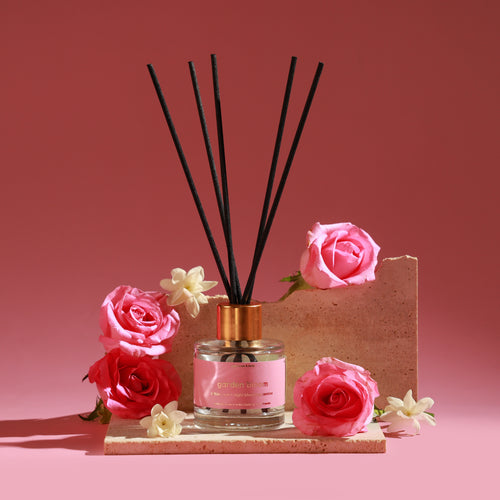 For a listing shown for months₹749Shop →
The bag, the routine, and the ways this goes wrong
Assume you have bought one. The routine that makes it reliable is short, and the reason to write it down is that equipment which requires improvisation gets left at home. Keep one bag permanently packed and never unpack it: the machine, its adapter, a five-metre extension lead, a spare sealed oil bottle and a microfibre cloth. The extension lead is the item most people omit and then need every third viewing, because in a vacant flat the socket that is live and the position the machine should occupy are almost never in the same room. The spare bottle is for the one occasion in a year when a tank ends forty minutes from your office. The cloth is for putting a piece of equipment down on somebody else's surface, which is a courtesy nobody has ever remarked on and which would certainly be remarked on if it were missing. Then the setup, which is genuinely two minutes at each end: place, plug in, set low, lock, leave — and collect on your way out at the end of the slot rather than as a separate trip back. The only setting that varies between properties is intensity, and the direction is nearly always downwards: lower in a small flat, lower again in a well-sealed one, lower still where the air conditioning is already running, because a machine into still cooled air behaves quite differently from the same machine into a cross-ventilated hall.
Then placement in a property you may be visiting for the first time, and the timing that portability actually buys you. Three or four metres inside the front door, at waist height or above, out of the direct throw of an air-conditioning vent and never standing in the doorway. In an unfurnished flat the surfaces available are a windowsill, a kitchen counter, the top of a shoe cabinet or an electrical ledge, in that order, and the machine lies flat where the depth is not there. Two hours before the appointment is the target, and the timers are what make that achievable for somebody who is driving between four properties. Arm a 4h schedule from the app the evening before, or on your way out after the morning viewing in the same building, and the fragrance step completes itself while you are in traffic. That is worth more than it sounds, because the failure mode in a busy portfolio is not choosing the wrong scent, it is arriving eight minutes before a buyer and doing the whole thing in a hurry. At thirty minutes, if you are on site, walk in from the lift with outside air in your nose and adjust downwards. Carrying one machine between properties introduces a specific version of nose-blindness, which is that you arrive at the second flat already carrying the calibration of the first, and the second flat is a different volume at a different temperature. Reset by entering from outside rather than by memory.
Then the two things that actually go wrong, and the constraints. The first is leaving it behind. It is ₹11,999 of your own equipment sitting in somebody else's hall, and the moment it becomes invisible is the moment you have handed keys back to a seller and driven off. The fix that works is procedural rather than mental: collect the machine as the last physical act before locking the door, in the same movement as the keys, every single time, so that it is part of locking up rather than a separate item to remember. If you genuinely leave one in a listing between viewings, tell the seller and the society, and use the key-lock so nobody adjusts or unplugs it. The second is over-scenting a small property because you set the machine for the last big one. Adjust it at the point of placement, not afterwards. On the constraints: the Vaayu runs its own undiluted oil and does not take the water-based Hotel Collection bottles, which belong in ultrasonics; four hotel-inspired scents come with the machine, and I would nominate one as your house default rather than varying it by listing, because a decision taken once stops being a decision taken badly in a car park. The Sukoon at ₹1,899 and Megh at ₹3,499 are water-based and belong in occupied rooms. A reed diffuser from ₹749 needs 24 to 72 hours and is the answer for a property with no power or a listing shown over months. A candle must be attended, which rules it out of an unoccupied flat. And whatever you buy, it is presentation and not concealment: if a listing has damp, a leak or a drain fault, that is a material fact — find it, fix it or disclose it.
The SOSA edit
In buying order for a consultant showing ₹3–10 crore homes regularly. The second and third rows exist because not every reader of this page should buy the first one, and a buying guide that only lists the expensive answer is an advertisement rather than advice.
| Buy | What it is | When it is the right answer | Price |
|---|---|---|---|
| 1. SOSA Vaayu ★ | 0.9 kg, 165 × 80.5 × 215 mm, 5W, waterless sealed oil, key-lock, auto-stop, 1h/4h/8h/24h timers, up to 1000 m³ | Six or more viewings a month. About ₹167 a viewing in year one at six, ₹83 at twelve, and oil thereafter | ₹11,999 |
| 2. A second Vaayu | An identical unit, so both can be armed on schedules from the same app | When two viewings routinely overlap, or one listing is being opened almost daily and stays locked and scheduled | ₹11,999 |
| 3. Sukoon | 500ml ultrasonic, 270–320 sq ft, 16–18h on low, steady/2H/4H timers, three 15ml scents included | Two or three viewings a month, or a single occupied living room. Water-based, so not for a closed vacant flat | ₹1,899 |
| 4. reed diffusers | Alcohol-free reeds needing 24 to 72 hours to establish, then holding a level for months | A property with no power at all, and any listing you will show repeatedly over a season | from ₹749 |
| 5. Aangan | Up to 3,000 m³, 800ml reservoir, HVAC or standalone, programmable, under 42 dB | A sales gallery, a clubhouse or a very large villa with ducted air. Not a 2,000 sq ft apartment | ₹25,999 |
| The kit list: extension lead, spare bottle, cloth | A five-metre lead, one sealed spare and a microfibre cloth, kept in the same bag permanently | From the first viewing. The lead is the item people omit and then need in every second vacant flat | — |
Versailles
I would rather talk you through the arithmetic than the product, because the product is straightforward and the arithmetic is where people go wrong in both directions. Some readers of this page should not spend ₹11,999, and the test is not what their listings are worth — it is how many times a month they unlock a door. At two or three viewings the number per viewing is absurd and a ₹1,899 machine or a set of ₹749 reeds is the proportionate answer. At twelve it is about ₹83 in the first year and effectively nothing in the second, which is less than most people spend on the flowers for a single open house. That is the whole commercial case, and it does not need dressing up.
The specification I would actually judge a portable machine on is the one nobody puts on the front of the box, which is that it contains no water. You are carrying equipment into a property that is not yours, standing it on somebody's marble, and leaving it there unattended for two hours — and a sealed bottle of undiluted oil with nothing to fill and nothing to spill is a completely different proposition from half a litre of water in a plastic tank. Add a lock so that the setting survives whoever else comes through the door, and an auto-stop for the tank ending while the flat is empty, and you have a machine you can deploy rather than one you have to supervise. That, and keeping one bag permanently packed, is the difference between equipment you use for years and equipment that lives in your boot until you sell it.
Everything is made and supported from Pune, and a part of every order funds girl-child education through Nanhi Kali. You get a space that smells like somewhere considered; a girl gets a classroom. That equation has always felt right to me.
Frequently asked questions
- Can I use one professional scent machine across different luxury listings — the same machine, from the operations side.
- I show 20 premium properties every month — is professional scenting worth investing in — the high-volume version of this arithmetic.
- Should a realtor invest in a professional scent machine — the purchase decision, without the portfolio maths.
- Should professional fragrance be treated as a property-staging expense — equipment against staging, and what a seller can be billed for.
- Brand: the SOSA founder story.
Facts verified August 2026: Product facts used in this guide. SOSA Vaayu ₹11,999: waterless cold-air nebulising diffuser, atomises undiluted fragrance oil to a dry residue-free nano-mist, coverage up to 1000m³ (approximately 2,000–3,000 sq ft), 400ml refillable tank lasting up to about 75 days per fill, Bluetooth app plus onboard control, 1h/4h/8h/24h timer scheduling, adjustable intensity, under 38 dB, DC 12V/1A at 5W, 165 × 80.5 × 215 mm and 0.9 kg, freestanding or wall/HVAC mounted, auto-stop and key-lock, CE, RoHS and SGS certified, supplied with four hotel-inspired fragrances. SOSA Aangan ₹25,999: HVAC-connected or standalone commercial nebulising diffuser, coverage up to 3,000m³ (roughly 8,000–10,000 sq ft), 800ml reservoir, metal body, programmable schedules, under 42 dB. Ultrasonic machines are water-based and consume 30–50 ml of water an hour: Sukoon ₹1,899 (500ml, 270–320 sq ft, 16–18 hours on low, 3–6 drops per tank, steady/2H/4H timers, three 15ml Hotel Collection scents included), Boond ₹899 (300ml), Megh ₹3,499 (6 litres). Hotel Collection water-based fragrance 15ml ₹299, 100ml ₹999, 300ml ₹1,799, Pack of 7 at 15ml ₹1,799 against ₹2,093 bought singly; the Vaayu and Aangan take their own undiluted oil rather than these water-based bottles. Reed diffusers (separate alcohol-free line) from ₹749, requiring 24–72 hours to reach their working level. Scented candles from ₹379, scenting a room in roughly 15–20 minutes but requiring attendance. Free shipping above ₹499. Timings: a nebulising diffuser reaches a working level within minutes and a stated viewing level well inside two hours. This guide makes no claim that fragrance affects a property's price, offer level or time on market; it is presentation, in the same category as photography, styling and lighting. Fragrance must never be used to conceal a material defect. SOSA is not affiliated with or endorsed by any hotel brand. Prices subject to change — see the live product pages.