
I Just Moved Into a New Rental and It Still Smells Like the Previous Tenant — What Should I Do?

I Just Moved Into a New Rental and It Still Smells Like the Previous Tenant — What Should I Do?

★ Just moved in · the flat still smells like somebody elseCandle ₹379 · reed ₹749 · Boond ₹899 · Sukoon ₹1,899 · free shipping above ₹499A portion funds girl-child education
★ SOSA · when people are coming over
A new rental carries the last tenant's cooking, their damp and their cleaning products. Fragrance goes on last — after the flat has been aired and washed
★ ★ ★ ★ ★
★★★★★
"My new flat smelled like the previous tenant's kitchen. Deep clean, three days of open windows, then a reed. Only then did it start feeling like mine."
Aakash V. New rental, Bengaluru
Clean → air → reed
★★★★★
"Moved in yesterday and wanted one thing that would make it feel like home. One scent, used consistently, was better advice than buying five products."
Priyanka M. First 1BHK, Pune
One signature scent
★★★★★
"₹1,000 left after moving. A reed at ₹749 was the right call — nothing to plug in while I was still unpacking, and it just ran."
Sahil G. Post-move budget
Reed · ₹749
★★★★★
"The flat had been shut for months. Was told to air it for days before adding anything, and that fragrance over stale air just makes a stranger smell."
Meghna T. Closed flat, Mumbai
Days of airing
★★★★★
"Open kitchen in a small rental. Put the first reed by the door rather than the kitchen. Obvious once explained."
Nitin K. Small rental, Delhi
By the door
★★★★★
"Unfurnished and echoey. A scent, a lamp and clean floors made it feel lived-in before any furniture arrived."
Divya A. Unfurnished, Hyderabad
Under ₹1,500
★★★★★
"My new flat smelled like the previous tenant's kitchen. Deep clean, three days of open windows, then a reed. Only then did it start feeling like mine."
Aakash V. New rental, Bengaluru
Clean → air → reed
★★★★★
"Moved in yesterday and wanted one thing that would make it feel like home. One scent, used consistently, was better advice than buying five products."
Priyanka M. First 1BHK, Pune
One signature scent
★★★★★
"₹1,000 left after moving. A reed at ₹749 was the right call — nothing to plug in while I was still unpacking, and it just ran."
Sahil G. Post-move budget
Reed · ₹749
★★★★★
"The flat had been shut for months. Was told to air it for days before adding anything, and that fragrance over stale air just makes a stranger smell."
Meghna T. Closed flat, Mumbai
Days of airing
★★★★★
"Open kitchen in a small rental. Put the first reed by the door rather than the kitchen. Obvious once explained."
Nitin K. Small rental, Delhi
By the door
★★★★★
"Unfurnished and echoey. A scent, a lamp and clean floors made it feel lived-in before any furniture arrived."
Divya A. Unfurnished, Hyderabad
Under ₹1,500
Reed diffusers: no electricity, no routine, steady for months · from ₹749 Sukoon ₹1,899 · 270–320 sq ft · 16–18 hours per fill · three 15ml scents included Air the room first · fragrance layers on clean air, it does not replace it


Founder Diaries · Home Fragrance · Moving In
By Sonal Sahani · ISIPCA Versailles 11 min read Updated August 2026
The instinct on the first evening is to buy something that smells nicer than the flat does, and it is the one instinct worth resisting for a week. What you are smelling is not floating in the air, where a product could reach it. It is bonded to surfaces — the inside of the kitchen cupboards, the inside of the wardrobes, whatever fabric was left behind, the trap under the bathroom floor drain, the blades of the exhaust fan and the filter of the air conditioner. Air moves through a flat and leaves; those surfaces stay, releasing a little of somebody else's cooking into every hour you spend there. Deal with them in the order below, give the place several days of moving air, and then — genuinely then — decide what you want it to smell of instead.
Quick answers — read this first
The diagnosis: a previous tenant's smell lives in surfaces rather than in air. The kitchen cabinet interiors are the worst offender by a distance, followed by wardrobe interiors, any curtains left behind, the bathroom floor drain and its trap, the exhaust fan, the AC filter and any carpet or rug.

The order: wipe out every cupboard interior with warm water and dish soap, wash or replace the fabric, pour water down every drain, clean or change the AC filter, then cross-ventilate for several days with two openings on opposite walls. Fragrance comes after all of that.

Then, and only then: a reed diffuser from ₹749 for a scent that holds for months with nothing to switch on, or the Sukoon at ₹1,899, which includes three 15ml Hotel Collection scents of your choice. This is the right moment to pick one scent and keep it.
The short answer
Short answer: clean the surfaces the smell is actually stored in — cupboard and wardrobe interiors first, then fabric, then the drain trap, the exhaust fan and the AC filter — and cross-ventilate the flat for several days. Adding fragrance before that produces a compound smell that is worse than the original, because a stranger's kitchen and your new candle do not cancel, they combine.
The pick, once the flat is clean: a reed diffuser from ₹749 if you want a steady background with no plug and no routine while you are still unpacking, or the Sukoon at ₹1,899 if you would rather have timers, coverage for 270–320 sq ft and three 15ml scents included. A Bookshop candle at ₹379 is the cheapest way to find out whether a room is actually ready.
Shop: reed diffuser from ₹749 for 50ml and ₹1,249 for 130ml; Sukoon ₹1,899 with steady, 2H and 4H timers, 16–18 hours per fill on low and three 15ml Hotel Collection scents of your choice; Boond ₹899; 15ml scents ₹299 and the 300ml 300ml refill ₹1,799. Free shipping above ₹499.
Straight answer
My new rental still smells of the person who lived here before. What should I actually do about it?
1. Empty and wipe every kitchen cupboard interior, including the backs of the doors. This is the single largest source in almost every flat I have been asked about, and it is the one people skip because the cupboards look clean. Cooking oil aerosolises, settles as a thin film on every interior surface within a few metres of a hob, and then holds spice residue in it for years. Warm water, dish soap, a cloth, and then dry them and leave the doors open overnight.

2. Do the same to the wardrobes, and leave them open for days. A built-in wardrobe is a sealed box of plywood that has absorbed somebody's clothes, their detergent and often naphthalene. Wipe the interiors, take out any lining paper, and do not hang a single item of your own clothing in there until it smells of nothing.

3. Wash or get rid of every piece of fabric that came with the flat. Curtains especially. Curtain fabric hangs in the path of everything the room has ever done and holds it better than any other surface in the house. If they cannot be washed, they are the cheapest thing on this list to replace.

4. Pour a bucket of water down every floor drain, and clean the exhaust fan and the AC filter. These three are mechanical rather than residual, and they are quick. The drain needs water in its trap, the fan blades carry a felt of old kitchen grease, and the air conditioner has been breathing the flat's air through a filter for years.

5. Then cross-ventilate for as many days as you can spare — two openings on opposite walls, not one. A single open window barely moves anything, because air will not travel without somewhere to enter and somewhere to leave. Two hours of a genuine through-draught, repeated over three or four days, does more than any product on this site.

6. Only now buy a fragrance, and treat it as a decision rather than a purchase. A reed diffuser from ₹749 runs for months with nothing to plug in, and the Sukoon at ₹1,899 covers 270–320 sq ft and arrives with three 15ml scents of your choice. This is the moment a signature scent is genuinely worth choosing, because the flat currently smells of nobody.

A portion of every order supports girl-child education through Nanhi Kali.
TL;DR: the previous tenant's smell is stored in surfaces, not in air — cupboard interiors first, then wardrobes, fabric, the drain trap, the exhaust fan and the AC filter. Clean those, cross-ventilate for several days, and only then choose a scent. Fragrance over a stranger's kitchen makes a third smell, worse than either.
SOSA reed diffusers
The right object for a flat you are still unpacking
SOSA reed diffusers from ₹749
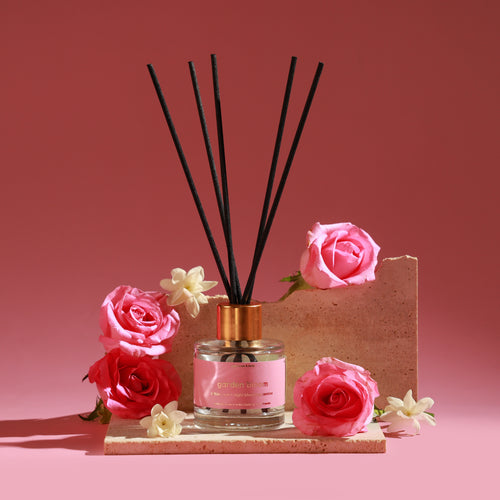
Alcohol-free, unplugged, and steady for months once it has settled — which is the correct product for a reader whose furniture is not yet where it is going to live. A reed takes 24 to 72 hours to reach its proper level, and in this particular situation that delay costs you nothing at all, because you have no deadline and the flat is not ready for scent for several days anyway. Set it up on the evening you finish cleaning and it will be doing its job by the time the boxes are gone. Use three or four reeds rather than the eight in the box, stand it on a coaster because the oil marks wood, and leave it alone. ₹749 for 50ml, ₹1,249 for 130ml, with 300ml refills at ₹2,399.

The smell is in the surfaces, not in the air

Almost everybody arrives at this problem with the wrong mental model, and the wrong model is what makes them spend money badly. People picture a smell as something suspended in the room, a cloud that could in principle be replaced with a nicer cloud. It is not. The air in your new flat has already been changed dozens of times since the previous tenant left, and it still smells of them, which by itself tells you the smell is not stored in the air. It is stored in materials — in porous, absorbent, oil-holding surfaces that have been quietly taking in that household for years and are now quietly giving it back into every fresh volume of air that arrives. Find those surfaces and clean them and the problem ends. Spray something over them and you have two smells instead of one.

1
THE WORST OFFENDER
The inside of the kitchen cupboards, and the backs of their doors
Start in the kitchen, and start inside the cupboards rather than on the counter. Cooking oil does not stay in the pan. Heat aerosolises a fine mist of it that travels several metres and settles as a thin, tacky film on every surface in range — and the surfaces in range include the entire interior of every cupboard within reach of the hob, because cupboard doors are opened during cooking. That film is the problem. It is not itself very smelly, but it is an excellent solvent and an excellent trap, and over several years it accumulates the whole vocabulary of somebody else's kitchen: turmeric, asafoetida, mustard seed, fried onion, fish, ghee. It sits there on plywood and laminate that was never sealed properly on the inside, and every time you open a cupboard door you release a small amount of it into the room. Test it the way I do: put your head fully inside a cupboard with the door shut against your shoulders, and breathe. In perhaps four rentals out of five, the answer to this entire page is in there. The fix is warm water and ordinary dish soap, which is a degreaser and is exactly the right tool for an oil film — not a scented cleaner, which adds a third smell to the two you already have. Take everything out, wipe every interior surface including the backs of the doors and the underside of each shelf, dry them, and then leave every cupboard door standing open for a night or two. The backs of the doors are the part everybody misses and they face the room.
2
THE ENCLOSED VOLUMES
Wardrobes, curtains, carpet — anything that has been holding still air
Then the same logic applied everywhere else it holds, which is anywhere a volume of air has sat undisturbed against an absorbent surface. A built-in wardrobe is the second-worst offender in a rental and for the same structural reason as the cupboards: it is a sealed box of unsealed plywood, it has held one family's clothing for years, and plywood is porous enough to take on detergent, body odour, hair oil, camphor and naphthalene and to release them slowly for months afterwards. Wipe the interiors the same way, pull out any lining paper the last tenant left, and then keep the doors open for several days before you put anything of yours inside. Cotton is patient and absorbent, and a wardrobe that still smells of somebody else will hand that smell to your shirts within a fortnight, at which point you are wearing the problem to work. Curtains, if they were left, are the largest single piece of fabric in most flats and they hang directly in the path of everything the room has ever done. Wash them, and if they cannot be washed, replace them — a pair of curtains is one of the cheaper things on this list and by far the most effective per rupee. The same goes for any carpet or rug that came with the place: a rug can be professionally cleaned, and if it cannot be, it should leave. Soft furnishings you inherit are not furniture. They are somebody else's air, in solid form.
3
THE MECHANICAL THREE
The floor drain, the exhaust fan and the AC filter
Then three quick ones that are not about residue at all, and take under an hour between them. The bathroom floor drain has a trap under it — a bend that is supposed to hold a small standing volume of water and act as a seal between your flat and the building's soil stack. In an empty flat that water evaporates, the seal breaks, and the drain starts admitting sewer gas straight into the room. It is a genuinely common cause of a smell people spend weeks blaming on damp, and the fix takes ten seconds: pour a bucket of water down every floor drain in the flat, including the ones in the balcony and behind the washing machine, and run every tap for half a minute. The kitchen exhaust fan is the second. Its blades and housing carry a felt of old grease that is heated every time the fan runs, which is to say it is a small device for reheating somebody else's cooking and blowing it around your kitchen. Unscrew the cover, wash it, and wipe the blades. The third is the air conditioner, whose filter has been passing the flat's air through a mesh for years and holds both dust and, in most Indian cities for part of the year, damp. Slide the filter out, wash it, dry it fully before it goes back, and run the unit on fan-only for twenty minutes afterwards.
The one-sentence version of this whole section: if a smell survives a completely changed volume of air, it is being released by a surface — so stop trying to treat the air, find the surface, and wash it.

Every surface, ranked by how much it is contributing

The seven places a previous tenant's smell is actually stored, ranked by how much of the problem each one is in a typical Indian rental. The third column is what to do about it and the fourth is roughly how long it takes, because the honest news on this page is that the work is cheap and the time is the expensive part. Nothing in this table costs more than a bottle of dish soap.

Ranked by contribution
Where a previous tenant's smell is actually stored, in order
Surface Why it holds the smell What to do Time Share of the problem
Kitchen cupboard interiors ★ Aerosolised cooking oil settles as a film on unsealed plywood and traps years of spice residue Empty them, wash every interior surface and the backs of the doors with warm water and dish soap, dry, leave open overnight 2–3 hours Largest, by a distance
Wardrobe interiors A sealed box of porous plywood that has held one family's clothing, detergent and naphthalene for years Wipe out, remove lining paper, leave the doors open for several days before your own clothes go in 1 hour, then days of airing Second largest
Curtains left behind The biggest piece of fabric in the flat, hanging in the path of everything the room has done Wash them. If they cannot be washed, replace them — it is the best value item on this list A wash cycle, or ₹500–1,500 Large in a small flat
Carpet or rug left behind Deep pile holds oil, dust and pet residue and releases it whenever anybody walks on it Professional clean, or remove it. Do not shampoo it yourself and then close the room on it A day, or a decision Large if present
Bathroom floor drain and trap The water seal evaporates in an empty flat and the drain starts admitting sewer gas into the room Pour a bucket of water down every floor drain and run every tap for thirty seconds 10 minutes Small but very noticeable
Kitchen exhaust fan Blades and housing carry old grease that is reheated and blown into the room every time it runs Unscrew the cover, wash it, wipe the blades and the housing 30 minutes Small, and constant
Air conditioner filter Years of the flat's own air passed through a mesh, holding dust and seasonal damp Slide it out, wash it, dry it completely, then run the unit on fan-only for twenty minutes 30 minutes plus drying Small, and worse in monsoon
Shop this guide
Once the flat is clean, three ways to make it yours
The SOSA principle
A stranger's kitchen and your new candle do not cancel each other out. They combine, and the third smell is worse than either of the first two.
Which is why the order on this page is not a formality. A scented flat that still smells faintly of somebody else is the worst possible outcome — it reads as concealment, and it is the one impression a new home should never give.

Clean, air, then scent — and what each stage actually takes

Take the airing seriously, because it is the stage people compress and it is the one that cannot be compressed. Cleaning removes the reservoir; ventilation removes what has already left the reservoir and is now in the plaster, the paint, the air and the soft edges of the room, and that takes days rather than hours. The mechanism is simple enough to plan around. Air will not move through a flat unless it has somewhere to enter and somewhere to leave, so a single open window achieves very little — what you want is two openings on opposite walls, ideally on opposite sides of the building, with the internal doors wedged open so there is a continuous path from one to the other. Twenty minutes of that changes the air in a room completely. Two hours of it, repeated morning and evening across three or four days, is what actually shifts a flat that has somebody else's household in its surfaces. Run the ceiling fans while you do it, because they break up the still layer that sits against walls and ceilings and hold nothing but their own history. If you can only manage one long session, make it the day after you clean rather than the day of, so that everything the washing loosened has somewhere to go. And if the building faces a road, do the airing early in the morning, when the outside air is at its cleanest and the flat is at its coolest. None of this costs anything, and it will outperform any product I sell for exactly this problem.

Then the scent, and the reason it belongs at the end rather than the beginning. A fragrance does not displace another smell. It adds itself to whatever is already there, and the nose receives the sum rather than the newest ingredient. Put a lemon reed into a flat that still holds a stranger's fried cooking and the room does not smell of lemon; it smells of lemon and old cooking, which is a stranger and less pleasant thing than old cooking on its own, because the brain reads the combination as an attempt. Everybody has walked into a room like that and known instantly what had happened in it. So the sequence is not fussiness, it is the difference between a flat that smells looked after and one that smells covered. Once the surfaces are washed and the air has been changed several times, the flat will smell of very little, and that neutrality is the actual goal — it is the blank you are then allowed to write on. At that point a reed diffuser from ₹749 is the natural first object, because it needs no electricity in a flat where you have not yet decided where anything goes, and its 24 to 72 hours of settling is irrelevant when you have no deadline. If you would rather have control and coverage, the Sukoon at ₹1,899 runs the Hotel Collection at three to six drops per tank across 270–320 sq ft, gets to a steady level in about twenty minutes, and includes three 15ml scents of your choice — which is ₹897 of fragrance arriving with the machine. The Boond at ₹899 is the same idea in one room. A Bookshop candle at ₹379 is the cheapest possible way to find out whether the room is ready, because a candle tells you the truth in fifteen minutes.

Three last things, and then the reason this page matters more than it looks. The first is that you will lose the ability to judge your own flat within about a fortnight, so make your decisions early. A nose is a change detector and it discards anything constant, which means the previous tenant's smell will seem to fade whether or not you have done anything about it — and it will still be entirely obvious to the first friend who visits. Clean it now, while you can still smell it. The second is the constraints, which are worth knowing before you buy anything. The Hotel Collection is water-based and runs only in an ultrasonic machine — the Sukoon, the Boond and the Megh at ₹3,499 — never in a reed, which is a separate alcohol-free line with its own scents, and never in the waterless Vaayu at ₹11,999, which takes its own undiluted oil. Raw essential and carrier oils clog a 2.4MHz misting plate, so keep them out of the tank, and rinse the tank when you change scent. SOSA does not make a room spray for the home; the sprays in the range are car perfumes, and a spray would be the wrong instrument here in any case, since it treats the air and this problem is not in the air. And the third is the opportunity, which is the real reason to do the work properly: a flat that smells of nothing is the only flat you can give a signature to. Most people never get a clean slate. You have one for about a week, and what you run in the flat from here is what it will smell like to you in five years.

A scented flat that still smells faintly of somebody else is the worst outcome available. It does not read as fragrance — it reads as concealment.
— Sonal Sahani, SOSA

The SOSA edit

In buying order for somebody who has just taken possession of a flat that smells of the last person in it. The first row is free and it is genuinely the first row, and nothing below it works properly until it is done. The last row states what SOSA does not make, so you do not go looking for it.

The SOSA edit
A new rental with somebody else's smell in it, in buying order
Buy What it is When it earns its place Price
1. Dish soap, cloths and four days ★ Cupboard and wardrobe interiors washed, fabric laundered, drains filled, filter and fan cleaned, then cross-ventilation First, always, and it is the largest effect available. This is a real row rather than a modest one — most readers need nothing else Under ₹200
2. reed diffuser · 50ml Alcohol-free reeds in five scents — no electricity, no routine, months of steady background Once the flat is clean and aired. The 24–72 hours it needs to settle costs you nothing when there is no deadline from ₹749
3. Sukoon 500ml, 270–320 sq ft, 16–18 hours on low, steady/2H/4H timers, three 15ml scents included If you want control, coverage and the ability to change your mind. ₹897 of fragrance arrives with the machine ₹1,899
4. Bookshop candle 80g scented jar candle, roughly 15–18 hours of burn, scent in the room in 15–20 minutes As a test rather than a solution. Fifteen minutes tells you honestly whether the room is ready for anything at all ₹379
5. Boond or a second reed diffuser 300ml ultrasonic for a single room, or a second reed for the bedroom Later. One scent in the main room first, for at least a few weeks, before the flat gets a second one ₹899 / from ₹749
Not in the range: a room spray for the home The SOSA sprays are car perfumes, formulated and sized for a car cabin Printed rather than implied — and a spray treats air, while this problem is stored in surfaces
Honest notes for buyers: fragrance is the last step, not the first — it layers on air that is already clean and moving, and it will not cover cooking, damp or a room that has been shut for weeks. Timing matters as much as product: a candle scents a room in fifteen to twenty minutes and a Sukoon in about twenty, which is why both work when people are arriving tonight, while a reed diffuser needs a day to three days before it is doing its job properly — it is the wrong buy for a deadline and the right buy for a room you want to hold a steady scent for months. SOSA does not make a room spray for the home; the sprays in the range are formulated and sized for a car. The Hotel Collection is water-based and runs in the Sukoon, Boond and Megh only — not in reeds, and not in the waterless Vaayu. Reed diffusers are a separate alcohol-free line with their own scents. Candles must be attended and put out before guests leave a room unattended. The Hotel Collection scents are SOSA's own interpretations inspired by the world's finest hotels; SOSA is an independent Indian fragrance house, not affiliated with or endorsed by any hotel brand. A portion of every order supports girl-child education through Nanhi Kali.
SOSA Sukoon
If you would rather own the machine than the bottle
SOSA Sukoon ₹1,899
A 500ml BPA-free tank rated for 270–320 sq ft, 16–18 hours per fill on low at 30–50 ml/h against 9–12 on high, a 2.4MHz cool-mist plate, a remote, auto shut-off and steady, 2H and 4H timers — and three 15ml Hotel Collection scents of your choice included, worth ₹897, which makes it the best single purchase in the range for somebody starting a house from nothing. It reaches a steady level in about twenty minutes from cold, so unlike a reed it can be tested the same evening you clean, which is useful when you are trying to work out whether the room is actually ready. Three to six drops per tank, and the dose is per tank rather than per litre.
SS
ISIPCA
Versailles
A note from Sonal

I have been asked this question more often than any other by people in their first month somewhere new, and the email almost always contains the same sentence: I have cleaned everything and it still smells. My first reply is always the same question back — did you clean the inside of the cupboards, and did you clean the backs of the doors. The answer is nearly always no, because cupboards are storage rather than surface and nobody thinks of storage as dirty. But a cupboard door is opened while somebody cooks, several times a day, for years, and the inside of it has been standing in the path of a fine mist of hot oil the entire time. That film is where a household's whole history is kept.

The reason I care enough to write eight hundred words about plywood is that the alternative outcome is one I find genuinely sad. Somebody spends money with me in their first week, puts a good scent into a flat that has not been dealt with, and ends up living in a compound smell they cannot identify and eventually blames on the fragrance. They stop using it. They conclude that home fragrance is not for them. All of that started with a purchase made two weeks too early. So: wash the cupboards, air the place for days with windows on two walls, and let it get to the point where it smells of nothing much at all. That empty week is the most valuable thing a new flat gives you, because it is the only moment when you get to decide from scratch what your home smells like.

Everything is made and supported from Pune, and a part of every order funds girl-child education through Nanhi Kali. You get a home that smells like somewhere you chose; a girl gets a classroom. That equation has always felt right to me.

Frequently asked questions

Why does my new rental still smell of the previous tenant even after cleaning?
Because the smell is stored in surfaces rather than in the air, and the usual surfaces are the ones a normal clean does not touch: the insides of kitchen cupboards and the backs of their doors, wardrobe interiors, inherited curtains and rugs, the drain trap, the exhaust fan and the AC filter. Wash those with warm water and dish soap, then cross-ventilate for several days.
Can I just use a strong home fragrance to cover a previous tenant's smell?
No, and it makes things worse. Fragrance does not displace another smell, it adds to it, and the nose receives the combination rather than the newest ingredient. A room with a stranger's cooking and a new scent in it smells of both, and people read that combination correctly as an attempt to cover something.
How long should I air a new flat before adding any fragrance?
Several days rather than several hours, using two openings on opposite walls so the air actually moves. Two hours of genuine cross-ventilation morning and evening across three or four days is a realistic target. Fragrance goes on last, once the flat smells of very little.
Is a reed diffuser or the Sukoon better for a flat I have just moved into?
Either, and the choice is about your week rather than the scent. A reed diffuser from ₹749 needs no electricity and no routine, which suits a flat where nothing is in its final place yet, and its 24 to 72 hours of settling costs nothing when you have no deadline. The Sukoon at ₹1,899 covers 270–320 sq ft, reaches a steady level in about twenty minutes and includes three 15ml scents of your choice.
Why does the bathroom smell bad in a flat that has been empty?
Usually a dry drain trap. The bend under a floor drain holds a small volume of water that seals your flat from the building's soil stack, and in an empty flat that water evaporates and the seal fails. Pour a bucket of water down every floor drain and run every tap for thirty seconds.
Clean first, then choose
Wash the cupboards, air it for daysthen decide what it smells of
Reed diffusers are ₹749 for 50ml and ₹1,249 for 130ml, alcohol-free and steady for months with nothing to switch on. The Sukoon is ₹1,899 for 270–320 sq ft with steady, 2H and 4H timers, 16–18 hours per fill on low and three 15ml Hotel Collection scents of your choice included. The Bookshop candle is ₹379. Free shipping above ₹499, and a portion of every order supports girl-child education through Nanhi Kali.
Shop reed diffusers → See the Sukoon · ₹1,899
Continue the read
More from SOSA
Editorial standards & sources
About this guide: Written by Sonal Sahani, ISIPCA Versailles-trained founder and perfumer at SOSA Home & Body, on why a previous tenant's smell survives a change of air, which seven surfaces actually store it, why kitchen cupboard interiors are the worst offender in an Indian rental, why a dry drain trap admits sewer gas into an empty flat, and why fragrance laid over any of it produces a compound smell worse than the original.

Facts verified August 2026: Timings in this guide: a scented candle puts noticeable fragrance into a normal room in roughly 15–20 minutes; a Sukoon ultrasonic diffuser reaches a steady level in about 20 minutes from cold; a reed diffuser needs roughly 24–72 hours for the oil to travel the reeds and the room to settle, so it is not a same-day solution. SOSA products and prices: Sukoon 500ml ultrasonic diffuser ₹1,899 (270–320 sq ft, 16–18h on low, 9–12h high, 30–50 ml/h, 2.4MHz cool mist, 7-colour LED, remote, steady/2H/4H timers, BPA-free, auto shut-off, includes three 15ml Hotel Collection scents of your choice); Boond 300ml ₹899; Megh 6-litre ₹3,499; waterless Vaayu ₹11,999 (up to 1000m³); Aangan ₹25,999; Meenar ₹38,500. Hotel Collection water-based fragrance 15ml ₹299, 100ml ₹999, 300ml ₹1,799, Pack of 7 at 15ml ₹1,799 / 100ml ₹5,999 / 300ml ₹10,799; dose 3–6 drops per tank. Reed diffusers (separate alcohol-free line): Morning Freshness from ₹749, Garden Bloom and Evening Calm from ₹799, Fresh Brew and Mountain Breeze from ₹849; 130ml from ₹1,249; duos from ₹1,498; 300ml refills ₹2,399. Scented candles: Bookshop 80g ₹379 (~15–18 hours), Bookshop + Cozy Corner ₹664 (~30–36 hours), Amber Rose 130g ₹599 (~25–30 hours) and 220g ₹799 (~40–50 hours), ceramic jar candles ₹949, Pure Calm wax melt set ₹854. Free shipping above ₹499. SOSA does not make a room or linen spray for the home — the sprays in the range are car perfumes. The Hotel Collection scents are SOSA's own interpretations; SOSA is not affiliated with or endorsed by any hotel brand. Prices subject to change — see the live product pages.
Zurück zum Blog