

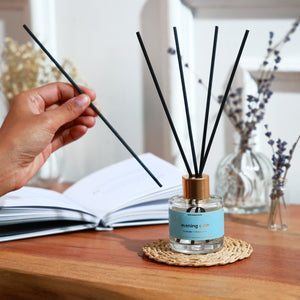

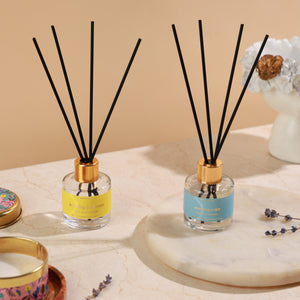
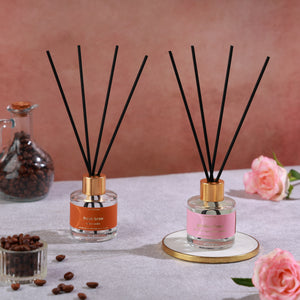
The seasonal adjustment: three reeds through the monsoon, when humidity holds scent in the room; four to five in dry winter air, which pulls it away faster. The reed count is the lever — not a second bottle.
If it seems to have stopped working: ask a visitor before you buy anything. Most of the time it is your own nose adapting, not a dead bottle.
2. Open one window for eight minutes every morning. A reed diffuser has no fan, so scent has to move off the fibres into still air by evaporation alone. A little air exchange carries that scent further into the room before it settles back onto the same few square feet around the bottle. Eight minutes is enough to turn the air over once without cooling the flat down or undoing anything the AC did overnight.
3. Keep the bathroom door closed, always, and the kitchen door closed while you cook. A rented flat's layout is fixed — you cannot move a wall or add a vent — so the doors you already have are the only airflow control on offer. A closed bathroom door holds humidity and fragrance together in a small room where both work in your favour; a closed kitchen door keeps frying and tadka smoke from cutting straight through whatever the living-room bottle is doing.
4. Stand the bottle about 300mm off any window, never on the sill. Direct sun heats the glass and accelerates the lighter top notes off first, so a bottle left on a sill smells brighter for a week and then oddly hollow — the top notes are gone and only the heavier base is left. Thirty centimetres of distance and any curtain or blind removes almost all of that effect.
5. Re-dose by season, not by memory. Three reeds usually carry a room through the monsoon, when the humidity in the air itself helps hold fragrance close to where it is released. The same three reeds under dry winter air, where moisture and scent both leave a room faster, read as noticeably weaker — that is the point to add a fourth or fifth reed, not to open a new bottle.
Get these five right and a single Morning Freshness 50ml at ₹749 or an Evening Calm 50ml at ₹799 runs 10–14 weeks. Alcohol-free, IFRA-compliant, composed by an ISIPCA Versailles-trained perfumer and handmade in small batches in Pune — and every purchase funds a girl's education through Nanhi Kali.
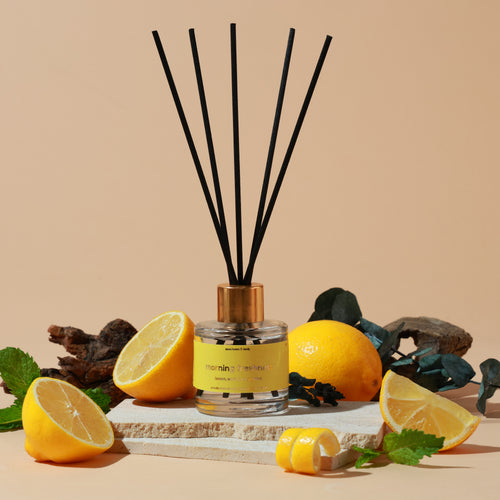
Why a rented flat needs a routine, not a bigger bottle
A homeowner who finds a room's fragrance fading can renovate around the problem — cut a vent, add a fan, move a wall. A tenant cannot. The layout of a rented flat is fixed the day you sign the agreement: one window in the living room, a kitchen that opens straight onto the passage, a bathroom with no extractor. None of that is going to change, and none of it needs to, because a reed diffuser was never solving for square footage in the first place. It was always solving for a handful of small, repeatable habits around a bottle that already works.
This is the part that gets missed. People treat "the flat smells fresh every day" as a strength-of-product question — is this bottle strong enough, is 50ml really enough, should I buy the 130ml just to be safe — when it is actually a timing question. A reed diffuser releases fragrance continuously and at a fairly constant rate for as long as the reeds are wet, wherever it stands and whatever size it is. What changes week to week is not the bottle's capability; it is whether the reeds were flipped on schedule, whether the room got any air exchange, whether a door was left open at the wrong moment, and whether the reed count still matches the season outside. Every one of those is something you do, not something you buy.
That reframe matters most for a renter precisely because the alternative — buying more, buying bigger, buying a second bottle — is the expensive way to solve a problem that a five-minute weekly habit solves for free. A ₹749 bottle maintained on schedule outperforms a ₹1,249 bottle left to its own devices, and it does so at a lower weekly cost. The routine is the upgrade. The bottle was already enough.
The three maintenance decisions that actually matter
 Morning Freshness 50ml₹749Flipping is the only moving part in this entire product. Each reed is a wick — oil climbs it by capillary action, and the exposed end releases fragrance as it evaporates. Flip that end back into the bottle and expose the drier end instead, and you get a fresh burst of throw for a day or two while the newly exposed fibre saturates. The mistake is assuming that if a little flipping helps, more flipping helps more. It does not, because the fibre cannot saturate meaningfully faster than it already does — flipping daily just drags oil up and off the reed before the room has had time to benefit from it, so the bottle empties in five to six weeks instead of ten to fourteen, for a throw that never actually gets stronger.
The daily, weekly and seasonal routine, in one table
None of this needs an app, a reminder or a second bottle. It is six habits, most of them under a minute, run on their own separate clocks — some daily, some every few days, one only when the weather changes.
| Task | Do this | Interval | Why it works |
|---|---|---|---|
| Flip the reeds | Saturated end back into the bottle, dry end out | Every 3–5 days | Lets the exposed end refresh without over-draining the reed; daily flipping wastes oil for no extra throw |
| Air the room | Open one window | 8 minutes, each morning | Moves scent off the fibres and into the room rather than letting it settle in place |
| Bathroom door | Keep it closed | Always | Holds humidity and fragrance together in a small, enclosed room |
| Kitchen door | Keep it closed | While anything is cooking | The only airflow control a rented kitchen offers; keeps smoke out of the rest of the flat |
| Bottle placement | Stand it ~300mm off any window, never on the sill | Fixed — set once | Direct sun burns off the top notes early and leaves the heavier base behind |
| Reed count | Adjust up or down | At each season change | Monsoon humidity holds scent on fewer reeds; dry winter air needs more to compensate |
| Note on nose adaptation: if the flat smells fine to a visitor but flat to you, that is your smell receptors adjusting to a constant background, not a finished bottle. Step out for an hour, or ask someone else, before you decide anything needs replacing. | |||
Morning Freshness · kitchen-side rooms50ml ₹749Shop → 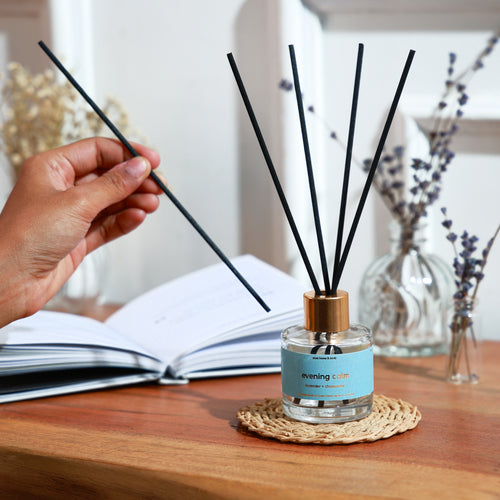 Evening Calm · the bedroom50ml ₹799Shop →
 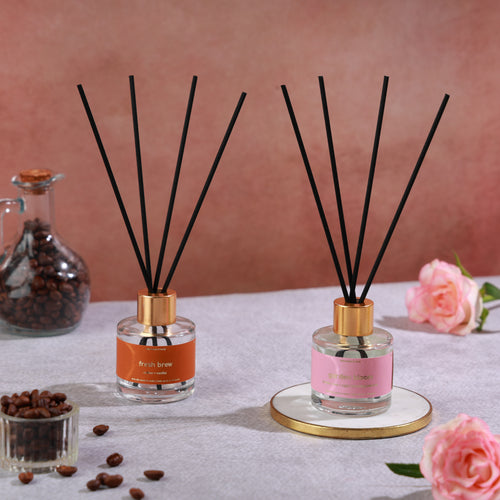 Refill · once the routine has run its course300ml ₹2,399Shop →
Reed count, placement and the deposit-safety rules
Reed count is the one variable that should move through the year, and most people leave it fixed at whatever it was set to on day one. Through the monsoon, the air itself is carrying moisture that slows evaporation and keeps fragrance sitting closer to where it was released, so three reeds in a small bedroom or bathroom is often plenty. Once the air turns dry — typically from late October through winter in most Indian cities — the same three reeds read as noticeably fainter, because dry air both evaporates the oil faster off the exposed fibre and disperses the released scent more quickly than humid air does. Four or five reeds through the dry months restores the same felt strength the three reeds gave you in August, for the same bottle, at no extra cost beyond pulling two more sticks out of the box that came with it.
Placement is worth getting right once and then never thinking about again. Keep the bottle roughly 300mm — about a foot — from any window, and off the sill entirely. A closed window with strong afternoon sun still heats the glass and the oil inside it; the lighter top notes are the first casualties, which is why a bottle left on a sill smells brightest in week one and strangely one-dimensional by week four, with only the heavier base note still coming through. A shelf, console or dresser a foot back from the glass avoids nearly all of that heat without needing a different room entirely.
And because this is a rented flat, the placement decision is also the deposit decision. Reed oil will mark polished wood, laminate and painted surfaces if the bottle wicks, sweats or is knocked over, and a security deposit is not the place to find that out. Stand every bottle on a saucer, coaster or small tray, on a surface you would not mind a faint ring appearing under regardless. It costs nothing, it takes five seconds when you first set the bottle down, and it is worth more to a tenant than any fragrance choice in this guide.
What it costs to keep a rented flat smelling fresh every day
The arithmetic below is checked by hand. A reed diffuser has no electricity cost and no running consumable beyond the oil itself, so a maintained bottle is genuinely cheaper per week the longer it is made to last — which is the entire case for getting the routine right rather than replacing the bottle.
| Route | What you get | Runs | Cost per week |
|---|---|---|---|
| The start ★ | One Morning Freshness 50ml ₹749, flipped every 3–5 days | 10–14 weeks | ₹54–₹75 |
| The bedroom pick | One Evening Calm 50ml ₹799, same schedule | 10–14 weeks | ₹57–₹80 |
| The two-room duo | Day & Night duo, 2 × 50ml ₹1,498 — saves ₹50 against buying both separately | 10–14 weeks each | ₹107–₹150 |
| The over-flip mistake | The same bottle, flipped daily instead of every 3–5 days | 4–6 weeks | ₹125–₹187 |
| Running cost | A 300ml refill ₹2,399 — about six 50ml fills into the same glass | Ongoing | ≈₹400 a fill |
Versailles
The question I get most from renters is not "which scent" — it is "why did it stop working." Almost every time, when I ask a few follow-up questions, the answer turns out to be one of two things: the reeds were being flipped every day instead of every few, or the person asking has simply lived with the bottle long enough that their own nose has gone quiet on it. Neither is a reason to buy a second bottle.
Human smell adapts to a constant background scent within days — it is not a flaw in you, and it is certainly not a flaw in the fragrance. It is exactly why I always ask a client to check with a flatmate, a visitor, or their own reaction after a night away, before they conclude anything is finished. Nine times out of ten, the flat still smells exactly as it should. It is the person standing in it who has stopped noticing.
So the advice I give renters is deliberately unglamorous: flip on schedule, crack a window for a few minutes each morning, mind the doors you already have, and change the reed count with the weather rather than the bottle with the month. None of that costs anything beyond a habit. Every purchase funds a girl's education through Nanhi Kali — not a percentage, not a quarterly cheque. Every one.
Frequently asked questions
- How to make a rented flat smell amazing — the setup this routine is built to protect.
- Best reed diffuser for a rented apartment — which bottle and scent to start with.
- The cheapest way to keep a rented flat smelling good — where ₹379 and ₹474 genuinely beat a reed.
- Is a reed diffuser worth buying if I move flats often? — what survives a move and what does not.
- Brand: the SOSA founder story.
SOSA products & prices (verified August 2026): Scented candles from ₹379 (small, ~15–18 hrs) · candle duos ₹664 (~30–36 hrs) · wax melts ₹474 · woodenwick and ceramic jar candles ₹949. Reed diffusers: Morning Freshness 50ml ₹749 · 130ml ₹1,249 · Evening Calm 50ml ₹799 · 130ml ₹1,299 · Garden Bloom 50ml ₹799 · 130ml ₹1,299 · Fresh Brew 50ml ₹849 · 130ml ₹1,349 · Mountain Breeze 50ml ₹849 · 130ml ₹1,349; six fibre reeds and refillable glass with every bottle, 50ml lasts 6–8 weeks at six reeds and longer at three, 130ml 14–18 weeks. Reed duo sets 2 × 50ml ₹1,498–₹1,598 · 2 × 130ml ₹2,498–₹2,598. Reed refills 300ml ₹2,399 · 500ml ₹3,499. Ultrasonic diffusers: Boond ₹899 (USB) · Sukoon ₹1,899 (ships with three 15ml fragrances) · Megh ₹3,499; Hotel Collection water-based fragrance 15ml ₹299 · 100ml ₹999 · 300ml ₹1,799 — a fragrance for a machine, not a standalone product. Reed oil and the water-based Hotel Collection are not interchangeable. Alcohol-free, phthalate-free, paraben-free, IFRA-compliant; composed and handmade in small batches in Pune. Every purchase funds a girl's education through Nanhi Kali. Prices and availability subject to change — see the live product pages.