



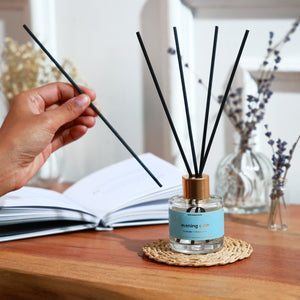
The object: plain, with no festival iconography, nothing printed on it, nothing to take part in and nothing edible. A 50ml reed diffuser at ₹749 is a glass bottle and six reeds; a jar candle at ₹379 is a jar. Neither carries a motif.
Give everyone on the list the same thing. Uniformity is the practical form of inclusion here: nobody is singled out for special handling and nobody is left off.
Avoid food above all. Sweets and hampers carry the most assumptions of any category — about ingredients, about restrictions, about what someone eats and when. A non-edible gift asks nothing of anyone's kitchen.
2. Choose an object with nothing on it. No festival imagery, no motifs, no printed message, no engraving, nothing that has to be lit at a particular moment or used in a particular way. A plain glass bottle or a plain ceramic jar carries no instruction to anybody.
3. Give the same thing to everyone on the list. The moment one person on a team receives something different, the difference becomes the message. Uniformity removes both errors at once — nobody is singled out for careful handling, and nobody is quietly left off.
4. Avoid food, and avoid it hardest here. Edible gifts carry assumptions about ingredients, preparation, restrictions and timing that you almost certainly cannot verify, and being wrong about food has a consequence that being wrong about a candle does not.
5. Hand it over the same way you hand over everything else. No ceremony, no explanation, no speech about inclusion. A gift that arrives with a paragraph attached makes the recipient the subject of the moment, which is the opposite of what you were trying to do.
6. Prefer something that finishes. A consumable leaves nothing permanent in someone's home and no obligation to display it when you next visit. A 50ml reed diffuser is empty in 6–8 weeks; a ₹379 jar candle in an evening or two.
7. If they decline, stop. Some people would rather not receive anything tied to an occasion, and saying so takes a certain amount of nerve. Take it at face value, without persuasion and without treating it as a problem to solve.
Everything is composed and handmade in small batches in Pune, and a portion of every order supports girl-child education through Nanhi Kali.
Part one — the sentence, the object, the diet
Three things decide whether this lands as courtesy or as an assumption, and only one of them costs money. I have put them in the order in which they actually matter, which is not the order most people think about them in — the wording comes first, the object second, and the price a distant fourth.
 Everyday mug₹474Three properties, in order of importance. No iconography — nothing with a lamp, a motif or an emblem on it, because a decorative object marked with someone else's occasion becomes a thing the recipient has to find a place for and keep. Nothing to take part in — anything that has to be lit at a particular moment, or used in a particular sequence, is an invitation rather than a gift, and an invitation should be extended in words where it can be declined. And nothing permanent, ideally: a consumable finishes and leaves the situation clean. An Everyday Beautiful Mug at ₹474 is the exception I would allow, because it disappears into a kitchen and becomes an ordinary object within a week. Plain jars and plain glass only: nothing with a slogan, a joke or a message printed on it belongs on any list, and least of all on this one.
Part two — what each gift quietly assumes
The audit below is about assumptions, not about taste or quality. Every row asks the same two questions: what does handing this over take for granted about the person receiving it, and does it require them to participate in anything? No price appears for any category outside our own range, because the point has nothing to do with cost.
| The obvious gift | What it quietly assumes | Does it ask them to take part? | The courteous version |
|---|---|---|---|
| A plain unmarked object ★ | Nothing at all about the recipient | No — it is simply used, or not | Already correct: 50ml bottle ₹749 |
| A box of sweets or a food hamper | Ingredients, restrictions, timing, a whole kitchen | Yes — it has to be eaten to be a gift | Anything non-edible: jar candle ₹379 |
| Lamps, diyas or a tealight set | That the occasion is theirs to mark | Yes, and at a particular moment | Cloud trinket dish ₹664 — a dish, and nothing more |
| Decor carrying festival motifs | That they want your occasion on their wall | No, but it must be kept and displayed | Something that finishes: Evening Calm ₹799 |
| A card addressed to their festival | That they mark it — the commonest slip of all | No, but it lands as a small correction | A line that says the gift is from you, this Diwali |
| Giving only to the colleagues who celebrate | That you know who does, from their name | No — it excludes instead | The same object for the whole floor, no exceptions |
| The honest caveat: plenty of people are perfectly happy to receive sweets, lamps or a card with a festival greeting on it, and will think none of this worth a moment's thought. The reason to default to the plain version is not that the other is offensive — it is that you cannot tell in advance which recipient is which, and the plain version is the one that is correct in both cases. This is a page about buying without information, which is the situation nearly every Diwali list puts you in. | |||
 Misty Mornings · a jar, unmarked₹379Shop →
  Cloud dish · a dish, and nothing more₹664Shop →
 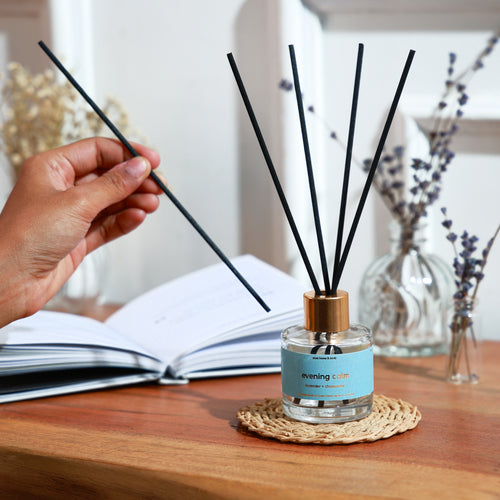 Evening Calm · the softest, and it ends₹799Shop →
Part three — the two opposite ways this goes wrong
The first failure is over-correction, and it is the more common one among people who are trying hard. It looks like this: the gift is chosen separately, wrapped differently, handed over privately, and accompanied by an explanation of why it has been thought about so carefully. Every one of those adjustments makes the recipient the subject of the moment. A colleague who receives a different parcel from everyone else on the floor, together with a small speech, has been marked out rather than included, and the kindness is now something they have to respond to. The remedy is simple to the point of being dull: the same object, the same wrapping, the same handover, the same three or four words for everybody.
The second failure is the opposite and it is quieter. It is the list that is assembled by guessing who does and does not mark the occasion — usually from names, which is both unreliable and not a thing anyone should be doing — and then leaves some people off. Being skipped is noticed far more sharply than being included slightly imperfectly. If you are giving to a team, a floor, a building committee or a set of neighbours, the unit is the whole group. Fourteen identical bottles at 14 × ₹749 = ₹10,486, or fourteen candles at 14 × ₹379 = ₹5,306, are both defensible; a list of nine with five names quietly omitted is not, whatever it cost.
There is a third case, less a failure than a fact. Some people would prefer not to receive anything connected to an occasion at all, and a person who says so has usually thought about it more carefully than you have. Take it at face value. Do not persuade, do not leave it on their desk anyway, and do not treat it as an obstacle. A short acknowledgement and no parcel is a complete and courteous outcome, and it costs nothing — which, on a long Diwali list, is occasionally the most welcome line in the whole budget.
Part four — seven names, what to say and what to hand over
Seven relationships from a normal Diwali list, the wording I would use for each, and the object. The wording is doing most of the work; the price column is deliberately narrow, because on a list like this the point is that everybody gets the same thing rather than that anybody gets an expensive one.
| Who you are giving to | The sentence I would use | The object | Cost |
|---|---|---|---|
| A mixed team of fourteen ★ | "We're celebrating Diwali — one of these for everyone" | One SKU, fourteen times: Morning Freshness 50ml | 14 × ₹749 = ₹10,486 |
| A large office floor, tighter budget | The same line, said once to the room | Misty Mornings jar candles, identical | 14 × ₹379 = ₹5,306 |
| A neighbour you know a little | "We're celebrating this week and wanted to send something" | Garden Bloom 50ml | ₹799 |
| Someone who works for you | Nothing elaborate — hand over the envelope first | Cash, then a Sandalwood jar if you want an object too | ₹449 on top of the cash |
| A client or supplier contact | "From all of us here, this Diwali" | Cloud trinket dish — desk-sized, unmarked | ₹664 |
| A close friend who marks other occasions | Say whatever you normally say to them | Evening Calm 130ml, the softest in the range | ₹1,299 |
| Someone who has said they would rather not | "Understood — happy to leave it" | Nothing. Do not send it anyway | ₹0 |

Versailles
We are a small workshop in Pune and the people who make our candles and fill our bottles do not all mark the same days. That was the first place I had to think about this properly, and what I learned there was not about products at all. The thing that works is treating the occasion as mine to share rather than as a category people fall into. Everyone gets the same thing, everyone gets it the same way, and the sentence is about us, not about them.
I would also say plainly what this company is not. SOSA makes no ritual product. Nothing on our shelf is described as suitable for any observance, and I would not sell one that was, because I am a perfumer and that is not my subject. What I make is fragrance for rooms. It has no meaning attached to it beyond what a room smells like, and on a page like this, that absence is precisely the useful property.
I will not tell you that any gift will be appreciated or will smooth anything over. I do not know that. I can tell you that a plain bottle carries no imagery, that a 50ml is finished in 6–8 weeks, and that fourteen identical ones remove a great many decisions from a difficult week. Everything is made in Pune in small batches, and a part of every order funds a girl's classroom through Nanhi Kali.
Frequently asked questions
- Is it rude to give everyone the same gift? — the uniformity argument in full.
- What not to gift and whether to gift your boss.
- Is a reed diffuser appropriate for anyone? — where fragrance is the wrong call.
- The Diwali gifting etiquette guide — direction, distance and visibility, end to end.
- Brand: the SOSA founder story.
SOSA range & prices used in this guide (verified from the live store, 27 August 2026): Reed diffusers — alcohol-free, phthalate-free, paraben-free, IFRA-compliant compositions on a heat-stable coconut-derived (CCT) carrier, in a refillable glass bottle with six fibre reeds; 50ml lasts 6–8 weeks, 130ml lasts 14–18 weeks. Morning Freshness 50ml ₹749 · 130ml ₹1,249; Garden Bloom ₹799 · ₹1,299; Evening Calm ₹799 · ₹1,299; Fresh Brew ₹849 · ₹1,349; Mountain Breeze ₹849 · ₹1,349. Duo sets: Day & Night ₹1,498, Fresh & Grounded ₹1,548, Warmth & Bloom ₹1,598 (2 × 50ml); ₹2,498–₹2,598 (2 × 130ml). Oil-only refills 300ml ₹2,399 · 500ml ₹3,499 (vessel and reeds not included). The least expensive SOSA reed diffuser is ₹749 — no reed diffuser exists below that price in any size. Below it: scented jar candles from ₹379 (roughly 15–18 hours), Sandalwood or Smoked Oudh jar candle ₹449, wax melts ₹474 (a burner is needed and is not included), ceramic mugs ₹474, ribbed and face mugs and taper candles ₹569, Amber Rose candle ₹599, ceramic trinket dish ₹664, candle two-pack ₹664 (roughly 30–36 hours). Machines: Boond 300ml ₹899 · Sukoon 500ml ₹1,899 · Megh 6L ₹3,499 (~215 sq ft, a runtime and humidity machine rather than a coverage upgrade) · waterless Vaayu ₹11,999 · Safar car and travel diffuser ₹3,999. The water-based Hotel Collection (15ml ₹299 · 100ml ₹999 · 300ml ₹1,799) is a fragrance for an ultrasonic machine, not a standalone gift. SOSA publishes no bulk or corporate gifting terms — there is no discount slab, no minimum order quantity, no stated GST-invoicing arrangement, no custom branding service and no published lead time — and SOSA sells no gift card, gift hamper, gift box or curated gift set. Larger orders should be discussed with SOSA directly through the contact page before committing. Gift wrapping, gift notes, direct-to-recipient shipping and delivery timing are unconfirmed — check at checkout rather than assuming them; no delivery date is promised anywhere in this guide. Per-head and total costs shown are arithmetic on the listed prices, not quotations. Fragrance adds scent to a room; it does not clean air, remove cooking or smoke smells, or change how anyone feels. Fragrance oil is flammable — keep any diffuser away from diyas, candles and open flame. Composed and handmade in small batches in Pune, India; tested through 45°C summer heat and 85% monsoon humidity. Free shipping above ₹499. A portion of every order supports girl-child education through Nanhi Kali. Prices subject to change — see the live product pages.