



Why age zoning fails: a newborn and a teenager share the same six chairs and the same return grille.
Why staff cannot manage it live: olfactory adaptation is complete in about twenty minutes, so nobody at the desk can judge the level by mid-morning.
What it produces: a lower setting than a single-age clinic would run, and frequently nothing at all.
2. And frequency does not reduce the weight of that case. Owners often argue that newborns are five per cent of the list, so the newborn cannot set the policy for the other ninety-five. But the setting is fixed and the newborn attends anyway, so the five per cent is not diluted — it is simply the group for whom the fixed setting is wrong. The only way frequency would matter is if the setting could change when they arrive, and it cannot: a diffuser has thermal and sorptive inertia, soft furnishings hold what has already been emitted, and nobody at a busy desk is watching the door to adjust a duty cycle.
3. Which is why live adjustment is not a plan. The suggestion that comes up next is to run higher during the school-age afternoon clinic and turn it down for the morning baby session. It fails on three counts. Staff have been in the building for hours and olfactory adaptation is essentially complete in about twenty minutes, so they cannot judge what they are adjusting. The room does not clear on demand — a closed clinic sits at roughly 0.2 to 0.5 air changes an hour, so an afternoon’s output is still present in the evening. And cushions, curtains and soft toys released nothing on a schedule.
4. Zone by air, or do not zone at all. There is one legitimate version of the split, and it is worth doing for infection-control reasons anyway: separate well-child and sick-child streams, each with its own waiting area. If those two areas are genuinely separate air spaces with separate return air, then it is defensible to leave the sick-child stream completely unscented and run a light note in the well-child stream. If they are two halves of one room with a screen between them — which is the usual arrangement — they are one air space and the stricter answer applies to both.
5. The result is lower than a single-age clinic, and often nothing. Work the rule honestly and a multi-age clinic ends up with a setting below what a clinic seeing only school-age children would choose, in a format with a low ceiling rather than a wide adjustment range, and frequently with the conclusion that the front of house is not worth scenting at all. That is a normal outcome of this reasoning rather than a failure of it, and the clinic loses nothing by it if the housekeeping, ventilation and interior work has been done.
Made in India, composed by an ISIPCA Versailles-trained perfumer — and a portion of every order supports girl-child education through Nanhi Kali.
Why averaging a patient list is the wrong operation
The instinct to average comes from thinking of scent as a service level — something delivered to a customer base, where you optimise for the middle and accept some dissatisfaction at the tails. That framing works for seating, magazines and appointment lengths, and it does not work for air. Air is a single shared condition, not a distribution of individual experiences, and the person at the tail is not mildly under-served; they are the only person for whom the condition is actually wrong. A newborn in a carrier at knee height and an adolescent at standing height are not receiving different service levels — they are receiving different doses of the same emission, and the younger, smaller occupant is receiving the larger one, because concentration falls with distance from the source and a child’s breathing zone sits roughly 0.8 to 1.2 m from the floor against an adult’s 1.5 to 1.7 m. The tail of your age distribution is also the high end of your dose distribution. Averaging gets that exactly backwards.
The second reason is that multi-age clinics are the clinic type least able to correct a mistake. A single-purpose clinic can tune its environment to one population and know quickly whether it is working. A general paediatric list produces a stream of one-off encounters across the whole age range, so a setting that is uncomfortable for a small group generates almost no feedback — the family that found the waiting room oppressive simply does not mention it, and may not return. Meanwhile staff cannot smell the level, and the well-documented consequence is that clinics creep upward rather than downward over time. In an environment with weak feedback and a known drift direction, the sensible engineering response is to start low and remove the adjustment — which is why a format with a ceiling often beats a machine with a range in exactly this clinic type.
Three moves for a mixed-age list
 A ceiling, not a dialFrom ₹749Go through a normal week and identify the least tolerant patient who is routinely in the waiting area: newborn and under-one attendances, asthma and nebulisation follow-ups, post-viral cough, allergic rhinitis, and any child whose family has told you they react to added fragrance. Write down which of those is your design case and put the name of the group — not an individual — on the policy page. Every subsequent decision, from format to setting to whether to scent at all, follows from that one line, and it stops the discussion restarting each time a new member of staff joins the desk.
Zone by zone, for a general multi-age clinic
The second row is where multi-age clinics differ from every other clinic type in this cluster, because it is the row where a newborn, an asthmatic eight-year-old and a well adolescent are all sitting at once.
| Area of the clinic | Scented? | Why | What we would use |
|---|---|---|---|
| Entrance and reception desk ★ | Yes, at the bottom of the range | Short dwell and arriving noses — but the same air reaches the seating four metres away | Reed on three reeds from ₹749, kept behind the counter |
| Shared waiting seating, all ages | Minimum, or nothing | A carrier at knee height and a teenager at standing height take different doses of one emission | No separate unit — and nothing where newborns wait routinely |
| Well-child stream on genuinely separate air | Reviewable | The only legitimate age split, and only where it has its own return path and a door | A reed, if governance agrees and the split is verified |
| Sick-child and respiratory waiting stream | No | Asthma, nebulisation follow-up and post-viral cough attend here — the design case for the building | Nothing |
| Consultation, examination and sample-collection rooms | No | Clinicians rely on their own sense of smell and the patient cannot move away from the room | Nothing |
| Vaccination, nebulisation and neonatal follow-up | Never | Injection association, respiratory patients and newborns — none of it is open to local variation | Nothing |
| Before any of this: this table assumes the housekeeping and ventilation baseline is already clear. A mixed-age waiting room accumulates more than most — nappy bins, spills, wet coats, soft toys — and a describable smell at six in the evening is a source to trace rather than a level to set. | |||
Small reception · no power neededFrom ₹749Shop →  Mid reception · has an off switch₹1,899Shop →
 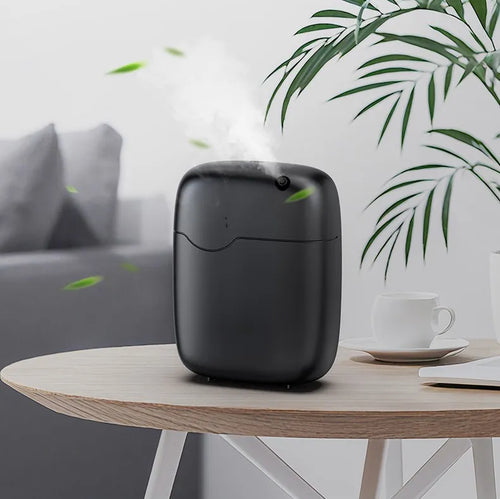 Large lobby · timed, dialable₹11,999Shop →
Setting it for the limiting case
Choose a format with a ceiling before you choose a level. In most clinic types we would start from what the machine can do; here the more useful question is what it cannot. A reed diffuser on three reeds has a fixed maximum that no adaptation-blind member of staff can exceed, and that is a genuine engineering advantage in a room with a mixed list. If the reception is large enough to need an active unit, a Sukoon at three drops in intermittent mode, or a Vaayu at the shortest on-time and longest off-time it offers, scheduled to clinic hours only. Direction stays dry and low in sweetness rather than floral or gourmand.
Then calibrate seated, at a metre, with an outside nose. Almost all calibration advice is given standing at the counter, which is the one position in the room where nobody spends any time. Have someone who has been outside for thirty minutes sit in the chair furthest from the door and then in the chair nearest the unit, at roughly a metre above the floor rather than at their own head height, and describe what they can smell in each. The spread between those two readings tells you more about your installation than the machine’s own setting does, and if the near chair is describable while the far chair is not, the problem is placement rather than level.
And write the design case, the setting and the off-switch on one page. Which group the level was set for, what the setting is, who may change it, who can switch it off within seconds for a family that asks, when it is reviewed and by whom. A multi-age clinic has more staff turnover at the desk than any other, and an unwritten setting is a setting that will be raised. The page belongs with your clinical governance, infection-control and housekeeping leads, whose decision stands over any recommendation from a supplier, including this one.
What we would install, given a mixed list
The starred row is the recommendation for most multi-age clinics, and it is starred for a reason that has nothing to do with price: it is the option that cannot be turned up.
| Option | Suits | Control you get | Price |
|---|---|---|---|
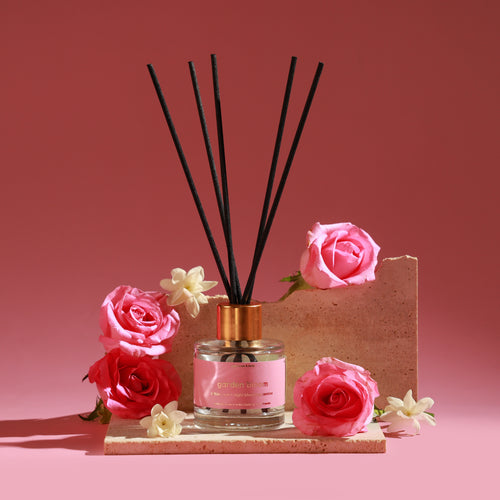
| Reed diffuser ★ | A small reception desk — a mixed-age reception desk — three reeds not six, behind the counter, and no dial for anyone to raise | Reed count only — no switch, no timer | from ₹749 |
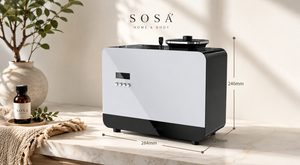
| Sukoon 500ml | A reception up to ~320 sq ft — a larger front-of-house that needs an active unit, three drops, intermittent, with the lead off the floor | On/off, intermittent mode, you control the drops | ₹1,899 |
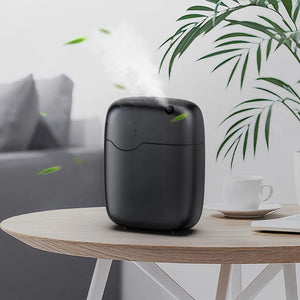
| Vaayu | A large lobby or a zoned duct — a large lobby physically distant from the seating, at the shortest duty cycle, scheduled to clinic hours | Duty cycle in seconds, timer, app scheduling | ₹11,999 |
| Aangan | Whole-facility HVAC — a multi-zone facility with zoned ducting where the sick-child stream and all clinical rooms are excluded | Zone-level control, but only if the ducting is zoned | ₹25,999 |
| Nothing at all | Any clinic where newborn or respiratory attendance is routine, or where one waiting area serves every age with no separation at all | Complete — and the correct answer more often than the trade admits | ₹0 |
Versailles
The phrase I hear most in this conversation is “our patients are mostly older children”. It is usually true and it is not the relevant fact. A room does not average its occupants; it gives all of them the same air. If a six-week-old is in that room every Tuesday, the setting has to be one that suits a six-week-old on Tuesday, and since nobody is going to change it on Wednesday, it has to suit them all week.
The second thing I would say is that multi-age clinics should prefer equipment that cannot be adjusted. That is an odd thing for someone who sells adjustable machines to write, but the failure I see over and over is not a bad first decision — it is a year of small increases made by people who stopped being able to smell the room twenty minutes after arriving. A reed diffuser with three sticks in it has never once been turned up by a receptionist on a slow afternoon.
And if your design case turns out to be a newborn or an asthma follow-up, take the answer the rule gives you. Scent nothing at the front of house, spend the money on the airing routine, the bins, the seating and the lighting, and be able to say plainly that the clinic uses no added fragrance in patient areas. Put it to your own clinical governance and infection-control leads before you put it to me. A portion of every SOSA order funds a girl’s classroom through Nanhi Kali.
Frequently asked questions
- Children sensitive to smells — why they set the default.
- Thirty to sixty minutes in the waiting area — the dwell-time problem.
- Clinic versus wellness centre — where the latitude comes from.
- Clinics serving newborns — the most restrictive answer we give.
- Brand: the SOSA founder story.
SOSA products & prices (verified August 2026): Hotel Collection water-based ultrasonic diffuser fragrance 15ml ₹299 · 100ml ₹999 · 300ml ₹1,799 · Pack of 7 (15ml, all fragrances) ₹1,799; refills 100ml from ₹999. Seven scents: The Ritz-Carlton-inspired (white tea · bergamot · cedar), Westin-inspired (white tea · aloe · cedar), 1 Hotels-inspired (cedarwood · vetiver · green leaves), The St. Regis-inspired (amber · violet · woods), Shangri-La-inspired (jasmine · green tea · white tea), Four Seasons-inspired (citrus · floral · sandalwood), W Hotels-inspired (citrus · pepper · amber). Diffusers: Boond 300ml ₹899 · Sukoon 500ml ₹1,899 · Megh 6L ₹3,499. Water-based, phthalate-free, composed to IFRA standards for home diffusion; 3–6 drops per tank. Made in India, Pune. The Hotel Collection scents are SOSA's own interpretations inspired by the world's finest hotels; all hotel names are trademarks of their respective owners and are used only to describe the scent style — SOSA is an independent Indian fragrance house, not affiliated with or endorsed by any hotel brand. Prices and availability subject to change — see the live product pages.