


What it costs: roughly in proportion to what it gives. Nine reeds turns a six-to-eight-week 50ml into about five weeks. Ten reeds turns it into four to five.
Three cheaper things first: flip all six reeds; move the bottle into passing air near a doorway at waist-to-chest height; and get a second opinion from someone who does not live there — your own nose adapts to a constant within minutes.
Where the ceiling actually is: past roughly 250–300 sq ft of connected open space, or whenever you want scent on demand, no reed count will do it. A Sukoon at ₹1,899 will.
2. Ten reeds is the ceiling of the format. It gives you the most a passive diffuser can produce and empties a 50ml in roughly four to five weeks. Excellent for a festive month or a week of guests; expensive as a permanent habit.
3. Twelve is not a strength setting, it is a crowded neck. Past ten in a 50ml the reeds pack the opening, wick unevenly and encourage oil to creep down the outside of the glass. You get mess and marked furniture rather than a louder room.
4. Do the three free things before the ninth reed. Flip all six reeds with gloves. Move the bottle into gentle passing air near a doorway, waist to chest height, away from AC vents and out of direct sun. And ask someone who does not live in the house whether the room smells of anything — your nose stops reporting a constant within minutes.
5. Buy strength in the composition too. Fresh Brew sits at 9.5 and Mountain Breeze at 9.4 on our internal scale, against 8.9 for the softest two. Ten reeds of a quiet composition is still a quiet composition.
6. Know where the ceiling is. If ten reeds of a 9.5 in the right position is still not the room you pictured, the format is the limit. That is when a second bottle at the far end of the space, or a Sukoon at ₹1,899, is the honest answer rather than a third reed purchase you cannot make anyway.
Composed and handmade in small batches in Pune, and a portion of every order supports girl-child education through Nanhi Kali.
Part one — three things that are cheaper than the ninth reed
A reed costs you nothing at the till and several weeks at the bottle, so it is worth being sure you need it. In the correspondence I see, the great majority of people asking how many reeds to add for a stronger room have one of three things wrong — and all three are free to correct, take under an hour, and cost no bottle life at all. Work through them in this order before you add a single reed, and if the room is fixed at step one, you have kept three weeks of fragrance you were about to spend.
 Mountain Breeze₹849 · 9.4/10A reed diffuser has no propulsion. It releases, and the room distributes — so a bottle in an alcove, low on a coffee table or behind a sofa is producing exactly as much fragrance as one on a console by the door and delivering a fraction of it to you. Move it into gentle incidental traffic, raise it to waist-to-chest height, and give it clear space. Then run the free test that settles the argument: close the room for an hour with the bottle in its new position and walk back in. If the room greets you, the diffuser is working and your problem was distribution or adaptation, not output. Keep several feet between the bottle and an AC vent or fan — a direct draught strips the reeds, weakens the room and empties the bottle weeks early, which is the worst of all three outcomes at once.
Part two — what eight to ten reeds actually delivers
Here is the honest audit. The left column is what people tell me they are hoping the extra reeds will do; the middle column is what the top of the format really produces; the right column is what would actually deliver the hope, where anything can. Strength positions quoted are on SOSA's own internal scale at six reeds — our scale, not an industry standard, and not a concentration.
| What you are hoping for | What 8–10 reeds actually does | What would actually deliver it | Price |
|---|---|---|---|
| A room that greets you at the doorway ★ | Delivers this well — the clearest gain the setting produces | Eight reeds, bottle near the door at waist height | Free |
| Noticeable from the sofa, ten to twelve feet away | Usually yes at ten reeds, in a normal closed room with some traffic | Ten reeds plus a 9.4–9.5 composition | From ₹849 |
| Covering an open living-dining end to end | No — a point source cannot reach both ends however loud it is | Two 50ml bottles at opposite ends, or a duo set | From ₹1,598 |
| Scent on demand, before guests arrive | No — reeds are constant by design and cannot surge | Sukoon, 270–320 sq ft, timers, three 15ml scents in the box | ₹1,899 |
| Masking last night's cooking | No — fragrance over cooking smells makes a third smell nobody designed | Extractor, window ten minutes, close up, wait half an hour | Free |
| Smelling it yourself, all evening, every evening | No — you adapt to the new level within days, as you did to the old one | Nothing does this. Guests are your witness | — |
| The honest caveat: three of the six rows above cannot be bought with reeds at any count, and that is the point of the table. A reed diffuser is constant, passive and deliberately low; its ceiling is roughly 250–300 sq ft of connected open volume and it has no surge setting at all. Where the row says a machine, I mean it — and reed oil never goes into a machine, just as the water-based Hotel Collection never goes into a reed bottle. | |||
Part three — what the top of the range actually costs
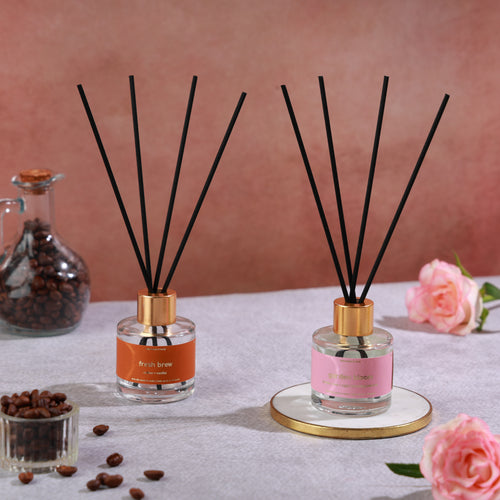
The trade is simple and worth stating in weeks rather than adjectives. A 50ml is rated at six to eight weeks with its six fibre reeds, weekly flipping, no draught and no direct sun. At nine reeds expect something closer to five weeks; at ten, four to five. The gain and the cost move roughly together, which is exactly what you would expect from a system where release rate scales with exposed surface. What surprises people is how quickly the cost compounds with the other accelerants: ten reeds in a west-facing room in a Pune May, or ten reeds two feet from a split AC, is a bottle that will be gone before the month is out — and, in the draught case, gone without ever having filled the room. If you are going to run the format hard, put it somewhere kind first.
There are two smaller costs that nobody mentions at the point of purchase. The first is that a high reed count makes the weekly flip compulsory rather than advisable — more reed surface means more accumulation of the heavy fraction, so a ten-reed bottle that is not flipped drifts into a base-heavy, flat version of the fragrance faster than a six-reed one does. The second is mechanical: crowding the neck of the bottle changes how the reeds sit, and reeds that lean against each other wick unevenly and encourage oil to creep down the outside of the glass. That is the real reason I stop at ten rather than any dramatic olfactory limit; the failure modes of overloading are covered properly in the guide on too many reeds. Stand the bottle on a tray regardless of count. Reed oil marks wood and stone, and at ten reeds you are far more likely to find out.
Which brings me to running cost, because that is what decides whether eight reeds is a setting or a phase. A 50ml at ₹849 works out around ₹15–17 per millilitre; the oil-only refill works out at roughly ₹7–8 — about 55 per cent less at the top of the range. A 300ml at ₹2,399 keeps a vessel going for something like eight to eleven months at ordinary use, and the 500ml at ₹3,499 for fourteen to eighteen. Run at eight or ten reeds those windows shorten in proportion, as everything does, but the per-millilitre saving is what makes a loud room affordable rather than occasional. Two honest notes attached to that: the refill is oil only, and you reuse your own glass vessel and reeds; and we do not sell reeds separately, which at a high count matters more than usual, because a hard-run reed reaches the end of its useful life sooner. Refresh reeds every few months, and always when you refill.
Part four — the strong-room edit, in the order I would do it
Everything above as a sequence, with what each move does to the room, what it does to a 50ml bottle, and whether you can undo it. The first three rows cost nothing and a good share of people never need row four.
| Move | Effect in the room | Effect on a 50ml bottle | Reversible? | Price |
|---|---|---|---|---|
| 1. Flip all six reeds ★ | Returns the bottle to its designed rate within hours | Small — much less than a reed costs you | n/a | Free |
| 2. Reposition into passing air, waist to chest height | Often the single biggest change of all | None — and moving it out of a draught adds weeks back | Yes | Free |
| 3. Close the room for an hour, then walk in | Tells you whether you have a real deficit or adaptation | None | Yes | Free |
| 4. Go to eight reeds | Clearly fuller — the practical strong setting | Roughly five to six weeks instead of six to eight | Yes, in ten seconds | Free |
| 5. Go to ten reeds | The most the format produces | Roughly four to five weeks | Yes, in ten seconds | Free |
| 6. Move to a louder composition | Fresh Brew 9.5 or Mountain Breeze 9.4 against 8.9 | No change at the same count | It is a new bottle | ₹849 |
| 7. Add a second bottle at the far end | Raises the total output of the space, which one bottle cannot | Two bottles running their own clocks | Yes | From ₹1,498 |
| 8. Switch to an oil refill for running cost | No change in the room — changes what a loud room costs | Roughly ₹7–8 per ml against ₹15–17 | Yes | ₹2,399 / 300ml |
| Past the ceiling: Sukoon | 270–320 sq ft, 16–18 hrs on low, remote and timers | A different product line entirely — water-based | — | ₹1,899 |
Versailles
There is a version of this range that would win week one against anything on the shelf. You raise the volatile fraction and you use a phthalate solvent that pushes fragrance off the reed hard and fast. It is not a secret and it is not difficult. What it buys you is a spectacular first fortnight and an acrid bottle by week six, because those solvents degrade in heat, and Indian heat is not a hypothetical.
So we build on a heat-stable coconut-derived CCT base and accept a smaller opening in exchange for a longer, flatter plateau — a level the bottle can actually hold until it is empty, through a 45°C May and an 85 per cent humidity August. That decision is why the ceiling in this guide is where it is. It is a real limit, and I would rather draw it for you than let you find it by spending.
If you have flipped, moved the bottle, run ten reeds of a 9.5 and the room is still not what you pictured, please do not buy a third bottle in hope. Buy a second bottle for the far end of the space if it is a distribution problem, and buy a Sukoon at ₹1,899 if what you actually want is a strong room on demand. Most homes I know end up running both formats, in different rooms, for different reasons. Everything we make is composed and handmade in Pune, and a part of every order funds a girl's classroom through Nanhi Kali.
Frequently asked questions
- Does using more reeds make fragrance stronger? — exposed surface area, which is the real variable.
- Too many reeds and how many for a mild room — the two ends of the same dial.
- Reed count by room size — the room-by-room table.
- The complete guide to choosing a reed count, and the complete strength guide.
- Brand: the SOSA founder story.
SOSA reed diffuser range & prices (verified August 2026): alcohol-free, phthalate-free, paraben-free and IFRA-compliant compositions on a heat-stable coconut-derived (CCT) carrier, low-VOC, supplied in a refillable glass bottle with six fibre reeds; 50ml lasts 6–8 weeks and 130ml lasts 14–18 weeks. Morning Freshness (Malabar lemon · peppermint · Nilgiri eucalyptus) 50ml ₹749 · 130ml ₹1,249 · 9.0/10; Garden Bloom (British rose · night-blooming jasmine) 50ml ₹799 · 130ml ₹1,299 · 8.9/10; Evening Calm (Kashmir lavender · chamomile) 50ml ₹799 · 130ml ₹1,299 · 8.9/10; Fresh Brew (Coorg coffee · Kerala vanilla) 50ml ₹849 · 130ml ₹1,349 · 9.5/10; Mountain Breeze (Himalayan pine · sage · Indian cedar) 50ml ₹849 · 130ml ₹1,349 · 9.4/10. Reed diffuser refills are oil only — you reuse your own vessel and reeds: 300ml ₹2,399 (roughly 8–11 months) · 500ml ₹3,499 (roughly 14–18 months), about ₹7–8 per ml against ₹15–17 per ml for a 50ml bottle. Duo sets ₹1,498–₹1,598 for 2 × 50ml and ₹2,498–₹2,598 for 2 × 130ml. Strength figures are positions on SOSA’s own internal strength scale, not an industry standard. Replacement reeds are not sold as a separate SKU; SOSA guidance is to refresh reeds every few months. The reed line is separate from the water-based Hotel Collection for ultrasonic machines (15ml ₹299 · 100ml ₹999 · 300ml ₹1,799) and the two are not interchangeable. Diffusers: Boond 300ml ₹899 · Sukoon 500ml ₹1,899 · Megh 6L ₹3,499 · waterless Vaayu ₹11,999. Composed and handmade in small batches in Pune, India; tested through 45°C summer heat and 85% monsoon humidity. Free shipping above ₹499. A portion of every order supports girl-child education through Nanhi Kali. Prices subject to change — see the live product pages.