

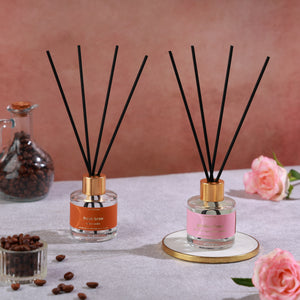
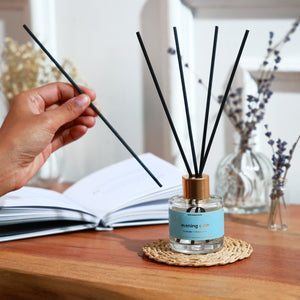
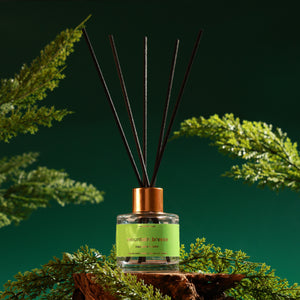
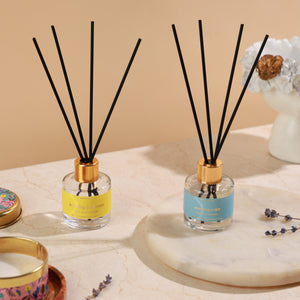
If what you want is more places that smell strong, here is the rule: buy one bottle per place you actually occupy. Two is legitimate in a long or L-shaped room used at both ends. The third bottle in one room is where it becomes a mechanism question, because by then you are buying for empty air rather than for a place you sit.
The money version of the same rule: three 50ml bottles in one room is ₹2,247–₹2,547 every six to eight weeks, or roughly ₹39–₹45 a day, indefinitely. Sukoon is ₹1,899 once.
Free before any of it: a ceiling fan on low in a closed room supplies the transport a reed lacks, and it costs nothing. Then halve the distance to where you sit.
The honest gap: between Safar ₹3,999 and Vaayu ₹11,999 SOSA has no mid-sized waterless bedroom machine, and Vaayu at 1000 m³ — roughly 2,000–3,000 sq ft — is the wrong purchase for one bedroom.
2. If the requirement is instead more strong places, count occupancy, not floor area. One bottle per place you actually sit. A bedroom where you only ever occupy the bed needs one, placed near the bed. A long room with a desk at one end and a sofa at the other legitimately takes two. The moment you are buying a bottle for a stretch of room that nobody stands in, the purchase has changed character — you are trying to fill a valley, and point sources do not fill valleys.
3. The number, plainly: the third bottle in one room. Two can be defended on geometry. Three cannot, because a room rarely has three separate occupied ends, and by the third bottle you are almost always chasing the middle. That is the line, and it holds whether the bottles are 50ml or 130ml, because volume is a duration specification rather than a coverage one.
4. The arithmetic agrees with the geometry, which is what makes it a rule. Two 50ml bottles is ₹1,498–₹1,698 per six-to-eight-week cycle — a little under the ₹1,899 Sukoon. Three is ₹2,247–₹2,547 per cycle, roughly ₹39–₹45 a day, and that repeats indefinitely. So at the third bottle a single refresh already costs more than the machine, and you buy it again seven weeks later. I cannot tell you what the machine costs to run, because SOSA publishes no oil-consumption rate and I will not estimate one.
5. Before the rule fires, take the free options seriously. A ceiling fan on low in a closed room is the best free fix there is, because a fan is exactly the transport a reed lacks. Halve the bottle-to-person distance. Put it at nose height on a surface. Keep it out of a draught but not in a dead corner. Close the door. And drop to three reeds rather than six if you want the bottle to last twice as long.
Alcohol-free, phthalate-free, paraben-free, IFRA-compliant, 0 ppm formaldehyde, six fibre reeds in a refillable glass bottle, composed in Pune. Free shipping above ₹499, and a portion of every order supports girl-child education through Nanhi Kali.

The prior question, which can make the answer zero
Before any counting, it is worth being precise about what you are buying, because two quite different requirements hide behind the same sentence. One is intensity: you want the places you sit to smell strongly of something you like. The other is evenness: you want the room to smell the same wherever you are in it. Extra bottles serve the first requirement well and the second not at all — and most people who arrive at a third bottle turn out to have been chasing the second without ever putting it into words.
Here is why the second requirement is a wall rather than a hill. A reed diffuser is a passive capillary device: oil climbs six fibre reeds and evaporates, with no fan, no pump, no heat and no energy input. Nothing pushes the vapour anywhere. It reaches the rest of the room by molecular diffusion, which is far too slow to cross metres usefully, and by whatever air the room is already moving, which belongs to the room and not to the bottle. So each bottle produces a peak that falls away with distance, and putting two in one room produces two peaks with a valley between them — the midpoint being, by definition, the farthest point from both sources at once. Add a third and you have three peaks and a more complicated set of valleys. Evenness never arrives, because evenness is a property of moved air and cannot be purchased any other way.
There is one more possibility worth ruling out before you count anything, and it costs nothing to test. Receptors adapt to a constant stimulus within minutes: the signal keeps arriving and the brain stops reporting it, so somebody can sit in a properly scented room and honestly say they smell nothing. Leave for a quarter of an hour and walk back in; better still, ask a visitor, who is a far better instrument than you are in your own home. And it is worth knowing that a fragrance you can smell continuously is set too strong for the room — home fragrance is meant to register on arrival and at transitions, not as a permanent hum. If guests remark on it and you cannot detect it, the room is working for everybody except you, and no further bottle is required.
The three tests, and the point where they agree
This is the rule in its working form. Each test is useful on its own; the reason I am willing to publish a number is that all three land on the same bottle.
 Evening Calm₹799The single most useful question, and it takes ten seconds. Walk the room and name the places you are actually in: the bed, the reading chair, the desk, the doorway you pass through. Now ask what the next bottle is for. If it is for one of those places, buy it — that is a zone with a person in it, and a reed diffuser is superb at exactly that. If it is for the middle of the floor, or for "the rest of the room", stop, because that is a valley and no point source fills a valley. Most people's honest answer at bottle three is that it was for the space between the other two.
 Refill₹2,399A 50ml runs six to eight weeks at ₹749 to ₹849, which is roughly ₹13 to ₹15 a day. Two bottles in one room is ₹1,498–₹1,698 a cycle and roughly ₹26–₹30 a day, which sits just below the ₹1,899 Sukoon. Three bottles is ₹2,247–₹2,547 a cycle and roughly ₹39–₹45 a day — above it, and then above it again next cycle, and the cycle after that. At three bottles you are paying for the machine roughly every seven weeks and not getting one. Two honest caveats: I cannot compute what a machine costs to run, because SOSA publishes no oil-consumption rate; and a 300ml refill at ₹2,399, roughly six 50ml fills, materially reduces the reed side if you already own the bottles.
 Sukoon₹1,899This is the test people find most persuasive because it uses evidence they already have. If bottle two produced exactly the same shape of result as bottle one — lovely near it, thin a few steps away — then bottle three will too, and you already know that without spending anything. A repeated result from a repeated intervention is not bad luck; it is the mechanism telling you what it does. You have run the experiment at your own expense and it has produced a clean answer, which is worth something: dose is ruled out, maintenance is ruled out, and the remaining variable is the mechanism itself. Also worth checking before you conclude anything: are all six reeds in, and are you flipping them every three to five days? A flip restores output for hours, though it adds no range.
The rule as a table
Bottle by bottle, what each one is actually buying, and where the line sits. The last row is the purchase I would talk you out of and the gap in our own range.
| In one room | What it costs per cycle | What it buys | Verdict |
|---|---|---|---|
| One 50ml, placed where you sit ★ | ₹749–₹849 every 6–8 weeks · ₹13–₹15 a day | One correct zone, silently, with no socket and nothing to remember | Right for most rooms |
| Two, at two genuinely occupied ends | ₹1,498–₹1,698 · ₹26–₹30 a day | Two zones, and a valley in the middle that nobody stands in | Legitimate if the room really has two ends |
| Two, both aimed at the same middle | ₹1,498–₹1,698 · ₹26–₹30 a day | Two peaks and the same weak middle. Twice the emission, no transport | The rule has already fired |
| Three, in one room | ₹2,247–₹2,547 · ₹39–₹45 a day, indefinitely | A third peak, and a cycle that now costs more than the machine | Change mechanism ★ |
| A 130ml instead of two 50ml | ₹1,249–₹1,349 every 14–18 weeks | The same reach for far longer. Volume is duration, never coverage | Good value above 150 sq ft, over-specified in a 120 sq ft bedroom |
| Three bottles fed by a 300ml refill | ₹2,399 per roughly two rounds of filling | The same arrangement, materially cheaper. Oil only — you must own the glass | Cheaper, but it does not change the geometry |
| Sukoon, once ★ | ₹1,899 once, three 15ml scents included, then oil at an unpublished rate | 270–320 sq ft, 16–18h on low, and moved air, which is the property no bottle count supplies | Where the rule points for one bedroom |
| What I would talk you out of, and the gap: Vaayu in one bedroom | ₹11,999 | 1000 m³, roughly 2,000–3,000 sq ft — nine-tenths wasted in 120 sq ft. And nothing sits between Safar ₹3,999 and Vaayu | No, and the gap is named rather than sold around |
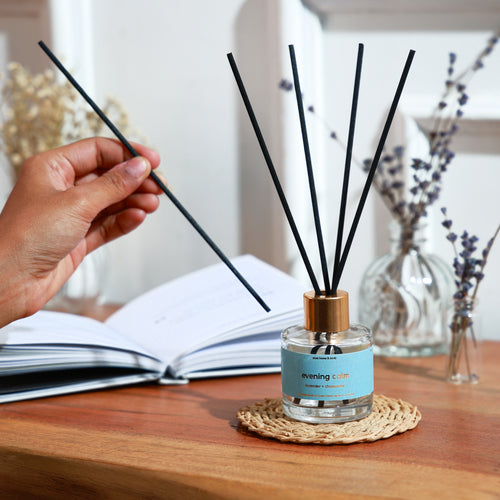 Bedside zone · Evening Calm₹799Shop →
 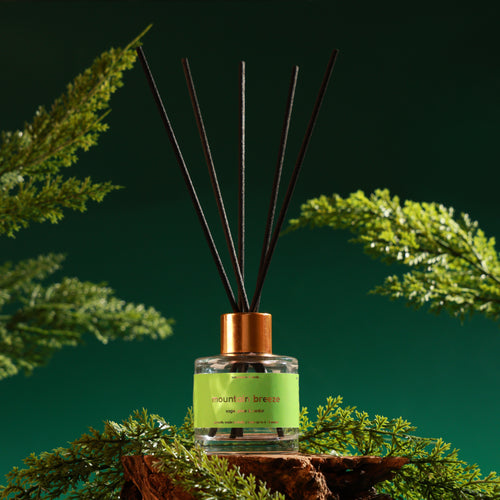 Desk zone · Mountain Breeze₹849Shop → The third-bottle line · Sukoon₹1,899See it →
When the rule does not apply, stated so you can ignore me with confidence
A rule with no exceptions is a slogan, so here are the four situations in which I would keep buying bottles past the line and not feel I had made a mistake. A long or L-shaped room used at three genuinely separate places — rare, but real in a large open-plan living-dining space, and if you truly occupy three ends then three zones is a design rather than an escalation. A home rather than a room: three bottles across three rooms is precisely what three bottles are good at, and if you have been stacking them in one room, redistributing them costs nothing and fixes more than another purchase would. Wanting different scents in different places, which is something several bottles do effortlessly and no single machine can do at all. And a budget genuinely short of ₹1,899, in which case a second bottle placed where you actually sit is a sound purchase and I would far rather you made it than stretched.
There is also a version of this question that is not about counting at all, and it is worth naming because it saves money. If the complaint is that the fragrance is not strong enough rather than not everywhere enough, the lever is reed count and distance, not bottle count. Six reeds is full projection and three is a soft bedside level that roughly doubles the life of the bottle, so if you have been running three reeds and buying second bottles, put all six in the first one before you buy anything. And if a room has ever felt cloying rather than fragrant, that is over-dosing rather than a wrong scent — the reed count is a dial and almost nobody uses it as one.
Finally, the warning that applies the moment the rule does fire, because it is the likeliest disappointment in this subject. Switching mechanism may mean switching scent. Reed oil cannot go into an ultrasonic machine; the water-based Hotel Collection cannot go into reeds, and there is no hotel-inspired reed diffuser; Safar takes pure fragrance oil and can be clogged by anything thick, sticky or water-based. Plan for the machine to run a different fragrance from the reed you have grown fond of, and keep the reed rather than replacing it.
What to buy once the rule fires
Free first, then the machine the rule actually points at, then the waterless option with its disclosures attached, and the gap in our own range at the bottom.
| Do this | What it is | When it is the right answer | Price |
|---|---|---|---|
| 1. Ceiling fan on low, door closed, all six reeds in ★ | The transport a reed structurally lacks, already installed | Before any purchase. It shortens the bottle's life, which is a real trade and yours to make | Free |
| 2. Redistribute the bottles you own | One per room that has none, rather than three in one room | Immediately, if the stack happened by accident. Three zones in three rooms is what three bottles are for | Already paid for |
| 3. Sukoon ultrasonic | 500ml, 270–320 sq ft, 16–18h on low, three 15ml Hotel Collection scents included. Moves air | Where the rule points for one bedroom. Never skip it on the way to something dearer | ₹1,899 |
| 4. Safar waterless | Undiluted oil as a dry mist, 20ml, 2000 mAh Type-C, cordless, three speeds, 1/2/3-hour timer. Named and sold as a car and travel diffuser; no published room coverage figure; not set-and-forget | When water, dilution, humidity or mineral dust are the objection. Buy one, never several | ₹3,999 |
| 5. Keep one reed anyway | Silent, no socket, nothing to fill or charge, works in a power cut, never breaks, roughly ₹13–₹15 a day | Alongside the machine, not instead of it. The reed is an object; the machine is an appliance | ₹749–₹849 |
| What I would talk you out of, and the gap: buying by tank size | Megh ₹3,499 holds six litres and runs about 100 hours, and covers only about 215 sq ft — less than the ₹1,899 Sukoon. And between Safar ₹3,999 and Vaayu ₹11,999 SOSA has no mid-sized waterless bedroom machine; Vaayu at 1000 m³ is wrong for one bedroom | Capacity is runtime, never room. The gap is named rather than sold around | ₹3,499 / ₹11,999 |
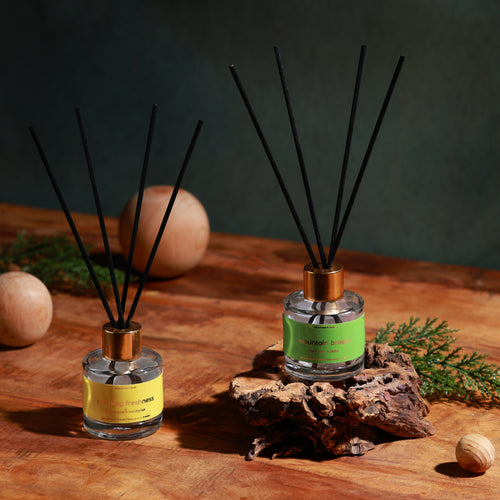
Versailles
People ask for a number and are usually given an adjective — several, a few, it depends — which is a way of avoiding the question while sounding thoughtful. So I have committed to one. In a single room, the third bottle. I am comfortable publishing it because I did not choose it: I worked out where the geometry runs out, then worked out where our own prices cross the price of the machine, and the two answers turned out to be the same bottle. When two independent tests agree, you have a rule rather than a view.
The part I would not want you to skim is the prior question. If what you actually want is for the room to smell the same everywhere, then the number is not three and it is not thirty — there is no number, because evenness comes from moved air and a passive bottle moves none. That is a hard sentence for a company that sells reed diffusers to write, and it is the truest one on this page.
Everything else I would say is practical. Try the fan first, honestly and for two nights. Put all six reeds in the bottle you already own and move it to where you actually sit. If you own three bottles and one room, spread them across three rooms and see what that does. And if the rule still fires, go to Sukoon at ₹1,899 and stop there for one bedroom, keeping a reed alongside it because a reed is silent, needs no socket, works when the power does not and never breaks. Everything is composed in Pune, and a part of every order funds a girl's classroom through Nanhi Kali.
Frequently asked questions
- Should I buy two if one isn't filling my bedroom? — two hills, not a plateau.
- One on the opposite side of the room? — what actually happens in the middle.
- Two smaller bottles or one active diffuser? — and the sizes SOSA really sells.
- One by the bed, one by the door — a reasonable setup, and its limit.
- Better coverage, or two strong corners? — the clearest statement of the geometry.
- I keep buying more to make it stronger — a rational response to a misdiagnosis.
- Cheaper long-term: several reeds or a waterless machine? — the arithmetic, with the counterweights.
- Two reeds against Safar — the head-to-head, scored honestly.
- About to buy a third for one room? — the moment the requirement changed.
- Brand: the SOSA founder story.
SOSA facts verified August 2026: Reed diffusers in 50ml and 130ml only — Morning Freshness ₹749 / ₹1,249, Evening Calm ₹799 / ₹1,299, Garden Bloom ₹799 / ₹1,299, Mountain Breeze ₹849 / ₹1,349, Fresh Brew ₹849 / ₹1,349. 50ml suits rooms up to about 150 sq ft and runs 6–8 weeks; 130ml suits above 150 sq ft and runs 14–18 weeks; roughly ₹13–₹15 a day. Six reeds is full projection; three is a soft level that roughly doubles the life of the bottle; flip every 3–5 days. Six fibre reeds, not rattan, in a refillable glass bottle, on a heat-stable CCT carrier rather than DPG, alcohol-free, phthalate-free, paraben-free, IFRA-compliant, 0 ppm formaldehyde, tested at 45°C and 85% RH, composed in Pune. Duos: Day & Night ₹1,498, Fresh & Grounded ₹1,548, Warmth & Bloom ₹1,598 (50ml × 2). Refills 300ml ₹2,399, roughly six 50ml fills, and 500ml ₹3,499 — oil only, never a first purchase. Machines: Boond ₹899 (300ml, up to about 150 sq ft, about 6 hours, USB), Sukoon ₹1,899 (500ml, 270–320 sq ft, 16–18h on low, three 15ml Hotel Collection scents included), Megh ₹3,499 (6 litres, about 100 hours runtime, only about 215 sq ft), Safar ₹3,999 (waterless cold diffusion of undiluted oil, 20ml, 2000 mAh Type-C battery, up to 10 hours continuous or about 30 hours intermittent per charge, three speeds, 1/2/3-hour auto-off timer, 6.9 cm — named and sold as a car and travel diffuser, with no published room coverage figure), Vaayu ₹11,999 (up to 1000 m³, roughly 2,000–3,000 sq ft, 400ml tank, under 38 dB). Between Safar and Vaayu SOSA has no mid-sized waterless bedroom machine, and this guide names that gap rather than stretching a product to cover it. Hotel Collection oils are water-based and ultrasonic-only: 15ml ₹299, 100ml ₹999, 300ml ₹1,799; the 15ml is a machine refill and never a first purchase. Reed oil and the Hotel Collection are not interchangeable in either direction, and there is no hotel-inspired reed diffuser. No health, air-quality, allergy or sleep claims are made for any SOSA product, and fragrance does not remove an unwanted smell — deal with the source, then ventilate, then fragrance. Free shipping above ₹499. A portion of every order supports girl-child education through Nanhi Kali. SOSA is an independent Indian fragrance house; the Hotel Collection is SOSA's own interpretation inspired by the world's finest hotels, and SOSA is not affiliated with or endorsed by any hotel brand. Prices subject to change — see the live product pages.