



Leak two: buying a second bottle when the fix was two more reeds. ₹1,249 against ₹0.
Leak three: buying 50ml repeatedly. ₹4,212 a year across three rooms.
Leak four: buying because you stopped noticing. That is adaptation, and the second bottle disappears just as fast.
2. Add reeds before you add a bottle. Six fibre reeds come in every box and most people run four. Going from four to six is free and instant; buying a second bottle for the same room is ₹1,249 and buys a second point of origin rather than a wider circle. A second bottle genuinely earns its place in an L-shaped room, a blind leg, a run over about twenty-two feet or a double-height volume — and in none of those cases should you reach for it before you have tried the reeds.
3. Stop buying the 50ml for rooms that run all year. A 50ml at ₹749 lasts 6–8 weeks and costs about ₹105 a week of use; a 130ml at ₹1,249 lasts 14–18 and costs about ₹78. That is ₹27 a week, ₹1,404 a year in one room and ₹4,212 across three, for an identical result — coverage is set by reed count, not bottle size. The small bottle has two honest jobs: testing a blend, and a small bathroom on two or three reeds.
4. Never buy because you stopped noticing it. Olfactory adaptation is essentially complete within about twenty minutes, so the person who lives with a diffuser is the one person who cannot judge it. The bottle bought to fix that will vanish just as quickly, because the mechanism is in your nose rather than in the glass. Leave the flat for half an hour and judge the first breath back in, or ask a visitor before you say anything.
5. Then, once you own the glass, stop buying glass. A 300ml refill at ₹2,399 is about ₹8.00 a millilitre against roughly ₹9.61 for the liquid inside a new 130ml. The bottle and collar were always the durable part. Refilling drops a running position from about ₹78 a week to about ₹65, and it is the only one of these changes that requires no judgement at all.
Made in India, composed by an ISIPCA Versailles-trained perfumer — and a portion of every order supports girl-child education through Nanhi Kali.

Why the money leaves quietly
Home fragrance overspending is unusual in that it almost never involves a purchase anybody would call extravagant. Every individual decision looks modest — another ₹749 bottle, one more room, a second diffuser because the living room felt flat — and none of them registers as the moment things went wrong. What makes it expensive is repetition. A 50ml position asks for ₹749 roughly seven times a year; a bottle in an unused room asks for the same money on the same schedule while delivering nothing; and a second bottle bought to fix a room your nose had simply stopped reporting joins the rotation permanently. By the time the annual figure is visible it is made of a dozen small, defensible purchases, which is exactly why nobody ever spots it.
Put the two extremes side by side and the scale becomes obvious. A six-space flat where somebody has bought per room on the plan, added a duplicate in the living room, and used the small size throughout, is running seven positions at about ₹105 a week of use — ₹38,220 a year. The same flat with three occupied rooms in 130ml kept going on refills runs at about ₹65 a week per position, which is ₹10,140. The gap is ₹28,080, and the better-smelling house is the cheaper one, because four bottles have been removed from rooms that were diluting the effect rather than adding to it. A home where everything is scented reads as one undifferentiated smell; a home with three deliberate rooms and unscented space between them is where each of those rooms registers.
The three free fixes, and the one that is not
 Occupied rooms onlyFrom ₹749People count doorways on a plan and buy one bottle per doorway. But a diffuser does not know whether anyone is in the room — it evaporates on schedule regardless, so an unoccupied position costs the same as an occupied one and returns nothing. At about ₹78 a week that is ₹4,056 a year per empty room, and a typical six-space flat has three of them: a kitchen with its own smells and extraction, a passage measured in seconds of occupancy, and a guest room used a few nights a year. Roughly ₹12,168, spent on air nobody breathes.
Where each rupee is actually going
The left column is the space, the right column is what it costs you a year at bottle prices. Three of these rows should be ₹0 in your house and usually are not.
| Space | What it needs | How many | Cost |
|---|---|---|---|
| Living room, occupied every evening, 130ml on six reeds ★ | Earning its money. Move it to refills after the first bottle and the position drops to about ₹65 a week | One 130ml | about ₹4,056 a year |
| Main bedroom, occupied all night, 130ml on four reeds | Also earning it, and the lower reed count pushes the bottle past eighteen weeks — cheaper again | One 130ml | under ₹4,056 a year |
| The same living room, with a second bottle added because it felt quiet | Try two more reeds first. They came in the box and they cost nothing. A second bottle adds a starting point, not a wider circle | None extra | ₹0 instead of ₹1,249 |
| Any room, on a 50ml, running all year | About ₹105 a week against ₹78 for a 130ml in the same room, with no difference in how it smells | Switch size | ₹1,404 a year wasted |
| Kitchen, passage or landing | Nothing. Extraction, cooking smells and seconds of occupancy respectively — no bottle earns its place in any of them | None | ₹0 |
| Guest room used a few nights a year | Nothing. Move a bottle in the day before guests arrive and take it out again — the bottle you already own does the job for ₹0 | None | ₹0 |
| A note on all of the above: the ₹78 a week figure is a 130ml bottle at ₹1,249 across sixteen weeks, and it falls to about ₹65 once you are refilling rather than rebuying. All of it assumes closed rooms of standard ceiling height; a draughty or high-ceilinged room burns through a bottle faster, which makes the rooms that do not deserve one even more expensive to keep. | |||
One room · the unitFrom ₹749Shop → 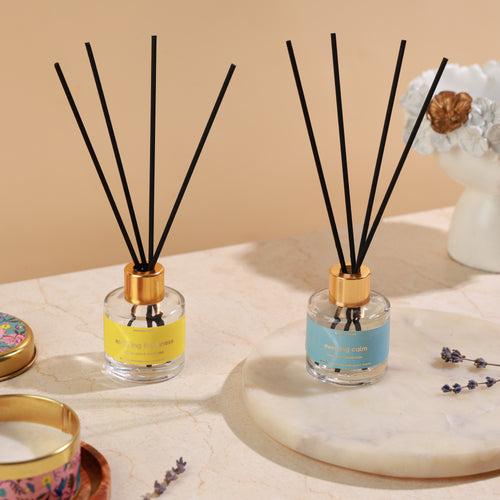 Two rooms · better value₹1,498Shop →
  Large room · a switch₹1,899Shop →
The habits that keep it down
Write the occupied-room list before you look at any product. Walk the flat and note only the spaces where somebody sits, sleeps or works for hours at a stretch. For most homes that is two or three rooms, and the exercise takes five minutes. Then buy for those and stop — not because money is tight, but because a house where everything is scented reads as one flat smell, while a house with three deliberate rooms and plain air between them is a house where each of those rooms registers when you walk in. The rooms you leave out are doing work.
Make "reeds, placement, wait" the standing response to a quiet room. Add a reed and give it forty-eight hours, because fibre has to saturate along its whole length before it throws properly. If that is not enough, move the bottle towards the doorway or somewhere with gentle air movement, and out of direct sunlight and the path of a fan — placement is worth more than most people expect and costs nothing. Only after both of those, and only after somebody who does not live there has confirmed the room really is flat, should a second bottle be on the table. In practice the free steps settle it most of the time.
Then buy liquid rather than glass, and change the reeds when you pour. Once the first bottle is yours there is no reason to buy another container: a 300ml refill at ₹2,399 is about ₹8.00 a millilitre against roughly ₹9.61 inside a new 130ml, and it takes a running position from about ₹78 a week to about ₹65. The one condition is the wick. Pouring fresh fragrance through reeds that have already spent sixteen weeks clogging is how people conclude that refills are weaker than bottles — they are not, and six fresh reeds came with every bottle you have ever bought.
What to buy
Ordered by what each option actually costs you across a year rather than what it costs at the checkout, which is where this whole problem starts.
| Buy | What it covers | Lasts | Price |
|---|---|---|---|
| One 50ml | A single reed diffuser — a small bathroom on two reeds, or a blend you are testing — not a room that runs all year | 6–8 weeks | from ₹749 |
| One 130ml | The value size — every room somebody actually sits in: about ₹78 a week against ₹105, for the same result | 14–18 weeks | from ₹1,249 |
| The duo | Day & Night duo — two occupied rooms opened together, if you would rather make one decision than two | 6–8 weeks each | ₹1,498 |
| Sukoon | 500ml ultrasonic — a genuinely large room, where a second and third reed bottle was the expensive wrong answer | Runs when you switch it on | ₹1,899 |
| 300ml refill ★ | The running cost — the habit that ends the leak — about ₹65 a week per position instead of ₹78 | Roughly 2 × 130ml fills | ₹2,399 |
Versailles
I sell this and I still think most homes buy too much of it. The pattern is always the same and it is never extravagant: somebody looks at a floor plan, counts six spaces, and buys six bottles. A bottle in a kitchen, a passage and a spare bedroom empties on exactly the same schedule as the one in your living room — around ₹4,056 a year each at bottle prices — and returns nothing at all, because nobody is standing in those rooms.
The second pattern is the one I find hardest to answer by email. Somebody says the living room has gone quiet and asks which bottle to add. Usually nothing has gone quiet — they have adapted, which takes about twenty minutes and happens to everybody. The honest reply is to go outside for half an hour, or to wait until a friend visits and see if they say anything. It is not a satisfying answer and it costs me the sale, but the second bottle would have disappeared into the same adaptation by Friday.
So the whole method is short enough to remember. Buy for the rooms with hours in them. Try two more reeds before you try another bottle. Use the 130ml where a room runs all year and the 50ml only for small wet rooms and trials. And once you own the glass, buy liquid. That is the difference between around ₹38,000 a year and around ₹10,000, in the same flat, with the better-smelling version being the cheaper one. A portion of every order supports girl-child education through Nanhi Kali.
Frequently asked questions
- Should I scent rooms nobody uses? — the largest leak, examined.
- A second diffuser, or more reeds? — the free fix comes first.
- The first-year cost of three rooms — ₹10,544, itemised.
- A whole home under ₹2,500 — the exact list, checked.
- Brand: the SOSA founder story.
SOSA products & prices (verified August 2026): Hotel Collection water-based ultrasonic diffuser fragrance 15ml ₹299 · 100ml ₹999 · 300ml ₹1,799 · Pack of 7 (15ml, all fragrances) ₹1,799; refills 100ml from ₹999. Seven scents: The Ritz-Carlton-inspired (white tea · bergamot · cedar), Westin-inspired (white tea · aloe · cedar), 1 Hotels-inspired (cedarwood · vetiver · green leaves), The St. Regis-inspired (amber · violet · woods), Shangri-La-inspired (jasmine · green tea · white tea), Four Seasons-inspired (citrus · floral · sandalwood), W Hotels-inspired (citrus · pepper · amber). Diffusers: Boond 300ml ₹899 · Sukoon 500ml ₹1,899 · Megh 6L ₹3,499. Water-based, phthalate-free, composed to IFRA standards for home diffusion; 3–6 drops per tank. Made in India, Pune. The Hotel Collection scents are SOSA's own interpretations inspired by the world's finest hotels; all hotel names are trademarks of their respective owners and are used only to describe the scent style — SOSA is an independent Indian fragrance house, not affiliated with or endorsed by any hotel brand. Prices and availability subject to change — see the live product pages.