



Effect two — cold, dry air: a cooler room evaporates less. The bottle lasts longer and the room reads quieter. Neither is a fault.
Effect three — the sealed room: shut doors and windows stop the air exchanging with outside, so what the reeds release stays put. This is the one that helps, and why a sealed AC bedroom is often the best-smelling room in an Indian flat.
The net: move the bottle out of the air path, add a reed or two through the cold months, and an AC room becomes one of the easiest rooms a reed diffuser can live in.
2. Cold and dry air slows the system rather than damaging it. A room held at 22–24°C evaporates less than the same room at 33°C, so a 50ml will tend towards the long end of its 6–8 week window and the room will read a shade quieter. Nothing has gone wrong; you are seeing the same bottle spread over more days.
3. The sealed room is a real advantage, and nobody mentions it. Fragrance leaves a room mainly by leaving the building, and shut doors and windows stop that. A closed air-conditioned bedroom keeps what the reeds give it in a way a cross-ventilated hall never can.
4. The fix is measured in feet, not rupees. Move the bottle out of the stream — diagonally across the room from a split unit, or well to the side of a window unit — at roughly waist to chest height on a tray, with clear air around it.
5. If the room is cold all day, add reeds rather than changing bottles. Six reeds is the calibrated count; nine takes a 50ml closer to five weeks than eight.
6. Do not buy a 130ml hoping it will beat the air conditioning. It holds more oil and lasts 14–18 weeks rather than 6–8, and at the same six reeds it projects the same. Size buys duration, never reach.
Composed and handmade in small batches in Pune, and a portion of every order supports girl-child education through Nanhi Kali.
Part one — the three effects, separated
Air conditioning gets blamed as a whole because its three effects arrive together and feel like one experience: a cold room where the diffuser seems to be doing nothing and the bottle is going down anyway. Pull them apart and each has a different signature, cost and remedy. Two work against you and one quietly works for you — which is why I never tell anyone to abandon a reed diffuser because their flat is air-conditioned.
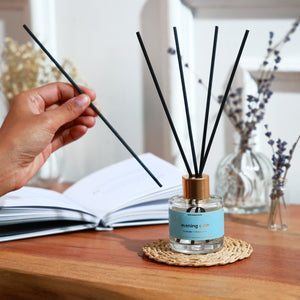
 Evening Calm₹799 · 8.9/10Fragrance mostly leaves a room by leaving the building. Running an air conditioner means shutting the doors and windows, and a shut room exchanges far less air with the outside than an open one. Everything the reeds release stays in the space and accumulates instead of drifting out of a window. It is why a sealed 120 sq ft bedroom with a split unit is very often the best-smelling room in the house while the naturally ventilated hall next door seems to swallow everything, and it explains the six o'clock effect people describe: strongest in the morning, after hours sealed with nothing opened. Give a sealed room a soft composition and it will carry it perfectly well.
Part two — the air-conditioning ledger
Here are all three effects set out as a ledger, with what each does to the reeds, what it does to the room, and what it does to a 50ml bottle rated at six to eight weeks with its standard six reeds. Where a figure is a range rather than a number, that is deliberate — these are working observations from our own testing and from customer correspondence, not laboratory measurements, and your ceiling height and unit size move them.
| What the AC is doing | Effect on the six reeds | Effect on the room | Effect on a 50ml | Verdict |
|---|---|---|---|---|
| Blowing directly across the bottle ★ | Exposed ends dry faster than they can rewet | Thin plume, very little accumulation | Finishes well inside 6–8 weeks | The one real problem — move the bottle |
| Blowing across the room, bottle out of the path | Untouched — reeds work at their own rate | Gentle circulation carries scent about | Normal, often the long end of the window | This is the placement you want |
| Holding the room at 22–24°C | Slower release from the same surface | Quieter, softer, more even | Stretches towards 8 weeks and beyond | Not a fault — add reeds if you want more |
| Pulling humidity out of the air | Fibre unaffected; no clogging as rattan would | Notes read sharper and drier | Marginal change at most | Neutral to mildly positive |
| Doors and windows shut, unit cycling or off | No change at the reed | Fragrance accumulates instead of escaping | No change | The hidden advantage of an AC room |
| The honest caveat: these are SOSA's own working figures from in-house testing and customer correspondence, not laboratory data. A tower unit in a 90 sq ft cabin and a five-star ducted system in an open-plan flat are different problems, and the only reliable way to know which effect you are living with is the tissue survey described in our AC placement guide. Strength ratings quoted anywhere on this page are positions on SOSA's internal scale at six reeds, not an industry standard and not a concentration. | ||||
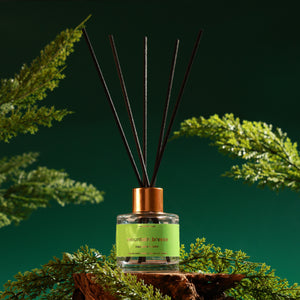
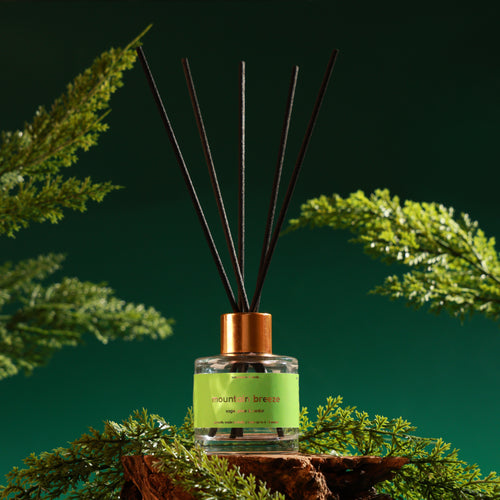
Mountain Breeze · 9.4/10from ₹849Shop → 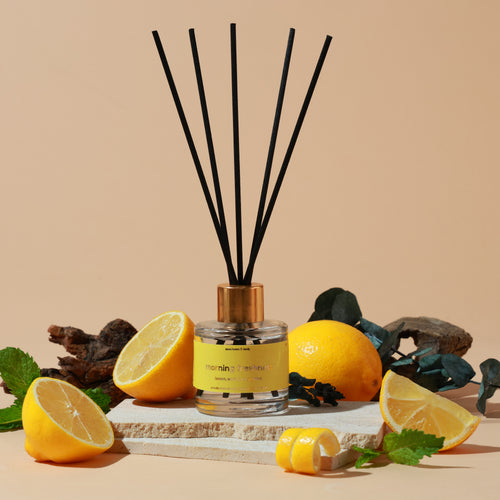 Morning Freshness · 9.0/10from ₹749Shop →
 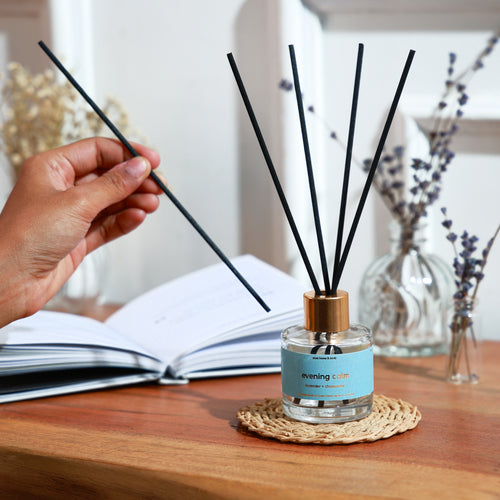 Evening Calm · sealed bedroomsfrom ₹799Shop →
Part three — living with the on/off cycle
An air conditioner is not a constant condition; it is a schedule. In most Indian homes the bedroom unit runs from about eleven at night until six or seven in the morning, and the living-room unit runs in bursts through the evening. The diffuser in each room is living two different lives a day, and people almost always judge it in the wrong half of the cycle. You walk into a bedroom at nine in the evening — warm, unsealed, doors open, nothing accumulated for hours — and conclude the bottle is finished. The same room at six in the morning is frequently the strongest-smelling space in the flat. The fair test is at the end of a closed period, not the beginning.
The cycle also changes what a good placement looks like. With the compressor running you want the bottle out of the stream but still inside the room's circulation: the far side of the space, across a diagonal from the unit, on a console rather than a high shelf near the ceiling where the cold jet travels. With the unit off, the room becomes still air, and stillness is the other failure mode — nothing carries the fragrance from the glass to the doorway. The placement that survives both halves is one where people walk past a few times an hour — a chest of drawers on the route to the bathroom, a sideboard by the bedroom door. Intermittent human traffic distributes; continuous mechanical air strips. That distinction is the whole of airflow, and it is why the answer to "does AC hurt?" is always "which part of it, and where is your bottle?"
One habit worth changing: many people set the unit to swing. A swinging louvre turns a fixed stream into one that sweeps a wider arc, and it will find a bottle you thought was safely out of the way. Fixing the louvre to blow away from the diffuser is free and settles the question. And if your room is genuinely large — past roughly 250–300 sq ft of connected open volume — no placement will make a passive point source fill it, air-conditioned or not. That is the format's honest ceiling, and a Sukoon at ₹1,899, covering 270–320 sq ft with timers, is the correct answer rather than a third bottle.
Part four — what to change, in order
Everything above as a sequence of decisions, cheapest first. The first three cost nothing at all, and in my experience they settle three-quarters of the AC complaints that reach us.
| Move | Which of the three effects it addresses | What it costs | Price |
|---|---|---|---|
| 1. Take the bottle out of the vent's air path ★ | The directed stream — the only harmful one | Nothing, and it usually adds weeks back | Free |
| 2. Stand it waist to chest height on a tray, a few feet clear | Stream and stillness together | Nothing — the tray also protects the wood | Free |
| 3. Flip all six reeds weekly, gloves on | Restores the designed rate in any conditions | Nothing | Free |
| 4. Add two to three reeds for the cold months | Cold, slow release — restores presence | Proportional bottle life: nine reeds ≈ 5 weeks on a 50ml | Free |
| 5. Move to a drier, higher-projecting composition | Cold flattening sweetness | A new bottle and a change of character | ₹849 · ₹749 |
| 6. 300ml oil refill | Makes running eight or nine reeds affordable | Nothing — oil only, you reuse your vessel and reeds | ₹2,399 · 8–11 months |
| Not a fix: a 130ml bottle | None of them — it changes duration only | Said plainly rather than sold as an upgrade | From ₹1,249 |
Versailles
When we were testing this range through a Pune summer, the room that behaved worst was not the hottest one. It was a small sealed cabin with the split blowing straight along the shelf where we had put the bottle. The oil went down faster than anywhere else in the building and the room smelled of almost nothing, which is the exact combination that makes people write to us convinced they have been sold a weak product.
We moved the same bottle to the opposite wall, four or five feet out of the stream, and left everything else identical. The level slowed and the room filled. Nothing about the fragrance had changed. That is the lesson of this page: an air conditioner seals a room and also aims a jet through it, and a reed diffuser cares enormously about the jet while rather liking the seal.
I would rather you moved a bottle three feet than bought a second one. If, after all of it, your living-dining is simply too large for a passive point source, buy a machine — that is a limit I would rather name than sell around. Everything is composed and handmade in small batches in Pune, and a part of every order funds a girl's classroom through Nanhi Kali.
Frequently asked questions
- Where to place a diffuser in an air-conditioned room — the tissue survey, step by step.
- Should you put one near an AC vent? — what the stream actually costs, in weeks.
- Does airflow make it stronger or finish faster? — intermittent versus continuous, the central idea.
- The complete airflow and placement guide — this page and the eight around it in one place, plus why can't I smell my reed diffuser?
- Brand: the SOSA founder story.
SOSA reed diffuser range & prices (verified August 2026): alcohol-free, phthalate-free, paraben-free and IFRA-compliant compositions on a heat-stable coconut-derived (CCT) carrier, low-VOC, supplied in a refillable glass bottle with six fibre reeds; 50ml lasts 6–8 weeks and 130ml lasts 14–18 weeks. Morning Freshness (Malabar lemon · peppermint · Nilgiri eucalyptus) 50ml ₹749 · 130ml ₹1,249 · 9.0/10; Garden Bloom (British rose · night-blooming jasmine) 50ml ₹799 · 130ml ₹1,299 · 8.9/10; Evening Calm (Kashmir lavender · chamomile) 50ml ₹799 · 130ml ₹1,299 · 8.9/10; Fresh Brew (Coorg coffee · Kerala vanilla) 50ml ₹849 · 130ml ₹1,349 · 9.5/10; Mountain Breeze (Himalayan pine · sage · Indian cedar) 50ml ₹849 · 130ml ₹1,349 · 9.4/10. Reed diffuser refills are oil only — you reuse your own vessel and reeds: 300ml ₹2,399 (roughly 8–11 months) · 500ml ₹3,499 (roughly 14–18 months), about ₹7–8 per ml against ₹15–17 per ml for a 50ml bottle. Duo sets ₹1,498–₹1,598 for 2 × 50ml and ₹2,498–₹2,598 for 2 × 130ml. Strength figures are positions on SOSA’s own internal strength scale, not an industry standard. Replacement reeds are not sold as a separate SKU; SOSA guidance is to refresh reeds every few months. The reed line is separate from the water-based Hotel Collection for ultrasonic machines (15ml ₹299 · 100ml ₹999 · 300ml ₹1,799) and the two are not interchangeable. Diffusers: Boond 300ml ₹899 · Sukoon 500ml ₹1,899 · Megh 6L ₹3,499 · waterless Vaayu ₹11,999. Composed and handmade in small batches in Pune, India; tested through 45°C summer heat and 85% monsoon humidity. Free shipping above ₹499. A portion of every order supports girl-child education through Nanhi Kali. Prices subject to change — see the live product pages.