


Choosing Fragrances That Match Spa Interiors
Read the dominant materials and style, choose a cast that agrees with them, then audition two candidates in the actual space before committing.
Where do I start?
Trial two Hotel Collection casts (from ₹299) a fortnight apiece, run through a SOSA Vaayu (₹11,999) in reception, and ask staff and regulars which one feels like the room.
2. Read the temperature of the palette. Cool, bright, minimal interiors want translucent notes; warm, textured, natural interiors want grounding ones. Match the scent’s warmth to the room’s.
3. Match the light, too. A space lit cool and bright reads differently from one lit warm and low; choose a cast that sits with the lighting, not against it.
4. Keep it restrained. A matching scent should feel like part of the design, never a perfume sprayed over it. If a guest names the fragrance before the room, it is too loud.
5. Audition, do not guess. Trial two Hotel Collection casts (from ₹299) a fortnight each in the real space; materials, light and airflow change everything.
6. Ask the people who live in it. Staff and regulars will tell you which cast “feels like us”. A portion of every order supports girl-child education through Nanhi Kali.

The mood board has a smell
When a designer assembles a palette, every decision is really a decision about feeling. Honed limestone feels different from polished marble; oiled teak feels different from lacquered oak; a raw-linen drape feels different from a silk one. The board works when all those feelings agree. What is rarely acknowledged is that each of those materials also carries an implied scent — a limestone-and-linen room has a cool, dry, mineral quietness to it, while a teak-and-rattan room has a warm, resinous, faintly sweet depth. Choosing a fragrance to match the interior is, at bottom, the act of making that implied smell explicit and coherent.
Get it right and something quietly satisfying happens: the fragrance stops reading as “a nice smell” and starts reading as a property of the surfaces themselves. Guests will swear the stone smells expensive or the wood smells warm, when in fact the scent in the air is doing that work. Get it wrong — a sugary floral in a raw, mineral space, or a sharp citrus in a deep, woody one — and the dissonance is felt even by people who could never name it. The room and the air are telling two different stories, and the guest’s nervous system notices the contradiction long before the conscious mind does.
So the goal is not the most beautiful scent in the abstract. It is the most congruent one — the cast that agrees with the palette you have already spent months resolving. Congruence, here as everywhere in scent marketing, matters far more than intensity.
Reading materials into scent families
| Dominant materials | Fragrance family that agrees |
|---|---|
| Limestone, marble, glass, pale linen | Clean white tea, bergamot, neroli — cool and translucent |
| Teak, rattan, clay, brass | Sandalwood and vetiver — warm, grounding, resinous |
| Water features, hydro, recovery | Eucalyptus-adjacent fresh — clean, green, restorative |
| Soft plaster, muted pastels, beauty-led | Restrained florals held well below statement level |
| Dark stone, low light, contemplative | Deep vetiver and sandalwood, kept short of heavy incense |
Hotel Collection · audition twofrom ₹299View →
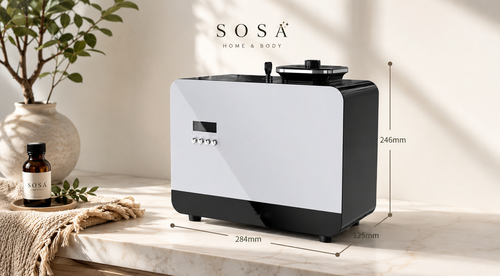
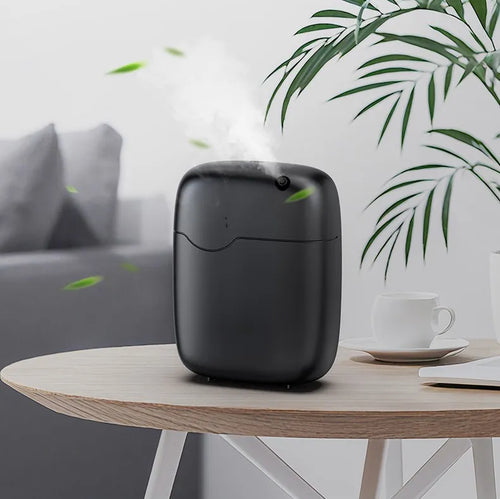 SOSA Vaayu · the test bed₹11,999View →
 SOSA Aangan · roll out wide₹25,999View →
Auditioning in the actual room
No cast can be chosen on a blotter alone, and certainly not from a description. A fragrance behaves differently once it is diffused into a real volume of air, over real materials, under real light, moved by real airflow. A white tea that seems too faint on paper can bloom beautifully across a bright stone lobby; a sandalwood that seems perfect in the hand can turn heavy in a warm, low-lit room. The only honest test is to run the candidate in the space it is meant for, at the intensity you will actually use, for long enough that the novelty wears off and you are judging how it lives day to day.
My method is simple and I recommend it to every client. Shortlist two Hotel Collection casts that fit the palette on paper — at ₹299 each, this costs almost nothing — and run each one for a fortnight in reception through a Vaayu (₹11,999), whose app control lets you hold a steady, comparable level. Then ask the people who know the room best: the front-of-house team who breathe it all day, and the regulars who will tell you, unprompted, whether it feels like you. One cast almost always wins clearly. That is your signature, and because it was chosen in situ, it will still feel right in month six.
Once chosen, the cast is portable across the whole interior. The same oil that you auditioned in reception can be rolled out building-wide through an Aangan (₹25,999), or carried to a second site unchanged — so the match you made to your materials becomes the signature of the brand.
The SOSA commercial edit
To choose and then roll out a matched signature, you want a cheap way to audition and a clean way to deliver. Here is the shortlist.
| System | Best for | Why it works | Price |
|---|---|---|---|
| Boond | A single treatment room, washroom or changing room | Compact, low-output ultrasonic; easy to hold to a trace so the treatment leads | ₹799 |
| Sukoon + Hotel Collection | A single reception or a small relaxation lounge | Compact front-of-house scenting; audition two casts a fortnight apiece | ₹1,799 + from ₹299 |
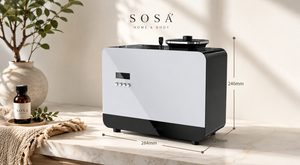
| SOSA Vaayu ★ | Reception, corridors and lounges — the professional standard | Waterless cold-air nebulising, up to ~1000m³, app + 1/4/8/24h timer, <38dB, no added humidity | ₹11,999 |
| SOSA Aangan | A whole wellness centre, 8,000–10,000 sq ft, via the HVAC | One signature ducted across every public zone, wet areas left on their own circuit | ₹25,999 |
| SOSA Meenar | A flagship or large property, 12,000–18,000 sq ft | The largest HVAC unit for multi-wing centres and resort spas | ₹38,500 |
| Hotel Collection refills | Keeping the signature running | 100ml / 300ml top-ups; low running cost across long daily hours | from ₹999 |
Versailles
A designer once sent me her entire material schedule — the limestone, the bleached oak, the undyed linen — and asked me to “make it smell like this photograph.” It is one of my favourite briefs, because it treats scent exactly as it should be treated: as another material in the palette, chosen to agree with the rest.
We shortlisted two casts, ran them a fortnight each, and the team chose a translucent white tea within days. It was the same decision the eye had already made in stone and light; the nose simply ratified the design. That is what a matched scent does — it makes the whole room feel deliberate.
We compose our casts in Pune, and a portion of every order supports girl-child education through Nanhi Kali. Your interior gets a scent that belongs to it; a girl gets a classroom.
Frequently asked questions
- Spa Interior Design and Fragrance — scent as the interior’s final, unifying layer.
- How to Create a Signature Spa Journey With Fragrance — taking your matched cast through the whole guest arc.
- Hotel Collection fragrances — casts to audition against your palette, from ₹299.
- Brand: the SOSA founder story — how an ISIPCA perfumer treats scent as a material in the palette.
Facts verified August 2026: ambient scent-marketing effects on dwell time, perceived quality and recall are real but moderate, congruence with the space matters more than intensity, and there is no measurable benefit on unclean or poorly ventilated premises. SOSA system specifications and prices as stated: Boond ₹799, Sukoon ₹1,799, Megh ₹3,499, Vaayu ₹11,999, Aangan ₹25,999, Meenar ₹38,500, Hotel Collection scents from ₹299, refills from ₹999. The Hotel Collection scents are SOSA's own interpretations inspired by the world's finest hotels; SOSA is an independent Indian fragrance house, not affiliated with or endorsed by any hotel brand. Prices subject to change.