



Real vetiver: 1 Hotels-inspired Forest Suite at ₹299 for 15ml — cedarwood · vetiver · green leaves, the driest of the seven hotel-inspired scents. Water-based, ultrasonic only.
Real sandalwood: Four Seasons-inspired Warm Welcome at ₹299 for 15ml — citrus · floral · sandalwood, the most staying power of the seven. Water-based, ultrasonic only.
The machine either one needs: Boond ₹899 for a room up to 150 sq ft, Sukoon ₹1,899 for 270–320 sq ft with three 15ml scents included in the box, or Megh ₹3,499 for a 100-hour tank at 215 sq ft coverage.
Nearest to oud: the St. Regis-inspired scent at ₹299 — amber · violet · woods. It is a real amber and it is not an oud, and I will not let it be sold as one.
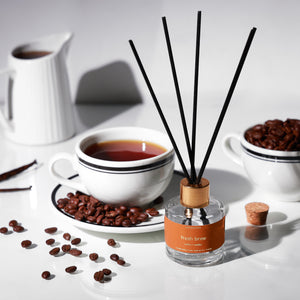
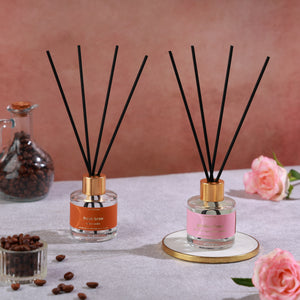
Nearest in a reed: Mountain Breeze ₹849 / ₹1,349 at 9.4 for the dry, cool, structural register nearest vetiver; Fresh Brew ₹849 / ₹1,349 at 9.5 for the deep warmth people often want from an oud room — though it is a coffee-and-vanilla gourmand, not a resin.
2. For vetiver, buy the 1 Hotels-inspired Forest Suite at ₹299. Cedarwood, vetiver and green leaves — the driest of the seven hotel-inspired scents and a genuine vetiver, not a suggestion of one. It is water-based and goes only in an ultrasonic machine: a Boond at ₹899 for a study or bedroom, a Sukoon at ₹1,899 for a hall or living room, with three 15ml scents in the box.
3. For sandalwood, buy the Four Seasons-inspired Warm Welcome at ₹299. Citrus, floral and sandalwood, and it has the most staying power of the seven, which is exactly what sandalwood is supposed to do. Same machine, same rules. In a bedroom, three drops in a Boond tank, started two hours before you sleep on the 2H timer.
4. For oud, buy nothing here, and read the oud page first. Real oud is fermented resin from agarwood that has been infected by a specific mould. It is one of the most expensive raw materials in perfumery, and a home fragrance selling an "oud" for a few hundred rupees is selling you a synthetic accord for something you have very likely never actually smelled. The nearest resinous plushness in our range is the St. Regis-inspired scent at ₹299 — amber, violet and woods. It is a real amber. It is not oud, and it will not be labelled as one on any page I write.
5. If it has to be a reed, choose the neighbour by register, knowing it is a neighbour. Mountain Breeze at ₹849 for 50ml, 9.4 on the SOSA strength scale, Himalayan pine, real sage and Indian cedar — the dry, cool, structural register closest to what a vetiver does to a room. Fresh Brew at ₹849, 9.5, Coorg coffee, Kerala vanilla and soft caramel — the deep evening warmth people often want from an oud room, arriving as a gourmand rather than a resin. Both are substitutions of one quality for another, not matches, and I will keep saying so.
Alcohol-free, phthalate-free, paraben-free, IFRA-compliant, 0 ppm formaldehyde, six fibre reeds in a refillable glass bottle, composed in Pune. Free shipping above ₹499, and a portion of every order supports girl-child education through Nanhi Kali.
Part one — the principle: two sentences hold this entire family
Nine pages, three materials, one shelf — and the whole thing rests on two facts that almost nobody is told before they buy. The first is about difference. These three materials are lumped together as "expensive woods" and they are not alike in any way that matters. Oud is hot, sandalwood is warm and vetiver is cool. Oud projects, sandalwood persists and vetiver grounds. They occupy different parts of a room, they behave differently across a day, and a person who genuinely loves one of them will quite often find the other two beside the point. The price ladder between them — oud at the top by an enormous margin, sandalwood in the middle, vetiver near the bottom — reflects how difficult each material is to obtain, not how good any of them is. Vetiver is cheap because a grass grows quickly and its roots can be dug up in eighteen months. Oud is dear because a tree has to be infected by a mould and then left for years, and most trees never are. Neither of those facts has anything to do with which one belongs in your bedroom.
The second fact is about honesty, and it is the more useful of the two. The honesty of what you are buying varies enormously by material. Vetiver in a home fragrance is nearly always genuine, for the unglamorous reason that vetiver is cheap enough that faking it would cost more than using it. Sandalwood is usually a fair deal: either a legitimate Australian species — a different tree from the Mysore one, drier and slightly sharper, but honestly a sandalwood — or one of the respectable synthetic sandalwood molecules, which are good, stable materials that a serious perfumer uses without embarrassment. Oud is the exception and it is not a small one: oud at a household price is almost never oud. The same word covers a material worth more than gold by weight and a synthetic accord that costs a fraction of a rupee per gram, and nothing in the labelling tells you which one is in the bottle. Everything else in this guide follows from those two sentences — including our own gaps, which are set out below rather than blurred into a phrase like "woody notes available".
It is worth asking why the lumping happens at all, because the answer explains most of the bad buying decisions in this category. The three materials are shelved together for a commercial reason rather than an olfactory one: they are the three notes that signal expense. A brand that puts any of the three words on a label is buying a price anchor, and a shopper who sees all three on one page reasonably concludes they are variations of a single idea — dark, serious, costly, grown-up. In a perfumer's vocabulary they are not neighbours at all. Vetiver sits with the earthy-green materials, beside things like galbanum and moss. Sandalwood sits with the creamy-lactonic ones, closer in behaviour to a soft musk than to a resin. Oud sits with the animalic materials, near leather and civet, which is why it is the only one of the three that can smell faintly alarming on first meeting. The practical consequence is that you cannot substitute across this group. A person disappointed by an oud will not be consoled by a sandalwood. Somebody who loves khus will find an amber-oud accord loud and beside the point. This is the single most useful thing to know before spending anything, and it is why the three-way comparison page exists as its own argument.
There is a simple test for working out which of the three you actually want, and it does not involve smelling anything. Ask what you want the room to do. If you want the room to impress somebody at the moment they walk in, you are describing oud, and you are describing an event rather than a fragrance — which changes how it should be dosed and is the whole subject of the living-room page. If you want the room to feel settled and cared for at eleven at night and again at six in the morning, you are describing sandalwood, and you want persistence rather than projection. If you want the room to feel cooler, quieter and slightly more serious than it did, you are describing vetiver, and what you want is not really a smell at all but a change in the temperature of the air. Three different jobs. One shelf. No overlap worth relying on.
 Nearest: amber₹299Oud is not really a wood. It is resin that an agarwood tree produces defensively when a particular mould infects its heartwood, and the infected wood is then aged, distilled or burnt. That is why it is expensive and that is why it smells the way it does — animalic, medicinal, sweet-rotten, leathery, enormous. It is the hot material of the three: it radiates, it fills a volume rather than sitting in it, and it announces that something has been done to the room. The oud page makes the harder point at length — that almost every oud-labelled home fragrance in India is a synthetic accord doing an impression, and that most buyers are chasing a memory of a hotel lobby rather than of oud itself. The luxury-oud page then asks the more practical question: what are people actually buying when they buy oud for a home, and how do you get that thing honestly.
Warm Welcome₹299Sandalwood is creamy, lactonic, faintly milky and almost shy. Its projection is very low and its life is very long, which is an unusual combination and the reason the bedroom page argues that it is simply the best bedroom material in existence: it does not travel far enough to disturb anyone and it is still there in the morning. The sandalwood page handles the part Indian buyers care about most — that Santalum album from Mysore is now scarce and strictly controlled, that most of what is sold today is Australian Santalum spicatum or a synthetic sandalwood molecule, and that the second and third of those are not frauds so long as nobody pretends otherwise. It is the warm material: it does not radiate like oud, it accumulates, and a room with sandalwood in it feels as though it has been that way for some time.
Forest Suite₹299Vetiver is not a wood at all. It is the root of a grass, and in India it has a name most people met long before they met the word vetiver: khus, the woven screen hung in a doorway and wetted in summer so that the air coming through it arrives cooler and smells of damp earth. The vetiver page makes the case that this is the material Indians grew up inside without ever filing it under perfume. It is dry, earthy, smoky-green and structural — the cool material, the one that makes a room feel a degree less warm rather than a degree fuller. The sophisticated-home page adds the observation I find truest of the three: vetiver fails a shop test and wins a year. Smelled from a bottle on a counter it seems like very little. Lived with for twelve months it becomes the thing you would miss.
Nearest: amber₹299Oud is not really a wood. It is resin that an agarwood tree produces defensively when a particular mould infects its heartwood, and the infected wood is then aged, distilled or burnt. That is why it is expensive and that is why it smells the way it does — animalic, medicinal, sweet-rotten, leathery, enormous. It is the hot material of the three: it radiates, it fills a volume rather than sitting in it, and it announces that something has been done to the room. The oud page makes the harder point at length — that almost every oud-labelled home fragrance in India is a synthetic accord doing an impression, and that most buyers are chasing a memory of a hotel lobby rather than of oud itself. The luxury-oud page then asks the more practical question: what are people actually buying when they buy oud for a home, and how do you get that thing honestly.
Warm Welcome₹299Sandalwood is creamy, lactonic, faintly milky and almost shy. Its projection is very low and its life is very long, which is an unusual combination and the reason the bedroom page argues that it is simply the best bedroom material in existence: it does not travel far enough to disturb anyone and it is still there in the morning. The sandalwood page handles the part Indian buyers care about most — that Santalum album from Mysore is now scarce and strictly controlled, that most of what is sold today is Australian Santalum spicatum or a synthetic sandalwood molecule, and that the second and third of those are not frauds so long as nobody pretends otherwise. It is the warm material: it does not radiate like oud, it accumulates, and a room with sandalwood in it feels as though it has been that way for some time.
Forest Suite₹299Vetiver is not a wood at all. It is the root of a grass, and in India it has a name most people met long before they met the word vetiver: khus, the woven screen hung in a doorway and wetted in summer so that the air coming through it arrives cooler and smells of damp earth. The vetiver page makes the case that this is the material Indians grew up inside without ever filing it under perfume. It is dry, earthy, smoky-green and structural — the cool material, the one that makes a room feel a degree less warm rather than a degree fuller. The sophisticated-home page adds the observation I find truest of the three: vetiver fails a shop test and wins a year. Smelled from a bottle on a counter it seems like very little. Lived with for twelve months it becomes the thing you would miss.
Part two — what SOSA has for this family, and what it does not
Here is the complete position, stated up front rather than assembled from hints. No oud, sandalwood or vetiver reed diffuser exists at SOSA, and there is no oud anywhere at SOSA in any format. The reed line is five scents and there is no sixth, no seasonal edition and no exclusive. Not one of the five contains any of the three materials this guide is about — not in a small quantity, not as a base note, not in a limited run. If you came here searching for an oud reed diffuser, a sandalwood reed diffuser or a vetiver reed diffuser, the product does not exist in our range and it is not going to appear further down the page in disguise.
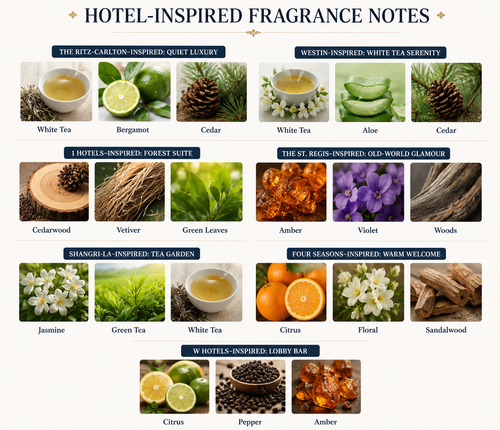
Now the good news, which deserves proper weight rather than a footnote, because two of the three materials genuinely exist here as real notes. Real vetiver is in the 1 Hotels-inspired Forest Suite at ₹299 — cedarwood, vetiver and green leaves, and it is the driest of the seven hotel-inspired scents by a clear margin. If you have ever wanted a room to read as cool, quiet and slightly severe, that is the bottle. Real sandalwood is in the Four Seasons-inspired Warm Welcome at ₹299 — citrus, floral and sandalwood, and it has the most staying power of the seven, which is the sandalwood behaving exactly as sandalwood behaves. Both of these are water-based and ultrasonic only. They cannot go into a reed bottle, reed oil cannot go into an ultrasonic machine, and the two product lines never cross over in either direction. They need a machine: the Boond at ₹899, a 300ml tank rated up to 150 sq ft running about six hours, USB-powered with a night light; the Sukoon at ₹1,899, a 500ml tank rated 270–320 sq ft running 16 to 18 hours on low, with three 15ml scents included in the box, which makes it the cheapest sensible way into this family; or the Megh at ₹3,499, a six-litre tank running about 100 hours but covering only 215 sq ft, which is a runtime and humidity machine rather than a coverage upgrade over the Sukoon.
For oud there is no such good news and I am not going to manufacture any. The nearest thing in this house to the plush resinous quality people are chasing when they type the word is the St. Regis-inspired scent at ₹299 — amber, violet and woods. It is an amber, not an oud. Amber is a warm, resinous, faintly powdery accord; oud is a fermented resin with an animalic, medicinal edge that amber does not have and does not try to have. They overlap in the way two warm dark things overlap, which is enough to satisfy some buyers and nowhere near enough for anyone who actually knows oud. I would rather you bought it knowing that than bought it believing something else. The oud living-room page takes this further and is worth reading if a drawing room is what you are scenting.
And then the reed neighbours, labelled as neighbours. Mountain Breeze at ₹849 for 50ml and ₹1,349 for 130ml — Himalayan pine, real sage and Indian cedar, 9.4 on the SOSA strength scale and the deepest woody in the reed line, 6–8 weeks on the small bottle and 14–18 on the large, rated 4.9 across 138 verified buyers with 96% saying they would recommend it. It is the dry, cool, structural register nearest to what a vetiver does to a room, and it is a mountain rather than a root: green where vetiver is earthy, resinous where vetiver is smoky. Fresh Brew at ₹849 and ₹1,349 — Coorg coffee, Kerala vanilla and soft caramel, 9.5, the deepest and warmest scent we make, 4.9 from 127 verified buyers. It is the nearest thing we have to the depth and evening weight people want from an oud room, and it gets there as a gourmand. A coffee is not a resin. Somebody who wants an oud drawing room and is handed a coffee one may well be happy; they should at least be told which one they are being handed.
Since both of those numbers get misread, the strength scale deserves a sentence of its own here. The SOSA scale runs 8.9 to 9.5 across the five reeds and it measures depth, not projection. Mountain Breeze at 9.4 is not louder in a room than Evening Calm at 8.9; its centre of gravity sits lower and holds for longer. Depth is how far down a fragrance goes and how long it lasts. Projection is how far across a room it travels. This distinction matters more in this family than in any other, because the three materials it is about are precisely the ones people misjudge on it. Sandalwood is the extreme case — very deep and almost no projection at all, which is exactly why it works next to a sleeping person. Oud is the opposite — it projects enormously, which is why it is a receiving scent and a poor bedroom one. Vetiver is deep, dry and low-projecting, and reads as structure rather than as volume. So when you see 9.4 next to Mountain Breeze and worry it is too much for a bedroom, it is not the number you should be adjusting. It is the reed count.
One further note on why the good news lives on the ultrasonic side rather than in a bottle of reed oil, because it is a formulation fact rather than a commercial choice. A reed diffuser has no switch. Whatever is in it is in the room continuously for six to eighteen weeks, and the material has to behave itself at 45°C in a sealed flat for the whole of that time without being turned down. The large, slow, heavy molecules that make sandalwood and oud what they are do not thin out across a hot afternoon the way pine and cedar do — they sit, and they keep sitting. A machine solves that problem by being a machine: it runs for two hours and stops, it can be dosed at three drops rather than six, and it can be aimed at an evening rather than at a season. That is the honest engineering reason our sandalwood and vetiver live in a water-based, ultrasonic-only format, and it is the same reason I have not yet put either into a reed bottle I would be happy to leave in somebody's bedroom for two months with no way to turn it off.
| Scent | Notes | Strength | How close it gets to this family | Best room | 50ml / 130ml |
|---|---|---|---|---|---|
| Mountain Breeze ★ | Himalayan pine · sage · Indian cedar | 9.4 · deep woody | The nearest register to vetiver — dry, cool, structural. A mountain rather than a root, and a substitution rather than a match | Study, hall, bedroom at three reeds | ₹849 / ₹1,349 |
| Fresh Brew | Coorg coffee · Kerala vanilla · soft caramel | 9.5 · deepest in range | The nearest depth and evening warmth to what people want from an oud room — but it is a gourmand, not a resin | Drawing room, study, winter evenings | ₹849 / ₹1,349 |
| Evening Calm | Kashmir lavender · chamomile · soft musk drydown | 8.9 · softest in range | Not close. It is the quiet bedroom option if what you wanted from sandalwood was calm rather than creaminess | Bedside, guest room | ₹799 / ₹1,299 |
| Garden Bloom | British rose · night-blooming jasmine · soft musk drydown | 8.9 · medium floral | Not close at all — a floral. Listed because a guide that hides the non-matches is an advertisement | Entryway, drawing room | ₹799 / ₹1,299 |
| Morning Freshness | Malabar lemon · peppermint · eucalyptus globulus | 9.0 · bright | The opposite end of the house. Included for completeness, and because some people who ask for vetiver actually want cool, which this also delivers | Bathroom, kitchen, desk | ₹749 / ₹1,249 |
| Scent | Notes | What it is for | Machine | 15ml |
|---|---|---|---|---|
| 1 Hotels-inspired · Forest Suite ★ | Cedarwood · vetiver · green leaves | Real vetiver, and the driest of the seven. A study, a hall, a home you want to read as cool and quiet | Boond ₹899 or Sukoon ₹1,899 | ₹299 |
| Four Seasons-inspired · Warm Welcome | Citrus · floral · sandalwood | Real creamy sandalwood, and the most staying power of the seven. The bedroom answer in this family | Boond ₹899 at three drops | ₹299 |
| St. Regis-inspired · Old-World Glamour | Amber · violet · woods | The nearest resinous plushness to what oud buyers want. It is an amber and it is not an oud | Sukoon ₹1,899 for a drawing room | ₹299 |
| W Hotels-inspired · Lobby Bar | Citrus · pepper · amber | A livelier amber with a pepper lift, if the St. Regis reads as too still for you | Sukoon ₹1,899 | ₹299 |
| Ritz-Carlton, Westin, Shangri-La-inspired | White tea · bergamot · cedar / white tea · aloe · cedar / jasmine · green tea · white tea | The clean and tea end of the collection — cedar appears, but no vetiver, no sandalwood, no oud | Any of the three machines | ₹299 |
| Oud, in any bottle at SOSA | — | Does not exist. Not in the reeds, not in the Hotel Collection, not at any price | — | — |
Real vetiver & sandalwood · Hotel Collection₹299Shop →  The machine they need · Sukoon₹1,899Shop →
  Nearest dry reed · Mountain Breeze₹849Shop →
Part three — rooms, doses and formats, drawn from three pages of this cluster
This is where the principle becomes instructions, and the instructions are different for each of the three materials because the materials are different. Start with oud, which is a receiving scent — the argument of the oud living-room page. Nobody actually wants to live inside an oud. What people want is for a drawing room to be impressive at the moment someone else walks into it, which is a different requirement and has a different solution: you dose for the arrival, not for the evening. On a machine that means running it for the half-hour before people come and letting it idle afterwards, because a resinous scent at full strength for four continuous hours stops reading as luxury and starts reading as a lot. If you are doing this with the St. Regis-inspired amber at ₹299 on a Sukoon at ₹1,899, that is the pattern. If you are doing it with a reed, Fresh Brew at ₹849 in the 130ml at ₹1,349 gives you the depth, and you flip the reeds on the morning of the evening rather than an hour before, so the room has settled by the time the doorbell goes.
Sandalwood is a bedroom material, and the sandalwood bedroom page makes the strongest single-room claim in this cluster: that it is the best bedroom material there is. The reasoning is physical rather than romantic. Sandalwood has very low projection and a very long life, so it does not travel across a bed and bother the person on the other side of it, and it is still faintly present at six in the morning when almost everything else has gone. The setting is specific: the Four Seasons-inspired Warm Welcome at ₹299, three drops in a Boond at ₹899, started two hours before you sleep on the 2H timer, so the machine has finished by the time you are actually in bed and what you sleep in is the residue rather than the mist. That last detail is the one people get wrong. A bedroom fragrance should be finishing when you arrive, not starting.
Vetiver belongs in a study or a hall, and it is the one material in this family I would tell you to commit to and never rotate — the conclusion of the sophisticated-home page. Vetiver fails a shop test. Smelled from a bottle it is dry, quiet, a little austere and it does not perform at all, which is why it loses to almost anything sweeter on a counter. Lived with, it does something no performing scent manages: it stops being noticeable and starts being characteristic, so that the room reads as a place with a quality rather than a place with a fragrance in it. That effect only exists if you leave it alone. Rotate a vetiver every six weeks and you get nothing from it; run the 1 Hotels-inspired Forest Suite at ₹299 in the same hall for a year and people will begin to associate the smell with your house without ever being able to name it. In a reed, Mountain Breeze at ₹849 does the same job in a different accent, and the same instruction applies: commit to it.
The money is worth laying out too, because this family looks expensive from the outside and mostly is not. The entire vetiver answer is a Boond at ₹899 and a 15ml Forest Suite at ₹299 — and the machine is a one-off, so the second scent and the third cost ₹299 each. The Sukoon at ₹1,899 is better value than it looks precisely because three 15ml scents come in the box: if two of those three are the sandalwood and the vetiver you would have bought anyway, most of the difference between the two machines has already paid for itself. Larger bottles follow at ₹999 for 100ml and ₹1,799 for 300ml, and the pack of seven is ₹1,799, which is the cheapest way to find out which of the seven you actually live with. Against that, a reed is ₹849 for a 50ml running 6–8 weeks or ₹1,349 for a 130ml running 14–18, at roughly ₹15 a day at full six-reed strength and considerably less at the three or four reeds most rooms want. Neither format is the expensive one. The expensive purchase in this category is the premium-priced "oud" that contains no oud, bought once a year by somebody who has never been told what oud is.
A word, finally, about what to do if you are buying for somebody else, since this family attracts gift buyers more than any other — the words themselves sound like a present. Do not gift an oud-register scent. It is the most polarising thing in home fragrance, it is the one most likely to be too much in a house that is not yours, and the recipient has no way to turn it down if it arrives as a reed. Sandalwood is the safe gift of the three, because low projection means it cannot embarrass anybody, and because the Warm Welcome reads as pleasant to almost everyone before it reads as sandalwood to anyone. Vetiver is the connoisseur's gift and the riskiest: it will underwhelm on the day it is opened and may well be the thing they thank you for a year later, which is a lovely outcome and a poor birthday. If you want a gift from the reed line that reliably lands in this register, it is Mountain Breeze at ₹849 — 4.9 from 138 verified buyers with 96% saying they would recommend it, and the least gendered, least polarising thing we make.
Now the format mechanics, because the two lines are operated completely differently and this is where most of the money gets wasted. For reeds: use three to six fibre reeds according to room size — six in a hall, four in a living room, three in a bedroom, two in a small bathroom, where a 50ml then runs close to three months. 50ml suits rooms up to about 150 sq ft and 130ml suits anything above that. Flip the reeds every five to seven days, which gives you a lift each time and costs nothing. Keep the bottle out of the direct path of a running split AC, which strips the top off within days and leaves you with the base. For the Hotel Collection on a machine: three to six drops per tank — per tank, not per litre, which is the single commonest overdose we hear about, and it is the reason a first evening with a new machine sometimes ends with somebody opening a window. Rinse the tank between scents, because a residue of one hotel scent under another is how you get a muddle rather than a fragrance. Never put raw essential oils into a 2.4MHz ultrasonic plate — undiluted oil damages the plate and voids the point of buying a good machine. And put the machine at waist height or above, on a console or a shelf rather than on the floor, because cool mist falls and a machine on the floor scents your ankles.
One more time, plainly, because it is the mistake that costs people the most: the two product lines never cross over in either direction. Reed diffuser oil is an oil-based formulation on a heat-stable CCT carrier and it goes into a glass bottle with fibre reeds and nothing else. The seven hotel-inspired scents are water-based and go into an ultrasonic machine and nothing else. You cannot pour Hotel Collection scent into a reed bottle and get a reed diffuser, you cannot pour reed oil into a Boond and get a working machine, and there is no hotel-inspired reed diffuser and there will not be one. If the answer to your search is a real sandalwood or a real vetiver, then the answer to your search is a machine, and the cheapest sensible route to it is the Sukoon at ₹1,899 with three 15ml scents already in the box.
Part four — the complete edit, in buying order, and the honest gaps
Here is the whole range as it applies to somebody who arrived asking for oud, sandalwood or vetiver, in the order I would actually buy it. The decision-tree page takes this one branch at a time and the three-way comparison argues the differences properly; this is the same conclusion laid flat. This family is the one where SOSA's answer is most often "not from us in this format", and the table below is written to be useful rather than complete. Two of the five rows send you to a ₹299 bottle and a machine rather than to a reed, one row sends you to a reed while telling you it is a neighbour, and the last row is the gap, which is the row I care most about. If you leave this page having bought nothing and knowing what oud is, the page has done the job I wrote it to do.
| Buy | What it is | When it is the right answer | Price |
|---|---|---|---|
| 1. 1 Hotels-inspired Forest Suite ★ | Cedarwood · vetiver · green leaves — real vetiver, the driest of the seven. Water-based, ultrasonic only | If you want vetiver. Put it in a study or a hall, and then leave it there for a year | ₹299 |
| 2. Four Seasons-inspired Warm Welcome | Citrus · floral · sandalwood — real creamy sandalwood, the most staying power of the seven. Water-based, ultrasonic only | If you want sandalwood. Three drops in a bedroom, two hours before sleep on the 2H timer | ₹299 |
| 3. Boond or Sukoon | The machine either of the above requires — Boond 300ml up to 150 sq ft, about six hours, USB and night light; Sukoon 500ml for 270–320 sq ft, 16–18 hours on low, three 15ml scents included | Boond for a bedroom or study, Sukoon for a hall or living room. Megh ₹3,499 only if you want a 100-hour tank at 215 sq ft | ₹899 / ₹1,899 |
| 4. Mountain Breeze 50ml | Himalayan pine, sage and Indian cedar, 9.4 — the dry, cool, structural reed nearest to a vetiver register, 4.9 from 138 verified buyers | If it must be a reed and what you liked about vetiver was the dryness. A neighbour, not a match | ₹849 / ₹1,349 |
| 5. Fresh Brew 50ml | Coorg coffee, Kerala vanilla and soft caramel, 9.5, the deepest and warmest scent we make | If it must be a reed and what you wanted from an oud room was evening depth. It is a gourmand, and I would rather you knew | ₹849 / ₹1,349 |
| The honest gap: no oud, and no oud, sandalwood or vetiver reed at all | There is no oud reed diffuser at SOSA and no oud anywhere at SOSA in any format, including the Hotel Collection. There is no sandalwood reed and no vetiver reed. The nearest resinous plushness is the St. Regis-inspired amber at ₹299, which is an amber and not an oud | Said plainly rather than stretched to fit. If oud is what you want, the honest recommendation is that you buy nothing from us and now know why | ₹0 / ₹299 |
Part four, continued — when the format is the answer, and when nothing we make is
This cluster sits inside a blog about reed diffusers, so it is worth saying exactly when a reed is the right tool for these three materials and when it is not, because the answer differs by material and it is not the answer commerce would prefer. A reed is the correct format for vetiver. Vetiver's whole effect depends on constancy — it becomes characteristic only by never varying, and a reed never varies: no socket, no motor, no water, no timer, nothing to switch on and nothing to remember, present at the same level at seven in the morning and eleven at night. That is precisely the behaviour a vetiver hall wants, and it is why Mountain Breeze at ₹849, for all that it is a mountain rather than a root, does a genuinely useful version of the job. A reed is an acceptable format for sandalwood and a poor one for oud. Sandalwood wants persistence, which a reed provides, but it also wants the option of being finished before you go to sleep, which only a machine provides. Oud wants to be an event — half an hour before guests arrive, then off — and a reed has no off. Running an oud-register scent continuously is the commonest way to turn something expensive into something oppressive, which is one more reason I am content that we do not sell one.
That leaves the situations where I would tell you to buy nothing from us, and there are three of them. The first is if you specifically want oud — real oud, knowingly, having smelled it — in which case nothing at SOSA is it and the St. Regis-inspired amber at ₹299 will not become one because you hoped. Go to an attar shop, ask to smell an oud oil, and understand that what you are buying at that point is a material rather than a home fragrance. The second is if you want Mysore sandalwood specifically, as against sandalwood in general: Santalum album is scarce and controlled, and anything claiming it at a household price deserves scepticism from you and would deserve it from me. Our Four Seasons-inspired sandalwood is a real, creamy sandalwood and I am not going to attach a provenance to it that I cannot evidence. The third is an open-plan space above roughly 250 to 300 sq ft, where a fanless reed bottle cannot carry the volume whatever is dissolved in it — there the answer is two 130ml bottles at opposite ends of the room, or the Sukoon at ₹1,899, which is rated 270–320 sq ft. In every one of those three cases I would rather lose the sale than have you find out in a fortnight, which is the editorial position this entire family is built on.
Versailles
I should be honest about what this is. I commissioned ten pages about three materials my reed line does not contain, and I am aware that this is a strange thing for a founder to do. Every other family in this plan ends with me recommending something we make. This one ends with a ₹299 bottle that needs a machine, two reeds described as neighbours rather than matches, and — for a third of the people who arrive here — nothing at all.
The reason is simple enough to say in one sentence. A buyer who learns what oud actually is and leaves without buying anything is a better outcome for me than a buyer who buys an amber believing it is an oud. The second person is happy for about a fortnight. Then either they never find out, in which case I have taught them something false about a material they were curious about, or they do find out, in which case they know exactly who told them the untruth. There is no version of that transaction I want.
The oud situation deserves its own paragraph. Real oud is fermented resin from agarwood infected by a mould, it is one of the most expensive raw materials in the world, and the gap between what it costs and what an "oud" home fragrance sells for in India is so large that the arithmetic answers the question on its own. This is not a scandal and it is not a secret — synthetic oud accords are legitimate materials and some of them are very well made. What is not legitimate is selling one to somebody who thinks they are getting the other. So I have taken the position that costs me the most and troubles me the least: there is no oud at SOSA in any format, and there is not going to be one until I can make something I would be willing to explain in full.
Sandalwood and vetiver are a happier story and I want to give them their proper weight, because it would be a poor guide that spent all its candour on the absence. The vetiver in the 1 Hotels-inspired scent is real vetiver and it is the driest thing in this house — I use it in my own study and I have not changed it in over a year, which is exactly the instruction I have given you above. The sandalwood in the Four Seasons-inspired scent is a genuine creamy sandalwood with the longest staying power of the seven, and it is the one I put in a guest room before my parents visit. Both are ₹299. Both need a machine. Neither can be poured into a reed bottle, and I would rather repeat that four times than have one person try it.
What I will not do is stretch Mountain Breeze to cover a vetiver or Fresh Brew to cover an oud. They are both good bottles and I am proud of both. A Himalayan pine is not a khus root and a Coorg coffee is not a fermented resin, and the day I start describing them as though they were is the day this blog becomes something I would not read. So: if you wanted vetiver, ₹299 and a Boond. If you wanted sandalwood, the same. If you wanted oud, I hope this saved you some money and told you something true, and I would rather have written it than sold you the nearest dark thing on the shelf. Everything we make is composed in Pune, and a part of every order funds a girl's classroom through Nanhi Kali.
Frequently asked questions
- Oud in India and Luxury oud at home — what oud is, and why almost nothing sold as oud is oud, and what to buy when nobody makes the reed.
- Sandalwood in India and Vetiver in India — Mysore, Australian, and the synthetic majority, and khus, and the one place SOSA has real vetiver.
- Oud in a living room and Sandalwood in a bedroom — the honest substitution, and the creamiest answer in the house.
- Vetiver at home and Oud versus sandalwood versus vetiver — the driest thing SOSA makes, and three woods, three different rooms.
- The decision tree — one bottle, no reading, if you want one bottle and no argument.
- Brand: the SOSA founder story.
SOSA reed diffusers — facts verified August 2026: Five scents, all alcohol-free, on a heat-stable CCT (caprylic/capric triglyceride, coconut-derived) base rather than DPG, phthalate-free, paraben-free, IFRA-compliant, 0 ppm formaldehyde, six fibre reeds in a refillable glass bottle, composed and made in Pune, India. Mountain Breeze (Himalayan pine · sage · Indian cedar) 50ml ₹849 · 130ml ₹1,349 · 9.4 on the SOSA strength scale, the deepest woody in the range · 4.9 from 138 verified buyers, 96% would recommend. Fresh Brew (Coorg coffee · Kerala vanilla · soft caramel) 50ml ₹849 · 130ml ₹1,349 · 9.5, the deepest in the range · 4.9 from 127 verified buyers. Morning Freshness (Malabar lemon, cold-pressed · peppermint · eucalyptus globulus) 50ml ₹749 · 130ml ₹1,249 · 9.0 · 4.9 from 41 verified buyers. Evening Calm (Kashmir lavender · chamomile · soft musk drydown) 50ml ₹799 · 130ml ₹1,299 · 8.9, the softest in the range · 4.9 from 164 verified buyers, 97% would recommend. Garden Bloom (British rose · night-blooming jasmine, sambac/mogra · soft musk drydown) 50ml ₹799 · 130ml ₹1,299 · 8.9 · 4.9 from 138 verified buyers. Longevity 6–8 weeks on 50ml and 14–18 weeks on 130ml; two or three reeds in a small bathroom makes a 50ml last nearly three months. Sizing: 50ml suits rooms up to about 150 sq ft, 130ml above that. Reed flip cadence every five to seven days. Duos: Fresh & Grounded ₹1,548, Day & Night ₹1,498, Warmth & Bloom ₹1,598 for 50ml × 2. Refills 300ml ₹2,399 · 500ml ₹3,499. Climate-tested through 45°C heat soak and 85% RH monsoon humidity. Ultrasonic machines, a separate product line: Boond ₹899 (300ml, up to 150 sq ft, about six hours, USB, night light), Sukoon ₹1,899 (500ml, 270–320 sq ft, 16–18 hours on low, three 15ml scents included) and Megh ₹3,499 (six-litre tank, about 100 hours runtime, 215 sq ft coverage — a runtime machine rather than a coverage upgrade); Hotel Collection fragrance 15ml ₹299 · 100ml ₹999 · 300ml ₹1,799 · pack of seven ₹1,799, comprising Ritz-Carlton-inspired (white tea · bergamot · cedar), Westin-inspired (white tea · aloe · cedar), 1 Hotels-inspired (cedarwood · vetiver · green leaves), St. Regis-inspired (amber · violet · woods), Shangri-La-inspired (jasmine · green tea · white tea), Four Seasons-inspired (citrus · floral · sandalwood) and W Hotels-inspired (citrus · pepper · amber). The SOSA reed line contains no oud, no sandalwood, no vetiver, no amber, no orange blossom or neroli, no aquatic or clean-linen accord and no musk as a lead note — soft musk appears only as a drydown in Evening Calm and Garden Bloom; where this guide is asked for one of those it says so rather than stretching the nearest scent to cover it. There is no oud anywhere at SOSA in any format, including the Hotel Collection. Reed diffuser oil and the water-based Hotel Collection are separate products and are not interchangeable in either direction, and there is no hotel-inspired reed diffuser. SOSA Home & Body is an independent Indian brand and is not affiliated with, endorsed by or connected to any hotel brand; the hotel-inspired scents are SOSA's own interpretations. Free shipping above ₹499. A portion of every order supports girl-child education through Nanhi Kali. Prices subject to change — see the live product pages.