
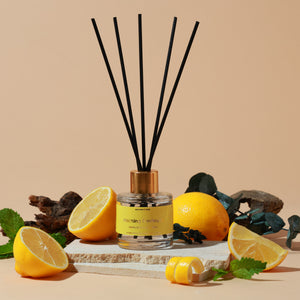

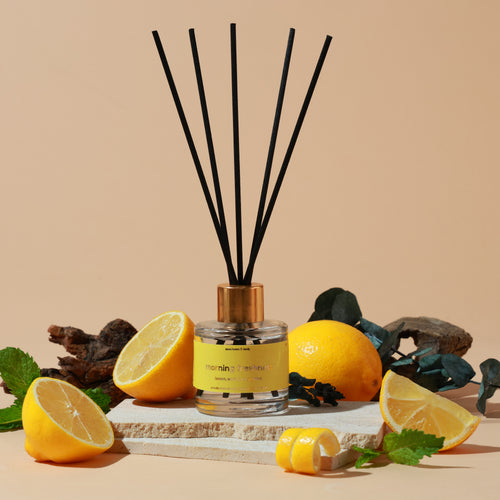
The pick: the Morning Freshness reed diffuser, 50ml, ₹749 — glass, a composition that opens quiet, 6–8 weeks of presence — clears all seven without trying.
The one to watch: wax melts at ₹474 look complete on the shelf and are not. Without a burner, they are the single most common incomplete gift at this budget.
2. A scent that hits hard on opening and is gone within the hour is the tell people notice without knowing why. Inexpensive fragrance compositions over-dose the volatile top notes because that is what sells a bottle off a crowded shelf in the first three seconds — so they announce themselves loudly and then have nothing left. A composition that opens quietly and is still readable an hour later is the one that reads expensive, at any price. The Morning Freshness reed diffuser at ₹749 is built this way by design, not by accident.
3. An incomplete gift is a gift that hands the recipient a problem. Wax melts at ₹474 with no burner, or a fragrance with no machine to run it in, both fail this test — the fix (a Little Heart Ceramic Burner at ₹569) pushes the total to ₹1,043, which is over this budget. At ₹750, wax melts are only a complete gift for someone who already owns a burner.
4. The commonest tell of all has nothing to do with money. A gift with no evidence of choice in it — something that could have been handed to anyone on the list — reads as an afterthought regardless of what it cost. A single line on the card naming the recipient's actual habit fixes this entirely, and it is free.
5. Judged against all seven tells, one object at this budget clears every one without effort. The Morning Freshness reed diffuser at ₹749 is glass, opens quietly, runs 6–8 weeks and is composed under a named structure rather than a vague label. The Handmade Ribbed Mug at ₹569 and the candle duo at ₹664 clear them too, by different routes.
Alcohol-free, IFRA-compliant, composed by an ISIPCA Versailles-trained perfumer and handmade in small batches in Pune — and every purchase funds a girl's education through Nanhi Kali.
Why the real fear is embarrassment, not ambition
Ask someone with ₹750 to spend on a gift what they are trying to achieve and almost nobody says "impress." What they say, in some form, is "I don't want them to think I didn't try" — which is a fear of a specific, visible failure rather than a desire for a specific, visible success. That distinction matters because it changes what the gift needs to do. A gift built to impress needs to signal cost. A gift built to avoid embarrassment only needs to avoid the handful of things that read as an afterthought. Those are much smaller, cheaper problems to solve, and they are the seven tells this guide catalogues rather than the general question of how to make ₹750 look expensive — a different brief, answered elsewhere on this site, and one that is not this one.
The useful distinction underneath all seven tells is that cheap and inexpensive are not the same property, and only one of them is visible. Inexpensive is a fact about the receipt. Cheap is a fact about what the object communicates when it is picked up, unwrapped, sniffed or used — and an object communicates that regardless of what it cost. A ₹569 ceramic mug chosen because the giver noticed a genuine habit does not look cheap to anyone who receives it. A ₹1,500 object bought in a hurry because it filled the number often does. Every tell in this guide is a way that a visible signal leaks through the wrapping and tells the recipient something the giver did not intend to say — about haste, about inattention, or about the object itself being built down to a price rather than up to a purpose.
This is also why the fixes below cost so little. A tell is, by definition, a small and specific thing — a sticker, a font choice, a missing accessory — and small specific things have small specific fixes. Nobody needs to spend more to solve any of the seven. They need to notice the tell before the recipient does, which is a different and much more achievable job than trying to manufacture the impression of a bigger budget. The ₹202 guide to premium-reading gifts under ₹500 makes a related point about weight and restraint at an even smaller number — the mechanism there is largely the same one at work here, just diagnosed from the opposite direction.
The three tells worth understanding properly
 Morning Freshness₹749Two things give away a cheap gift before it is even out of the box: a visible price and a box that is trying too hard. The first is the sticker — an MRP flash, a discounted price printed under a struck-through one, a barcode left facing outward. It takes ten seconds to remove and check the base of the object, where a second sticker often hides, and that ten seconds is the highest-return effort in this entire guide. The second is packaging that uses several fonts, a starburst graphic, or a "50% OFF" flash intended for a shelf rather than a hand. Plain stock — a single typeface, generous white space, kraft paper or a solid colour — reads as considered at any price point, because restraint is itself the signal. A loud box says "buy me"; a quiet one says "this is for you."
All seven tells, why each one reads cheap, and what it costs to fix
Laid out together, the pattern is clear: most of these tells cost nothing to fix, and the two that do (an incomplete gift, or upgrading from plastic to glass) still land inside or close to a ₹750 budget when the right product is chosen from the start rather than patched afterwards.
| The tell | Why it reads cheap | The fix | Cost of fixing it |
|---|---|---|---|
| A visible price sticker or MRP flash | Quantifies the object before it has been felt or smelled | Peel it off; check the base too | ₹0 |
| Packaging that shouts | Several fonts, a starburst or a discount flash reads as a shelf, not a gift | Plain stock, one typeface, kraft or a solid colour | ₹0 |
| A scent that hits hard, then fades within the hour | Cheap compositions over-dose top notes to sell fast off a shelf | Choose a composition built to open quiet and hold — Morning Freshness | ₹749 |
| Plastic where glass is expected | Weight is assessed in the hand before the eye even engages | Choose a glass object at this budget — the reed diffuser is one | ₹749 |
| An incomplete gift (fragrance with no machine, wax melts with no burner) | Hands the recipient a problem instead of a finished object | Pair it — wax melts ₹474 + burner ₹569 | ₹1,043 — over this budget |
| Something that finishes in an evening | Reads as slight for an occasion that mattered enough to mark | Choose the duo or the diffuser over the single small candle | from ₹664 |
| No evidence of choice — could have gone to anyone | The commonest tell, and the one least about money | One line on the card naming their actual habit | ₹0 |
| Reading the table: four of the seven tells cost nothing to fix at all. The two genuine spending decisions are choosing glass over plastic and choosing a composition built to last — and one product at this budget, the ₹749 reed diffuser, answers both at once rather than requiring two separate purchases. | |||
Morning Freshness · the pick50ml ₹749Shop →  Handmade Ribbed Mug · weight₹569Shop → Candle duo · the pair₹664Shop →
Presentation, wrapping and the one line on the card
Presentation at this budget is almost entirely about subtraction rather than addition. The instinct when a number feels small is to compensate with more — more ribbon, a bigger bow, tissue paper in three colours — and that instinct is exactly backwards, because it recreates the shouting-packaging tell with the giver's own hands. One colour of paper, tied once, with the sticker already removed, reads more considered than a gift wrapped by someone trying to make up for the price. If the retail box is plain, use it. If it is not, a plain paper wrap over it takes under a minute and solves the problem completely.
Delivery matters more than most people budget for at ₹750, because it is the last thing that happens before the tell either lands or does not. Handing something over yourself, in person, removes the courier-bag problem entirely — a gift that looks fine on a table looks considerably less so pulled out of a plastic courier sleeve with a shipping label still creased into it. If it has to be posted, ask whichever platform is used whether gift wrap is available at checkout; several are, for a cost well inside this budget, and it removes the wrapping question altogether.
The card is the cheapest and highest-leverage move in this whole guide, and it is worth treating as part of the gift rather than an afterthought bolted onto it. One sentence naming something specific and true about the recipient — a habit, a running joke, a thing they mentioned once that the giver remembered — does more to answer the evidence-of-choice tell than anything spent on the object itself. It is also the one fix on this list that a bigger budget cannot buy either; a ₹5,000 gift with a card that says "Happy birthday!" and nothing else has exactly the same problem as a ₹379 candle with the same card.
The costed shortlist — what actually passes all seven
Four routes clear every tell in this guide, and one deliberately does not, included here because it is the mistake worth seeing in numbers rather than in the abstract. Every total below has been checked by hand.
| Pick | What it is | Against the seven tells | Price |
|---|---|---|---|
| The pick ★ | Morning Freshness reed diffuser — glass, quiet opening, 6–8 weeks | Passes all seven, unaided | ₹749 |
| The safe object | Handmade Ribbed Mug — ceramic weight, daily use, no fragrance risk to get wrong | Passes all seven — no scent, nothing to fade | ₹569 |
| The generous pair | Candle duo, ~30–36 hrs — two objects, related, not one padded one | Passes all seven — two related objects are their own evidence of choice | ₹664 |
| Elegant, but say so | Taper candles, set of 4 — genuinely the best-looking cheap object on this list | Passes six of seven — brief, an evening at most; worth naming honestly | ₹569 |
| What to avoid | Wax melts ₹474 alone, for someone with no burner — the classic incomplete gift | Fails tell five; completing it costs ₹1,043, over budget | ₹474 |
Versailles
People ask me constantly how to make ₹750 look like more than it is. I understand the question, but I think it is aimed at the wrong target. Nobody who receives a well-chosen ₹750 gift is doing arithmetic on it. They are noticing a sticker, or not noticing one. They are catching a scent that has already left the room, or one that is still there an hour later. They are feeling plastic where they expected glass, or they are not. The whole question of "looking cheap" resolves at that level of specificity, not at the level of the number.
I trained as a perfumer before I ever thought about gifting, and the scent tell is the one I feel most strongly about, because it is the one people can least explain and most reliably detect. A composition dosed to sell fast off a shelf announces itself and then disappears — and something in a recipient's nose registers that disappearance as absence, as a gift that did not last, even if they could never say why. Building something that opens quietly and holds is not a luxury flourish. At ₹749, it is simply the difference between a gift that reads considered and one that does not.
The honest heart of this whole guide is one distinction: cheap and inexpensive are not the same thing, and only cheap is visible. A ₹569 mug chosen because you actually noticed how someone takes their coffee will never look cheap, whatever it cost. A ₹1,500 object bought because it hit a number, with no sticker checked and no thought behind the card, very often does. Every purchase funds a girl's education through Nanhi Kali — not a percentage, not a quarterly cheque. Every one.
Frequently asked questions
- Best gifts under ₹750 in India — the full picks list this guide deliberately does not repeat.
- Best luxury-looking gifts under ₹750 — the same budget, argued from what makes it read expensive.
- Best home fragrance gifts under ₹750 — fragrance-first, register by register.
- I have ₹750 for a gift — what should I buy? — the quick-decision version of this guide.
- Brand: the SOSA founder story.
SOSA products & prices (verified August 2026): Scented candles from ₹379 (small, ~15–18 hrs) · candle duos ₹664 (~30–36 hrs) · wax melts ₹474 · message and affirmation candles ₹699 · woodenwick and ceramic jar candles ₹949 · massage body candle ₹699. Reed diffusers: Morning Freshness 50ml ₹749 · 130ml ₹1,249 · Evening Calm 50ml ₹799 · 130ml ₹1,299 · Garden Bloom 50ml ₹799 · 130ml ₹1,299 · Fresh Brew 50ml ₹849 · 130ml ₹1,349 · Mountain Breeze 50ml ₹849 · 130ml ₹1,349; six fibre reeds and refillable glass with every bottle, 50ml lasts 6–8 weeks and 130ml 14–18 weeks. Reed duo sets 2 × 50ml ₹1,498–₹1,598 · 2 × 130ml ₹2,498–₹2,598. Reed refills 300ml ₹2,399 · 500ml ₹3,499. Ultrasonic diffusers: Boond ₹899 · Sukoon ₹1,899 (ships with three 15ml fragrances) · Megh ₹3,499; Hotel Collection water-based fragrance 15ml ₹299 · 100ml ₹999 · 300ml ₹1,799 — a fragrance for a machine, not a standalone gift. Reed oil and the water-based Hotel Collection are not interchangeable. Alcohol-free, phthalate-free, paraben-free, IFRA-compliant; composed and handmade in small batches in Pune. Every purchase funds a girl's education through Nanhi Kali. Prices and availability subject to change — see the live product pages.