


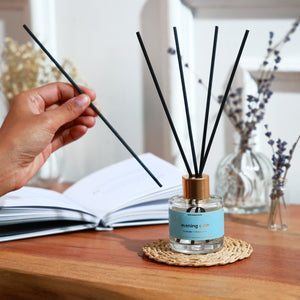
The level: the lowest on the circuit, by a clear step. A sealed room has very little air to charge and very little exchange to dilute it, so it reaches a perceptible level easily and then keeps it.
The honest hardware answer: a Vaayu ₹11,999 is rated to 1000 m³ and is over-specified for a small bedroom demo. Sukoon ₹1,899 covers 270–320 sq ft and is often the proportionate choice — with the caveat that it is an ultrasonic machine and adds humidity.
The alternative nobody suggests: leave it unscented and let the adjacent volume serve it when the door is open. On a circuit where the corridor and living zone are already scented, that is frequently the better-looking answer.
2. Set it a clear step below every other zone on the circuit. A sealed room of a couple of hundred square feet has very little air to charge and almost no exchange to dilute it, so it reaches a perceptible level quickly and then holds it. The visitor also arrives here later in the walkthrough, carrying traces of everywhere they have already been. Both facts point the same way: down.
3. Be honest about the machine. Vaayu is rated to 1000 m³, roughly 2,000–3,000 sq ft at an ordinary ceiling height, and in a 200 sq ft bedroom demonstration nine-tenths of that capability is unused. Specify it here only where the room is genuinely large, opens into a dressing area and a bathroom as one volume, or where the client wants one product family across the whole showroom for the sake of the handover.
4. Consider not scenting it at all. If the door stands open between demonstrations, the room already inherits the corridor and the main volume, and a visitor stepping into a slightly quieter version of the building’s own accord is a more sophisticated experience than a room with a second fragrance in it. Leaving a room out of the scheme is a specification, not an oversight.
5. Use the schedule rather than the intensity to control it. The run windows of 1h / 4h / 8h / 24h with day selection let a small sealed room be charged before opening and then left alone, which is far better than running a machine into an unoccupied bedroom for nine hours. Auto-stop and the key-lock finish the job, and the key-lock is what stops a well-meaning member of staff raising the level because they cannot smell it any more.
Where a Vaayu is used it is ₹11,999, covers up to 1000 m³, runs under 38 dB, draws 5W at DC 12V / 1A, holds a 400ml sealed residue-free tank lasting up to about 90+ days, and is CE, RoHS and SGS certified. Free shipping above ₹499, and a portion of every order supports girl-child education through Nanhi Kali.

Why the bedroom zone takes the softest accord in the building
Every other room on a demonstration circuit is showing capability. This one is showing an outcome, and the outcome is repose. The client watches the shades come down together, the lights fall to a warm low level, the climate settle, perhaps the audio drop to nothing — and the point being made is that the building can produce calm on demand. A fragrance that has any assertion in it contradicts that in the first second, before anyone has consciously registered why. Bright citrus reads as morning. A dry woody accord reads as a study or a boardroom. A floral reads as an occasion. What agrees with the scene is a soft herbal register with a musky drydown, which is the perfumery equivalent of a room getting quieter.
 Evening Calm₹799There is a difference between a soft fragrance and a loud fragrance turned down, and it is worth understanding because they behave differently in a sealed room. A soft composition is built quiet: the materials themselves are gentle, so it stays coherent at a low level. A strong composition at a low setting tends to lose its top and its lift first and leave you with the heaviest part of the base, which in a small closed room is the least pleasant possible outcome. Our own reed range makes the point plainly — Evening Calm sits at 8.9 on the SOSA strength scale and is deliberately the gentlest thing we compose, and that scale exists precisely so that somebody buying for a small sealed bedroom can choose downwards on purpose rather than by accident. Choose a quiet composition, then set it low. Do not choose a loud one and hope the setting saves you.
 Vaayu₹11,999A closed, air-conditioned bedroom is the most cooperative environment in the whole showroom, and specifiers rarely think of it that way. Recirculation inside a sealed volume distributes fragrance very evenly — it is the same effect that makes a bedroom at home smell strongest at night with the door shut and the split running. There is no draught stripping the air, no open door bleeding it into a corridor, and no large volume to fill. So the setting that works here is dramatically lower than the setting that works in the main demonstration volume, and if you set both the same you have over-dosed one of them. The corollary matters too: air that leaves takes the fragrance with it, so if this room’s door is propped open all day it is not really a sealed zone at all, and it should be treated as part of the corridor volume rather than given a machine of its own.
Ask before specifyingContactThe bedroom demonstration is the one room on the circuit where the audio is deliberately taken to nothing, the shades are down and everybody stops talking for a moment to feel the room settle. That is a beautiful piece of theatre and it is ruined by any device with an audible cycle. Vaayu is stated at under 38 dB, which SOSA describes as quiet enough for a bedroom, a clinic or an office — and this is exactly the room where a specifier should check that figure against the noise floor they have engineered. It is also the room where mounting matters acoustically: freestanding on a shelf inside a small quiet space puts the unit close to the client’s ear, whereas a wall mount at height or a position outside the visual field is both quieter in perception and tidier. A low-voltage supply at DC 12V / 1A and 5W has to be at that point, which is a services coordination item rather than an afterthought.
Vaayu₹11,999A closed, air-conditioned bedroom is the most cooperative environment in the whole showroom, and specifiers rarely think of it that way. Recirculation inside a sealed volume distributes fragrance very evenly — it is the same effect that makes a bedroom at home smell strongest at night with the door shut and the split running. There is no draught stripping the air, no open door bleeding it into a corridor, and no large volume to fill. So the setting that works here is dramatically lower than the setting that works in the main demonstration volume, and if you set both the same you have over-dosed one of them. The corollary matters too: air that leaves takes the fragrance with it, so if this room’s door is propped open all day it is not really a sealed zone at all, and it should be treated as part of the corridor volume rather than given a machine of its own.
Ask before specifyingContactThe bedroom demonstration is the one room on the circuit where the audio is deliberately taken to nothing, the shades are down and everybody stops talking for a moment to feel the room settle. That is a beautiful piece of theatre and it is ruined by any device with an audible cycle. Vaayu is stated at under 38 dB, which SOSA describes as quiet enough for a bedroom, a clinic or an office — and this is exactly the room where a specifier should check that figure against the noise floor they have engineered. It is also the room where mounting matters acoustically: freestanding on a shelf inside a small quiet space puts the unit close to the client’s ear, whereas a wall mount at height or a position outside the visual field is both quieter in perception and tidier. A low-voltage supply at DC 12V / 1A and 5W has to be at that point, which is a services coordination item rather than an afterthought.
The order of the walk, and why this room arrives last
There is one more reason to keep this zone quiet that has nothing to do with bedrooms and everything to do with circuits. By the time a visitor reaches the bedroom demonstration they have already walked through the entrance, the main living volume and probably a corridor, and they are carrying traces of all of it. Fragrance accumulates across a walkthrough; it does not reset at each door. A little clings to clothing and hair, a little leaks under doors, and the nose that arrives in the bedroom is neither as fresh as the one that came through the front entrance nor as adapted as the staff’s. Setting this room as though it were the first thing anybody smelled is a reliable way to make it the strongest thing anybody smells.
This is also the strongest argument for keeping one accord across the whole showroom rather than giving each room a character. If the bedroom runs a different composition from the living volume, the corridor between them holds a mixture of the two, and mixtures are what make a well-made building smell cheap. One composition at a lower intensity produces the effect people actually want from a bedroom zone, which is not a different smell but a quieter room. It also removes a whole category of operational risk: one oil to buy, one refill cadence, one setting relationship to maintain, and no chance of somebody topping up the wrong tank.
On scheduling, use the windows properly rather than running everything for the same hours. A bedroom demonstration is visited for a few minutes at a time and perhaps only on some appointments; charging it for an hour before opening and letting it hold is usually better than eight hours of continuous running into an empty room, and it keeps a 400ml fill going up to about 90+ days depending on intensity and hours. If the showroom is closed on a particular day, deselect that day rather than leaving the machine to fragrance an empty building. None of that is a technical accomplishment — it is simply using the timer the way it was designed to be used, and it is the difference between a considered installation and an expensive one.
Registers judged for a bedroom experience zone
The same comparison I would run for any small restful room, with the two directions I would talk you out of at the bottom. The reed scents are named as references for the register; reed oil and cold-air oil are different physical systems and cannot be swapped in either direction.
| Register | What it reads as | Behaviour in a small sealed volume | Verdict for this zone | Reference direction |
|---|---|---|---|---|
| Soft herbal ★ | Quiet, grown-up, restful | Built gentle, so it stays coherent at a very low setting | The answer — lavender, chamomile, soft musk drydown | Evening Calm direction, ₹799 · 8.9 on the scale |
| Clean-skin musk | Fresh linen, a well-kept room | Very easy to live with; almost impossible to over-notice | An honest second choice, especially with pale interiors | The soft drydown side of Evening Calm |
| Dry woody | Composed, architectural, focused | Holds well but reads as a study rather than a bedroom | Right for the living zone, wrong for this one | Mountain Breeze direction, ₹849 · 9.4 |
| Bright citrus-mint | Awake, cool, energetic | Lifts the room, which is the opposite of the demonstration | Actively fights the scene being shown | Morning Freshness direction, ₹749 · 9.0 |
| Warm gourmand | Cosy, edible, heavy | Accumulates on bedding and upholstery and builds through the day | The worst choice on the circuit for a sealed room | Fresh Brew direction, ₹849 · 9.5, the deepest we make |
Sukoon · 270–320 sq ft₹1,899See it →  Vaayu · where volume justifies it₹11,999See specification →
 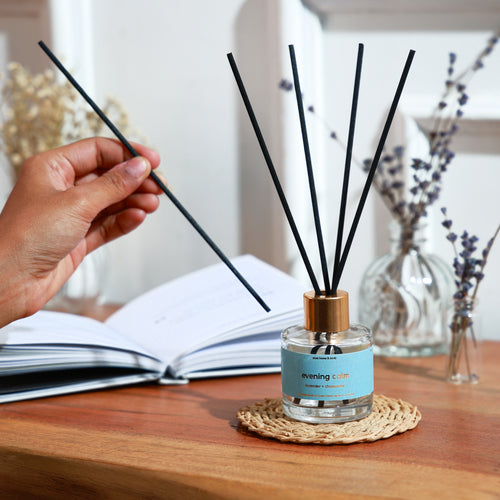 The softest register₹799Shop →
The hardware question, answered against our own interest
I would rather lose a ₹11,999 sale than have an integrator specify a machine that is wrong for the room and then have a client notice. So let me be blunt about the sizing. Vaayu is rated to 1000 m³ — roughly 2,000 to 3,000 sq ft at an ordinary ceiling height — and a bedroom demonstration zone is typically a tenth of that. Putting one in a small sealed room does not produce a subtler result; it produces the same result with nine-tenths of the capability idle, and it makes the showroom look as though nobody sized anything. There are three honest answers and the right one depends on what else is in the room.
The first is to leave it out of the scheme. If the door is open between appointments the room borrows the corridor and the main volume, and a visitor stepping into a quieter version of the building’s own character is a better experience than a room with its own agenda. The second is something proportionate: Sukoon at ₹1,899 covers 270 to 320 sq ft with a 500ml tank and sixteen to eighteen hours on low. It is ultrasonic, which means oil diluted in water and thrown as a wet mist, and that has consequences a specifier must weigh: added humidity, and the possibility of a fine white mineral deposit over time. In a soft-furnished bedroom set that is often acceptable. Anywhere near a media wall, a rack, a touch panel or lacquered joinery it is not, and while I am being honest about our own range, Megh at ₹3,499 is never the answer to a coverage question — six litres of tank and about a hundred hours of runtime but only around 215 sq ft of coverage, which is less than the Sukoon at ₹1,899. It is a runtime and humidity machine.
The third answer is a Vaayu anyway, and there are two respectable reasons for it. One is that the bedroom demonstration is not actually small: where it opens into a dressing area and an en-suite as a single volume with the doors habitually open, the connected volume can be several times the bedroom’s own floor area, and the waterless machine is then correctly sized as well as correctly specified. The other is standardisation — a showroom that runs one product family everywhere has one oil, one refill routine, one handover document and one set of settings to record, and for a business running several branches that consistency has genuine operational value. What I would not accept as a reason is that the bedroom deserves a machine because it is a room, and rooms should be equal. Rooms are not equal in this discipline. Volumes are.
What I would specify for this zone — and the honest gap
The bedroom experience zone written as a specification, in the order the decisions are made, with the limitation stated at the bottom rather than buried. An integrator who is told at drawing stage designs around it; one who finds out at commissioning remembers it for years.
| Decision | What to specify | Why | Reference |
|---|---|---|---|
| 1. Register | The softest composition available — lavender, chamomile, soft musk drydown, nothing bright on top | The demonstration is of repose; an assertive accord contradicts the scene in the first second | Evening Calm direction, 8.9 on the SOSA scale |
| 2. Machine, sized to the volume | Sukoon ₹1,899 for a genuinely small sealed room; Vaayu ₹11,999 only where the connected volume or standardisation justifies it | A 1000 m³ machine in a 200 sq ft room is nine-tenths unused, and it shows | Sukoon 270–320 sq ft · Vaayu up to 1000 m³ |
| 3. Mechanism, checked against the room contents | Waterless anywhere near screens, racks, panels or lacquer; ultrasonic only in a soft-furnished room | Ultrasonic dilutes oil in water, adds humidity and can leave a fine mineral deposit | Sealed residue-free tank on Vaayu |
| 4. Intensity | A clear step below every other zone, set from the doorway and then key-locked | A sealed room reaches a level easily and a visitor arrives here already carrying the circuit | Adjustable intensity, key-lock |
| 5. Window and days | A short charge before opening rather than continuous running; closed days deselected | Keeps a 400ml fill going up to about 90+ days and avoids scenting an empty room | 1h / 4h / 8h / 24h, auto-stop |
| 6. Acoustic position | Under 38 dB, mounted at height or out of the visual field, with the low-voltage point at that position | This is the room where the audio is taken to nothing and any audible cycle is a defect | Under 38 dB · DC 12V / 1A, 5W |
| Sometimes the answer is none: the honest gap | There is no product that makes a small sealed room worth a dedicated machine when the door stands open between appointments. In that case the room inherits the corridor, and that is the better-looking answer as well as the cheaper one | Write the unscented rooms into the specification with the reason beside each, so nobody adds a machine in year two thinking it was an oversight | Ask us first |
Versailles
I am asked for a bedroom scent more often than for any other room, and the request almost always arrives with an adjective that worries me: luxurious, indulgent, memorable. The bedrooms that actually feel expensive smell of very little. What they have is consistency — the same quiet character every time you walk in, at a level that never once asks for your attention. That is a much harder thing to compose than something impressive, and it is the reason the softest scent in our range took longer to get right than the deepest one.
In a showroom the discipline is the same but the stakes are clearer, because the client is judging the whole building in about ninety seconds inside this room. If they notice the fragrance as a fragrance, the room has failed at the thing it was built to demonstrate. If they step in and their shoulders drop half an inch, everything else you have installed gets the credit, which is exactly the right outcome for you and for us.
And I will keep saying the unpopular part. A small sealed demonstration bedroom rarely deserves the biggest machine in the catalogue. Either size it properly, or leave the room alone and let it borrow from the corridor, and put the money into getting the entrance and the main living volume exactly right — because those are the volumes a visitor crosses, and crossing is where scent is perceived at all. Everything is composed in Pune, and a portion of every order funds a girl’s classroom through Nanhi Kali.
Frequently asked questions
- Scenting a multi-room demonstration suite — closed doors make separate zones.
- The living-room demonstration zone — the largest volume, and a dry register.
- Should the home theatre be scented? — often not, and here is the reasoning.
- The smart-kitchen display — a clean-air room pretending to cook.
- A different fragrance in every room? — why a circuit accumulates.
- One signature scent or multiple zones — the decision page.
- The arrival fragrance — threshold and the un-adapted nose.
- Fragrance inside a demonstration — what can honestly be shown.
- Light, sound, climate and fragrance together — run as a timetable.
- Brand: the SOSA founder story.
SOSA Vaayu — facts verified August 2026: ₹11,999. Waterless cold-air nebulising diffuser; pressurised air shatters undiluted oil into a dry nano-mist, with no water, no dilution, no added humidity and no residue. Coverage up to 1000 m³, approximately 2,000–3,000 sq ft at standard ceiling height, read as connected volume rather than floor area. Control: Bluetooth app plus onboard buttons, run windows of 1h / 4h / 8h / 24h, day selection, adjustable mist intensity, auto-stop and key-lock; each unit holds one schedule and one intensity, stored in that unit. SOSA publishes no Wi-Fi, Alexa, Google Assistant, Matter, Zigbee, Z-Wave, KNX, Crestron, Control4, RS-232, dry-contact or API integration of any kind; Vaayu units cannot be grouped, zoned, addressed, triggered or monitored by any home-automation control system, voice assistant, hub or sensor, and there is no central app across units. Mounting: freestanding, wall-mounted or into an HVAC return — a mechanical integration, not a digital one. Power DC 12V / 1A, 5W at the mounting position. Under 38 dB, which SOSA states is quiet enough for a bedroom, clinic or office. 400ml sealed, residue-free, refillable tank lasting up to about 90+ days depending on intensity and scheduled hours; SOSA publishes no millilitres-per-hour consumption rate and none is estimated here. CE, RoHS and SGS certified. Black and white finishes. Oils must be alcohol-free, water-free fragrance oils formulated for cold-air diffusion, such as the SOSA Hotel Collection (100ml ₹999 · 300ml ₹1,799 · pack of seven ₹1,799); thick undiluted essential oils are not recommended as they clog the fine nozzle. Other SOSA machines: Sukoon ₹1,899 ultrasonic (500ml, 270–320 sq ft, 16–18h on low, three 15ml scents included), Boond ₹899 (up to about 150 sq ft), Megh ₹3,499 (six-litre tank, about 100 hours runtime, only about 215 sq ft — a runtime and humidity machine, never a coverage upgrade over Sukoon), Aangan ₹25,999 (~8,000–10,000 sq ft), Meenar ₹38,500 (12,000–18,000 sq ft). Ultrasonic machines dilute oil in water, add humidity and can leave a fine white mineral deposit. SOSA reed diffusers named here as register references are alcohol-free, phthalate-free, paraben-free, IFRA-compliant and 0 ppm formaldehyde, with six fibre reeds in a refillable glass bottle, composed in Pune; Evening Calm 50ml ₹799 sits at 8.9 on the SOSA strength scale, the softest in the range. Reed oil and cold-air oil are separate systems and are not interchangeable. A scent machine adds fragrance; it does not clean, purify or deodorise air, and SOSA makes no health or air-quality claim. SOSA publishes no dealer programme, reseller margin, trade price, territory, minimum order, lead time, installation charge or maintenance contract; commercial enquiries are welcome at https://sosahomeandbody.com/pages/contact. Free shipping above ₹499. A portion of every order supports girl-child education through Nanhi Kali. SOSA is an independent Indian fragrance house; the Hotel Collection scents are SOSA’s own interpretations inspired by the world’s finest hotels, and SOSA is not affiliated with or endorsed by any hotel brand or any home-automation manufacturer. Prices subject to change — see the live product pages.