



The two we would use: Ritz-Carlton-inspired Quiet Luxury (white tea, bergamot, cedar) and Westin-inspired White Tea Serenity (white tea, aloe, cedar).
Avoid outright: gourmand and confectionery notes — vanilla, coffee, anything edible — and heavy florals such as dense jasmine or rose.
On reeds: Mountain Breeze. Not Fresh Brew, not Garden Bloom. Three reeds, not six.
2. The two right answers on a water-based unit. Ritz-Carlton-inspired Quiet Luxury — white tea, bergamot and cedar — and Westin-inspired White Tea Serenity — white tea, aloe and cedar. Both are built on white tea over a dry woody base, which is about as close to “ambient” as a composed fragrance gets. Quiet Luxury has a slightly brighter opening from the bergamot; White Tea Serenity is the flatter and quieter of the two and is the one we would put in a clinic that is nervous about the whole idea.
3. Gourmand is wrong here, and not marginally. Vanilla, coffee, caramel and confectionery accords fail on three separate counts. They read as commercial — a café, a bakery, a mall — which undercuts the impression of clinical seriousness the clinic is paying for. They are edible cues in a room that contains children who are nauseated, fasting for a blood test, or about to be examined. And they are the most memorable class of material in perfumery, which makes them the most efficient thing to accidentally pair with an injection.
4. Heavy floral is wrong for different reasons. Dense jasmine, rose and tuberose read unmistakably as applied fragrance rather than as air, so they never achieve the low-contrast effect you are after. In most Indian households they also carry strong existing associations — room freshener, agarbatti, ceremonial flowers — none of which belong in a paediatric reception. And they are heavy: floral absolutes and their fixatives are exactly the materials that settle into upholstery and curtains and are still there a week after you switch the unit off.
5. On reeds, one blend and one only. Of the five reed blends, Mountain Breeze — Himalayan pine, sage and cedar — is the only one we would put on a clinic desk. Morning Freshness is citrus-and-eucalyptus and lands close to cleaning product, which is a different problem discussed elsewhere in this cluster. Evening Calm is a lavender-chamomile, too soft and too suggestive of a spa. Garden Bloom is the heavy floral. Fresh Brew — coffee and vanilla — is the single worst choice available for a clinic, and it is the one clinics ask for most often because it smells welcoming in the shop.
Made in India, composed by an ISIPCA Versailles-trained perfumer — and a portion of every order supports girl-child education through Nanhi Kali.

Why dryness, specifically, is the brief
“Dry” is not a mood word here; it describes what is in the bottle. A dry accord is low in sugar-adjacent materials — vanillin, ethyl maltol, lactones, benzoin, heavy ambers — and low in the dense fixatives that make a fragrance cling. White tea, green tea, aloe and cedar behave in air more like a texture than like a smell: they raise the perceived cleanliness of the room slightly and then get out of the way. That is exactly the effect a clinic reception wants, because the effect you are buying is a reduction in institutional flatness, not the addition of a perfume. A sweet or floral accord at the same dose does something different — it puts an object in the room, and objects invite judgement. Parents who notice a fragrance in a clinic tend to ask themselves why it is there, and the answer they reach for is rarely flattering.
There is a second, more practical reason, and it is about what happens over months rather than seconds. Waiting areas in children’s clinics are full of soft, absorbent material — cushions, fabric seating, curtains, a rug, a bin of soft toys that is washable in theory and washed in practice about twice a year. Textiles take up airborne fragrance and release it again slowly, and they are not neutral about which materials they hold. Heavy florals, ambers and gourmand fixatives are precisely the ones that persist; the light tea and citrus-adjacent materials clear comparatively quickly. Choose a sweet, heavy direction and you are not merely choosing what the room smells of today — you are choosing what the seating will smell of in March if you decide in January to stop scenting altogether.
The three directions clinics actually consider
 Quiet Luxury · White Tea SerenityFrom ₹299White tea over cedar, with either bergamot (Quiet Luxury) or aloe (White Tea Serenity) doing the lifting at the top. Both are low-sweetness, both sit flat in a room rather than blooming, and both hold their character at very low output, which matters because a clinic runs everything at the bottom of its range. If you can only remember one rule from this page: white tea and cedar, three drops, reception only. Tea Garden — jasmine, green tea, white tea — is a distant third and only if the jasmine facet does not assert itself in your room; test it before committing.
Where the direction applies — and where no direction does
Choosing well does not extend the map. The two right answers are still wrong in every clinical room, at every dose, on every machine.
| Area of the clinic | Scented? | Why | What we would use |
|---|---|---|---|
| Entrance and reception desk ★ | Yes, low | Fresh noses, short dwell, and the only place a direction is genuinely perceived | Quiet Luxury or White Tea Serenity on Sukoon |
| Reception desk, very small | Yes, passive | Under ~150 sq ft a reed is sufficient and has a ceiling low enough to be self-limiting | Mountain Breeze, three reeds |
| Parent and child waiting seating | Minimum only | Long dwell, and the upholstery here is what will hold whatever you choose | Same source; dry direction matters most here |
| Consultation and examination rooms | No | A dry, quiet direction is still an added odour where a clinician needs unaltered air | Nothing |
| Vaccination, injection and procedure rooms | Never | Any characterful note repeatedly paired with a painful procedure becomes attached to it | Nothing |
| Nebulisation, asthma, neonatal and isolation areas | Never | Respiratory and newborn patients — added airborne load is the thing being avoided, not sweetness | Nothing |
| Before any of this: settle the smell you already have. If the reception carries disinfectant, damp or bin odour, no direction fixes it — the parent simply receives both. Source, then air, then surfaces, then, if you still want it, fragrance. | |||
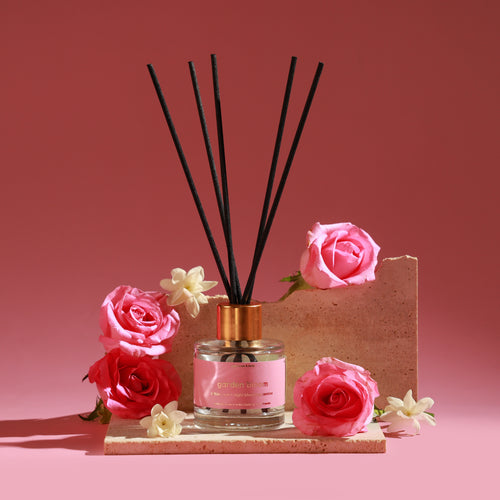 Small reception · no power neededFrom ₹749Shop →
  Mid reception · has an off switch₹1,899Shop →
 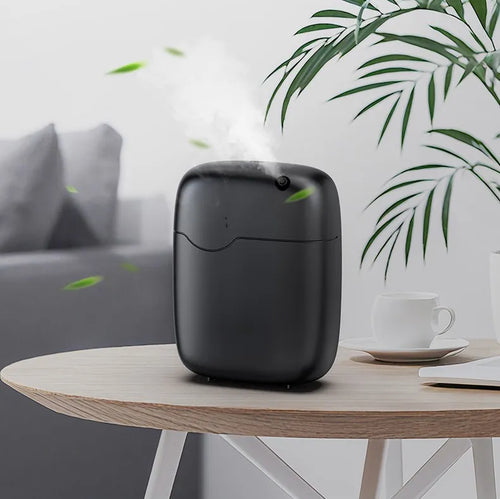 Large lobby · timed, dialable₹11,999Shop →
Direction is not dose — and dose is where clinics go wrong
The right direction at the wrong dose is still an over-scented clinic. Choosing white tea over vanilla buys you a lower ceiling and a faster clear-down; it does not buy you permission to run the unit harder. On a Sukoon that means three drops rather than six and intermittent rather than continuous mode. On a Vaayu it means the shortest on-time and longest off-time the duty cycle allows, scheduled to clinic hours only. On reeds it means three reeds in the neck, not the six in the box.
Test the direction in your own room before buying a year of it. Tea and cedar accords are sensitive to what they sit on top of: a reception with an air-conditioner running hard reads them drier and thinner, while a humid monsoon week pushes everything up and makes the same setting feel twice as strong. Buy a 15ml at ₹299 first, run it for two weeks, and judge with a nose that has been outside for thirty minutes — staff adapt within about twenty minutes and will tell you it has stopped working when it has not.
Then keep the direction fixed and the off switch reachable. Rotating fragrances is a retail habit and it has no place in a clinic; every change resets whatever quiet familiarity the room has built and gives you a fresh opportunity to overshoot. Keep one direction, one dose, one schedule. Be willing to switch it off within seconds for a family with an asthmatic or scent-sensitive child, say so at the desk, and take the decision with your own clinical governance, infection-control and housekeeping leads rather than on a supplier’s recommendation, including this one.
What we would actually install
The direction is the same at every size; only the delivery changes. The last row remains on the table because for a great many clinics it is still the right answer.
| Option | Suits | Control you get | Price |
|---|---|---|---|
| Reed diffuser | A small reception desk — Mountain Breeze on three reeds; the only reed blend we would put on a clinic desk | Reed count only — no switch, no timer | from ₹749 |
| Sukoon 500ml ★ | A reception up to ~320 sq ft — Quiet Luxury or White Tea Serenity, three drops, intermittent — up to about 320 sq ft | On/off, intermittent mode, you control the drops | ₹1,899 |
| Vaayu | A large lobby or a zoned duct — either of the two dry directions as neat oil, at the lowest duty cycle the unit offers | Duty cycle in seconds, timer, app scheduling | ₹11,999 |
| Aangan | Whole-facility HVAC — a zoned 8,000–10,000 sq ft facility, dry direction only, with clinical branches excluded at the duct | Zone-level control, but only if the ducting is zoned | ₹25,999 |
| Nothing at all | Any clinic whose reception already smells of nothing — the direction question does not arise until there is a reason to add anything at all | Complete — and the correct answer more often than the trade admits | ₹0 |
Versailles
The request I get most often from children’s clinics is for something sweet and friendly, and it is the one I turn down most often. I understand where it comes from — the interior is bright, there are decals of animals on the wall, and vanilla feels like it matches. But the room has to work for a child who is about to be given an injection, and sweetness is the most memorable thing I can put in the air. I would rather sell that clinic a ₹299 bottle of white tea than a year of refills it will regret.
At ISIPCA we were taught to think about a fragrance as behaving in a space, not as a list of notes on paper. White tea and cedar behave well in a room: they lift the perceived cleanliness slightly and then flatten out. Jasmine absolute and vanillin behave badly in a room: they bloom, they persist, and they take up residence in the cushions. In a clinic that second property matters more than anything about how the fragrance smells on a blotter.
So: white tea, cedar, three drops, reception desk, off switch within reach. That is the whole recommendation, and it costs less than a set of waiting-room chairs. Keep it out of every clinical room, run the housekeeping list before you run the diffuser, and let your own infection-control and clinical governance people set the policy. A portion of every order funds a girl’s classroom through Nanhi Kali.
Frequently asked questions
- Fresh, or completely neutral? — why “fresh” usually means cleaning product.
- Direction for a minimal interior — where restraint and scenting agree.
- Premium without heavy perfume — the lever is dose, not blend.
- Which areas stay fragrance-free? — the seven zones, and why.
- Brand: the SOSA founder story.
SOSA products & prices (verified August 2026): Hotel Collection water-based ultrasonic diffuser fragrance 15ml ₹299 · 100ml ₹999 · 300ml ₹1,799 · Pack of 7 (15ml, all fragrances) ₹1,799; refills 100ml from ₹999. Seven scents: The Ritz-Carlton-inspired (white tea · bergamot · cedar), Westin-inspired (white tea · aloe · cedar), 1 Hotels-inspired (cedarwood · vetiver · green leaves), The St. Regis-inspired (amber · violet · woods), Shangri-La-inspired (jasmine · green tea · white tea), Four Seasons-inspired (citrus · floral · sandalwood), W Hotels-inspired (citrus · pepper · amber). Diffusers: Boond 300ml ₹899 · Sukoon 500ml ₹1,899 · Megh 6L ₹3,499. Water-based, phthalate-free, composed to IFRA standards for home diffusion; 3–6 drops per tank. Made in India, Pune. The Hotel Collection scents are SOSA's own interpretations inspired by the world's finest hotels; all hotel names are trademarks of their respective owners and are used only to describe the scent style — SOSA is an independent Indian fragrance house, not affiliated with or endorsed by any hotel brand. Prices and availability subject to change — see the live product pages.