
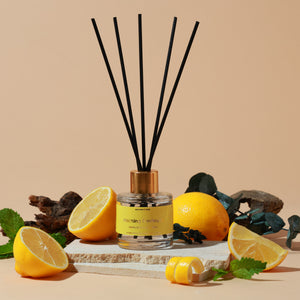



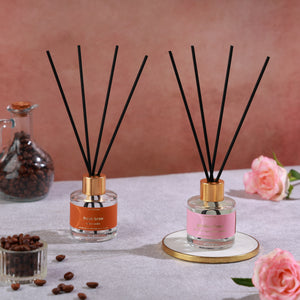
Why cheap citrus smells like cleaning: limonene, the dominant molecule in citrus peel, is also the cheapest deodorising material in the world, so it is in nearly every floor cleaner, dishwash bar and surface spray you have ever met. A cheap citrus fragrance is essentially that molecule plus two markers — which is not a bad smell, it is the correct smell for a cleaning product, and your nose files it accordingly.
The ten-second test: smell for bitterness. Real cold-pressed peel is bitter and faintly waxy underneath the brightness. Cleaning citrus is sweet and flat, because bitterness is the first thing a reconstruction drops.
The honest gap: Morning Freshness is the only citrus in the SOSA reed line. There is no orange blossom, no neroli, no bergamot, no grapefruit and no mandarin reed. And SOSA batch-verifies its phthalate, paraben and formaldehyde figures in-house rather than publishing third-party certificates — I would rather say that plainly than let "tested" imply an external laboratory.
2. The problem is recognition, not badness. Limonene is the dominant molecule in citrus peel and also the cheapest deodorising agent in the world, which is why it is in your surface spray, your dishwash bar and your floor cleaner. A cheap citrus fragrance is limonene plus two or three markers, and that is precisely the cleaning-product profile. It does not smell wrong. It smells correct — correct for a bucket. Your nose obliges by filing it there.
3. Real peel comes with a supporting cast, and the cast is the point. Cold-pressed Malabar lemon brings dozens of minor molecules along with the limonene: the bitterness of pith, a slight green edge, a waxiness that reconstructions never bother to reproduce because nobody asks for it. Those minor materials are the difference between your nose concluding fruit and concluding product.
4. What the citrus is paired with either breaks the reference or confirms it. Cleaning products pair citrus with pine, or with nothing at all. Morning Freshness pairs it with peppermint in the heart and eucalyptus globulus in the base, which is a stack no cleaning product uses. By the time the association would have formed, the fragrance has already gone somewhere your memory has no file for.
5. Then check the shape over time, because shape is part of the signature. An aerosol is a blast and then nothing, and a front-loaded citrus diffuser reproduces that shape even with decent materials in it. Morning Freshness is deliberately quieter on day one and still present in week six: the eucalyptus base slows the lemon's evaporation roughly three to four times, so a 50ml runs 6–8 weeks rather than the usual ten-to-fourteen-day citrus fade, and the 130ml at ₹1,249 runs 14–18 weeks.
Alcohol-free, phthalate-free, paraben-free, IFRA-compliant, 0 ppm formaldehyde, six fibre reeds in a refillable glass bottle, composed in Pune. A portion of every order supports girl-child education through Nanhi Kali.
Why your nose files lemon under cleaning before it files it under fruit
Every other sense reports to the thalamus first and gets processed on the way to memory. Smell does not. It goes more or less straight into the oldest part of the brain, the part that handles memory and emotion, which is why a smell can put you back in a particular corridor of a particular house before you have consciously identified what you are smelling. That wiring is a gift when the memory is a good one. It is a problem for anyone selling citrus in India, because the strong lemon most of us met first was not a lemon. It was a deodorising agent in a bucket of water on a Sunday morning, and we met it at about four years old, and the file has been open ever since.
The chemistry behind that accident is unglamorous. Limonene is the dominant molecule in citrus peel — it is what makes an orange smell like an orange when you break the skin — and it also happens to be one of the cheapest and most effective deodorising materials available at industrial scale. So it went into everything: floor cleaner, dishwash bar, surface spray, toilet cleaner, the lemon-scented half of the cleaning aisle entire. Whether your household's deodoriser register was lemon or the pine-and-phenyl one does not matter much; the mechanism is identical, which is why Mountain Breeze gets the pine version of the same review — Rohit B. in Hyderabad opens with "Was terrified this would smell like Phenyl." He is describing a fear formed decades before he saw the product.
Here is the part that people find genuinely surprising, and it is the whole argument of this page. The problem is not that cheap citrus smells bad. It is that it smells correct. A reconstruction built from limonene plus two or three markers is an accurate rendering of the reference your brain already holds — and a fragrance that hits a stored reference exactly gets filed with it. You will then describe it as cheap, or synthetic, or "like a surface spray", and you will be right about the category and wrong about the cause. The formula did not fail. It succeeded at the wrong thing. Everything below is about how a composed citrus fails, deliberately, to be that.
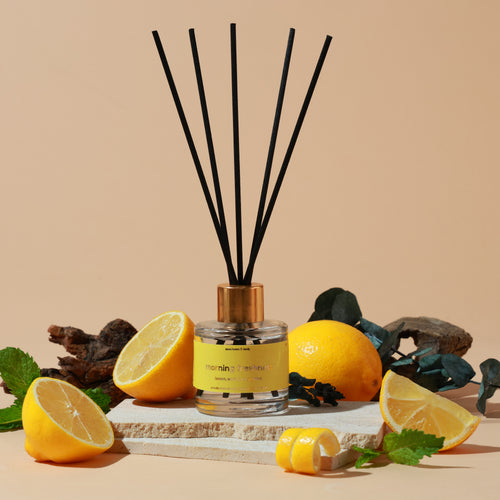
 Morning Freshness₹749Cold-pressed Malabar lemon is pressed out of actual peel, and peel is not a single molecule. Around the limonene sits a supporting cast of dozens of minor materials — the bitterness that belongs to pith, a slight green stalkiness, a waxiness that is really the cuticle of the fruit. None of them is the smell of lemon on its own. Together they are the reason your nose says fruit. A reconstruction is limonene plus two or three markers chosen for punch and cost, which is not a lesser lemon so much as a different object that shares a headline — and it is the identical object your cleaning cupboard is built from. This is why the most repeated sentence in Morning Freshness reviews is about category rather than quality. Devika S. in Mumbai: "Most citrus reed diffusers smell like dishwashing liquid. This one smells like an actual cut lemon. Lasted 7 weeks with 4 reeds."
Lemon · mint · eucalyptus9.0An association is a pattern, and patterns can be interrupted. Cleaning products pair citrus with pine, or with nothing at all — those are essentially the only two grammars in the aisle, and both of them are in your file. Morning Freshness pairs its lemon with peppermint in the heart and eucalyptus globulus in the base, a stack that no cleaning product on any Indian shelf uses. The consequence is that the recognition never completes: your nose starts down the familiar path, meets a cool camphoraceous base it has no cleaning reference for, and has to file the whole thing somewhere new. Aanya R. in Gurugram put it more briskly than I ever have — "Finally a lemon that doesn't smell like Phenyl. The eucalyptus base is the unfair advantage." The eucalyptus was chosen for longevity. Breaking the reference turned out to be the second thing it does.
Morning Freshness₹749Cold-pressed Malabar lemon is pressed out of actual peel, and peel is not a single molecule. Around the limonene sits a supporting cast of dozens of minor materials — the bitterness that belongs to pith, a slight green stalkiness, a waxiness that is really the cuticle of the fruit. None of them is the smell of lemon on its own. Together they are the reason your nose says fruit. A reconstruction is limonene plus two or three markers chosen for punch and cost, which is not a lesser lemon so much as a different object that shares a headline — and it is the identical object your cleaning cupboard is built from. This is why the most repeated sentence in Morning Freshness reviews is about category rather than quality. Devika S. in Mumbai: "Most citrus reed diffusers smell like dishwashing liquid. This one smells like an actual cut lemon. Lasted 7 weeks with 4 reeds."
Lemon · mint · eucalyptus9.0An association is a pattern, and patterns can be interrupted. Cleaning products pair citrus with pine, or with nothing at all — those are essentially the only two grammars in the aisle, and both of them are in your file. Morning Freshness pairs its lemon with peppermint in the heart and eucalyptus globulus in the base, a stack that no cleaning product on any Indian shelf uses. The consequence is that the recognition never completes: your nose starts down the familiar path, meets a cool camphoraceous base it has no cleaning reference for, and has to file the whole thing somewhere new. Aanya R. in Gurugram put it more briskly than I ever have — "Finally a lemon that doesn't smell like Phenyl. The eucalyptus base is the unfair advantage." The eucalyptus was chosen for longevity. Breaking the reference turned out to be the second thing it does.
 300ml refill₹2,399People think of an air freshener as a smell. It is also a shape: a violent arrival, a plateau of about ninety seconds, and then nothing. Your memory stored that curve alongside the material, which means a diffuser can be built from perfectly respectable oils and still read as aerosol simply by behaving like one. A front-loaded citrus — all the top notes crammed into the first fortnight so the shop-floor sniff is dramatic — reproduces the shape faithfully. A composed citrus refuses to. Morning Freshness is quieter on day one than a front-loaded competitor and still present in week six, because the eucalyptus globulus base slows the lemon's evaporation roughly three to four times: 6–8 weeks on a 50ml instead of the ten-to-fourteen-day citrus fade, 14–18 weeks on the 130ml. Riya M. in Bengaluru: "Six weeks in and still going strong."
The portable test: smell for the bitterness
You cannot run a gas chromatograph in a shop, and note lists on packaging are marketing rather than disclosure. So here is the one test I give friends, and it takes about ten seconds. Smell past the brightness and look for a bitter edge. Real citrus peel is bitter. It has to be — the bitterness lives in the pith and the peel oil comes off the same fruit, so a cold-pressed material always carries a faintly astringent, slightly waxy tail underneath the sparkle. Cleaning citrus is sweet and flat by comparison, because bitterness is the very first thing a reconstruction drops. Nobody has ever asked a surface spray to be complicated, and bitterness costs money and reads as a fault to a factory buyer.
Once you know to look for it you will not stop noticing it. Cut a lemon in your kitchen, smell the peel rather than the flesh, and hold that in mind: there is a green, slightly bitter, almost oily quality sitting behind the brightness, and it is what makes the smell feel like an object rather than a note. Now smell a lemon surface spray. It is sweeter, rounder and much simpler — pleasant, in its way, and utterly one-dimensional. That gap is the entire distance between a citrus fragrance you will still like in week six and one you will quietly move to the guest bathroom in week two. Tanya K. in Pune describes the good end of it without ever using the word bitter: "Smells exactly like a spa — clean, breathable, not floral." Breathable is a bitterness word. Sweet flat citrus never reads as breathable.
Two smaller tells travel with it. The first is temperature behaviour: a citrus built on DPG, the cheap industry-standard carrier, will crack above about 40°C and go sour or acrid — the "chemical" turn people describe in a Delhi May. Every SOSA reed sits on a heat-stable CCT carrier, coconut-derived, tested through a 45°C heat soak and 85% RH monsoon humidity, which is why Anjali R. in Pune could write of the pine version, "Lasted exactly through one monsoon. Pine stayed pine — no bitterness, no chemical shift." The bitterness she means there is the carrier's, not the fruit's: peel bitterness is a structural quality that belongs in the bottle from day one, while carrier bitterness is an off-note that arrives in July. Fading and turning are different failures and only one of them is the formula's fault. The second tell is what else is in the liquid: phthalates are used to slow evaporation on the cheap and they off-gas indoors, with most plug-ins testing at 800–2,000 ppm. Every SOSA reed is phthalate-free, paraben-free, IFRA-compliant and 0 ppm formaldehyde, and Morning Freshness is low-VOC within CARB guidance. Those figures are batch-verified in our own lab; we are a small independent house and do not publish third-party certificates, and I would rather tell you that than let the word "tested" do work it has not earned.
| What you are comparing | Cleaning-product citrus | Composed citrus (Morning Freshness ₹749) |
|---|---|---|
| The material | A reconstruction — limonene plus two or three markers, built for punch and cost | Cold-pressed Malabar lemon, pressed from real peel |
| Supporting molecules | Almost none. The bitterness of pith, the green edge and the waxiness are all dropped first | Dozens of minor materials around the limonene — bitter, faintly green, faintly waxy |
| What it is paired with | Pine, or nothing — the only two grammars in the cleaning aisle, and both are already in your memory | Peppermint heart, eucalyptus globulus base — a stack no cleaning product uses |
| Week one | Dramatic. Front-loaded so the first sniff sells the bottle | Quieter on purpose — bright at 9.0 on the SOSA scale, mild-medium rather than loud |
| Week six | Gone. The usual citrus fade is ten to fourteen days; what remains is oil with sticks in it | Still present. 6–8 weeks on 50ml, 14–18 weeks on the 130ml at ₹1,249 |
| At 45°C | Turns. DPG cracks above about 40°C and the citrus goes sour or acrid | Holds. Tested through a 45°C heat soak and 85% RH monsoon humidity |
| Carrier | DPG — cheap, industry standard, unstable in Indian heat | Heat-stable CCT, coconut-derived, alcohol-free |
| Phthalate content | Usually undisclosed. Most plug-ins test at 800–2,000 ppm | Phthalate-free, paraben-free, IFRA-compliant, 0 ppm formaldehyde — batch-verified in-house |
| Where your nose files it | Cleaning. Correctly, and permanently | Fruit — which is what every review of it is actually reporting |
Real lemon · Morning Freshness₹749Shop → 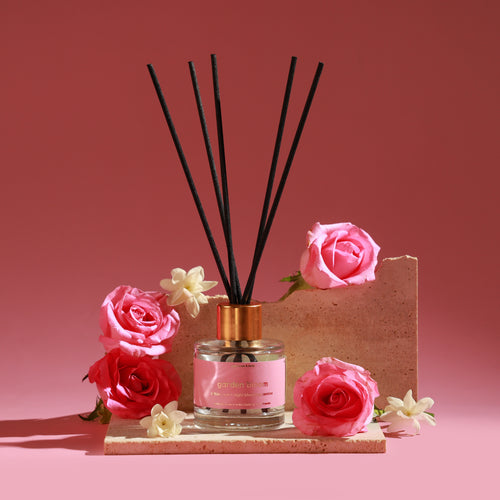 White floral · Garden Bloom₹799Shop →
  Bergamot · Ritz-Carlton-inspired₹299Shop →
Why the association cannot be undone — and what to do about it instead
People sometimes ask me whether they can train themselves out of it. The short answer is no, and it is worth understanding why, because the answer changes what you should buy. Odour associations formed in early childhood are laid down before language and are emotional rather than analytical, which means they are not the sort of belief you can argue with. You cannot decide that lemon no longer means cleaning any more than you can decide that a particular song no longer reminds you of a particular year. Knowing exactly how the association was formed — as you now do — does not dissolve it either. I have been a perfumer for years and a cheap lemon still puts me in my grandmother's veranda with a bucket.
So the working conclusion is not to fight the file but to avoid triggering it, which is a compositional job rather than a willpower job. It also has a practical consequence in your house that almost nobody thinks about: context reinforces the filing. If you put a citrus diffuser in the room where the cleaning actually happens — a bathroom that has just been mopped, a kitchen counter beside the dishwash bar — you are asking your nose to distinguish two lemons at the exact moment it has the most reason to conflate them. Move the same bottle to a desk, a hallway console, a reading corner, and the identification problem simply goes away. Morning Freshness is excellent in a bathroom, but if you have ever had a citrus diffuser you did not trust, start it somewhere else and let your nose meet it clean.
The second lever is reed count, which is free and which almost nobody adjusts before deciding they dislike a fragrance. Six fibre reeds is full strength — right for a living room or a 200 sq ft kitchen with the 130ml. Three or four suits a bedroom or a desk. Two or three in a small bathroom will make a 50ml run close to three months rather than eight weeks. Fibre rather than rattan matters here too: rattan clogs in Indian humidity and produces exactly the fade-then-nothing pattern that reads as aerosol, so the reeds themselves can push a good formula back into the wrong file. Flip them every three to five days for Morning Freshness and you will get a small lift each time without buying anything. And if the whole citrus register still feels compromised for you — some people's file is simply too strong — the honest advice is to buy a different family rather than a better lemon. Mountain Breeze at ₹849 is green and dry, and Evening Calm at ₹799 is the softest thing we make at 8.9.
What to buy for citrus — and the gap I am not going to talk around
Here is the range as it applies to somebody who came here because their last citrus diffuser smelt like a bucket, in the order I would actually buy it. Before the table, the plain statement: Morning Freshness is the only citrus in the SOSA reed line. There is no orange blossom reed, no neroli, no bergamot-led scent, no grapefruit, no mandarin, no yuzu and no lime. If one of those is the specific smell in your head, this range does not contain it, and I would rather send you elsewhere informed than sell you a lemon and let you discover the substitution in a fortnight.
| Buy | What it is | When it is the right answer | Price |
|---|---|---|---|
| 1. Morning Freshness 50ml ★ | Cold-pressed Malabar lemon, peppermint, eucalyptus globulus — 9.0, bright | First, for anyone who wants citrus that reads as fruit. ₹749 settles it in a week | ₹749 |
| 2. Morning Freshness 130ml | The same composition, sized for above 150 sq ft — living rooms, kitchens, open-plan | Once you know you like it. 14–18 weeks rather than 6–8 | ₹1,249 |
| 3. Garden Bloom 50ml | British rose and night-blooming jasmine with a soft musk drydown — 8.9, medium floral | If what you meant by orange blossom was white-floral warmth rather than citrus | ₹799 |
| 4. Day & Night duo | Morning Freshness with Evening Calm — bright where the day starts, soft where it ends | If you are scenting a flat rather than one room | ₹1,498 |
| 5. 300ml refill | Refills the glass bottle and reeds you already own — 500ml is ₹3,499 | Once Morning Freshness is simply the smell of your house | ₹2,399 |
| No orange blossom, no bergamot: the honest gap | One citrus exists in the reed line and it is a lemon. For orange blossom the nearest honest neighbour is Garden Bloom ₹799; for a genuine bergamot the only one in the house is the Ritz-Carlton-inspired Hotel Collection scent — white tea · bergamot · cedar — which is water-based and needs an ultrasonic machine | Said plainly rather than stretched. Machine: Sukoon ₹1,899 with three 15ml scents included, or Boond ₹899 | ₹799 / ₹299 |
Versailles
At Versailles they teach you to smell materials blind, and the first time I was handed a limonene sample I said "floor cleaner" before I had finished inhaling. Everyone in the room from India said some version of the same thing. The French students said "orange". Same molecule, same nose, two entirely different childhoods. That was the day I understood that composing citrus for an Indian house is not a chemistry problem, it is a memory problem.
Which is why Morning Freshness is built the way it is. Whole cold-pressed peel, bitterness left in, because the bitterness is the part a bucket never has. Peppermint and eucalyptus underneath, because no cleaning product has ever smelt like that and your memory therefore has nowhere to put it. And a level curve instead of a dramatic one, because a blast that dies in a fortnight is the shape of an aerosol, and shape is remembered as surely as smell.
The thing I would most like you to take away is the bitterness test, because it will save you money at counters that are not mine. Smell past the sparkle and find the bitter, waxy edge. If it is there, someone pressed a fruit. If it is not, someone bought a molecule. Everything is composed in Pune, and a part of every order funds a girl's classroom through Nanhi Kali.
Frequently asked questions
- The citrus category and A citrus home — why citrus is the hardest family to make last, and a spine plus neighbours, and what a year costs.
- Orange blossom and Bedrooms — the four things sold under that name, and why we make none, and the sleeping room versus the getting-ready room.
- Living rooms and Bathrooms — the only family that survives an Indian kitchen, and the cheapest permanently scented room in the house.
- Sophisticated citrus — sophistication is a property of the base.
- The decision tree — one bottle, no reading, if you want one bottle and no argument.
- The complete citrus guide — every decision in one place.
- Brand: the SOSA founder story.
SOSA reed diffusers — facts verified August 2026: Five scents, all alcohol-free, on a heat-stable CCT (caprylic/capric triglyceride) base, phthalate-free, paraben-free, IFRA-compliant, 0 ppm formaldehyde, six fibre reeds in a refillable glass bottle, composed and made in Pune, India. Those compliance figures are batch-verified in-house; SOSA does not publish third-party laboratory certificates. Morning Freshness (cold-pressed Malabar lemon · peppermint · eucalyptus globulus) 50ml ₹749 · 130ml ₹1,249 · 9.0 on the SOSA strength scale · 4.9 from 41 verified reviews; the eucalyptus globulus base slows lemon evaporation three to four times, giving 6–8 weeks on 50ml and 14–18 weeks on 130ml against the usual ten-to-fourteen-day citrus fade, and it is low-VOC within CARB guidance. Garden Bloom (British rose · night-blooming jasmine · soft musk) 50ml ₹799 · 130ml ₹1,299 · 8.9. Evening Calm (Kashmir lavender · chamomile · soft musk) 50ml ₹799 · 130ml ₹1,299 · 8.9, the softest in the range. Mountain Breeze (Himalayan pine · sage · Indian cedar) 50ml ₹849 · 130ml ₹1,349 · 9.4. Fresh Brew (Coorg coffee · Kerala vanilla · caramel) 50ml ₹849 · 130ml ₹1,349 · 9.5, the deepest in the range. Duos: Day & Night ₹1,498, Fresh & Grounded ₹1,548, Warmth & Bloom ₹1,598 (50ml × 2). Refills 300ml ₹2,399 · 500ml ₹3,499. Climate-tested through 45°C heat soak and 85% RH monsoon humidity; most plug-in air fresheners test at 800–2,000 ppm phthalate. The reed line contains one citrus and it is a lemon — there is no orange blossom, neroli, bergamot, grapefruit, mandarin, yuzu or lime reed, and no oud, sandalwood, vetiver, amber, aquatic or clean-linen accord either; where this guide is asked for one of those it says so rather than stretching the nearest scent to cover it. The Hotel Collection is water-based and ultrasonic-only — 15ml ₹299, 100ml ₹999, 300ml ₹1,799 — and cannot be used in a reed diffuser, just as reed oil cannot be used in an ultrasonic machine; there is no hotel-inspired reed diffuser. Machines: Sukoon ₹1,899 (500ml, 270–320 sq ft, three 15ml scents included) and Boond ₹899 (300ml, up to 150 sq ft). SOSA is independent and not affiliated with any hotel brand. Free shipping above ₹499. A portion of every order supports girl-child education through Nanhi Kali. Prices subject to change — see the live product pages.