


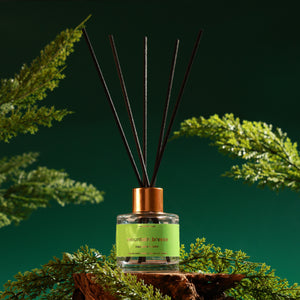
Why adding bottles cannot fix it: concentrations do add, but each bottle’s contribution at ten metres is negligible, and a sum of negligible quantities is still negligible. Meanwhile the bottle at your elbow dominates everything you perceive. So the room becomes patchy and locally too strong at the same time, which is the worst of the available outcomes in a room people sit still in.
The second failure is time, not space: ten bottles opened on different dates are ten different strengths, because a reed’s output falls as it runs down and rises in a draught. A field that varies by the metre and also by the week is not an identity, and it cannot be written down, scheduled, dosed down for an evening or key-locked.
What the lounge actually needs: one source putting fragrance into moving air, set low, held steady and judged from outside. A long-dwell room should sit below the level anyone can name, which is the opposite of what a ring of bottles produces.
The honest gaps: no quantity of reed diffusers at any price will scent a large lounge, and I would rather lose the order for ten bottles than take it. Nothing we make removes an odour either — there is no air purifier and no dehumidifier in the range — so if the lounge smells stale underneath, the reeds were never the question.
2. And it lands on the seating, every time, because of where bottles go. Reeds live on hard horizontal surfaces at the perimeter: console tables, window ledges, the ends of sideboards, the table by the fireplace, the shelf behind the wing chairs. Members live in the middle of the room, in clusters of armchairs around low tables, for two and three hours at a stretch. So the bottles are, almost by definition, arranged around the outside of the volume that matters, and the deepest valley in the field is the centre of the seating plan. That is the exact inversion of what the club is paying for: the strongest fragrance is beside the objects and the weakest is beside the people.
3. The sum of many negligible contributions is still negligible — while one nearby bottle dominates. Concentrations do add, and that is precisely the trap. Ten metres from a reed, one bottle’s contribution is a very small number; adding nine more very small numbers together produces a slightly larger very small number, and the member sitting there still reports that the room does not smell of anything. But sit that member at the side table with a bottle eighteen inches from the arm of the chair and the local value swamps everything else in the room. The result is a lounge that is simultaneously patchy and locally too strong, which is the worst outcome available, and it produces two contradictory complaints from two members who are both entirely correct because they genuinely are not smelling the same thing.
4. Ten bottles are also ten different strengths, and they drift apart over time. A reed’s output depends on how much wetted surface is standing above the neck, how warm that corner of the room is and how much air passes it, and it falls as the bottle runs down. So a set opened on different dates, some near a door and some on a still console, some with all six reeds turned last week and some not, is a collection of independent emitters at independent levels. Published life is 6–8 weeks for a 50ml and 14–18 weeks for a 130ml, which means the refill task never finishes and is done by whoever is free. A field that varies by the metre and also by the week cannot be written down, and a fragrance is only a system when it can be: fragrance, position, intensity, schedule, refill cadence, and one named person who owns it.
5. The answer is one source that puts fragrance into moving air, set low and held there. That is the only mechanism that produces a level rather than a set of zones, because it hands distribution to the air the building is already moving instead of waiting for the air to come and collect the fragrance from a bottle. Vaayu ₹11,999 is rated up to 1000 m³ ≈ 2,000–3,000 sq ft, runs under 38 dB, lays flat or wall-mounts or goes into an HVAC return, and can be key-locked so the level survives the night shift. Where the lounge shares an air system with the rooms around it, Aangan ₹25,999 covers up to 3,000 m³ ≈ 8,000–10,000 sq ft on that connection. Alcohol-free, phthalate-free, IFRA-compliant, composed in Pune, with a portion of every order supporting girl-child education through Nanhi Kali.

The arithmetic, and why it does not improve with quantity
A committee considering “a few more bottles” is making an intuitive assumption that deserves to be examined rather than dismissed, because the assumption is reasonable and merely wrong. The assumption is that coverage is additive in the way seating is: if one chair seats one person, ten chairs seat ten. Fragrance from a passive source does not behave like that, for three separate reasons.
 Mountain Breeze₹849Picture the concentration around a single bottle as a hill: a sharp peak at the neck, steep sides, and a long flat skirt of almost nothing. Now place ten of those hills around the perimeter of a large lounge. Where they overlap is out at the skirts, where each is already contributing very little, so the overlap produces low ground rather than a raised floor. The peaks stay exactly where the bottles are, and the middle of the room stays in the valley. A club could in principle attack this by placing bottles at close intervals throughout the seating, and clubs occasionally try: bottles on every low table between the armchairs. That produces the second failure instead of the first — a member seated for three hours beside a source, which is precisely the situation a long-dwell room must avoid, and the complaint changes from “it does not smell of anything” to “it is overpowering where I sit”. There is no arrangement of passive sources that resolves both, because the gradient is steep and a seated member is either in it or out of it.
 Vaayu₹11,999An emitter with no control on it is at the mercy of its own condition and its own corner of the room. Output rises with wetted surface and with the air passing the reeds, and falls as the bottle empties — so the bottle by the door runs down faster than the one on the still console, the one whose reeds were turned on Tuesday is briefly louder than the one that was not, and a bottle in its final fortnight is contributing a fraction of what it did when it was opened. Published life is 6–8 weeks for a 50ml and 14–18 weeks for a 130ml, and in a set of ten those intervals are staggered for ever after the first replacement. The practical result is that nobody can state what the lounge’s fragrance level is, which means nobody can hold it, defend it to the house committee, or notice when it has drifted. A fragrance becomes a system only when it is written down — the composition, the position, the intensity, the schedule, the refill cadence, the list of rooms that stay unscented, and one named person who owns it. A perimeter of bottles cannot be written down in that form, because there is no setting to record.
Aangan₹25,999The capital comparison is the one clubs make, and it is not the interesting one. Reeds are ₹749–₹849 for a 50ml and ₹1,249–₹1,349 for a 130ml, with refills at 300ml ₹2,399 and 500ml ₹3,499; a machine is ₹11,999. What the spreadsheet usually omits is that the bottles are a recurring operational task on a rolling schedule — every set replaced several times a year, on staggered dates, by whoever is available, with the oil handled in a members’ room. Ten open vessels of oil on polished timber and leather in a room full of members is also a risk register item, and a wiped-up spill on a French-polished table is an expensive way to save the price of one machine. Then there is what the room looks like: a ring of identical bottles reads as institutional rather than considered, and in a club the visual restraint is part of the same judgement as the olfactory restraint. A well-scented building is one in which a member cannot find the source at all, because the fragrance is introduced into the moving air upstream and there is nothing to walk towards.
Vaayu₹11,999An emitter with no control on it is at the mercy of its own condition and its own corner of the room. Output rises with wetted surface and with the air passing the reeds, and falls as the bottle empties — so the bottle by the door runs down faster than the one on the still console, the one whose reeds were turned on Tuesday is briefly louder than the one that was not, and a bottle in its final fortnight is contributing a fraction of what it did when it was opened. Published life is 6–8 weeks for a 50ml and 14–18 weeks for a 130ml, and in a set of ten those intervals are staggered for ever after the first replacement. The practical result is that nobody can state what the lounge’s fragrance level is, which means nobody can hold it, defend it to the house committee, or notice when it has drifted. A fragrance becomes a system only when it is written down — the composition, the position, the intensity, the schedule, the refill cadence, the list of rooms that stay unscented, and one named person who owns it. A perimeter of bottles cannot be written down in that form, because there is no setting to record.
Aangan₹25,999The capital comparison is the one clubs make, and it is not the interesting one. Reeds are ₹749–₹849 for a 50ml and ₹1,249–₹1,349 for a 130ml, with refills at 300ml ₹2,399 and 500ml ₹3,499; a machine is ₹11,999. What the spreadsheet usually omits is that the bottles are a recurring operational task on a rolling schedule — every set replaced several times a year, on staggered dates, by whoever is available, with the oil handled in a members’ room. Ten open vessels of oil on polished timber and leather in a room full of members is also a risk register item, and a wiped-up spill on a French-polished table is an expensive way to save the price of one machine. Then there is what the room looks like: a ring of identical bottles reads as institutional rather than considered, and in a club the visual restraint is part of the same judgement as the olfactory restraint. A well-scented building is one in which a member cannot find the source at all, because the fragrance is introduced into the moving air upstream and there is nothing to walk towards.
Why a long-dwell lounge punishes a patchy field hardest
A patchy field is survivable in a corridor and unforgivable in a lounge, and the reason is dwell time. A space you walk through and a space you sit still in need different doses, and the commonest mistake in club scenting is setting the sitting space at the walking-through level. In a corridor a member is in a given patch of air for a couple of seconds, so an uneven field reads as movement and variety rather than as a fault; in fact a step up and a step down along a route is part of what makes a building feel composed. In a lounge a member is in one chair for two or three hours, which means they are not sampling the field, they are living in one point of it. If that point is a peak they will name it, and they will name it as too strong. If it is a valley they will say the club does not smell of anything. Neither member is mistaken, and the general manager who has been in the building since seven cannot adjudicate between them, because the nose reports change rather than constancy and has long since stopped reporting the room.
The other consequence of long dwell is that the level a lounge should be held at is lower than instinct suggests, which makes the failure mode of a bottle cluster particularly unfortunate. Arrival can carry a clear signal because nobody stands in a threshold for three hours; a members’ lounge should sit below the level anyone would name. Restraint is the luxury signal and it costs nothing. A ring of reeds gets this backwards: it delivers a nameable level in a handful of small places and nothing in the rest, when the room wanted an unnameable level everywhere. And because the peaks are local and fixed to furniture, they cannot be dosed down for a busy evening or turned off for an event, which a scheduled machine can.
One further point belongs here, because it decides how a lounge behaves once it is scented properly. A soft, traditional lounge — carpet, underlay, curtains, upholstery — takes up fragrance as well as odour, so it charges slowly and then holds its level remarkably steadily. That is an argument for patience and for a low setting rather than for more sources: a machine set on day one will read quiet on day two and noticeably fuller by week four, and the club that raises the intensity in the first week spends the next season oscillating. Set it once, at a level chosen for the fullest hour, write it down with a date, turn the key-lock, and judge it only by walking in from the car park. And remember that a composition dosed low is mostly its heart and its base, because top notes go first — dry structured registers such as tea, cedar, vetiver and bergamot keep their outline when quiet, while sweet or powdery ones lose their shape and read as a vague smell of perfume.
Ten bottles against one source, line by line
This is the comparison I would put in a committee paper, because the capital number is the only line on which the bottles win and it is the line clubs look at first. The last row is the one to read twice.
| What the club cares about | Eight or ten reed diffusers | One waterless nebuliser on the airflow path |
|---|---|---|
| Shape of the fragrance in the room ★ | Hills at the bottles, valleys between them, and the deepest valley in the middle of the seating plan | A level across the connected volume, because the fragrance is handed to air that is already moving |
| Effect of adding more | More hills and more valley edges. The mechanism limit is not crossed at any quantity | Not usually needed; where it is, the question is zones and connected volume rather than quantity |
| Consistency over weeks | Ten outputs at ten ages, each falling as it runs down. 6–8 weeks for a 50ml, 14–18 for a 130ml | One written setting held until somebody changes it, with up to about 90+ days on a 400ml tank |
| Can it be dosed down for a full evening | No. There is no setting, so the only lever is removing bottles and putting them back | Yes — adjustable intensity, run windows of 1h / 4h / 8h / 24h and day selection |
| Can the setting be protected | No. Anybody can move a bottle, add reeds or take one away, and nobody will know | Yes. Auto-stop and a key-lock, which is what stops a night steward turning it up |
| Housekeeping and risk | Ten open vessels of oil on polished timber and leather, refilled on rolling dates by whoever is free | One sealed residue-free tank, under 38 dB, refilled on a stated cadence by a named person |
| Capital | ₹749–₹849 for a 50ml, ₹1,249–₹1,349 for a 130ml, refills 300ml ₹2,399 and 500ml ₹3,499 | ₹11,999 for Vaayu, or ₹25,999 for Aangan where the floor is on one air system |
| Where each one genuinely wins | Cloakrooms, washrooms, the secretary’s office, a small anteroom — where the zone is the whole room and no power point exists | Lobbies, arrival thresholds, lounges and any connected volume larger than a small closed room |
Zone · Vaayu₹11,999See it → Air system · Aangan₹25,999See it → Larger property · Meenar₹38,500See it →
What to do with the reeds you already own
Nothing in this page argues that a club should throw its bottles away, and I would be unhappy if it read that way. A reed is an excellent product in the role it was designed for, and every club has four or five rooms in that role. A closed door is a real boundary for fragrance, so in a small enclosed room the zone a reed makes is the whole room, and the qualities that count against it in a lounge count for it there: no power, so no low-voltage point and no cable on a panelled wall; no noise; no moving parts; nothing to service; and nothing anybody can turn up during a shift.
So redeploy them. The cloakroom. The washrooms and their lobbies, where the zone is most of the usable volume. The secretary’s office and the general manager’s office, where a personal, replaceable fragrance at a desk is right and a commercial machine is not. A committee anteroom or the small room off the main stair that everybody passes and nobody sits in. A landing on a residential or guest floor, where the requirement is a quiet marker. The published figures work honestly in your favour in all of those: up to about 150 sq ft for a 50ml at ₹749–₹849 lasting 6–8 weeks, or the 130ml at ₹1,249–₹1,349 lasting 14–18 weeks, six fibre reeds, a refillable glass bottle, alcohol-free, phthalate- and paraben-free, IFRA-compliant, 0 ppm formaldehyde, on a heat-stable CCT carrier tested at 45°C and 85% RH, composed in Pune. Morning Freshness at ₹749 and Mountain Breeze at ₹849 hold their outline best when they are quiet.
Two cautions while you are redistributing. Keep bottles away from the food route entirely — a gourmand or edible note anywhere near plated food reads as competition rather than as luxury, and the kitchen always wins — and keep them out of the rooms that should carry nothing at all: dining rooms, private dining, bar counters, gym floors, spa treatment rooms, boardrooms, and the library or card room in a heritage club, where old paper and timber are the identity worth protecting. And do not move reed oil between formats to solve anything. Reed oil cannot go into an ultrasonic machine; the Hotel Collection oils are water-based and ultrasonic-only, three to six drops into the water tank, and are not for reeds and not for the waterless commercial machines. The carrier decides the machine, which is also why no hotel-inspired reed diffuser exists at SOSA at all.
The order of work, and the two gaps
Here is the sequence as a committee paper would carry it. The first two lines cost nothing and may make the rest unnecessary; the fourth is the only purchase; the last row is what this range does not contain, stated plainly, because a member will check it.
| Step | What it is | Why it comes here in the order | Cost |
|---|---|---|---|
| 1. Establish that the lounge is clean and ventilated first ★ | Source, then moisture, then ventilation and air change, then cleaning. Water seals and drain traps, full fresh air before opening, carpets and underlay dried, curtain linings named in the contract | Because fragrance over a stale room produces a mixture that is judged worse than the original, and because a clean aired lounge often ends the complaint before any purchase | No purchase |
| 2. Map the field you actually have | Walk the lounge from outside, chair by chair, and mark where it is strong and where it is nothing. Do it at the hour members complain about, with a nose that has been out of the building | Because the pattern of peaks at the tables and valleys at the seating is the evidence that settles the argument, and because nobody who has been inside all day can judge it | No purchase |
| 3. Measure the lounge as a volume | Connected volume rather than floor area, ceiling height, which doors stay open, where supply and return sit, and whether the lounge and the rooms around it are one air system or several | Because a closed door is a real boundary and an open plan is one volume, and because a double-height or galleried room consumes coverage a square-foot figure hides | No purchase |
| 4. Put in one source, not ten — and set it low | Vaayu on the airflow path or into the HVAC return, or Aangan where the floor shares one air system. Set once for the fullest hour, written down with a date, key-locked, left alone for a month | Because only a device that puts fragrance into moving air produces a level, and because a long-dwell room should sit below the level anyone can name | ₹11,999 |
| 5. Redeploy the reeds you own | Cloakroom, washrooms and their lobbies, the secretary’s office, an anteroom, a landing. 50ml ₹749–₹849 for 6–8 weeks, 130ml ₹1,249–₹1,349 for 14–18 weeks | Because in a small closed room the zone is the room, and no power, no noise and nothing to service are genuine advantages there | Already bought |
| Two honest gaps: what SOSA does not sell you | No quantity of reed diffusers produces an even field in a large lounge — a mechanism limit rather than a quality limit, which no price and no number crosses, and which I would rather state than supply. And nothing in the range removes an odour: there is no air purifier and no dehumidifier, and no health, air-quality or VOC claim is made, because fragrance adds fragrance. No purchasable refill oil is listed for the waterless commercial machines either — that fragrance is specified and quoted per property, and no rupee total for a bottle programme is published | Said plainly, because the easy sale here is ten more bottles and it is the one purchase certain to disappoint | Quoted |
Versailles
I was once walked around a very handsome members’ lounge by a house committee that had, over about two years, worked its way up to eleven reed diffusers. They had started with two, been told by members that the room did not smell of anything, bought four more, been told the same thing, and kept going. Eleven bottles is not a foolish decision. It is a perfectly logical decision built on one wrong assumption, which is that coverage adds up.
What the room actually had was eleven small fragrant places and a large unfragranced one, and I could show them that in ten minutes by walking them from chair to chair. At the window console it was lovely. Three metres into the seating it was gone. And in one corner two bottles sat on adjacent tables beside a pair of wing chairs, and the member who habitually sat there had complained twice that the lounge was overpowering — which he was also right about. Two members, two opposite complaints, both accurate, in one room.
The other thing eleven bottles had produced was an administrative mess. Nobody could say what the lounge’s fragrance level was, because there was no setting to say. The bottles had been opened on nine or ten different dates, some were nearly finished and contributing very little, one near the terrace door had been emptied by the draught in half the expected time, and the refilling was done by whoever noticed. A signature fragrance is a decision held steadily for years; this was eleven independent decisions drifting apart.
We took ten of them out of the lounge and put them where they were the best product in the building — the cloakroom, the washroom lobbies, two offices, the anteroom, two landings. One machine went in on the airflow path, set lower than the committee expected because people sit in that room for hours, written down on a sheet with the date, and key-locked. The complaint file closed. The sentence I would want a general manager to take from all of this is the unglamorous one: the limit on a reed in a large room is a mechanism limit, not a quality limit, so no number of them ever gets there. Everything we make is composed in Pune, and a part of every order funds a girl’s classroom through Nanhi Kali.
Frequently asked questions
- What to fix first — the family pillar: the whole ordered checklist, with fragrance as the last line.
- Why one reed reaches the desk and not the door — the passive mechanism explained from the bottle outwards.
- Stronger fragrance or better diffusion — the test that tells you which of the two problems you actually have.
- Why a spray vanishes in a lobby — an event rather than a system, and why SOSA sells no such product for interiors.
- Why the lounge changes by evening and why it is worst at opening — the day’s load, and the overnight release.
- What carpets, leather, curtains and timber hold — the stores that also decide how a lounge holds a fragrance once it is clean.
- Why old clubs turn musty and why the monsoon makes it worse — the problems no diffuser of any kind addresses.
- Brand: the SOSA founder story.
SOSA commercial scenting — facts verified August 2026: Vaayu ₹11,999, waterless cold-air nebulising, coverage up to 1000 m³ ≈ 2,000–3,000 sq ft, 400ml refillable sealed tank lasting up to about 90+ days depending on intensity and hours, Bluetooth app plus onboard buttons, run windows of 1h / 4h / 8h / 24h, day selection, adjustable intensity, auto-stop and key-lock, under 38 dB, freestanding, wall-mounted or HVAC-return mounting, DC 12V / 1A at 5W, CE, RoHS and SGS, black and white. Aangan ₹25,999, HVAC or AHU connection or standalone wall-mount or lay-flat, coverage up to 3,000 m³ ≈ 8,000–10,000 sq ft, 800ml reservoir, under 42 dB, DC 12V at 14W, intelligent PCB with programmable work and pause cycles and daily schedules, metal body 3.9 kg at 284 × 125 × 246 mm, black or white, one-year warranty, imported; it has no app and no Bluetooth, and no certifications are published for it. Meenar ₹38,500 is the larger-property option and is specified on enquiry; no coverage figure is published for it here. Ultrasonic machines: Sukoon ₹1,899 at 270–320 sq ft, Boond ₹899 at up to about 150 sq ft, Megh ₹3,499 with a six-litre tank and around 100 hours of runtime but only about 215 sq ft of coverage. Reed diffusers ₹749–₹849 for 50ml lasting 6–8 weeks and ₹1,249–₹1,349 for 130ml lasting 14–18 weeks, six fibre reeds, alcohol-free, phthalate-free, paraben-free, IFRA-compliant, 0 ppm formaldehyde, heat-stable CCT carrier, refillable glass bottle, tested at 45°C and 85% RH, composed in Pune; refills 300ml ₹2,399 and 500ml ₹3,499. The Hotel Collection fragrance oils are water-based and ultrasonic-only at 15ml ₹299, 100ml ₹999 and 300ml ₹1,799; they are not for reed diffusers and not for the waterless commercial machines, and there is no hotel-inspired reed diffuser. No purchasable refill oil is listed for the waterless commercial machines — that fragrance is specified and quoted per property. SOSA publishes no leather fragrance in any format and no tobacco or smoky fragrance for any diffuser. SOSA sells no air purifier, no dehumidifier and no room spray for interiors, and makes no health, air-quality, VOC or mould claim. No digital integration of any kind exists on any SOSA machine; the Aangan HVAC connection is mechanical. No dealer programme, reseller margin, trade price, territory or service contract is published. Free shipping above ₹499. A portion of every order supports girl-child education through Nanhi Kali. SOSA is an independent Indian fragrance house; the Hotel Collection scents are SOSA’s own interpretations inspired by the world’s finest hotels, and SOSA is not affiliated with or endorsed by any hotel brand. Prices subject to change — see the live product pages.