
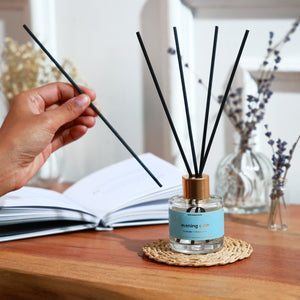
 Nightly AC 50ml ₹799 Large master 130ml ₹1,299
  For humidity too ₹1,899
  Refill ₹2,399
 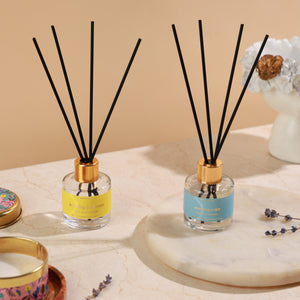 Two-bottle start ₹1,498
Reeds: two for a nightly-AC bedroom under 150 sq ft, three if the room is larger or the AC runs only part of the year. A sealed AC room holds fragrance better than a fan room, so it needs less, not more.
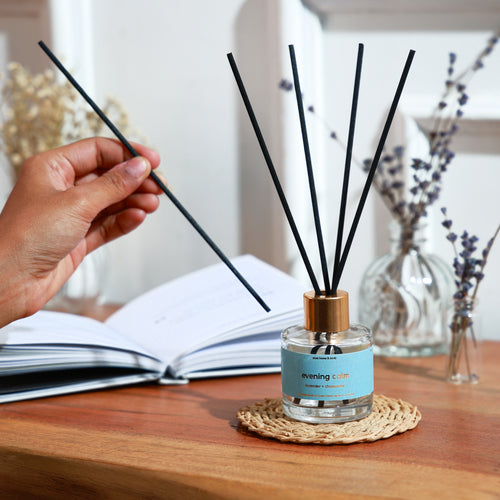
Bottle: Evening Calm 50ml ₹799 for a standard nightly-AC bedroom, 130ml ₹1,299 for a large master, both on three reeds at most.
2. The best spot is the far third of the room, off the throw axis, near the return path. Cold air falls at the far wall and travels back along the floor towards the unit — that return path is the calmest air in the room, and a bottle there gets gentle circulation without being stripped. In practice this is usually the bedside table on the side away from the AC, or a dresser against a side wall.
3. Use two reeds if the AC runs nightly and the room is sealed, three if the room is larger or the AC is seasonal. A closed, air-conditioned room exchanges little air with the outside, so a given reed count reads stronger than the same count in a room with a fan and an open window. Start low; it is easier to add a reed than to calm an over-scented room down.
4. Judge the room at the temperature you actually sleep at, not the temperature you walk in at. Evaporation slows as the oil cools, so a bottle that reads strong at 4pm in a 32°C room will read quieter at 11pm once the AC has done its work. That is expected behaviour, not a fault.
5. A dry AC room reads sharper and thinner — it is a placement problem, not a bottle problem. Do not compensate with more reeds; a very dry room simply carries top notes differently, and the fix, if you want one, is a separate humidity source rather than more oil.
Alcohol-free, IFRA-compliant, composed by an ISIPCA Versailles-trained perfumer and handmade in small batches in Pune — and every purchase funds a girl's education through Nanhi Kali.
Why an air-conditioned bedroom is two rooms, not one
Every general bedroom placement rule assumes fairly stable air — a room with a fan running or no moving air at all, a temperature that drifts a few degrees across the day. An air-conditioned bedroom does not behave like that. For roughly sixteen hours it is a warm, still room where fragrance follows the ordinary rules: it climbs the reeds, drifts a short radius, and stays roughly where you left it. For the other eight it is a room with a mechanical circuit running through it — cold air pushed out along the ceiling, falling as it cools and loses momentum at the far wall, then travelling back along the floor towards the unit to be drawn in and cooled again. Those two states are different enough that a placement correct for one is often wrong for the other, and most bedrooms only get furnished once, for the room as it looks in daylight.
The consequence that actually costs you money is the throw. A bottle standing in the direct path of that ceiling jet, or on the wall the unit is mounted on, sits in the fastest and most variable air the room produces. Every time the compressor cycles on, that air moves harder across the reed ends, carrying off the bright top notes disproportionately fast — this is the single commonest reason a bedroom diffuser that should last six to eight weeks is empty and smelling of nothing but base in three. It is not a faulty bottle. It is a bottle doing its job in the one place in the room where the job runs at double speed. The general rule for any bedroom is to keep a bottle out of a fan or AC draught — an air-conditioned room simply makes that draught a strong, structured, twice-daily event rather than an occasional breeze.
The consequence that actually helps you is the return. Once that thrown air has fallen and travelled back across the floor, it arrives at the unit having lost most of its speed — the return path is, by a meaningful margin, the calmest moving air anywhere in the room. A bottle sitting in or near that path gets just enough gentle circulation to carry scent without ever being blasted. Which is why the useful rule for an AC bedroom is not "keep it still" but "keep it in the slow air" — and the slow air is almost always the far third of the room, away from both the wall the unit hangs on and the wall directly opposite it.
The three mechanisms at work
 Evening Calm 50ml₹799A wall-mounted unit throws cold air out along the ceiling in a fairly narrow band, which falls as it loses heat and momentum near the far wall, then crawls back along the floor towards the unit's intake. A bottle in the throw band gets hit twice as often as anywhere else in the room, because the compressor cycles on and off repeatedly through the night rather than running as one continuous stream. A bottle in the return path gets the same air, but by the time it arrives it is slower, calmer and has already spent its force elsewhere. The two spots can be less than three metres apart and behave completely differently.
Position relative to the AC, compared
The table below assumes a standard split AC mounted high on one wall of a closed bedroom, a bottle on the reed count noted, and a flip every three to five days. "Verdict" reflects both how fast the bottle empties and how evenly the scent reads across the room.
| Position relative to the AC | What happens | Verdict | Reeds |
|---|---|---|---|
| On the wall the AC is mounted on, below or beside it | Caught by the outlet directly whenever the compressor cycles; occasional condensation drip risk too | Never | — |
| Directly opposite the AC, in the throw line | Sits in the fastest-moving air in the room; top notes strip within days and the bottle empties early | Avoid | — |
| Adjacent short wall, still inside the ceiling throw band | Catches spillover draught even though it looks out of the main jet | Avoid | — |
| Far third of the room, off-axis, near the return path ★ | Calmest air in the room; gentle circulation carries scent without stripping it | Best | 2 nightly · 3 seasonal or large |
| Bedside table on the side away from the unit | Usually falls inside the far third by default — the standard bedroom placement already works here | Best | 2–3 |
| Near the bedroom door, outside the throw entirely | Outside the AC's draught but nearer the air exchanged whenever the door opens | Acceptable | 3 |
| Note on ceiling fans in an AC room: if a fan runs alongside the AC on low, it can pull the return-path advantage away by mixing the calm air back into circulation. Check the return spot with a hand test with the fan on, not just the AC. | |||
Evening Calm · nightly-AC bedroom50ml ₹799Shop → Evening Calm · large master130ml ₹1,299Shop →  Sukoon · adds humidity, not just scent₹1,899Shop →
Reeds, drying air and reading the room at the right temperature
Start at two reeds in a nightly-AC bedroom under 150 sq ft, three if the room is larger or the AC only runs seasonally — not the six that would suit a living room, and not even the default three that suits a fan-cooled bedroom. A sealed, recirculating room holds scent with less competition than an open one, so the same fibre-reed count that reads correctly with a window cracked can read insistent behind a closed AC door. This is also where the AC's other effect shows up: cooling pulls moisture out of the air, and a very dry room tends to make a fragrance read sharper and thinner rather than rounder. If that bothers you more than the count of reeds does, the fix is a separate humidity source rather than more oil — an ultrasonic Sukoon at ₹1,899 genuinely helps here because it adds moisture to the air as well as fragrance, which a reed bottle cannot do. That is a different job from the reed's steady baseline, not a replacement for it — the two work well side by side in the same AC room, much as they do in the reeds-versus-Sukoon comparison for larger spaces, and the reed oil and the water-based Hotel Collection used in the Sukoon must never be swapped between the two vessels.
Flip the reeds saturated-end up every three to five days, the same cadence as any other room — a drier AC room does not need more frequent flipping, and over-flipping simply burns through the bottle faster for a stronger but shorter run. What does change in an AC bedroom is worth building into the routine: check the flip on a day the AC has been running, not the one day a week it happens to be off, since that is the air state the bottle spends most of its life in. Keep the bottle roughly a metre off the floor with clear air around it, as with any bedroom placement, and off the windowsill for the usual reasons of heat and light quite apart from the AC question.
The cold-start read deserves its own line because it causes more false alarms than any other AC-bedroom question I get. Evaporation slows as the oil cools, so the same bottle in the same spot will read more clearly at 6pm in a warm room than at midnight once the AC has brought the room down ten degrees. That is not the reed diffuser failing — it is the reed diffuser behaving exactly as the physics predicts. Judge the setup at the temperature you actually fall asleep at, not the temperature you walk in at after work, and resist the urge to add a reed based on an afternoon check. If it still reads too quiet at 11pm on three reeds in a genuinely sealed nightly-AC room, that is real information; an afternoon check in the same room is not.
What it costs to get an AC bedroom right
This is a single-room, single-bottle decision, so the numbers below are bottle and reed choices rather than a flat-wide kit — for context, the standard multi-room kits run ₹2,847 for a 1BHK, ₹3,696 for a 2BHK, ₹4,445 for a 3BHK and ₹5,244 for a 4BHK, and an AC bedroom bottle is simply the bedroom line inside whichever of those you are building towards. Placement itself costs nothing; the only real spend is the bottle and, if you want it, the humidity option.
| Setup | What you get | Reeds / longevity | Total |
|---|---|---|---|
| Small nightly-AC room ★ | Evening Calm 50ml, two reeds, in the return path | Sealed room on a low reed count — towards 10–12 weeks | ₹799 |
| Larger or seasonal-AC room | Evening Calm 50ml, three reeds | 6–8 weeks, standard bedroom rating | ₹799 |
| Large master, nightly AC | Evening Calm 130ml, three reeds — never six | 14–18 weeks, sized for the room not the AC | ₹1,299 |
| Running cost | A 300ml refill ₹2,399, or 500ml ₹3,499 (₹7/ml) | 500ml is ten 50ml fills — roughly ₹350 a fill, against ₹799 for a new bottle | from ₹2,399 |
Versailles
The AC question rarely arrives as a question about air conditioning at all — it arrives as a complaint that a bedroom bottle "used to last longer" or "smells different at night than it did when I bought it." Both are usually true, and both trace back to the same mechanical circuit most people never think about while they are choosing where to put a diffuser: a split unit throws air one way and pulls it back another, and those two paths behave completely differently.
What I want people to take from this is not caution so much as a small adjustment. You do not need a different bottle for an air-conditioned room, and you almost certainly do not need more reeds — you need the bottle in the calm third of the room instead of the busy one, and you need to judge it at the temperature you actually sleep at rather than the one you walked in at. Both cost nothing.
Sealed rooms are, if anything, the easier win: less air exchange means your fragrance has less competition, so the same bottle can run on fewer reeds and last longer for it. Every purchase funds a girl's education through Nanhi Kali — not a percentage, not a quarterly cheque. Every one.
Frequently asked questions
- Where to place a reed diffuser in a bedroom — the general rule this guide builds on.
- Reed diffuser on your bedside table — why it is usually the right surface, AC or not.
- Reed diffuser near a bedroom door — the other draught worth checking.
- How many reeds should you use for a bedroom? — the count question in full.
- Brand: the SOSA founder story.
SOSA reed diffusers & prices (verified August 2026): Morning Freshness (Malabar lemon · peppermint · eucalyptus) 50ml ₹749 · 130ml ₹1,249 · Evening Calm (lavender · chamomile) 50ml ₹799 · 130ml ₹1,299 · Garden Bloom (British rose · night-blooming jasmine) 50ml ₹799 · 130ml ₹1,299 · Fresh Brew (Coorg coffee · Kerala vanilla) 50ml ₹849 · 130ml ₹1,349 · Mountain Breeze (Himalayan pine · sage · cedar) 50ml ₹849 · 130ml ₹1,349. Duo sets: Day & Night 2 × 50ml ₹1,498 · 2 × 130ml ₹2,498; Fresh & Grounded 2 × 50ml ₹1,548 · 2 × 130ml ₹2,548; Warmth & Bloom 2 × 50ml ₹1,598 · 2 × 130ml ₹2,598. Refills 300ml ₹2,399 · 500ml ₹3,499. Six fibre reeds included with every bottle; refillable glass. 50ml suits rooms up to 150 sq ft and lasts 6–8 weeks; 130ml suits rooms above 150 sq ft and lasts 14–18 weeks. Fractionated coconut oil (CCT) carrier, alcohol-free, phthalate-free, paraben-free, IFRA-compliant, low VOC; tested through 45°C heat and 85% monsoon humidity. Composed and handmade in small batches in Pune. Ultrasonic machines quoted for comparison: Boond ₹899 · Sukoon ₹1,899 · Megh ₹3,499, which run the separate water-based Hotel Collection fragrances (15ml ₹299 · 100ml ₹999 · 300ml ₹1,799) — the two lines are not interchangeable. Every purchase funds a girl's education through Nanhi Kali. Prices and availability subject to change — see the live product pages.