



Constraint two: height. A toddler’s breathing zone is roughly 0.8–1.2 m, and on the floor it is lower again.
Constraint three: reservoirs. Foam mats, soft toys, cushions and rugs absorb odour and re-release it against faces.
The play area is not a reception. It stays unscented even where reception is not.
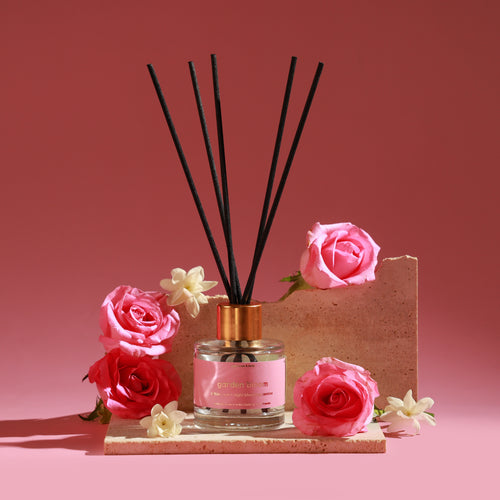
2. Which makes the reed diffuser, unusually, the wrong recommendation. We recommend reeds for clinic receptions more than any other format: no power, no maintenance, no setting to creep upward, and an intensity ceiling low enough that it cannot dominate a waiting area. All of that still holds. What does not hold is the assumption that "passive" means "safe around children". A reed diffuser is an open bottle of fragrance oil with sticks in it, and its natural home is a low console. If you use one in a toddler-heavy clinic, it goes behind the reception counter where nobody small can reach it, on three reeds — or you choose a wall-mounted unit instead.
3. The second difference is height, and it works against you twice. A toddler’s breathing zone sits around 0.8–1.2 m against an adult’s 1.5–1.7 m, and a toddler at play is frequently on the floor, lower again. Concentration falls with distance from the source, so a unit at desk or console height delivers more to the child than to the adult who set it. The fix is the same as elsewhere in this cluster but matters more here: mount high, aim away from seating and play space, and set the level standing where the children actually are rather than at the counter.
4. The third is that a toddler room is the most absorbent room in the clinic. Foam mats, a rug, cushions, soft toys, fabric book covers, a beanbag. Sorption means every one of those takes up airborne odour and releases it slowly afterwards, and unlike the air they cannot be switched off. It also means a toddler area holds whatever else has passed through it — a nappy incident, a spill, a wet mop — long after the event. This is an argument for hard, wipeable surfaces and a genuine washing rota far more than it is an argument for fragrance.
5. And the play area stays unscented even if reception does not. The scentable list in this cluster is entrance, reception desk, admin and the corridor to reception. A children’s play zone is not on it, and a toddler play zone least of all: it holds the longest dwell, the lowest breathing height, the most sorptive surfaces and the closest face-to-fabric contact in the building. If your play area is inside the reception air space — which it usually is — then the reception is not scentable either.
Made in India, composed by an ISIPCA Versailles-trained perfumer — and a portion of every order supports girl-child education through Nanhi Kali.
Why the binding constraint here is physical rather than olfactory
Ask a clinic owner what makes a toddler waiting room different and they will talk about noise, mess and attention span. Ask a scenting supplier and they will talk about intensity. Both are true and neither is the binding constraint. The binding constraint is that a toddler clinic is the only room in healthcare where the occupants systematically investigate the furniture with their hands and mouths, at a height between the floor and about a metre, during the exact window when their adult is distracted by a counter, a phone or a younger sibling. Every conventional place to put a diffuser sits inside that window — the low console by the chairs, the side table between the seats, the shelf under the noticeboard, the plug point near the skirting. So the design question stops being "how much" and becomes "is there anywhere in this room that a unit can go at all". In a great many toddler clinics the honest answer is no, and that settles it without a discussion about fragrance at all.
The second reason is that the toddler room concentrates every other risk factor in this cluster into one space. It has the longest dwell, because a toddler appointment runs late more often than any other and the child is not going to sit quietly through it. It has the lowest breathing height, because toddlers play on the floor. It has the most sorptive surfaces per square foot of any room in the building — foam, fabric, fur, felt — and those surfaces are pressed against faces rather than sat on. And it frequently has the worst ventilation, because it is the room furthest from the entrance and the one owners are least willing to open a window in. Where every variable stacks the same way, the conservative answer is not timidity; it is arithmetic.
Three design moves for a toddler-heavy clinic
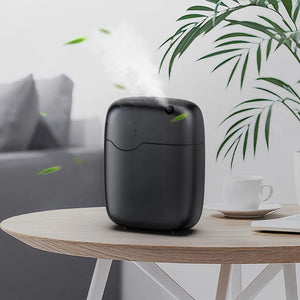
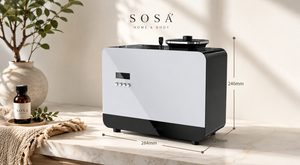
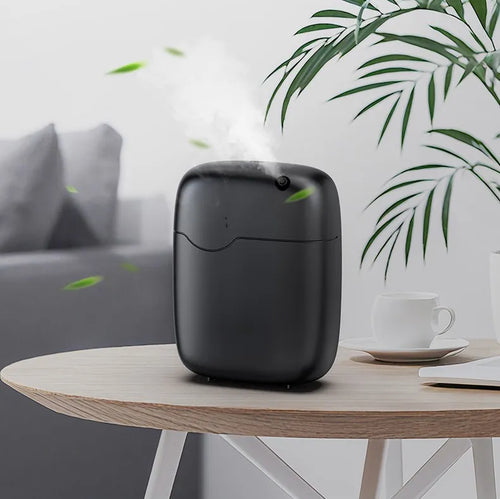
 Wall-mounted₹11,999Walk the room at toddler height and list every surface a small hand reaches: low tables, the ledge under the counter, window sills, the shelf beside the chairs, any plug point at skirting level. Those are not candidate positions, they are exclusions. What is left is a wall above about 1.8 m, ideally behind or above the counter, with the outlet aimed away from seating and play space. If nothing remains on the list, you have your answer and it costs nothing. A waterless wall-mounted unit is the only format that comfortably meets this test; anything with a reservoir, an open bottle or a lead across a floor does not.
Zone by zone, for a toddler-focused clinic
The row that does the work here is the third one. In most toddler clinics the play corner and the reception desk are the same air space, and once that is admitted the first row usually collapses into the second.
| Area of the clinic | Scented? | Why | What we would use |
|---|---|---|---|
| Reception desk, wall-mounted above 1.8 m, separate from play ★ | Yes, minimum only | Out of reach, aimed away from seating, and only where the play zone is genuinely on other air | Vaayu at shortest duty cycle, or a reed kept behind the counter |
| Toddler play zone and floor mats | No | Longest dwell, lowest breathing height, most sorptive surfaces, closest face-to-fabric contact | Nothing |
| Waiting seating sharing air with the play zone | No | If the play corner is in this air space, this row and the first row are the same room | Nothing |
| Any low table, console or skirting-level socket | Never | Within toddler reach — a tipping hazard and an ingestion hazard before it is a fragrance question | Nothing, at any level |
| Consultation, examination and vaccination rooms | Never | Clinicians rely on their own noses, and a scent paired with an injection becomes a cue for it | Nothing |
| Nebulisation, asthma and neonatal follow-up | Never | Respiratory and newborn patients, the two groups least tolerant of added airborne load | Nothing |
| Before any of this: a toddler clinic gets more from a washing rota than from anything on this table. Foam mats, rugs, cushions, cloth toys and seat covers absorb odour and release it back for weeks, and they are the surfaces children press their faces into. | |||
 Small reception · no power neededFrom ₹749Shop →
  Mid reception · has an off switch₹1,899Shop → Large lobby · timed, dialable₹11,999Shop →
Setting the level when the judges are two years old
Judge it from the floor, because that is where your patients are. The standard calibration advice in this cluster is to use a nose that has been outside for thirty minutes, because olfactory adaptation is essentially complete in about twenty and staff will therefore always ask for more. In a toddler clinic add one step: have that person crouch to about a metre in the play corner and take a breath there, not at the counter at standing height. The difference between those two readings is routinely larger than the difference between two settings on the machine, and it is the reading that describes the patient experience.
Use duty cycle rather than volume to get low. A passive diffuser has a floor — it emits what it emits, and the only controls are reed count and how far away you put it. A waterless machine such as the Vaayu sets intensity as seconds on against seconds off, which lets it run far below that floor, and schedules to clinic hours so you are not scenting an empty building overnight. That dialability, not coverage, is the only reason a commercial machine has any place in a small clinic — and it is worth saying plainly that its coverage rating is far more than a toddler clinic needs, which makes it the wrong machine for a 300 sq ft space rather than the premium one. If you are using a Sukoon instead, that means three drops and intermittent mode, with the unit out of reach and the lead not crossing any floor a child walks on.
Then check the room, not the machine, every quarter. The thing that drifts in a toddler clinic is not the setting; it is the furniture. Mats acquire spills, toys acquire history, a cushion gets wet and dries slowly, a rug sits over a floor that mops damp. Put a quarterly walk in the housekeeping schedule with a named owner: every soft item either goes through a wash or is replaced, the mats are lifted and the floor beneath them checked, and the AC filter and drain pan are done at the same time. And keep the off switch real — every member of reception staff should be able to stop the unit within seconds for a family who asks, with the decision itself owned by your clinical governance and infection-control leads.
What we would install, given the access constraint
This is the one table in the cluster where the reed is not the default first rung, because the usual reason to recommend it — that it needs no power and can sit anywhere — is precisely the problem in a room full of two-year-olds.
| Option | Suits | Control you get | Price |
|---|---|---|---|
| Reed diffuser | A small reception desk — a reception desk where the bottle lives behind the counter, out of sight and out of reach, on three reeds | Reed count only — no switch, no timer | from ₹749 |
| Sukoon 500ml | A reception up to ~320 sq ft — a separate front-of-house with the unit above reach and no lead crossing a floor — never near the play zone | On/off, intermittent mode, you control the drops | ₹1,899 |
| Vaayu | A large lobby or a zoned duct — a large front-of-house where a wall-mounted waterless unit above 1.8 m is genuinely the safest hardware | Duty cycle in seconds, timer, app scheduling | ₹11,999 |
| Aangan | Whole-facility HVAC — a multi-zone facility with ducted delivery and no equipment in the room at all — the play floor still excluded | Zone-level control, but only if the ducting is zoned | ₹25,999 |
| Nothing at all ★ | Any clinic where the play corner shares air with reception, or where there is nowhere above toddler reach to mount anything | Complete — and the correct answer more often than the trade admits | ₹0 |
Versailles
I spend most of this cluster telling clinics to buy a reed diffuser or nothing. A toddler clinic is the place where I change that advice, and it surprises people. A reed diffuser is a bottle of oil with sticks in it, and a two-year-old will find it. Behind the counter it is fine. On the low table by the chairs, where every clinic wants to put it because that is where it looks nice, it is the wrong object in the wrong room.
The second thing I would say to a toddler clinic is that most of what they want from fragrance is available from laundry. The complaints I get sent — a sour note near the play mat, something stale by the cushions, a smell that comes back every afternoon — are almost always soft furnishings holding on to an old event. Fragrance would join that smell rather than end it. A washing rota with a name against it does more for that room than anything on my price list, and it costs less than the cheapest thing I sell.
And if after all that a clinic still wants something at a large front-of-house, the answer is a wall-mounted waterless unit above head height, on the shortest duty cycle it offers, aimed away from the seating, scheduled to clinic hours, switchable off in seconds by whoever is on the desk, and never anywhere near the play floor. Put it to your own infection-control and clinical governance leads before you put it to me. A portion of every SOSA order funds a girl’s classroom through Nanhi Kali.
Frequently asked questions
- Positioning a machine away from children — height, reach and aim.
- Should a play area be scented? — the case for leaving it alone.
- Do toys and cushions hold odour? — sorption, and the washing rota.
- Reception fragrance where babies visit — one air space or two.
- Brand: the SOSA founder story.
SOSA products & prices (verified August 2026): Hotel Collection water-based ultrasonic diffuser fragrance 15ml ₹299 · 100ml ₹999 · 300ml ₹1,799 · Pack of 7 (15ml, all fragrances) ₹1,799; refills 100ml from ₹999. Seven scents: The Ritz-Carlton-inspired (white tea · bergamot · cedar), Westin-inspired (white tea · aloe · cedar), 1 Hotels-inspired (cedarwood · vetiver · green leaves), The St. Regis-inspired (amber · violet · woods), Shangri-La-inspired (jasmine · green tea · white tea), Four Seasons-inspired (citrus · floral · sandalwood), W Hotels-inspired (citrus · pepper · amber). Diffusers: Boond 300ml ₹899 · Sukoon 500ml ₹1,899 · Megh 6L ₹3,499. Water-based, phthalate-free, composed to IFRA standards for home diffusion; 3–6 drops per tank. Made in India, Pune. The Hotel Collection scents are SOSA's own interpretations inspired by the world's finest hotels; all hotel names are trademarks of their respective owners and are used only to describe the scent style — SOSA is an independent Indian fragrance house, not affiliated with or endorsed by any hotel brand. Prices and availability subject to change — see the live product pages.