


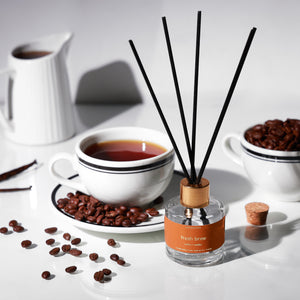

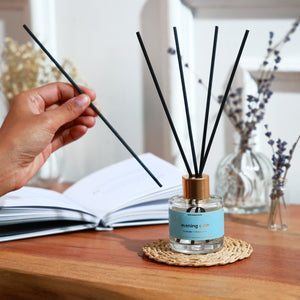
What sets delivered concentration: the mechanism. Passive capillary — a reed — evaporates oil from six fibre sticks and moves no air, so the number is high at the bottle and low everywhere else. Ultrasonic water mist — Sukoon ₹1,899 at 270–320 sq ft — raises it across a room, with the oil diluted in water. Waterless cold-air nebulising — Safar ₹3,999, Vaayu ₹11,999 — raises it with undiluted oil and no water at all. That is the hotel one.
If your bottle is a reed carrying a hotel-style scent: that is a real and pleasant product, but note that no hotel-inspired reed diffuser exists — the Hotel Collection is water-based and ultrasonic-only, and the two systems cannot be mixed either way.
The honest gap and the thing not to buy: there is no mid-sized waterless bedroom nebuliser between Safar and Vaayu, and the ₹299 Hotel Collection 15ml is a refill for a machine, not an inexpensive way in.
2. Because composition quality has a ceiling on what it can do for presence. A better oil smells better. It does not travel further, because travelling is not a property of the oil — it is a property of whatever is moving the air. This is the single most counter-intuitive fact in home fragrance and the reason so many people buy three bottles in a row hoping the fourth will behave differently.
3. Because a hotel bought the other half. A cold-air nebuliser shattering undiluted oil into a dry mist, released into air the building is already moving, on a schedule, at a fixed intensity, in the same scent for years. That is four purchases: atomisation, distribution, scheduling and consistency. The bottle is the cheapest part of it.
4. Because there is a third variable nobody prices — evenness. A hotel corridor smells the same at both ends. A reed-scented bedroom has a strong point and a weak point, and your nose reads that unevenness as “home fragrance” rather than “designed space”, even when the composition is identical. Evenness comes from air movement, never from more oil.
5. And because you are measuring in the worst possible conditions. You adapt to a constant smell in your own home within minutes, so the level you perceive is not the level in the room. A guest is a better instrument. Before you conclude that the experience is missing, get somebody who has just come in from outside to tell you what they notice.
Alcohol-free, phthalate-free, IFRA-compliant, 0 ppm formaldehyde. Free shipping above ₹499, and a portion of every order supports girl-child education through Nanhi Kali.
The two things that both get called “the fragrance”
If this page does one thing, I would like it to give you two separate words for two separate things, because once you have them the whole category stops being confusing. Everything sold to you as “a better fragrance” is an improvement to the first. Almost nothing sold to you as a fragrance improves the second. And the experience you are missing is mostly the second, with a large contribution from a third that nobody puts a price on at all.
 Garden Bloom₹799This is the half a perfumer controls, and I am not going to be modest about it, because it is where the difference between a fragrance you love and a fragrance you tolerate lives. It covers the quality of the materials, the way the accord is built so that it still makes sense in week six rather than collapsing into its base, and the unglamorous engineering underneath — the carrier that survives a Delhi May, the indole in a jasmine held below the level where heat makes it read animalic, a eucalyptus base that slows a lemon’s evaporation three to four times. Composition quality decides whether you like the smell. It is the only half that does. No mechanism ever invented will make you enjoy a fragrance you do not care for, which is why the machine-first advice on this page is not a dismissal of the bottle.
 Sukoon₹1,899How much fragrance is suspended in the air where you are, right now. It is set almost entirely by the mechanism and hardly at all by the liquid. A reed diffuser sets it high at the bottle and low across the room, because oil evaporating from six fibre sticks moves no air and has to rely on currents that may not exist. An ultrasonic machine raises it across a genuine 270–320 sq ft, at the cost of diluting the oil in water and adding humidity. A cold-air nebuliser raises it with undiluted oil and a dry mist, which is why the same composition can feel twice as present coming out of one device as out of another. Same bottle, different payload per droplet, different number in the room.
 Hotel Collection₹999Think about what you actually remember from the hotel. Not a peak. A steadiness — the same level in the lift as in the corridor, at nine in the morning and at midnight, on Tuesday and on the following Tuesday. That steadiness is produced by a machine held at a set intensity on a schedule, and it is the property most responsible for a smell reading as designed rather than added. Your reed cannot offer it, not because it is inferior but because its output rises and falls with the room’s temperature, humidity and draught all day, and it cannot be switched on or off. Control is a feature, not a luxury. Safar gives you three speeds and a one, two or three-hour auto-off; Vaayu gives you 1, 4, 8 or 24-hour run windows and a choice of days. And the free version of consistency is keeping one scent for a year instead of rotating five.
Why the same oil can read expensive in one home and cheap in another
Here is a thing that startles people when they first notice it, and it is worth knowing before you spend another rupee: dose changes the apparent quality of a fragrance more than most reformulations do. Almost any composition, at too high a concentration, flattens into a single sweet or sharp impression — which is exactly what people mean when they say something smells like an air freshener. The same oil at a lower dose reads as layered and considered, because the nose has room to resolve the separate materials rather than being handed one wall of scent. Restraint costs nothing and is invisible on any label, and it is the reason a reader running six reeds in a small sealed bedroom sometimes gets a better result by removing two.
This cuts directly against the instinct that brought you here. Delivered concentration needs to be high enough to be present across the room and low enough that any one point in the room is not saturated, and the only way to have both at once is even distribution — which is a mechanism property, not a dosing one. A reed cannot deliver both: to get anything at all four metres away you have to over-dose the first metre. A machine that moves air can, because it is topping up the far end of the room continuously instead of relying on a gradient. Evenness is what lets you have presence without loudness, and it is precisely what the hotel is doing that your bedroom is not.
There is also a quiet corollary about how much you should be able to smell. A diffuser you notice continuously in your own home is set too strong for the volume. Home fragrance is designed to register on arrival and at transitions — walking in, coming out of the shower, opening a door — and to sit below conscious notice the rest of the time. If you are chasing a level you can smell all evening while sitting still, you are chasing something the hotel is not doing either, because the guest who notices the lobby is a guest who has just walked in from the street. Understanding that will save you more money than any product on this page.
| Component | What it decides | A reed ₹749–₹849 | Sukoon ₹1,899 | Safar ₹3,999 |
|---|---|---|---|---|
| Composition quality | Whether you like the smell at all | Fully. Five scents, CCT carrier, tested at 45°C and 85% RH | Yes, with the water-based Hotel Collection, three 15ml scents included | Yes, with SOSA oils or good pure essential oil |
| Delivered concentration | Whether the room feels scented rather than the corner | High at the bottle, falling with distance. A fragrant zone | Genuine coverage, 270–320 sq ft — oil diluted in water, humidity added | Undiluted oil, dry mist, personal scale. No published room-coverage figure |
| Evenness | Whether it reads as designed rather than as an object on a table | Uneven by design — there is a strong point and a weak point | Even across its coverage, because the machine moves air | Even at personal range, carried by the room’s own airflow |
| Duration and control | Whether it is there when you want it and off when you do not | No control at all — a reed cannot be switched off. But also nothing to charge, fill or remember | 16–18 hours on low, on demand, tank needs filling | 3 speeds, 1/2/3-hour auto-off, up to 10 hours continuous or ~30 intermittent per charge |
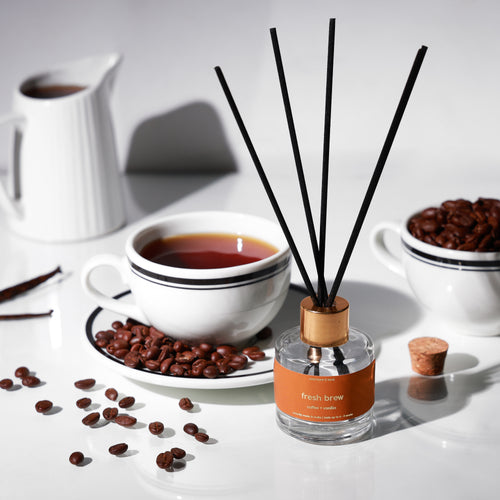
Composition · Fresh Brew₹849Shop →  Concentration · Sukoon₹1,899Shop →
  The oils · Hotel Collection₹999Shop →
Assembling an experience rather than buying a smell
If you take the four components seriously, the shopping list changes shape. Composition: done. You already own something you like, and replacing it would be spending in the one column that is already full. Delivered concentration: start free. Six reeds rather than three is close to a doubling of output and costs nothing; moving the bottle out of a dead corner into the path air already takes can change the reach entirely; closing the door of the room turns a leaking volume into a containable one. Only after all three of those have been tried and a visitor has confirmed that the room genuinely reads as unscented from the doorway does a machine become the honest recommendation.
When it does, the value answer is Sukoon at ₹1,899 — 500ml, 270 to 320 sq ft, 16 to 18 hours on low, and three 15ml Hotel Collection scents in the box, so composition and concentration arrive together for the price of the hardware. The trade-offs are honest ones: the oil is diluted in water, the machine adds humidity, the tank needs filling, and in a hard-water city there can be white mineral dust. If the water is the deal-breaker, Safar at ₹3,999 is the hotel mechanism itself at personal scale: pressurised air, undiluted oil, dry mist, a 20ml bottle, 2000 mAh battery, three speeds and a one, two or three-hour auto-off. It is named and sold as a car perfume diffuser, with car, handbag, desk, bedside and hotel room among its own stated uses — so a bedside is supported, but nobody should discover the word “car” after paying. SOSA has published no room-coverage figure for it, so treat it as personal scenting rather than a room machine.
And the purchase I would argue you out of, twice if necessary: Vaayu at ₹11,999 is not a bedroom product. It is rated to 1000 m³ — roughly 2,000 to 3,000 sq ft — and in a 120 sq ft room the great majority of what you paid for has nowhere to go. It is genuinely excellent on a whole floor, an open-plan living-dining, a large home, a villa, a clinic, a salon or a reception, and it is right when you want one machine scenting an entire flat on a schedule. That leaves the gap I will keep naming until it is filled: between Safar and Vaayu there is no mid-sized waterless bedroom nebuliser in this range, and no amount of enthusiasm on my part changes that. The other thing I would steer you away from is the ₹299 Hotel Collection 15ml. It is a refill for a machine you may not own, and as a first purchase it is an incomplete product rather than a cheap experiment.
What to buy, in order — and the rung that does not exist
In the order I would spend it, given that you already own the composition. The last row is the honest gap in the range.
| Step | What it is | When it is the right answer | Price |
|---|---|---|---|
| 1. Placement, six reeds, a closed door, one scent kept for a year ★ | Free concentration, free evenness, free consistency — the three components you can buy with attention | Always first. Consistency in particular is the luxury signal nobody pays for | ₹0 |
| 2. Right-sizing the reed | 50ml for up to about 150 sq ft, 130ml above it. Six fibre reeds, refillable glass, about ₹13–₹15 a day | When the bottle has been asked to hold a room it was never specified for | ₹749–₹1,349 |
| 3. Sukoon with the Hotel Collection | Ultrasonic water mist, 500ml, 270–320 sq ft, 16–18 hours on low, three 15ml scents included | The value answer: composition and concentration in one purchase, if water and humidity are acceptable | ₹1,899 |
| 4. Safar | Waterless cold-air nebulising — undiluted oil, 20ml, 2000 mAh, 3 speeds, 1/2/3-hour auto-off. Named and sold as a car and travel diffuser, with bedside and hotel room among its stated uses | When you want the hotel mechanism, no water, and control over the hours. No published room coverage | ₹3,999 |
| Not this: the ₹299 15ml | A 15ml Hotel Collection refill for an ultrasonic machine | Never a first purchase. Without the hardware it is oil with nowhere to go, and it is the item most often bought by mistake | ₹299 |
| The honest gap | No mid-sized waterless bedroom nebuliser exists at SOSA — nothing between Safar and the 2,000–3,000 sq ft Vaayu at ₹11,999, which is the wrong purchase for one bedroom | Said plainly, because it decides whether the honest answer is Sukoon with water or Safar without | — |
Versailles
It took me an embarrassingly long time to separate these two words, and I had the training that should have made it obvious. At Versailles you are taught to build a composition and to judge it on a blotter, at close range, in a still room. Nothing in that education tells you how much of the thing will be in the air two metres away at nine in the evening, and for years I did not think to ask.
What changed it was a customer who wrote something very like your question. She liked the fragrance. She had bought it twice. She simply was not getting the room she had imagined, and she assumed the fault was her own taste. It was not. She had bought a beautiful liquid and was waiting for it to behave like a system.
So the fairest thing I can tell you is where each half is worth spending. Spend on composition until you find something you genuinely like, and then stop — further spending in that column buys refinement rather than presence. Spend on mechanism only after the free adjustments have failed, and only at the scale of the room you actually have. And keep one scent for a year. Consistency is the component that reads most strongly as luxury and it is the only one that is free. Everything is composed in Pune, and part of every order funds a girl’s classroom through Nanhi Kali.
Frequently asked questions
- I bought a hotel-inspired reed diffuser and my room is not a hotel — the premise, corrected.
- Right up close, wrong across the room — the most diagnostic sentence in this family.
- Why it is not as powerful as the hotel — you are competing with a building.
- Weak oil or weak projection? — the three-point test you can run tonight.
- Lovely in the bottle, absent across the room — headspace against room concentration.
- Hotel-inspired scent vs hotel-style scenting and why the same notes do not give the same room.
- Oil or diffusion technology? — the two halves, weighted.
- Before blaming the oil — the family pillar.
- Brand: the SOSA founder story.
Facts verified August 2026: Three diffusion mechanisms are described — passive capillary (reed diffusers), ultrasonic water mist (Boond ₹899, 300ml, up to ~150 sq ft, ~6 hours; Sukoon ₹1,899, 500ml, 270–320 sq ft, 16–18 hours on low, three 15ml Hotel Collection scents included; Megh ₹3,499, 6L tank, ~100 hours runtime, ~215 sq ft, which is less coverage than Sukoon) and waterless cold-air nebulising (Safar ₹3,999, 20ml bottle, 2000 mAh Type-C battery, up to 10 hours continuous or around 30 hours intermittent, 3 speeds, 1/2/3-hour auto-off timer, 6.9 cm, named and sold as a car and travel diffuser with car, handbag, desk, bedside and hotel room among its stated uses, no published room-coverage figure; Vaayu ₹11,999, coverage up to 1000 m³ or roughly 2,000–3,000 sq ft, 400ml refillable tank lasting up to about 90+ days, Bluetooth app and onboard buttons, 1h/4h/8h/24h run windows, adjustable intensity, key-lock, under 38 dB, freestanding or wall/HVAC mount, 5W, CE, RoHS, SGS). SOSA reed diffusers: five scents, 50ml ₹749–₹849 lasting 6–8 weeks and suiting rooms up to ~150 sq ft, 130ml ₹1,249–₹1,349 lasting 14–18 weeks and suiting above 150 sq ft, six fibre reeds included and flipped every 3–5 days, about ₹13–₹15 a day, heat-stable CCT carrier rather than DPG, alcohol-free, phthalate-free, paraben-free, IFRA-compliant, 0 ppm formaldehyde, refillable glass bottle, climate-tested at 45°C and 85% RH, composed in Pune. SOSA strength scale: Evening Calm 8.9, Garden Bloom 8.9, Morning Freshness 9.0, Mountain Breeze 9.4, Fresh Brew 9.5. Hotel Collection fragrance oils are water-based and ultrasonic-only at 15ml ₹299 (a refill), 100ml ₹999 and 300ml ₹1,799; they cannot be used in reed diffusers and reed oil cannot be used in ultrasonic machines, so no hotel-inspired reed diffuser exists. No health, air-quality, allergy or antimicrobial claims are made, and fragrance does not remove a smell — source, then ventilation, then fragrance. Free shipping above ₹499. A portion of every order supports girl-child education through Nanhi Kali. SOSA is an independent Indian fragrance house; the Hotel Collection scents referenced here are SOSA’s own interpretations inspired by the world’s finest hotels, and SOSA is not affiliated with, endorsed by or a supplier to any hotel brand. Prices subject to change — see the live product pages.