


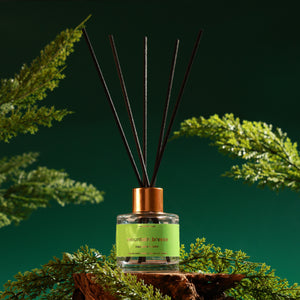
The perfumery catch: at a low setting you hear the heart and the base, not the top. A bright citrus opening that sold the committee will be almost absent in the lounge, where the cedar, the vetiver and the tea underneath it are what remains. Choose the identity by smelling it quiet, in a room, hours in — not on a blotter across a table.
Which registers survive being quiet: dry, structured ones. Tea, cedar, vetiver, bergamot keep their outline at low concentration. Sweet and powdery compositions lose their shape and read as a vague smell of perfume in the air, which is the impression a business club is trying to avoid.
Consistency in time, not only in space: a machine running gently and continuously produces a plateau; a machine running hard on a short cycle produces peaks, and people describe peaks as too strong even when the daily total is identical. That is a scheduling decision, and it is what Vaayu’s run windows and Aangan’s programmable work and pause cycles are for.
The honest gap: no consumption rate is published for any SOSA machine, so refill cadence across several zones cannot be calculated in advance — it has to be observed and written down. And no purchasable refill oil is listed for the waterless commercial machines; that fragrance is specified and quoted per property through the contact page.
2. Set each zone’s intensity by how long a person stays in it. Arrival and the entrance take the clearest signal, because nobody stands in a threshold. Circulation and lift lobbies take a light continuous level. A networking floor takes less, because people stand in it for an evening among a crowd already wearing their own fragrance. A lounge takes less still, dosed for the fourth hour rather than the first. Meeting rooms, boardrooms and anywhere food is served take nothing.
3. Choose the identity by how it smells quiet, not by how it smells strong. Turn a composition down and you do not get the same thing smaller — you get a different balance, because the volatile top notes disappear first and what remains is the heart and the base. A fragrance selected from a blotter at a committee table tells you almost nothing about how it will behave as a thin vapour across a large volume three hours later. Judge candidates at the setting you intend to run in the longest-dwell room, in that room, over a week.
4. Prefer dry, structured registers, because they hold their shape. Tea, cedar, vetiver, bergamot and clean woods remain recognisable at low concentration. Sweet, powdery and gourmand compositions lose their outline when quiet and read as a generalised smell of perfume in the air, which is precisely what a business club does not want. This is also why a networking floor should carry nothing edible: a gourmand note near people and food reads as competition rather than hospitality.
5. Write it down and give it one owner. A fragrance becomes a system only when it exists on paper: the composition, each machine’s position, each zone’s intensity, the schedule, the refill cadence, the list of unscented rooms, and one named person who may change any of it. Vaayu ₹11,999 has a key-lock precisely so the written setting and the actual setting stay the same thing. Alcohol-free, phthalate-free, IFRA-compliant, composed in Pune. A portion of every order supports girl-child education through Nanhi Kali.

The catch: what a fragrance becomes when you turn it down
Every composition is built in layers of volatility. The lightest materials leave the surface first and are gone soonest — that is the bright opening, the citrus, the cut-green freshness, the thing that makes a blotter attractive in the first thirty seconds. Underneath sit the heart materials, and underneath those the base: the woods, the resins, the fixatives, the slow things that hold a composition together and stay present for hours. When you run a fragrance at a very low concentration across a large volume, you are hearing mostly the heart and the base, because the top has already largely gone by the time the vapour has travelled and mixed. That is not a fault in the machine and it is not the fragrance being weak. It is the physics of volatility.
The consequence for a club is direct and expensive. A committee sits around a table, smells six candidates at full strength on blotters, and chooses the one everybody likes — which, at full strength on a blotter, is very often the one with the best opening. That composition is then run at a low setting in a members’ lounge, where its opening is largely absent, and what the room actually smells of is whatever was underneath it. If what was underneath is a clean cedar and a dry tea, the club has been lucky. If what was underneath is a soft sweet amber that was doing a supporting job behind the citrus, the lounge will smell faintly sweet and slightly anonymous, nobody will be able to say why they do not love it, and the club will conclude the machine is at fault.
So reverse the test. Judge candidates at the setting you intend to run in your longest-dwell room, in that actual room, and judge them after several hours rather than in the first minute. A blotter, a bottle and a committee table tell you almost nothing about behaviour as a thin vapour across a large volume; they tell you about the first thirty seconds of an object held near a face. If you can only test one thing properly, test the lounge setting, because the lounge is where the composition spends most of its life and where the least of it is present.
 Mountain Breeze₹849Some registers hold their outline when they are quiet and some dissolve. Dry, structured directions — white tea, green tea, cedar, vetiver, bergamot, clean woods, a little pepper — remain identifiable at very low concentration, because their character comes from structure rather than from sheer quantity of material. Sweet, powdery and gourmand directions do the opposite: turned down, they lose their shape and read as an unspecified smell of perfume, which is the impression that makes a serious room feel slightly commercial. For a business club this decides the answer before any product is chosen. It also happens to be the register that does not compete with what senior members are wearing, and the one that dates most slowly over the decade a signature is supposed to last.
 Vaayu₹11,999A business club has three olfactory situations rather than a dozen rooms. Transit — entrance, lobby, lift lobby, corridors — where nobody stays, so the level may be clearly perceptible and the corridors are often the best value in the scheme. Occupied social space — the networking floor, the bar lounge on an event evening — where a crowd is present for two or three hours, bringing its own fragrance with it, so the room goes lower than the corridor that feeds it. Long dwell — the members’ lounge, the reading corner, a coworking floor — which sits below the level anyone would think to name. Then the fourth category, which is not a setting at all: the meeting rooms, the boardroom and anywhere food is served or plated, all of which stay unscented.
Aangan₹25,999The nose reports change rather than constancy, which means perceived strength is set by the step between two spaces and not by the absolute level in either. A lobby feels clearly fragranced because the street was not. A lounge feels calm because the corridor was louder. This has a practical consequence when you are testing a scheme: walk the route, stop at the thresholds, and judge the transitions rather than standing in the middle of each room forming an opinion. A gradient with a step that is too large reads as two different places. A gradient with no step at all reads as one flat level, which is what a member means when they say the club smells the same everywhere in a tone that is not a compliment.
Vaayu₹11,999A business club has three olfactory situations rather than a dozen rooms. Transit — entrance, lobby, lift lobby, corridors — where nobody stays, so the level may be clearly perceptible and the corridors are often the best value in the scheme. Occupied social space — the networking floor, the bar lounge on an event evening — where a crowd is present for two or three hours, bringing its own fragrance with it, so the room goes lower than the corridor that feeds it. Long dwell — the members’ lounge, the reading corner, a coworking floor — which sits below the level anyone would think to name. Then the fourth category, which is not a setting at all: the meeting rooms, the boardroom and anywhere food is served or plated, all of which stay unscented.
Aangan₹25,999The nose reports change rather than constancy, which means perceived strength is set by the step between two spaces and not by the absolute level in either. A lobby feels clearly fragranced because the street was not. A lounge feels calm because the corridor was louder. This has a practical consequence when you are testing a scheme: walk the route, stop at the thresholds, and judge the transitions rather than standing in the middle of each room forming an opinion. A gradient with a step that is too large reads as two different places. A gradient with no step at all reads as one flat level, which is what a member means when they say the club smells the same everywhere in a tone that is not a compliment.
Why equal settings produce unequal rooms
There is a tempting shortcut that a general manager will propose at least once: put the same machine at the same setting in every zone, on the grounds that identical inputs must give an identical result. They do not, and understanding why is most of the skill in this. Air that leaves a room takes the fragrance with it, and air that stays lets it accumulate. A networking floor with high occupancy, a busy air system and doors opening all evening is constantly carrying its fragrance away, so it needs the fragrance replaced continuously. A sealed lounge on a quiet Tuesday with the air handling on low accumulates whatever it is given. Identical settings in those two rooms produce a thin networking floor and a heavy lounge.
Materials matter as much as air. Soft mass — carpet and underlay, heavy curtains, upholstered chairs, timber panelling — absorbs fragrance and releases it later, which is why a heavily furnished lounge behaves as a slow reservoir while a hard-surfaced networking space with stone, glass and metal shows a much faster rise and a much faster decay. Humidity plays its own part: the same composition reads heavier in a damp monsoon room than in a dry conditioned one, which changes perception without changing anything in the bottle. And air conditioning both helps and hurts, distributing fragrance evenly through a volume while removing it faster than a still room would.
All of which is to say that consistency is a perceived result produced by deliberately unequal inputs, and that the settings which produce it in your building cannot be derived from a table in an article. They are found by walking the route at the hours the club is actually busy, adjusting, and then leaving the scheme alone long enough for opinions to stop being about novelty. One caution while you do that: if any part of the property smells musty, none of this applies yet. Musty is a building condition — moisture, low air change and absorbent mass — and fragrance laid over it produces a mixture that members judge more harshly than the original, because it reads as concealment. Source, moisture, ventilation, cleaning, and only then fragrance. SOSA sells no air purifier and no dehumidifier and makes no air-quality claim of any kind.
The three space types, and what each one takes
This is the table I would put in front of a committee that has asked for consistency. It is arranged by dwell and by air behaviour rather than by room name, because two rooms with the same function can need different settings if one is sealed and the other is not. The final row is the one that makes the scheme credible.
| Space type | Dwell | How the air behaves | Setting | What serves it |
|---|---|---|---|---|
| Arrival: entrance, lobby, vestibule ★ | Seconds, fresh nose | High exchange, doors opening | Clearly perceptible — the signal | Vaayu in the airflow path or an HVAC return |
| Circulation: corridors, lift lobbies, stairs | Passing through, repeatedly | Connected to everything; lifts and stairs act as chimneys | Light, continuous | Often the best value in the whole scheme |
| Networking floor, event lounge | Two to three hours, standing, crowded | High occupancy, doors moving, personal fragrance present | Below the corridor | A zone unit set low, or the air system |
| Members’ lounge, reading corners | Two to four hours, seated | Soft mass absorbs and re-releases; slow decay | Below the level anyone would name | Aangan on HVAC, or a zone unit low |
| Coworking floor, quiet working areas | A full working day | Steady, conditioned, electronics present | The lowest setting in the building | A zone unit, key-locked, waterless only |
| Washrooms and cloakrooms | Minutes | Small, high turnover | Light and bright rather than woody | Reeds are genuinely right at this scale |
| Meeting rooms and the boardroom | One to three hours, captive | Small, closed, accumulates | Unscented | Identity in the corridor outside the door |
| Dining, private dining, bar counter | An hour or more, eating | Food aerosols dominate | Neutral, without exception | Nothing. The kitchen is the fragrance |
Per zone · Vaayu₹11,999See it → Air system · Aangan₹25,999See it → Larger property · Meenar₹38,500See it →
Consistency through the day, not only across the plan
Half the complaints a club receives about inconsistency are not about rooms at all; they are about hours. The lobby is correct at eleven and heavy at seven. The lounge is right on a Tuesday and overwhelming on a Friday. Those are scheduling problems and they have scheduling answers. A machine running gently and continuously produces a plateau; a machine running hard on a short cycle produces peaks — and people describe peaks as too strong even when the total delivered across the day is identical. So the instinct to run a machine at high intensity for a short burst before a busy evening reliably produces the complaint it was meant to prevent. Lower and longer beats higher and shorter, every time.
The hardware follows from that. Vaayu offers run windows of 1h, 4h, 8h or 24h with day selection and adjustable intensity, which lets a zone follow the shape of its week — a networking floor busy on three evenings does not need the schedule of a lobby open seven days. Aangan runs an intelligent PCB with programmable work and pause cycles and daily schedules, which is the right tool where the club is one air system and the whole property needs to breathe on the same rhythm. Both are waterless cold-air nebulisers: pressurised air shatters undiluted oil into a dry nano-mist carried by the room’s own airflow, with no water, no dilution, no added humidity and no residue, and far more fragrance per unit of mist than the same oil diluted in water. That last point is the entire reason commercial scenting went waterless, and it is also why nobody can find the diffuser in a well-run building: the fragrance is introduced into moving air upstream rather than released from an object, so there is no source to walk towards.
Two things to settle before anyone orders. First, sizing is reasoned in volume rather than floor area, because a double-height networking hall or a galleried stair consumes coverage a square-foot figure hides; a closed door is a boundary and an open plan is one volume; and lift shafts and open staircases behave as chimneys, carrying fragrance to floors nobody intended to scent. I will not publish a machine count as a formula — it depends on connected volume, ceiling height, door positions, whether the club runs on one air system or several, and the occupied hours of each zone. Send those to the contact page. Second, the Aangan connection into an air handling unit is a mechanical integration and a real one, but no digital integration exists on any SOSA machine: there is no building-management interface, no automation protocol and no smart-home connection, and a scheme that assumes central control from a facilities desk needs to be designed around that from the start.
The written specification — and the two gaps
A fragrance scheme only becomes consistent when it stops living in people’s heads. This is the page I would ask a general manager to produce and keep, and the last line is a pair of things SOSA does not publish, which belong in the table rather than in a footnote.
| Line | What it records | Why it matters to consistency | Cost |
|---|---|---|---|
| 1. The composition ★ | One fragrance for the whole property, chosen at its lowest setting in the longest-dwell room | Because a fragrance picked at full strength can be unrecognisable when quiet, and by then it is installed | Quoted per property |
| 2. Position, per machine | In the airflow path, never behind a desk; wall, lay-flat or HVAC return; the low-voltage point | Most complaints that a fragrance is weak are distribution complaints, not fragrance ones | No purchase |
| 3. Intensity, per zone | Named settings for arrival, circulation, networking, lounge and working floor | The gradient is the scheme; equal settings produce unequal rooms | No purchase |
| 4. Schedule, per zone | Vaayu run windows of 1h / 4h / 8h / 24h with day selection; Aangan work and pause cycles | Continuous low produces a plateau; short high bursts produce the peaks members call too strong | ₹11,999 / ₹25,999 |
| 5. The unscented list | Boardroom, meeting rooms, dining, private dining, bar counter, spa treatment, gym floor | Naming the exclusions is what makes the rest of the scheme credible to a chef and to a member | No purchase |
| 6. Refill cadence, observed | Vaayu’s 400ml tank runs up to about 90+ days depending on intensity and hours; Aangan’s 800ml reservoir goes weeks between refills on business-hours schedules | A zone set low outlasts a zone set high, so cadence differs by room and must be recorded from experience | No purchase |
| No consumption rate, and no listed commercial refill: the honest gaps | SOSA publishes no millilitres-per-hour figure for any machine, so refill intervals across a multi-zone scheme cannot be calculated in advance — they are observed over the first quarter and written down. And no purchasable refill oil is listed for the waterless commercial machines; that fragrance is specified and quoted per property | Said plainly, because a committee building a budget will ask for both, and an invented figure is worse than an honest absence | Quoted |
Versailles
The most useful hour I ever spent with a house committee was the one where I took the blotters away. They had shortlisted three compositions in a meeting room, passing strips across a table, and the vote was nearly unanimous for the one with the brightest opening. I asked them to come back a week later and walk the lounge instead, at four in the afternoon, with all three running at the setting the lounge would actually be given. The vote reversed completely. The one that had won on the table was, quiet and hours in, almost nothing at all — its whole character had been in the first minute, and the first minute is the part a lounge never gets.
This is the single piece of perfumery I would press on anyone specifying a club. A composition at low concentration is mostly its heart and its base, because the volatile top is the first thing lost. So the correct question at the selection stage is not which of these do we like, it is which of these is still itself when it is barely there. Dry structured things — tea, cedar, vetiver, a dry bergamot — are still themselves. Sweet, soft, powdery things stop being themselves and become a general impression of perfume, and a general impression of perfume in a business club is the outcome everybody was trying to avoid.
The rest is administration, and it matters more than it sounds. Write the settings down. Give one person the authority to change them and make sure that person is not the one who has been in the building since seven in the morning, because they have already stopped being able to judge it. Turn the key-lock. Walk the route at the busy hours rather than standing in the middle of rooms. Everything we make is composed in Pune, and a part of every order funds a girl’s classroom through Nanhi Kali.
Frequently asked questions
- What a premium business club should smell like — the family pillar, and what premium means when the room’s job is work.
- The executive networking lounge and a club used by founders and senior executives — crowd density, and competing personal fragrance.
- Private meeting rooms and the private boardroom — the rooms the gradient deliberately leaves out.
- Coworking areas inside a club and premium without the hotel-lobby register.
- Dark timber interiors and signature scent and the membership experience.
- Brand: the SOSA founder story.
SOSA commercial scenting — facts verified August 2026: Vaayu ₹11,999, waterless cold-air nebulising, coverage up to 1000 m³ ≈ 2,000–3,000 sq ft, 400ml refillable sealed tank lasting up to about 90+ days depending on intensity and hours, Bluetooth app plus onboard buttons, run windows of 1h / 4h / 8h / 24h, day selection, adjustable intensity, auto-stop and key-lock, under 38 dB, freestanding, wall-mounted or HVAC-return mounting, DC 12V / 1A at 5W, CE, RoHS and SGS, black and white. Aangan ₹25,999, HVAC or AHU connection or standalone wall-mount or lay-flat, coverage up to 3,000 m³ ≈ 8,000–10,000 sq ft, 800ml reservoir, under 42 dB, DC 12V at 14W, intelligent PCB with programmable work and pause cycles and daily schedules, metal body 3.9 kg at 284 × 125 × 246 mm, black or white, one-year warranty, imported; it has no app and no Bluetooth, and no certifications are published for it. Meenar ₹38,500 is the larger-property option and is specified on enquiry; no coverage figure is published for it here. Ultrasonic machines: Sukoon ₹1,899 at 270–320 sq ft and Boond ₹899 at up to about 150 sq ft. Reed diffusers ₹749–₹849 for 50ml lasting 6–8 weeks and ₹1,249–₹1,349 for 130ml lasting 14–18 weeks, six fibre reeds, alcohol-free, phthalate-free, paraben-free, IFRA-compliant, 0 ppm formaldehyde, heat-stable CCT carrier, refillable glass bottle, tested at 45°C and 85% RH, composed in Pune. The Hotel Collection fragrance oils are water-based and ultrasonic-only at 15ml ₹299, 100ml ₹999 and 300ml ₹1,799; they are not for reed diffusers and not for the waterless commercial machines. No purchasable refill oil is listed for the waterless commercial machines — that fragrance is specified and quoted per property. SOSA publishes no leather fragrance in any format and no tobacco or smoky fragrance for any diffuser. SOSA sells no air purifier, no dehumidifier and no room spray for interiors, and makes no health, air-quality, VOC or mould claim. No dealer programme, reseller margin, trade price, territory or service contract is published. Free shipping above ₹499. A portion of every order supports girl-child education through Nanhi Kali. SOSA is an independent Indian fragrance house; the Hotel Collection scents are SOSA’s own interpretations inspired by the world’s finest hotels, and SOSA is not affiliated with or endorsed by any hotel brand. Prices subject to change — see the live product pages.