
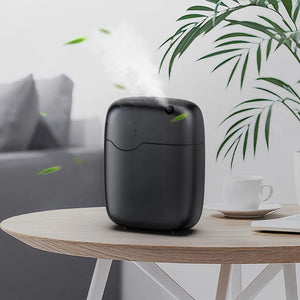

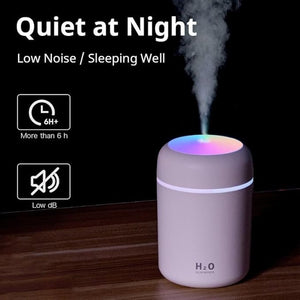

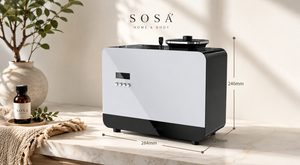
The kit? One Boond (₹799) per room, a Hotel Collection scent (from ₹299).
The golden rule? Same scent family across the wing; different intensity in every room.
2. Place the Boond (₹799) away from the face-cradle, on a side surface, out of the guest's breathing zone.
3. Set the level to a trace — light, easily switched off by the therapist.
4. Schedule it to run before the guest arrives; fall to neutral during, air out between.
5. Maintain it — clean, refill from ₹999, review with therapists, dial down at the first "too strong". A portion of every order supports girl-child education through Nanhi Kali.
Step 1 — Choose the scent
Begin with the note, and begin with restraint. A treatment room wants a single, quiet scent drawn from the same family you run front-of-house, so the guest meets one continuous identity through the spa rather than a new perfume at every door. Match the note to your character: a clean white tea, bergamot or neroli for a bright modern day spa; sandalwood or vetiver, grounding but never heavy incense, for an Ayurvedic one; something eucalyptus-adjacent and fresh where recovery and hydro are the theme.
Do not choose alone or in a hurry. Audition two Hotel Collection candidates (₹299 each) for a fortnight apiece on a Boond, and ask the people who will live with the result — your therapists, who spend all day in these rooms, and your regulars, who will notice a change before anyone else. The scent that wins is rarely the boldest; it is the one nobody objects to over two weeks.
Step 2 — Place the diffuser
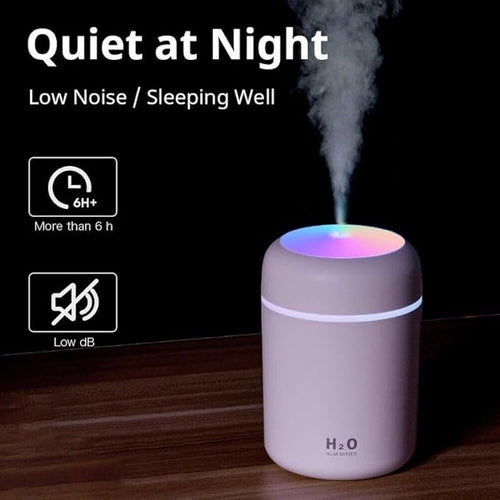
Where the diffuser sits decides half of what the guest experiences, and there is one inviolable rule: never over the face-cradle. A face-down massage guest breathing through a cradle must never be the nearest thing to the mist. Set the Boond (₹799) on a side surface or corner shelf, away from the head of the table, so the trace drifts into the room's air and reaches the guest already softened rather than arriving straight at the nose.
Give a thought to airflow too. Keep the diffuser clear of a fan or an air-conditioning draught that would either blast the scent across the room or whisk it away entirely. And leave a little air around it — a Boond is an ultrasonic that adds slight humidity, so it should never sit crammed against fabric or timber. The aim is a room that seems, to the guest, to have no source of scent at all; the fragrance is simply, quietly, already there.
Step 3 — Set the level
Now the measure. A treatment room runs a trace and nothing more — the lowest useful setting, enough to lift the room out of neutral and no further. This is the setting that respects the captive guest, that leaves room for the therapist's aromatherapy oils to lead, and that keeps allergies from becoming incidents. The oils the therapist selects for the treatment are their tool and should always sit in front of your ambient signature, never behind it.
Crucially, the level is not yours to fix permanently — it is the therapist's to adjust. A Boond (₹799) turns down or off in a second, and that control is the single most valuable feature in the room. When a guest mentions a sensitivity, or simply prefers plain air, the therapist honours it instantly and the treatment proceeds on trust. Set the default low; hand the dial over; trust the room to the person standing in it.
Step 4 — Schedule it across the day
| Moment | What the diffuser does | Why |
|---|---|---|
| Before the guest arrives | Run a trace to settle the room | The room greets the guest already calm |
| During the treatment | Often neutral; therapist's choice | The oils lead; captive guest protected |
| Between guests | Air out, then reset the trace | Clears the last treatment's oils |
| End of day | Off; leave the room to breathe | Fresh air resets for tomorrow |
The governing rhythm is run before, air between, restraint during. Scent each room to a settled trace before it is used, so the calm is waiting for the guest rather than building around them. Let the room fall to neutral once hands and oils are working. Between guests, open it up and air it out — this is when the previous treatment's oils clear, so the next guest meets your signature and not a stranger's massage blend. Front-of-house runs continuously; the treatment room is the disciplined opposite.
Boond — one per room₹799Shop Boond →  Hotel Collection — choose the notefrom ₹299Shop scents → Refills — for upkeepfrom ₹999Shop refills →
Step 5 — Maintain it
A treatment-room system is nearly effortless to keep, but "nearly" is not "no". Wipe the Boond (₹799) clean on a regular schedule so it mists cleanly, top it up with refills from ₹999, and air the rooms out daily as a fixed habit rather than an afterthought. In humid coastal cities especially, daily airing keeps the slight humidity of an ultrasonic from ever becoming a problem — and if a room runs many hours a day, consider whether a waterless system belongs in the parts of the spa that stay on longest.
Then keep listening. Review the level with your therapists every few weeks; they will tell you before the guests do if a room has crept too strong. And when the first "too strong" comment does arrive — it will — treat it as the gift it is, and dial down at once. Post honestly that front-of-house is lightly scented and treatment areas are kept low; a spa that is candid about its air is a spa guests trust with their bodies. Maintenance, in the end, is simply the habit of restraint repeated.
The SOSA commercial edit
Size the tool to the zone: the smallest, gentlest unit in each treatment room, something fuller for the lounge and reception, HVAC when a whole centre is scented as one.
| System | Best for | Why it works | Price |
|---|---|---|---|
| Boond | Each treatment room | Small zone, gentle, therapist-adjustable, off in a second | ₹799 |
| Sukoon + Hotel Collection | Relaxation lounge | Fuller signature where scent may stand up; scents from ₹299 | ₹1,799 |
| SOSA Vaayu ★ | Reception, corridors | Waterless, app + timer, no added humidity — the professional standard | ₹11,999 |
| SOSA Aangan | Whole wellness centre | HVAC nebulising for 8,000–10,000 sq ft via ducting | ₹25,999 |
| Refills | Maintaining the wing | Keeps every room scented for pennies against treatment margin | from ₹999 |
Versailles
People expect a perfumer to make treatment rooms smell of something. My actual advice is the opposite, and it takes them a moment to trust it: the finest treatment room barely smells of anything a guest can name. It simply feels settled.
That is why I give owners a recipe rather than a scent. Choose, place, set, schedule, maintain — five plain steps, each done with a light hand. Follow them and the room does its real job, which is to hold a calm the guest carries into the treatment and, later, out of the door.
None of it is difficult, and none of it is expensive. A Boond, a bottle, and the discipline to keep it quiet. Your rooms earn a memory that outlasts the appointment; a girl gets a classroom through Nanhi Kali. Both are built the same way — carefully, and in small, repeated measures.
Frequently asked questions
- Treatment Room Scent Marketing Guide — the strategic overview of the wing
- Best Fragrance for Spa Treatment Rooms — the scent casts in detail
- The Boond diffuser — the treatment-room pick, ₹799
- Brand: the SOSA founder story
Facts verified August 2026: Ambient scent-marketing effects on dwell time, perceived quality and recall are real but moderate; congruence between scent and setting matters more than intensity; scent does not compensate for unclean or poorly ventilated premises. SOSA systems and prices: Boond ₹799, Sukoon ₹1,799, Megh ₹3,499, Vaayu ₹11,999, Aangan ₹25,999, Meenar ₹38,500, Hotel Collection fragrance from ₹299, refills from ₹999. The Hotel Collection scents are SOSA's own interpretations inspired by the world's finest hotels; SOSA is an independent Indian fragrance house, not affiliated with or endorsed by any hotel brand. Prices subject to change.