


What makes it read as premium? Restraint and consistency, not strength. One considered blend, held steady, in the right places only.
Does the practice hall carry it? No — a premium wellness brand protects the breathing room by keeping it clean.
2. Make it coherent across touchpoints. The same welcome at reception, corridor and changing rooms, in agreement with your design and tone.
3. Make it portable. One blend, one machine setting, at every location, so the brand travels intact.
4. Let restraint do the signalling. Premium reads as considered, not strong; the discipline of less is the luxury cue.
5. Protect the practice hall. A wellness brand that fills the breathing room with scent has misunderstood itself. A Sukoon (₹1,799), Aangan (₹25,999) or Meenar (₹38,500) scales the signature to the space.
A portion of every order supports girl-child education through Nanhi Kali.
What premium actually signals
Premium is not a price; it is a set of signals that justify one. When a customer calls a wellness brand premium, they are responding to an accumulation of evidence that someone cared about details they were never obliged to. The thickness of the towel, the weight of the door, the calm of the greeting, the quality of the air — none of these is decisive alone, and all of them together form an impression that this is a serious, considered place. Luxury is coherence: the sense that every detail was chosen by the same discerning hand. Fragrance belongs in that list because it is one of the earliest and least resistible signals a customer receives, and one of the most telling. A brand that has thought about its smell has usually thought about everything.
The mistake many aspiring premium brands make is to reach for intensity as a shortcut to importance — a stronger scent, a bolder colour, a louder welcome. Real premium moves the other way. It signals confidence through restraint, letting quality speak quietly rather than shouting. A considered, well-placed scent that a customer half-notices reads as far more expensive than an aggressive one that announces itself in the car park. The signal you want to send is attended to, not trying hard.
Scent as a brand system, not a smell
The shift from having a nice scent to owning a brand signature is the shift from an object to a system. A smell is something in a bottle; a signature is a decision, documented and repeated — the same blend, at the same strength, in the same zones, at every location, indefinitely. Treat it the way you treat your logo: with a specification. Which blend. Which rooms. What strength. What schedule. Once it is a system rather than a whim, it can be handed to a manager in another city and reproduced faithfully, which is the entire point of a brand.
This is also what makes the investment defensible. A brand system compounds; a one-off pleasant smell evaporates. Every day the signature runs as specified, it deposits another small increment of recognition into the brand, and those increments accrue over years into something a competitor cannot easily copy — not because the scent is secret, but because the consistency is hard-won. A premium wellness brand is not built in a launch; it is built in the thousandth identical arrival, and the scent system is one of the cheapest ways to guarantee that arrival stays identical.
| Brand decision | The specification | The system |
|---|---|---|
| The signature blend | One Hotel Collection scent, chosen to agree with the brand | Held, never seasonally swapped |
| The zones | Front-of-house only; hall unscented | Documented, room by room |
| Strength & schedule | Fixed output, on before doors, off at the first Om | Set on the Vaayu app |
| Every location | Same blend, same setting | Reproducible by any manager |
 Sukoon · one small studio₹1,799Shop → Vaayu · every threshold₹11,999Shop →
 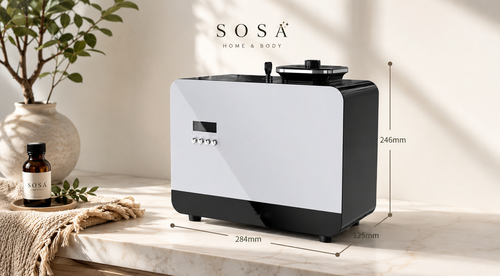 Aangan · whole centre₹25,999Shop →
Portable across every location
The true test of a brand arrives with the second location. Everything that felt like personality in a single studio must now be shown to be reproducible, or it was never a brand — just a place with a nice atmosphere the founder happened to create. Scent passes this test more reliably than almost any other sensory element, because it reduces to a machine setting rather than a mood. A member who loves your original location and visits your new one is running an unconscious audit: is this really the same brand I trust? The identical welcome at the door answers yes before they have consciously asked the question.
This is where the range matters. A single boutique location may need only a Sukoon at reception; a growing brand standardises on the Vaayu, one per threshold, same blend and schedule everywhere; a flagship wellness centre carries the signature through its ducting on an Aangan or, at the largest scale, a Meenar. The hardware changes with the size of the space, but the brand does not — the customer meets the same signature whether they are in your smallest studio or your flagship floor. That portability is precisely what separates a brand from a beloved single address.
The discipline of restraint
Everything a premium wellness brand does with fragrance is finally governed by restraint, and nowhere more than in the one room it must leave alone. It is tempting, once you believe in a signature, to want it everywhere — to carry the brand through a fog from the pavement to the mat. That instinct is the enemy of the very premium you are building. A wellness brand that fills its practice hall with scent has misunderstood what it sells, because the hall is where a member breathes deliberately and a fog of fragrance, however tasteful, is an imposition on the one act they came to perform. The most premium decision in the building is the empty air of the hall.
So the brand signature lives at the threshold — the entrance, the reception, the corridor, a trace in the changing rooms — and stops cleanly at the door of the practice room. Run the Vaayu from before opening and schedule it off at the first Om; the arrival carries the brand, the practice is left untouched, and the restraint itself becomes part of what makes the brand feel expensive. A brand that respects its members' breath is not a quieter brand. It is a more confident one, and confidence is the most premium signal there is.
The SOSA commercial edit
One ladder of machines to carry a single brand signature from a boutique desk to a flagship's ducting. Pick the rung the location needs and keep the specified blend identical across every one you open.
| System | Best for | Why it works | Price |
|---|---|---|---|
| Boond | Changing rooms, washrooms, shoe racks | Small, water-based, keeps side rooms to a trace | ₹799 |
| Sukoon + Hotel Collection | A single small studio reception | Gentle ultrasonic diffusion for one enclosed lobby | ₹1,799 + ₹299 |
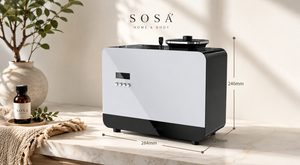
| SOSA Vaayu ★ | Reception, entrance, corridor, shoe rack | Waterless, app + timer, up to ~1000m³, under 38dB | ₹11,999 |
| SOSA Aangan | Whole wellness centre via ducting, 8,000–10,000 sq ft | One signature front-of-house, halls on their own zone | ₹25,999 |
| Hotel Collection refills | Keeping the studio running | The real running cost, low and predictable | from ₹999 |
Versailles
The premium wellness brands I most respect are almost never the loudest. They are the ones where every detail seems to have been chosen by the same quiet, exacting person — and the smell of the place is usually the first proof of it, felt before you have taken in a single visible thing.
When founders ask me to help them feel more premium, I steer them away from making anything stronger. Premium is a discipline of subtraction: one blend instead of five, front-of-house instead of everywhere, the same everywhere instead of a different mood per room. The confidence to hold back is the whole luxury.
Specify one signature, carry it to every door, and leave the hall to the breath. Your brand travels intact; a girl gets a classroom through Nanhi Kali.
Frequently asked questions
- How fragrance supports premium membership pricing — the fee a premium brand can hold.
- Yoga studio interior design and fragrance — the design the brand is built on.
- SOSA Vaayu — the waterless threshold standard.
- Brand: the SOSA founder story.
Facts verified August 2026: the evidence on ambient scent is that effects on dwell, perceived quality and recall are real but moderate, that scent-environment congruence matters more than intensity, and that no fragrance improves an unclean or poorly ventilated space — which is why the practice hall stays clean and the scent lives at the threshold. SOSA systems and prices as stated: Boond ₹799, Sukoon ₹1,799, Megh ₹3,499, Vaayu ₹11,999, Aangan ₹25,999, Meenar ₹38,500, Hotel Collection scents from ₹299, refills from ₹999. The Hotel Collection scents are SOSA’s own interpretations inspired by the world’s finest hotels; SOSA is an independent Indian fragrance house, not affiliated with or endorsed by any hotel brand. Prices subject to change.