



How do I match scent to my design? Read the room's language — warm timber and stone want sandalwood or vetiver; pale, bright, minimal rooms want green tea or citrus. Audition two Hotel Collection blends at ₹299 each.
Does it go in every room? No. It finishes the arrival; the practice hall is left clean.
2. It agrees with the palette. Warm, natural, grounded rooms want warm, grounded scents; pale, bright, minimal rooms want clean, lifting ones.
3. It is auditioned like a finish. Live with two Hotel Collection candidates at ₹299 each before you commit, the way you would with a paint or a stone sample.
4. It is placed on a plan. The scent has a zone — the arrival sequence — just as a light fitting has a position.
5. It leaves the practice hall bare. The one designed decision that matters most is where the scent stops. A Sukoon (₹1,799) or an Aangan (₹25,999) scales it to the room.
A portion of every order supports girl-child education through Nanhi Kali.
Scent as a design material
Interior designers think in materials — the grain of a floor, the weight of a curtain, the temperature of a light, the acoustic softness of a wall. Each is chosen to say something and to agree with the others. Scent is a material too, and a curiously powerful one, because it reaches a member before any of the visual choices do. You round the corner into a well-designed studio and the air has already told you what kind of place this is; only then do your eyes catch up and confirm it. Fragrance is the one finish a member experiences with their eyes closed, which is why leaving it to chance is the same mistake as leaving the lighting to a bare bulb.
Most studios that feel unfinished are not missing a material you can see. They have beautiful floors and considered light and then a neutral, slightly institutional smell that quietly undoes the rest. The air is doing what unpainted trim does to a room — nothing, loudly. Adding a considered scent is not decoration piled on top; it is the completion of a design that was always meant to include the sense that arrives first.
Matching the scent to the room
The brief for a studio's scent is written in the materials you have already specified. A warm interior — reclaimed timber, lime plaster, brass, low light, a hatha or yin sensibility — asks for a warm, grounded scent: sandalwood, vetiver, a whisper of something resinous. It would reject a bright citrus the way that room would reject a chrome-and-glass reception desk. A pale, minimal, bright interior — white walls, pale wood, big light, a vinyasa or power sensibility — asks the opposite: green tea, citrus, cedar, something that lifts and clarifies rather than settles. A meditation or breathwork room, if it carries any scent at its threshold at all, wants a near-neutral white tea that barely announces itself.
Choose the way you would choose any finish: with samples, in the actual light, over time. Audition two Hotel Collection blends at ₹299 each, a fortnight apiece, in the real room rather than from a description. Ask the people who will live in it — your teachers, your regulars — which one feels like the studio they already know. A scent chosen on paper is as unreliable as a paint chosen from a screen; the room has the final say.
| The design language | The scent that agrees | System |
|---|---|---|
| Warm timber, stone, low light (hatha, yin) | Sandalwood, vetiver — grounding, slow | Vaayu ₹11,999 |
| Pale, bright, minimal (vinyasa, power) | Green tea, citrus, cedar — lifting, awake | Vaayu ₹11,999 |
| Quiet, bare meditation threshold | Near-neutral white tea — barely there | Sukoon ₹1,799 |
| Whole designed centre on ducting | One signature, halls zoned out | Aangan ₹25,999 |
 Sukoon · one small studio₹1,799Shop → Vaayu · every threshold₹11,999Shop →
  Aangan · whole centre₹25,999Shop →
Where it sits in the plan
A good designer would never place a light fitting without knowing where its pool of light falls, and scent deserves the same rigour. It has a position on the plan, and that position is the arrival sequence: the entrance, the shoe rack, the reception, the corridor. This is the run a member walks while the studio makes its first and last impressions, and it is where the finishing layer belongs. The changing rooms take a trace; the washrooms take a trace. And then the plan reaches the one room where the design decision is to add nothing at all.
The practice hall is left bare on purpose. It is the one space in the whole plan where the correct specification for the air is clean and moving — well ventilated, unscented, yielding entirely to the breath. A hall full of people doing pranayama is the worst place to introduce a fragrance, however beautifully it agrees with your timber. So the most sophisticated design move in the building is a subtraction: the scent runs on a Vaayu through the arrival, scheduled off at the first Om, and the hall is given the dignity of empty air. The threshold carries the design; the hall yields to the breath.
The SOSA commercial edit
One ladder of machines, sized to the room you have designed. Pick the rung that fits the space and let the same considered blend run wherever the arrival leads.
| System | Best for | Why it works | Price |
|---|---|---|---|
| Boond | Changing rooms, washrooms, shoe racks | Small, water-based, keeps side rooms to a trace | ₹799 |
| Sukoon + Hotel Collection | A single small studio reception | Gentle ultrasonic diffusion for one enclosed lobby | ₹1,799 + ₹299 |
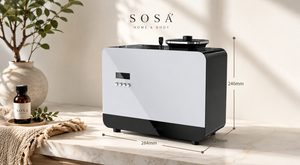
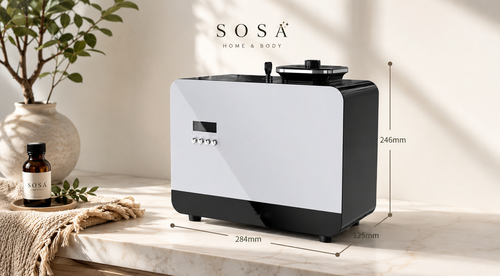
| SOSA Vaayu ★ | Reception, entrance, corridor, shoe rack | Waterless, app + timer, up to ~1000m³, under 38dB | ₹11,999 |
| SOSA Aangan | Whole wellness centre via ducting, 8,000–10,000 sq ft | One signature front-of-house, halls on their own zone | ₹25,999 |
| Hotel Collection refills | Keeping the studio running | The real running cost, low and predictable | from ₹999 |
Versailles
I have walked into studios where every visible decision was immaculate and the air let the whole thing down — a beautiful room breathing like a photocopier cupboard. The designers had thought about everything the camera could see and nothing it could not.
When I talk to studio owners about scent, I ask them to treat me the way they treated their architect: give me the materials, the light, the feeling you were chasing, and let me specify the air to match. The best results come when the scent is briefed from the room, not chosen from a list of nice smells.
Design the arrival, hold one blend that agrees with your materials, and leave the hall bare. Your studio finally feels finished; a girl gets a classroom through Nanhi Kali.
Frequently asked questions
- Creating a multi-sensory yoga experience — scent among light, sound and touch.
- Building a premium wellness brand through fragrance — the brand the design serves.
- SOSA Vaayu — the waterless threshold standard.
- Brand: the SOSA founder story.
Facts verified August 2026: the evidence on ambient scent is that effects on dwell, perceived quality and recall are real but moderate, that scent-environment congruence matters more than intensity, and that no fragrance improves an unclean or poorly ventilated space — which is why the practice hall stays clean and the scent lives at the threshold. SOSA systems and prices as stated: Boond ₹799, Sukoon ₹1,799, Megh ₹3,499, Vaayu ₹11,999, Aangan ₹25,999, Meenar ₹38,500, Hotel Collection scents from ₹299, refills from ₹999. The Hotel Collection scents are SOSA’s own interpretations inspired by the world’s finest hotels; SOSA is an independent Indian fragrance house, not affiliated with or endorsed by any hotel brand. Prices subject to change.