





Why the bedroom: the hot plume rises, spreads across the ceiling and travels sideways until it finds an opening. An open bedroom door is that opening.
The fix that costs nothing: close the bedroom door before you heat the pan, not after you smell it. By the time you smell it, the exposure has happened.
2. Because a spike defeats a steady extractor. A chimney moves a fixed volume of air per hour. It copes well with a simmering pan. It cannot cope with a sudden burst that expands past its capture zone in a couple of seconds. The overshoot is in the room before the motor can do anything about it, which is why people describe the chimney as useless "only for tadka" — it is not useless, it is simply outpaced.
3. Because hot air rises, then goes sideways. The plume is buoyant. It climbs to the ceiling, flattens out, and spreads horizontally in every direction until it meets a wall or an opening. Doorways sit in that layer. An open bedroom door is not a passive gap; it is the route the ceiling flow takes, and the bedroom is usually the coolest, stillest room in the flat, so once the air is in there it stops moving and settles.
4. Because the bed is the largest fabric surface you own. A mattress, a quilt, two pillows and a bedsheet together present far more absorbent surface area than the sofa. Deposited droplets sink into that fibre and are released slowly over the following days. That is why the bedroom holds a tempering longer than the kitchen does, and why you notice it most on waking, when your nose has been resting all night.
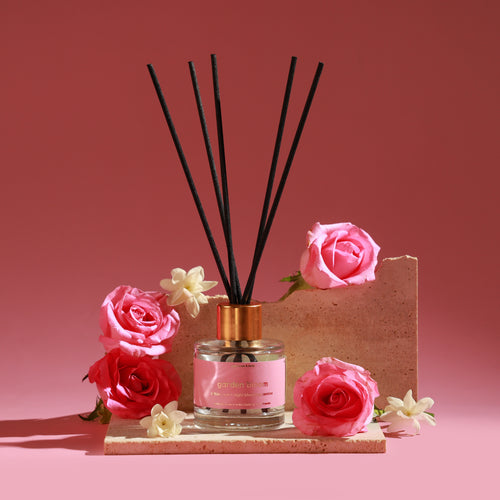
5. And fragrance is the last step here, not the first. A scented bedroom over a tadka-scented quilt gives you both at once, and at close range for eight hours. Air the room, wash the bedding, close the door next time — then a reed diffuser on a few reeds or a Sukoon before bed gives the room a character of its own.
Made in India, composed by an ISIPCA Versailles-trained perfumer — and a portion of every order supports girl-child education through Nanhi Kali.
What a tempering actually does to a room
It helps to separate two things that get lumped together: how strong a smell is, and how long it stays. A tempering scores high on both, for different reasons. It is strong because the aromatic compounds in hing, mustard, cumin and curry leaf are perceptible at very low concentrations — you do not need much in the air for a room to smell distinctly of it. It stays because it arrives as oil. Aerosolised oil does not disperse and disappear the way water vapour does; it travels, lands, and bonds. Ventilation removes the airborne part. It does nothing about the part that has already attached itself to a quilt.
The bedroom is a particularly bad destination for that deposit, for reasons that have nothing to do with cooking. It is usually the least ventilated room in the flat, often air-conditioned, which recirculates rather than ventilates. It contains the largest concentration of soft, porous material in the home. And you spend eight continuous hours inside it with your face roughly thirty centimetres from the pillow. So a small deposit that would be unnoticeable on a tiled floor is very noticeable indeed on bedding, and it is released back at you slowly, over several nights, warmed by your own body heat. That is the whole reason this question exists.
The route a tadka takes to your pillow
 Step fourFrom ₹749The splutter is mechanical. Water inside a mustard seed flashes to steam, the seed ruptures, and oil is thrown outward as fine droplets. Meanwhile the oil surface itself, at tempering temperature, is aerosolising steadily. Both together are why a tadka reaches further than a curry that has been simmering for twenty minutes. A splatter lid or a plate held over the pan for those few seconds cuts the ejected fraction sharply, and costs you nothing in flavour. So does not overheating the oil past the point where it starts to smoke — smoking oil produces far more aerosol and a harsher note.
Symptom to cause: tracing a tempering
Match what you actually notice, then run the confirmation step. Several of these have the same symptom and completely different fixes, which is why guessing is expensive here.
| What you notice | Most likely cause | How to confirm it | What actually fixes it |
|---|---|---|---|
| Bedroom smells of tadka within minutes of a tempering ★ | Ceiling-layer flow straight through an open bedroom door | Repeat with the door shut from before the pan is heated and compare | Shut the bedroom door in advance; fan off during the tempering itself |
| Bedroom still smells of it the next morning | Deposited oil re-releasing from bedding and curtains | Smell a fresh pillowcase from the cupboard against the one on the bed | Strip and wash bedding; air the quilt in sunlight; wash bedroom curtains seasonally |
| Only tadka causes this — a normal curry does not | A short, intense spike overshooting the chimney capture zone | Cook the tempering on a back burner with the hood on early and compare | Back burner, hood on before heating, splatter lid for the splutter seconds |
| Worse when the AC is on in the bedroom | An AC recirculates rather than ventilates — it moves the odour around, not out | Open the bedroom fully for ten minutes and note whether it clears faster than the AC managed | Ventilate before switching the AC on; wash the AC filter monthly |
| A sharp sulphurous note that lingers on clothes too | Hing and allium compounds absorbed by anything porous within reach | Smell a shirt left hanging in the room against one from inside the wardrobe | Keep wardrobe doors shut while cooking; do not leave worn clothes out on a chair |
| A gas-like smell in the kitchen at any point | A possible leak — this is not an odour problem | No flame, no switches. Close the cylinder valve, open windows, step out | Call the gas supplier straight away. This is an emergency, not a smell. |
| If none of these fit: check whether the bedroom shares a wall vent or a common shaft with the kitchen. In some flats the bathroom exhaust running in one room pulls air through the whole flat and drags the kitchen plume with it — running the bathroom fan during cooking can move the smell towards the bedroom rather than away. | |||
Reeds · always-on roomsFrom ₹749Shop →  Sukoon · when you want a switch₹1,899Shop →
  Hotel Collection · the scentFrom ₹299Shop →
What to change, in order
Change the sixty seconds itself first. Temper on a back burner, directly under the hood, with the chimney already running at full speed — switched on when the empty pan went on the flame, not when the seeds went in. Keep a lid or a plate to hand and cover the pan for the few seconds of active spluttering; you lose nothing and you keep most of the ejected oil in the pan. Do not let the oil reach smoking point before the seeds go in. And turn the ceiling fan off for that minute, because a fan mixes the plume downward into the room instead of letting it rise into the hood.
Then close the destination. Shut the bedroom door, and the wardrobe doors inside it, before the pan is hot. This is the single highest-value habit in the article and it costs nothing. Doing it after you notice the smell is too late — the ceiling flow reaches a doorway within a minute or two. Once cooking is finished, open the kitchen and living room wide for ten minutes while the odour is still airborne, then open the bedroom for a few minutes to flush whatever did get in. Order matters: purge the source room first, or you simply push kitchen air into the bedroom.
Then wash what caught it, and only then add fragrance. Bedding weekly at minimum, and immediately after a heavy cooking day if the room smells of it in the morning. Air the quilt and pillows in direct sunlight when the weather allows — UV and heat drive absorbed volatiles out faster than shade. Once the room reads neutral on the first breath in the morning, a fragrance layer is worth adding, and a bedroom wants less of it than a living room does. A reed diffuser from ₹749 on three or four reeds rather than six is usually right; Evening Calm in Kashmir lavender and chamomile suits a room you sleep in. If you would rather run something for half an hour before bed and then have silence, the Sukoon at ₹1,899 does that with 3–6 drops of the water-based Hotel Collection from ₹299.
The layers, in sequence
Two habits, one wash and one purchase. The habits are free and they matter most; the purchase is genuinely worth it once the room is neutral.
| Step | What to do | When | Cost |
|---|---|---|---|
| 1. Remove the source | Temper on a back burner under a hood already running; lid during the splutter; oil below smoking point | Before anything else | ₹0 |
| 2. Move the air | Bedroom and wardrobe doors shut before the pan heats; purge the kitchen first, then the bedroom | Daily, five to ten minutes | ₹0 |
| 3. Deal with what holds it | Wash bedding weekly and after heavy cooking days; air quilt and pillows in sunlight; curtains seasonally | Weekly to monthly | ₹0 |
| 4. Then the always-on layer ★ | A SOSA reed diffuser — a soft, permanent bedroom background on three or four reeds rather than six | 50ml 6-8 weeks · 130ml 14-18 | from ₹749 |
| 5. Or the on-demand layer | Sukoon with a Hotel Collection scent — half an hour of scent before bed and silence afterwards; covers roughly 270–320 sq ft | Run it when you want it | ₹1,899 |
Versailles
I love a tadka and I am not going to suggest anyone cook less of one. But it is worth knowing what it is doing. Those few seconds of spluttering put more odour-carrying oil into your flat than the entire twenty minutes of simmering that follow, and most of it happens before anyone has thought about the chimney. Once you see it that way, the fixes are obvious and free.
The bedroom part surprises people. They assume the smell drifted in slowly, so they open a window slowly. In fact it arrived within about a minute along the ceiling, settled onto the bed, and is now being released back at them all night. Airing helps the air. Only washing helps the bedding, and the bedding is where the tadka actually lives by the time you go to sleep.
So: shut the door first, wash the bedding second, and buy nothing until the room smells of nothing. When it does, keep the bedroom layer gentle. I would rather someone used four reeds and noticed the room felt calm than six and noticed the diffuser. A portion of every order funds a girl's classroom through Nanhi Kali.
Frequently asked questions
- Why the whole 1BHK smells of food — no buffer volume between pan and sofa.
- Why last night's dinner is still there in the morning — what re-releases and from where.
- Why an open-kitchen 2BHK holds it for hours — the airflow map of a flat.
- Why the bedroom smells different on waking — eight hours in a closed room.
- Brand: the SOSA founder story.
SOSA products & prices (verified August 2026): Hotel Collection water-based ultrasonic diffuser fragrance 15ml ₹299 · 100ml ₹999 · 300ml ₹1,799 · Pack of 7 (15ml, all fragrances) ₹1,799; refills 100ml from ₹999. Seven scents: The Ritz-Carlton-inspired (white tea · bergamot · cedar), Westin-inspired (white tea · aloe · cedar), 1 Hotels-inspired (cedarwood · vetiver · green leaves), The St. Regis-inspired (amber · violet · woods), Shangri-La-inspired (jasmine · green tea · white tea), Four Seasons-inspired (citrus · floral · sandalwood), W Hotels-inspired (citrus · pepper · amber). Diffusers: Boond 300ml ₹899 · Sukoon 500ml ₹1,899 · Megh 6L ₹3,499. Water-based, phthalate-free, composed to IFRA standards for home diffusion; 3–6 drops per tank. Made in India, Pune. The Hotel Collection scents are SOSA's own interpretations inspired by the world's finest hotels; all hotel names are trademarks of their respective owners and are used only to describe the scent style — SOSA is an independent Indian fragrance house, not affiliated with or endorsed by any hotel brand. Prices and availability subject to change — see the live product pages.