



The test: hold a sheet of tissue against the grille with the fan on. If it does not stick unaided, nothing is being extracted.
The fix that costs least: run-on time. Fifteen to twenty minutes after the shower, every time.
2. Because it is clogged. Bathroom air is warm, wet and full of skin, talc, hair and fibre. That mixture felts onto the grille, the impeller blades and the inside of the housing, and it does so steadily over years. A fan that has never had its cover taken off is very often moving a fraction of what it was rated for. This is a ten-minute job with a screwdriver, a vacuum and a damp cloth, and it is the highest-yield maintenance in the room.
3. Because the duct does not go outside. This one is more common than it should be, particularly in flats with false ceilings. The fan is fitted, the duct is run a short distance, and it simply ends above the plasterboard — or it was connected properly and has since fallen off its spigot. The fan then transfers steam from your bathroom into a dark unventilated void, where it condenses. You get the same musty room plus a slowly wetting ceiling. Push the cover off and follow the duct with a torch.
4. Because it is undersized for the room. Extract capacity has to be matched to the volume of the room and the length and bendiness of the duct. A small builder-supplied fan on a long flexible duct with three bends delivers far less than its box claims. If the tissue test is weak with a clean fan, a clear duct and the door open, the unit itself is the limit and replacing it with a properly specified one is the honest answer.
5. And because it is wired to the light. This is the single most common reason a working fan does not dry a bathroom. You shower for eight minutes, switch the light off, and the fan stops at the exact moment the room is at its wettest. Everything you did was fine; you just ended it fifteen minutes early. A fan needs to run on for fifteen to twenty minutes after the shower, and an electrician can fit a run-on timer module to an existing fan cheaply.
Made in India, composed by an ISIPCA Versailles-trained perfumer — and a portion of every order supports girl-child education through Nanhi Kali.
Why an extract fan is only half a ventilation system
Ventilation is a flow, and a flow needs two ends. The fan supplies one end — a pressure difference that pushes air out through the duct. The other end is an inlet, and in a bathroom that inlet is almost always the gap under the door. Take the gap away, and the room becomes a sealed box with a pump attached to it. The pump does not win: air is not compressible enough to be useful here, so the flow rate simply falls to whatever leaks in around the frame, which may be a tenth of what the fan could otherwise move. This is why so many people report a fan that "sounds strong but does nothing" — the noise is the motor, not the airflow. Open the door two inches, put a tissue against the grille, and watch the difference appear immediately.
The other half of the answer is time, and it is the part almost nobody gets right. A ten-minute hot shower puts a substantial quantity of water into a small volume of air and onto every surface in the room. At the moment you turn the shower off, the room is at maximum load: the air is close to saturation, the walls are wet, the mirror is fogged and the towel is damp. That is precisely when extraction matters, and precisely when most people switch the light off and end it. The fan then does nothing for the next twenty-three hours while the room dries slowly into itself, keeping grout, silicone and the ceiling damp enough to support growth. Musty is not a smell that a fan failed to remove; it is a smell that grew because the room never dried. Run-on time is the whole mechanism, and it is free.
Where to look, in the order that finds it fastest
 Step fourFrom ₹749Switch the fan on and hold one sheet of tissue flat against the grille. On a healthy installation it stays there unaided. If it falls, run the test twice more: once with the bathroom door open two inches, and once with the grille cover removed. If it sticks with the door open and not with it closed, your fault is make-up air — fit a gap or a grille in the door, or simply leave it ajar while the fan runs. If it sticks with the cover off and not with it on, the grille is clogged. If it fails all three, the problem is downstream: the duct, or the fan itself.
Symptom to cause: reading a musty bathroom
Musty is a growth smell, so every row below is really about moisture that is not leaving. Find the one that matches and note that the fix is nearly always mechanical rather than chemical.
| What you notice | Most likely cause | How to confirm it | What actually fixes it |
|---|---|---|---|
| Fan is loud but the room stays steamy ★ | No make-up air — the door seals and the fan works against a vacuum | Tissue test with the door shut, then with it open two inches | A 10–15mm gap or a vent grille in the door; run the fan with the door ajar |
| Mirror stays fogged long after the shower | Flow far below rating — a clogged impeller or a long bendy duct | Remove the cover and look; retest with the grille off | Vacuum and wipe the impeller and housing; shorten and straighten the duct |
| Ceiling damp or stained above the fan | The duct terminates in the ceiling void, or has come off its spigot | Follow the duct with a torch; check the external terminal from outside | Reconnect and duct it to an external terminal with a working flap |
| Room smells fine in the evening, musty by morning | Fan stopped with the light while the room was still saturated | Run the fan twenty minutes after tonight's shower and judge tomorrow | A run-on timer module, or a humidity-sensing fan; squeegee the walls |
| Sulphurous or sewer-like rather than musty | A failed water seal in a P-trap — plumbing, not ventilation | Pour water into every drain and see whether it clears within the hour | Refill the traps; if it recurs, get the vent and stack checked. |
| Dark patches spreading on the ceiling or in a corner | Mould from sustained condensation — a health issue | Check the corner furthest from the extract grille and above the shower | Fix the extraction, remove the growth. Never scent over this. |
| If none of these fit: turn the fan off entirely for two days and see whether anything changes. If the room is no worse without it, the fan was contributing nothing and you have been relying on a decoration. That is a genuinely useful thing to discover before you spend money on anything else. | |||
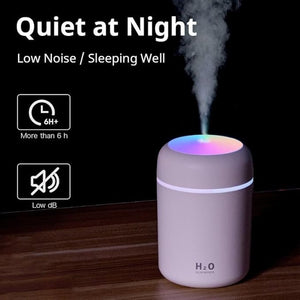
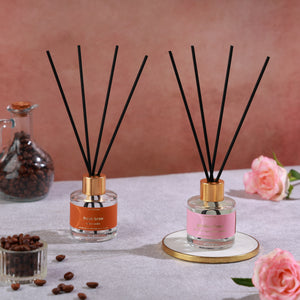
Reeds · always-on roomsFrom ₹749Shop →  Sukoon · when you want a switch₹1,899Shop →
  Hotel Collection · the scentFrom ₹299Shop →
Fixing the extraction, in order
Start with the thirty-second test, because it costs nothing and it narrows everything. Fan on, one sheet of tissue against the grille. Then the same with the door open two inches. Then the same with the grille cover removed. Those three results tell you whether you are chasing make-up air, a clogged unit, or something downstream. If the tissue holds firmly in all three conditions, the fan is fine and your problem is entirely run-on time, which is good news — it is the cheapest thing on this list to fix.
Then clean it and follow the duct. Isolate the power, take the cover off, and vacuum the grille, the impeller blades and the inside of the housing; wipe with a damp cloth and let it dry before reconnecting. Then trace the duct with a torch, ideally from both ends — check it is connected at the fan spigot, check it is connected at the terminal, check that the external grille or flap is not painted shut or blocked, and check that it does not simply stop somewhere above your ceiling. Shorten and straighten it if the layout allows. If after all that the flow is still weak, the unit is undersized for the room and duct run, and a properly specified replacement is the correct spend.
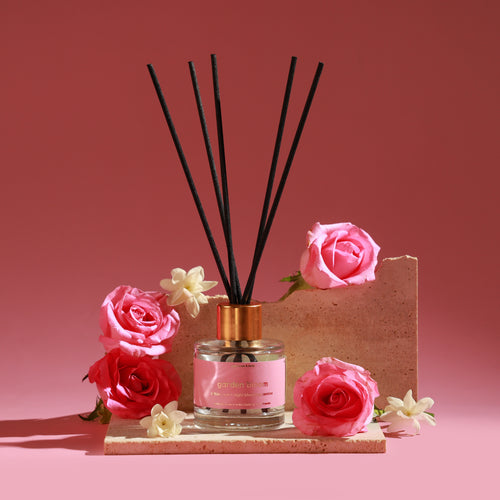
Then set the schedule, and only then think about scent. Run the fan for fifteen to twenty minutes after every shower, with the door ajar so air can get in. A run-on timer module is inexpensive, permanent and removes the need to remember. Squeegee the shower walls and glass, hang towels where they can actually dry rather than folded on a rail, and take the bath mat out to dry rather than leaving it flat on wet tiles. A bathroom that dries between uses stops being musty within a couple of weeks, because you have removed the condition that growth needs. At that point — and only then — a reed diffuser from ₹749 gives the room a steady, low background with no electricity, at two or three reeds rather than six. Put it on a shelf away from the direct line to the extract grille; a fan will happily pull your fragrance straight out of the building. If the bathroom is large or opens into a dressing area with a socket, the Sukoon at ₹1,899 with 3–6 drops of a Hotel Collection scent from ₹299 covers roughly 270–320 sq ft and gives you a switch instead.
What to do, in order
This is a mechanical problem with a mechanical solution, and three of the four steps below involve a screwdriver rather than a purchase from us. The fourth is genuinely worth having once the room is dry.
| Step | What to do | When | Cost |
|---|---|---|---|
| 1. Remove the source | Tissue test the grille, clean the impeller and housing, follow the duct to a real external terminal | Before anything else | ₹0 |
| 2. Move the air | Run on for fifteen to twenty minutes after every shower, door ajar so make-up air can get in | Daily, five to ten minutes | ₹0 |
| 3. Deal with what holds it | Squeegee the shower walls, dry the mat and towels properly, scrub grout and replace blackened silicone | Weekly to monthly | ₹0 |
| 4. Then the always-on layer ★ | A SOSA reed diffuser — a quiet constant background once the room dries between uses, at two or three reeds and away from the grille | 50ml 6-8 weeks · 130ml 14-18 | from ₹749 |
| 5. Or the on-demand layer | Sukoon with a Hotel Collection scent — a switch for a large bathroom or an adjoining dressing area with a socket; covers roughly 270-320 sq ft | Run it when you want it | ₹1,899 |
Versailles
I have lost count of the number of people who tell me their bathroom fan works because it makes a noise. Noise is the motor. Airflow is a separate question, and the tissue test answers it in half a minute. Do that test before you buy anything at all, including from us — half the time it ends the investigation on the spot, and the answer is a screwdriver and a vacuum cleaner.
The run-on point is the one I would most like people to take away. A shower ends with the room at its wettest, and that is the exact instant most of us kill the fan on our way out. Fifteen to twenty minutes afterwards changes a bathroom completely, and an electrician can fit a timer module to your existing fan for very little. It is the cheapest improvement in home odour I know of, and there is nothing to buy from a fragrance company in it.
When the room does dry between uses, a reed diffuser suits a bathroom particularly well — no socket, no switch, nothing to remember, and small rooms need very little. Two or three reeds. And put it somewhere the fan is not pointing at, because the extract grille will pull your fragrance out of the flat with everything else. A portion of every order funds a girl's classroom through Nanhi Kali.
Frequently asked questions
- A bathroom with no window at all — why run-on time is everything.
- Worse during monsoon — when the outside air cannot dry anything.
- Still smells right after cleaning — the drain, the rim and the grout.
- Keeping a bathroom good permanently — the routine once the fan is sorted.
- Brand: the SOSA founder story.
SOSA products & prices (verified August 2026): Hotel Collection water-based ultrasonic diffuser fragrance 15ml ₹299 · 100ml ₹999 · 300ml ₹1,799 · Pack of 7 (15ml, all fragrances) ₹1,799; refills 100ml from ₹999. Seven scents: The Ritz-Carlton-inspired (white tea · bergamot · cedar), Westin-inspired (white tea · aloe · cedar), 1 Hotels-inspired (cedarwood · vetiver · green leaves), The St. Regis-inspired (amber · violet · woods), Shangri-La-inspired (jasmine · green tea · white tea), Four Seasons-inspired (citrus · floral · sandalwood), W Hotels-inspired (citrus · pepper · amber). Diffusers: Boond 300ml ₹899 · Sukoon 500ml ₹1,899 · Megh 6L ₹3,499. Water-based, phthalate-free, composed to IFRA standards for home diffusion; 3–6 drops per tank. Made in India, Pune. The Hotel Collection scents are SOSA's own interpretations inspired by the world's finest hotels; all hotel names are trademarks of their respective owners and are used only to describe the scent style — SOSA is an independent Indian fragrance house, not affiliated with or endorsed by any hotel brand. Prices and availability subject to change — see the live product pages.