




The numbers: a shut flat sits at roughly 0.2–0.5 air changes an hour. Genuine cross-ventilation reaches 3–8. Five to ten minutes of the second beats an hour of one open window.
If all your windows face one way: use the kitchen or bathroom exhaust fan as the outlet, or put a pedestal fan in the window blowing outwards. You are manufacturing the pressure difference the building did not give you.
2. Because there is no height difference either. Warm air rises. A room ventilates far better when the incoming air can enter low and the warm, loaded air can leave high — that is the stack effect, and it works even on a still day when there is no wind at all. A single window in the middle of one wall gives you no inlet and no outlet, just one opening doing both jobs badly. A ventilator above the door, a high window or an exhaust fan near the ceiling is worth more than a large window at chest height.
3. Because your flat may be single-aspect. A great many compact flats have every window on the same face of the building. There is no cross-draught available, no matter how many of them you open, because they are all at the same pressure. In that case you have to create the pressure difference yourself — a fan in a window blowing outwards, or the kitchen chimney or bathroom exhaust running with the door to that room open.
4. Because the internal doors are closed. Even with a proper cross-draught available, air takes the shortest path it can find. A shut bedroom door means the bedroom is not being ventilated at all while the living room is. Open the internal doors during the purge, and if a door will not stay open, wedge it — a door swinging shut in the draught it created is the commonest reason a ten-minute airing achieves five minutes of work.
5. And fragrance does nothing about any of this. Scent added to still air is still air with a scent in it. Get the flow working, deal with anything wet, handle the fabric, and then add a reed diffuser or a Sukoon as the layer on top.
Made in India, composed by an ISIPCA Versailles-trained perfumer — and a portion of every order supports girl-child education through Nanhi Kali.

Why an open window on its own achieves so little
Ventilation is not a property of a window; it is a property of a path. Air moves through a building when there is a pressure difference between two points, and the two things that generate that difference in an ordinary flat are wind acting on opposite faces and buoyancy — warm air rising and leaving through a high opening while cooler air is drawn in through a low one. A single opening cancels both. There is no opposite face for the wind to push against, and there is no high exit for the warm air to take, so the same window has to serve as inlet and outlet simultaneously. What you get is a slow shuffle at the window plane and almost nothing behind it. This is exactly why the corner behind the sofa, the far end of the passage and the inside of a wardrobe can smell closed in a flat that has had a window open since morning.
The numbers make the point plainly. A shut flat exchanges roughly 0.2 to 0.5 of its internal air volume per hour. Two openings on genuinely different sides, with the internal doors open between them, take that to somewhere in the region of 3 to 8. That is not an incremental improvement — it is an order of magnitude, and it is why five to ten minutes of real cross-ventilation replaces more air than an hour of one open window. A 1BHK is also a small volume, which cuts both ways: it loads up faster because there is less air to dilute into, but it also purges completely in a very short time once a path exists. Ten minutes, done properly, is genuinely enough for most compact flats. The reason it is not working for you is almost never duration. It is the absence of a second opening.
Three ways to give the air somewhere to go
 Step four50ml ₹849Walk your flat and find the two openings furthest apart on different faces — commonly the kitchen window and the living-room window, or the bedroom window and the balcony door. Open both, then open every internal door on the line between them and wedge anything that swings shut. That is a path. Ten minutes of it will do more than the window you have had open since breakfast. The test is whether you can feel air moving in the middle of the flat, not at the window. If you cannot feel anything a metre from the frame, you do not have a flow, you have a hole.
Symptom to cause: why the window is not working
Each row here is a different reason an open window fails to ventilate. Match the one you actually observe rather than the one that sounds most likely, because the fixes are completely different.
| What you notice | Most likely cause | How to confirm it | What actually fixes it |
|---|---|---|---|
| Window open all day, flat still smells closed ★ | Single-sided ventilation — no outlet, so no flow through the room | Stand a metre inside the room and see whether you can feel any air movement at all | Open a second opening on a different wall and the doors between them |
| Fresh near the window, closed at the far end of the room | The flow is confined to the window plane and never reaches the depth of the room | Hold a light strip of paper at the window, then at the far wall, and compare | A fan in the window blowing outwards, or an exhaust fan as the second opening |
| Every window is on the same side of the flat | A single-aspect flat — there is no cross-draught available to find | Look at the building from outside and count which faces your openings are on | Manufacture the difference: fan blowing outwards, chimney or bathroom exhaust running |
| Living room clears but the bedroom never does | A closed internal door short-circuiting the path | Repeat the airing with every internal door wedged open and compare | Open and wedge internal doors during the purge; check for a ventilator above the door |
| Opening the windows makes it worse, not better | You are pulling in humid monsoon air, corridor air or a neighbour's cooking | Compare mid-morning on a dry day with late evening after rain | Air in dry spells and short bursts; use the exhaust as the outlet so you are pushing out, not drawing in |
| Damp, earthy smell that ventilation never shifts | Moisture in the structure or mould — not a ventilation or odour problem | Look at the base of external walls, behind wardrobes, and at bathroom ceiling corners | Find the water source and remove the growth. Fragrance has no role here. |
| If none of these fit: check what happens when the front door is open. If the flat clears the moment the main door is wedged and does not otherwise, your only real outlet is the corridor and you need to plan around that. | |||
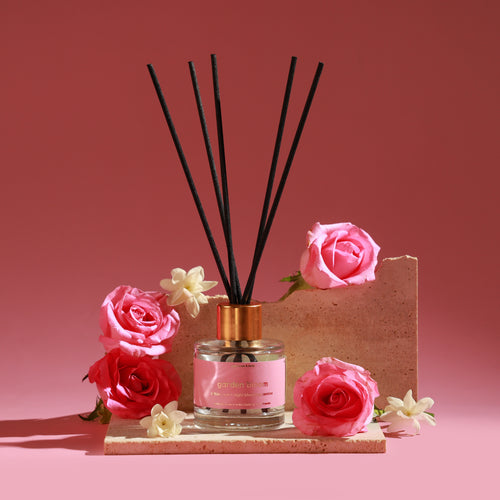 Reeds · always-on roomsFrom ₹749Shop →
  Sukoon · when you want a switch₹1,899Shop →
  Hotel Collection · the scentFrom ₹299Shop →
The ten-minute purge, done properly
First, find your path before you open anything. Walk the flat once and identify the two openings furthest apart on different faces of the building. In most 1BHKs that is the kitchen window and the living-room window, or the bedroom window and the balcony door. Then look up: a ventilator above a door, a high louvre or a ceiling-level exhaust point is your best outlet because warm loaded air collects at the top of the room. If those have been painted shut or hidden above a false ceiling, opening them again is the single highest-value change available to you and it is a one-off job.
Second, run the purge. Open both openings, open every internal door between them and wedge them so the draught cannot slam them shut, and leave it for five to ten minutes twice a day — ideally once in the morning and once in the evening, and in a monsoon city during whatever dry window the day gives you. If the flat is single-aspect, put a fan in one window facing outwards and run the bathroom exhaust and the kitchen chimney at the same time, with those doors open. Judge the result by standing in the middle of the flat, not at the window. If nothing is moving where you stand, the path is not open.
Third, deal with the fabric, then add the layer. Ventilation removes what is in the air; it does not empty the reservoir. Wash curtains seasonally, bedding weekly and cushion covers monthly, vacuum upholstery rather than only the floor, and get rugs into direct sunlight when the weather allows. Only then does fragrance have a clean surface to sit on. In a 1BHK the sizing is simple: a reed diffuser from ₹749 covers a room of up to roughly 150 sq ft on six reeds, so one bottle for the living area and a smaller presence in the bedroom is usually the whole plan. If the living area is larger and open-plan, the Sukoon at ₹1,899 covers roughly 270–320 sq ft with 3–6 drops of the water-based Hotel Collection from ₹299. Neither removes anything from the air. They give a flat that already ventilates a consistent character.
What to do, in order
The first three steps are structural and free, and in a small flat they work quickly because there is not much air to replace. The fourth is the purchase, and in a 1BHK it is mostly a sizing question.
| Step | What to do | When | Cost |
|---|---|---|---|
| 1. Remove the source | Unblock the ventilators and clean the mosquito mesh; check unused drains, the bin, the washing-machine gasket | Before anything else | ₹0 |
| 2. Move the air | Two openings on different faces plus every internal door wedged open, ten minutes twice a day — or a fan blowing outwards | Daily, five to ten minutes | ₹0 |
| 3. Deal with what holds it | Curtains seasonally, bedding weekly, cushion covers monthly, upholstery vacuumed, rugs sunned | Weekly to monthly | ₹0 |
| 4. Then the always-on layer ★ | A SOSA reed diffuser — a room of up to roughly 150 sq ft on six reeds — usually one bottle for the living area of a 1BHK | 50ml 6-8 weeks · 130ml 14-18 | from ₹749 |
| 5. Or the on-demand layer | Sukoon with a Hotel Collection scent — an open-plan living area of roughly 270–320 sq ft, run when you want it rather than always | Run it when you want it | ₹1,899 |
Versailles
This is the one where I most often end a conversation by telling someone to buy nothing. Somebody writes in convinced their flat needs a stronger fragrance, and three questions later it turns out every window in the place faces the same courtyard and the ventilator above the bedroom door was sealed when the false ceiling went in. No diffuser in the world competes with an outlet.
The other thing I have learned to ask is which way the fan is pointing. Almost everyone puts a fan in a window facing into the room, because it feels like it is bringing fresh air in. It is mostly moving the same air around. Turn it round to face outwards and the whole flat starts draining behind it. It is a small thing and it changes the result immediately.
When you do get to fragrance, size it honestly. A 1BHK is a small volume, and the most common mistake I see is over-scenting a compact flat — six reeds in a bedroom of a hundred square feet is too much, and it costs you bottle life as well. Use four. Save the full six for the living area. And if the smell is damp rather than closed, please stop and find the water first; that is a building problem, not a fragrance one. A portion of every order funds a girl's classroom through Nanhi Kali.
Frequently asked questions
- Why does my house smell stale even though I clean it every day? — the general case, in order.
- Cleaned at 9am, stale by 6pm — why a clean is a level, not a rate.
- A room nobody used all day still smells closed — stagnation without occupancy.
- How do I find the source of a stale smell? — the room-by-room method.
- Brand: the SOSA founder story.
SOSA products & prices (verified August 2026): Hotel Collection water-based ultrasonic diffuser fragrance 15ml ₹299 · 100ml ₹999 · 300ml ₹1,799 · Pack of 7 (15ml, all fragrances) ₹1,799; refills 100ml from ₹999. Seven scents: The Ritz-Carlton-inspired (white tea · bergamot · cedar), Westin-inspired (white tea · aloe · cedar), 1 Hotels-inspired (cedarwood · vetiver · green leaves), The St. Regis-inspired (amber · violet · woods), Shangri-La-inspired (jasmine · green tea · white tea), Four Seasons-inspired (citrus · floral · sandalwood), W Hotels-inspired (citrus · pepper · amber). Diffusers: Boond 300ml ₹899 · Sukoon 500ml ₹1,899 · Megh 6L ₹3,499. Water-based, phthalate-free, composed to IFRA standards for home diffusion; 3–6 drops per tank. Made in India, Pune. The Hotel Collection scents are SOSA's own interpretations inspired by the world's finest hotels; all hotel names are trademarks of their respective owners and are used only to describe the scent style — SOSA is an independent Indian fragrance house, not affiliated with or endorsed by any hotel brand. Prices and availability subject to change — see the live product pages.