


Why it reads as a smell: the nose is the sense that reports on air. Anything wrong with the air arrives labelled as an odour, whether it is one or not.
Why fragrance cannot fix it: scent is additive. It can only act on the smallest of the four components, and it adds to the load in a room that is already holding too much.
2. The humidity climbs, and humidity amplifies odour. Breathing and perspiring put a steady stream of water vapour into a closed room across eight hours. Higher relative humidity is felt directly as heaviness, and it raises the perceived strength of any odour that is present while slowing the rate at which bedding and towels dry. Condensation on the inside of the window in the morning is the visible version of this, and it is a genuine measurement rather than a nuisance.
3. The air has been breathed several times over. In a sealed bedroom carbon dioxide builds steadily through the night. You cannot smell carbon dioxide — it has no odour — but it is a very reliable marker of how many times the air in the room has already been used, and it rides along with everything else on this list. This is the component people describe as the room feeling "close" or "airless" without being able to name a smell.
4. And the volatiles accumulate — the only part that genuinely is a smell. Skin lipids transferring to sheets and pillow and oxidising against warm fabric, slow re-release from the mattress and curtains, whatever drifted in from the kitchen. In a room exchanging 0.2 to 0.5 of its air an hour, eight hours of that has nowhere to go.
5. Which is why scent is the last step and a small one. Fragrance is additive. It can join the fourth component; it cannot lower a temperature, dry a room or replace breathed air. Ventilate first, then a reed diffuser or a Sukoon is a pleasure rather than an extra load.
Made in India, composed by an ISIPCA Versailles-trained perfumer — and a portion of every order supports girl-child education through Nanhi Kali.
Why your nose hands you all four as a single smell
Smell is the sense that reports on air, and it is the only one with a rich enough vocabulary to describe it. You have no separate conscious channel that says "the carbon dioxide in this room has risen" or "the relative humidity is up eleven points". What you get instead is one summary impression, and because the summary arrives through the nose, you file it as a smell and go looking for something that is causing it. Then you buy a product designed for the one component that is actually an odour. That is the trap in this particular question, and it is a very expensive one, because the person eventually concludes their room is unusually difficult when in fact three-quarters of what they are perceiving was never a smell in the first place.
The practical consequence is uncomfortable for someone in my trade to write down: adding fragrance to a stuffy room usually makes it read stuffier. Not because the fragrance is bad, but because stuffiness is partly a sense of too much already being present in unmoving air, and scent is additive — it puts more into the air and takes nothing out. A well-ventilated room can carry a fragrance lightly. A hot, damp, unventilated one turns the same fragrance into another layer of heaviness, and you end up disliking a blend you would have loved in a room with an open window. This is also why air fresheners have such a poor reputation in bedrooms: they are most often deployed in exactly the conditions where they perform worst.
The four components, and what each one responds to
 Step fourFrom ₹749These two are what people mean when they say a room feels heavy rather than smelly. A sleeping body adds heat and water vapour continuously, and in a flat with a west wall or a top-floor slab the building is giving heat back after dark too. Warmth also speeds the evaporation and release of everything else in the room, so it quietly makes component four worse. Humidity does something similar from another direction: it raises how strongly you perceive an odour that is already present and it stops the bed drying out between nights. Look at the inside of the window glass in the morning — if it is misted, you have measured this without instruments.
Symptom to cause: separating the four
Because stuffiness is a composite, the useful diagnostic questions are about which part dominates. These rows are written to separate them, since each responds to something different.
| What you notice | Most likely cause | How to confirm it | What actually fixes it |
|---|---|---|---|
| Air feels heavy and close but you cannot name a smell ★ | Warmth, humidity and breathed air — the three non-odour components | Open the window and the door together; if it lifts within minutes, this is it | Ten to fifteen minutes of cross-ventilation morning and evening |
| Condensation on the inside of the window glass at dawn | Humidity, which also raises how strongly every odour reads | Look at the glass on waking, before you open anything | Ventilate on waking; no laundry drying indoors; en-suite door shut at night |
| Cool but still stuffy with the AC running all night | The unit recirculates — it cools the same air and exchanges none of it | Run a night with the window ajar and the AC off, and compare the morning | Purge on waking regardless of the AC; wash the unit filter monthly |
| A definite slept-in note strongest near the pillow | Skin lipids oxidising in the bedding — the genuine odour component | Smell the pillow against a freshly laundered one from the cupboard | Weekly linen, a washable pillow protector, duvet thrown back each morning |
| Sharp, chemical or gas-like smell, or anything burning | Not an odour problem at all — treat it as an emergency | Do not investigate with a flame or a switch | Ventilate, leave, shut off the supply at the cylinder or meter and call for help. |
| Musty and earthy, with marks on a wall or ceiling corner | Damp or mould — a health issue, not a fragrance one | Check external walls behind furniture and the ceiling corners in daylight | Find the moisture source and remove the growth first. |
| If none of these fit: sleep one night with the bedroom door propped open and the window on the latch. If the morning is transformed, your problem was air-change rate and only air-change rate. | |||
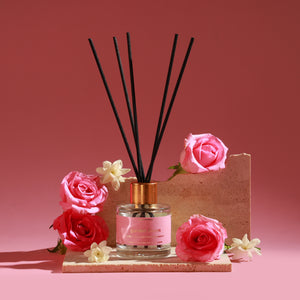
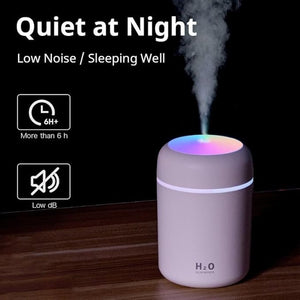
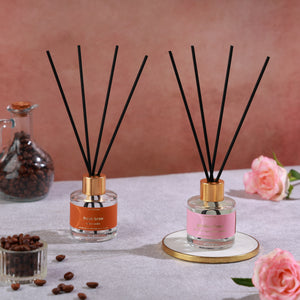
Reeds · always-on roomsFrom ₹749Shop →  Sukoon · when you want a switch₹1,899Shop →
  Hotel Collection · the scentFrom ₹299Shop →
Fixing all four at once
There is exactly one intervention that addresses every component, and it is free. Open the window and the bedroom door at the same time, so air has both an entrance and an exit, and leave them for ten to fifteen minutes on waking. In that time the room drops in temperature, drops in humidity, replaces the air that has been breathed all night, and carries out the volatiles that accumulated with it. Nothing else on the market does all four. If the window opens onto a shaft or a busy road, put a fan in it blowing outwards, which draws the room's air out behind it rather than pushing street air in. Do it again in the evening if you can, because a room you shut at nine and re-enter at eleven starts the night already partly loaded.
Then take the components one at a time where you can. For heat: keep curtains drawn against a west-facing wall through the afternoon so the room is not radiating at you all night. For humidity: never dry laundry in a bedroom, keep the en-suite door shut overnight so you are not sharing air with a permanently damp room, and run the ceiling fan over an open bed for an hour in the morning — moving air is what dries fabric, not time. For breathed air: there is only the window, and if the outside air is unusable that night, purge hard in the morning instead. For the volatiles: sheets and pillowcases weekly, a washable protector on the pillow washed monthly, duvet thrown fully back rather than the bed made, and the mattress aired each season.
Only then does fragrance make sense, and it should be small. A ventilated bedroom carries scent lightly; an unventilated one turns the same scent into another layer of weight. A reed diffuser from ₹749 on three or four reeds rather than six, placed across the room from the bed and away from an AC vent, is the right shape: continuous, quiet, no electricity, nothing to remember. Reed count is the volume control, and a bedroom is the smallest space you occupy for the longest stretch, so it needs the least. If you would rather scent were an event than a constant, the Sukoon at ₹1,899 takes 3–6 drops of the water-based Hotel Collection from ₹299 and covers roughly 270–320 sq ft — run it for an hour in the evening and switch it off at bedtime. The two liquids are not interchangeable.
What to do, in order
Everything that acts on three of the four components is free. The purchase acts on the fourth, and it is worth making once the other three are handled.
| Step | What to do | When | Cost |
|---|---|---|---|
| 1. Remove the source | Curtains drawn against afternoon sun, no laundry dried indoors, en-suite door shut, worn clothes in a basket | Before anything else | ₹0 |
| 2. Move the air | Window and bedroom door open together for ten to fifteen minutes on waking, and again in the evening | Daily, five to ten minutes | ₹0 |
| 3. Deal with what holds it | Weekly sheets and pillowcases, pillow protector washed monthly, fan over an open bed in the morning | Weekly to monthly | ₹0 |
| 4. Then the always-on layer ★ | A SOSA reed diffuser — a light, continuous character on three or four reeds once the room actually ventilates | 50ml 6-8 weeks · 130ml 14-18 | from ₹749 |
| 5. Or the on-demand layer | Sukoon with a Hotel Collection scent — scent as an evening event rather than a constant; covers roughly 270–320 sq ft | Run it when you want it | ₹1,899 |
Versailles
I get asked to recommend something "strong enough for a stuffy room" perhaps once a week, and it is the request I most often talk people out of. A stuffy room is mostly heat, moisture and used air, and a stronger fragrance in that room does not compete with those things — it joins them. The customer who buys a big bottle for a stuffy bedroom usually ends up disliking the fragrance, which is a shame, because in an aired room they would have loved it.
What I find genuinely useful about breaking stuffiness into four parts is that it tells you which effort is wasted. Buying a purifier because a room feels close will disappoint you, because a purifier filters the air it already has. Running the AC harder will disappoint you for the same reason. Opening two things at once for ten minutes will not disappoint you, and it is the cheapest thing in this article.
So the honest order is: air, then heat and damp, then the bedding, then me. When you get to me, go light. Three reeds in a bedroom, on the far side of the room from the pillow. You are going to be lying inside that decision for eight hours with a nose that stopped reporting after twenty minutes, so ask somebody who has just walked in. A portion of every order funds a girl's classroom through Nanhi Kali.
Frequently asked questions
- Window open versus window closed — the same room at two air-change rates.
- Fine at night, weird by morning — the eight-hour accumulation curve.
- Why an AC room is stale by morning — cooling is not ventilating.
- Two people in one bedroom — why emission doubles and the room cannot.
- Brand: the SOSA founder story.
SOSA products & prices (verified August 2026): Hotel Collection water-based ultrasonic diffuser fragrance 15ml ₹299 · 100ml ₹999 · 300ml ₹1,799 · Pack of 7 (15ml, all fragrances) ₹1,799; refills 100ml from ₹999. Seven scents: The Ritz-Carlton-inspired (white tea · bergamot · cedar), Westin-inspired (white tea · aloe · cedar), 1 Hotels-inspired (cedarwood · vetiver · green leaves), The St. Regis-inspired (amber · violet · woods), Shangri-La-inspired (jasmine · green tea · white tea), Four Seasons-inspired (citrus · floral · sandalwood), W Hotels-inspired (citrus · pepper · amber). Diffusers: Boond 300ml ₹899 · Sukoon 500ml ₹1,899 · Megh 6L ₹3,499. Water-based, phthalate-free, composed to IFRA standards for home diffusion; 3–6 drops per tank. Made in India, Pune. The Hotel Collection scents are SOSA's own interpretations inspired by the world's finest hotels; all hotel names are trademarks of their respective owners and are used only to describe the scent style — SOSA is an independent Indian fragrance house, not affiliated with or endorsed by any hotel brand. Prices and availability subject to change — see the live product pages.