
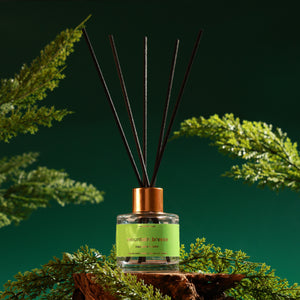


The reason specific to this family: seven people warm and humidify a small volume, and a volatile fresh register comes forward sooner in a warm cabin than in a cool one. Relative humidity also changes how a composition is perceived rather than what is in it — the same fragrance reads heavier in a damp cabin than in a dry conditioned one. So the setting has genuinely changed behaviour, not just audience.
Two things pull in the other direction, and they do not cancel it: seven people and their luggage are a great deal of absorbent mass, which takes odour up and gives it back later; and a full car usually has its rear climate zone running, which distributes rather than removes. Net of all of it, a loaded cabin reads stronger at the front and more variable everywhere.
What to do: one scent, two settings. Validate the family setting with somebody in the second row who has just got in, not from the driving seat. The published dial is the format itself — “Spray (Strong scent-throw)” and “Hanging (Mild scent-throw)” under the option “Car freshener form”, same price — or the Safar diffuser’s three speeds and its 1 / 2 / 3-hour auto shut-off.
The honest gap: no SOSA car format publishes a key-lock, an app, a schedule or a stored preset, so there is no way to save a solo setting and a family setting and switch between them. The only control is a written setting and one named person. And no coverage figure of any kind is published for the Safar diffuser, so nobody can tell you what a seven-person cabin “needs”.
- The straight answer, in five parts
- Why a full car is a physically different cabin, not just a busier one
- The three changes a loaded vehicle makes, and which one dominates
- Solo against loaded: what changes, and what to set
- Consent, and the setting nobody in the back row chose
- The two-pattern setting in buying order — and the gaps
- A note from Sonal
- FAQs
2. And in this family there is a physical reason on top of the social one. This is the part that is particular to a fresh, green or minty register and is the reason this page exists separately from the equivalent page in every other family. Seven people in a small enclosed volume raise its temperature and its humidity. Nobody needs a figure for that; it is the ordinary experience of a full car on a warm afternoon. The consequence for a volatile composition is direct: a warm cabin brings the lightest and most characteristic material of a fresh register forward sooner and more emphatically than a cool one does, because release from any source follows the cabin’s temperature. Meanwhile, relative humidity changes how a composition is perceived rather than what is in it — the same fragrance reads heavier in a damp cabin than in a dry conditioned one. Put those together and the same unit at the same setting is genuinely louder and genuinely heavier in a loaded warm car than in the one you validated alone. That is why lowering the level is a correction rather than a courtesy.
3. Two counter-forces exist, and they do not cancel it. Fairness requires naming the things that push the other way, because readers will think of them. The first is absorbent mass. Seven people, their coats, their bags and a loaded cargo area are a great deal of soft mass, and soft mass takes odour up and releases it later rather than leaving it in the air — so some of what your source produces is being absorbed instead of reaching noses. The second is airflow. A full car usually has its rear climate zone running, which moves fragrance around the cabin more evenly than a front-only setting does; air conditioning both helps and hurts, in that it distributes a fragrance through the volume and, on recirculation, removes almost none of it. Neither of those is strong enough to reverse the conclusion. Absorption redistributes rather than removes, and better circulation spreads the fragrance to the people who did not choose it. Net of everything, a loaded cabin reads stronger where the source is and more variable everywhere else, and the correct response to “stronger and more variable” is a lower setting and a better position.
4. Validate it from the second row, not from the driving seat, and ask properly. The driver’s nose is the worst instrument in the car — nearest the source, continuously exposed, and attached to the person who decides. On a family journey you have six better instruments available and you should use one. Two people in the same cabin genuinely perceive different intensities, because dwell time, seat position, height relative to the airflow and recent exposure all differ, so the right question goes to somebody who has just got in and sits where most of your passengers sit, which in practice is the second row rather than the third. Ask it openly — what does the car smell like — rather than offering your hypothesis, and ask it in the first minutes before they have adapted too. And take no reading at all in a vehicle that has just stood closed in the sun, because heat drives everything into the air at once and a judgement made in that first minute is a judgement about the weather rather than about the setting.
5. What is published, and the gap that makes this awkward. The minty direction is Icy Mint at ₹489 under the option “Car freshener form”, with the published values “Spray (Strong scent-throw)” and “Hanging (Mild scent-throw)” at the same price on every scent — so the format is the dial, and for a household whose car is regularly full, the mild continuous form is the better buy and costs nothing less. Hanging units are 12ml and the 15 ML hanging refill is ₹429; the Car Perfume Sprays Discovery Set is ₹699–₹899 for trios and ₹2,999 for a pack of nine; the 50 ML Car Perfume Spray is ₹1,499. The genuinely green-herbal direction, Sage & Cedar, exists only as a waterless oil — so green and minty are two different orders — and reaching it needs the Safar waterless diffuser at ₹3,999 for the house trios or ₹4,499 for the hotel-inspired ones, with three speed settings described as light to intense, a 1 / 2 / 3-hour auto shut-off, and up to 10 hrs continuous or up to 30 hrs intermittent per charge. That dial is the cleanest answer to a household running two patterns. Now the gaps, and the first one is genuinely inconvenient. No SOSA car format publishes an app, a schedule, a stored preset or a key-lock of any kind, so there is no way to save a solo setting and a family setting and switch between them — the control is a written setting and one named person who may change it, which sounds absurdly formal for a car and is the only thing that works. And no coverage figure of any kind is published for that diffuser, so nobody can tell you what a seven-person cabin requires; it is specified by speed, timer, runtime and placement. Everything is alcohol-free where applicable, phthalate-free, paraben-free and IFRA-compliant, composed in Pune. Free shipping above ₹499, and a portion of every order supports girl-child education through Nanhi Kali.
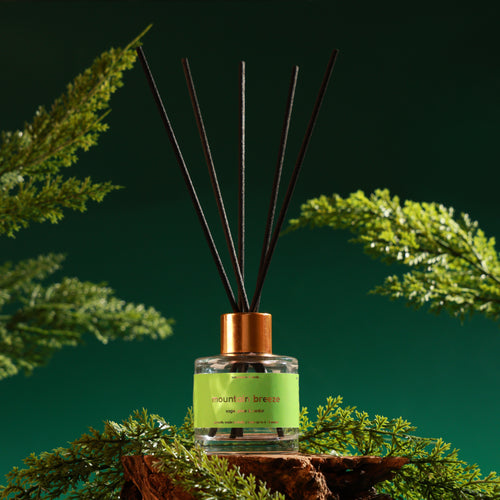
Why a full car is a physically different cabin, not just a busier one
It is worth separating two claims that are usually run together, because only one of them is commonly made and the other is the more interesting. The familiar claim is about judgement: more people means more opinions, and a preference validated alone is not a shared preference. That is true, it applies in every family in this cluster, and it is the reason the family setting is lower than the solo one almost everywhere. The less familiar claim is about conditions: a loaded cabin is warmer and damper than an empty one, and warmth and humidity are not neutral to a fragrance. In a dense woody or resinous register the effect is modest, because the material carrying the identity is heavy and relatively indifferent to a few degrees. In a fresh, green or minty one it is not modest at all, because the identity sits in the lightest and most volatile material in the composition — precisely the part that responds most to being warmed.
So the practical sequence in a full car is this. The cabin warms. The source releases more readily. The most characteristic part of the fragrance arrives sooner and more emphatically than it did in the cool morning cabin you set it in. At the same time the air is more humid, and relative humidity changes how a composition is perceived rather than what is in it: the same fragrance reads heavier and rounder in a damp cabin than in a dry conditioned one. An owner experiences this as the car being “much stronger with everybody in it” and reasonably concludes that the passengers are being sensitive. They are not being sensitive. They are describing a cabin that is doing something different.
The honest limits of this account matter, and I will state them before anybody asks. No figure is published anywhere in the SOSA range for any of it. There is no temperature coefficient for release, no humidity correction, no occupant-count guidance and no per-row concentration number, and no coverage figure of any kind is published for the Safar diffuser — no floor area, no volume, no occupant count. So what I am giving you is a direction and a mechanism rather than a quantity, and the correct use of a direction is to run a comparison rather than to hit a target. No experiment of this kind has been run by SOSA and no measurement or conclusion is reported here, because none exists. Anybody who offers you a number for what a seven-person cabin requires has invented it.
There is also a duration effect that compounds everything above, and it is specific to how families actually use large vehicles. A solo commute is a short exposure repeated often; a family journey is a long exposure taken occasionally, and the two have opposite dosing logic. Short frequent journeys are this family’s best case, because a brief trip is almost entirely the bright opening and the cabin never has time to accumulate. A long loaded journey is the other end: the composition moves past its opening, the sealed cabin banks what is put into it, and the fourth hour is running on everything the first three contributed. Dose for the last hour rather than the first five minutes — and in a loaded car the last hour is warmer, damper and fuller than the last hour of any solo drive.
 Icy Mint₹489This is the change that belongs to this family rather than to cars in general, and it is the reason the answer here is a correction rather than a compromise. Release from any source follows the cabin’s temperature, so a warmer cabin produces more fragrance from the same unit without anybody touching anything. A car with seven people in it on a warm afternoon is a warmer cabin than the same car with one person in it at seven in the morning, and the difference is not subtle to anybody sitting in the middle of it. Then humidity does something separate: it changes the perception rather than the content. The identical composition reads heavier, rounder and less crisp in damp air than in dry conditioned air — which in this family is a specific loss, because crispness is the thing you chose it for. So a loaded cabin gives you more of the fragrance and a less flattering version of it at the same time. The practical move is a lower setting on loaded journeys, and the practical test is to run the comparison rather than to guess: the same journey twice, same source, same position, once lightly loaded and once full, with the same person in the second row reporting in plain words each time. Record words rather than numbers, because no temperature coefficient, humidity correction or occupant-count figure is published anywhere in the SOSA range and I will not invent one for you.
 15 ML refill₹429These two pull in opposite directions and are worth understanding together, because an owner who knows only one of them draws the wrong conclusion. Absorbent mass takes fragrance out of the air and gives it back later rather than destroying it — coats, bags, upholstery, a loaded cargo area and the passengers themselves are all soft mass, so a full car is holding some of what your source produces and releasing it slowly. That is why a car can smell of a journey the following morning. Airflow, meanwhile, distributes. A full vehicle usually has its rear climate zone running, which carries the fragrance to rows that a front-only setting barely reaches — and air conditioning both helps and hurts, in that it evens a fragrance through the volume and, on recirculation, removes almost none of it. Neither force rescues a high setting. Absorption delays rather than removes, and distribution means the people who did not choose your preference now receive it properly. What the two together do explain is why a loaded car feels inconsistent: stronger near the source, more even further back than it used to be, and liable to give some of it back as a stale note on the next journey if the car is shut up warm. The fix for all three symptoms is the same single move, which is less at the source and more distance from the nearest face.
 Ask firstFreeThis change is the one owners never put on the list and it frequently explains the whole complaint. A solo commute carries you and a bag. A seven-person family journey carries sports kit, food and takeaway packaging, used cups, wet umbrellas after a downpour, damp third-row mats that nothing walks on and nothing dries, and luggage sitting behind a folded third row where nobody looks for a fortnight. Every one of those is an odour source in its own right, and the cargo area shares cabin air with all three rows, so a damp or loaded boot reaches the driver’s seat as surely as the back one. This matters more in this family than in any other, because a fresh register is the one most damaged by having something underneath it: a clean smell laid over a dirty one produces a mixture that reads as concealment and is judged worse than the original was. So before you adjust any setting for a family journey, empty the car. Source before fragrance, always. Take the kit out, take the packaging out, dry what is damp, look behind the folded row, and open the doors and the tailgate for long enough that the cabin genuinely exchanges its air — air that leaves takes the odour with it, and a sealed car banks it. That costs nothing and resolves a surprising share of the complaints that arrive described as a setting problem. And one precise note on what SOSA does not make, because it is the moment somebody reaches for a product: there is no car air purifier, no dehumidifier and no odour-removing product in the range at any price, and no SOSA fragrance makes any health, air-quality, VOC or mould claim.
Consent, and the setting nobody in the back row chose
There is a social half to this question and it deserves its own section rather than a footnote, because it is where most households actually have the argument. A fragrance chosen alone is a preference. The same fragrance in a full car is an imposition, however pleasant, because nobody else in the vehicle selected it and nobody can leave. That is not an argument against having one; it is an argument for setting it at a level that does not require agreement. A cabin that is quietly, pleasantly fresh is something nobody objects to. A cabin that is distinctly minty is something people either like or endure, and on a four-hour journey with six passengers you will have both in the car.
The practical version of consent is a test rather than a conversation, and it is worth running once properly rather than relitigating every weekend. Set the level conservatively, run two or three ordinary family journeys at that level without announcing it, and then ask — openly, of more than one person, in the first minutes before they adapt. If nobody mentions it unprompted and everybody reports the car as pleasant when asked, you have the right setting and you need never discuss it again. If somebody mentions it unprompted, that is your answer and it arrived at the lowest possible cost. Asking before testing produces an argument about a hypothetical; testing before asking produces a decision.
And then the gap that makes all of this harder than it should be, stated plainly because it is the single most practical limitation in the whole car range. No SOSA car format publishes a key-lock, an app, a schedule or a stored preset of any kind. Nothing remembers a solo setting and a family setting. Nothing prevents another driver from changing what you set. On a shared vehicle — and a vehicle that carries seven people is a shared vehicle by definition — this means the control cannot be technical, so it has to be procedural. Decide the two settings, write them down where the car can see them, and name one person who may change them. A note in the glovebox that says what the setting is for a loaded journey, and whose decision it is, does the work that a key-lock would do on a commercial machine. It sounds comically formal for a family car and it is the difference between a cabin you chose and a cabin that four people adjusted independently over three months.
One further refusal belongs here, because a long family drive is exactly where somebody will suggest it. SOSA publishes no claim that any fragrance improves alertness, improves concentration, keeps anybody awake, prevents drowsiness, combats fatigue, reduces stress, improves sleep or lifts a mood, and none is made here. A minty register attracts that framing more than any other and it is not available from anything SOSA publishes. Nor is any health or air-quality claim made, and no vehicle-safety or driving guidance is offered on this page. The question is about how much fragrance belongs in a warm full cabin, which is a question with a clean and honest answer on its own terms.
| What changes | Solo commute | Seven passengers | What to do |
|---|---|---|---|
| Cabin temperature ★ | One occupant, often a cool early cabin | Warmer — and release follows the cabin’s warmth | Lower the setting. The same unit is producing more without being touched |
| Humidity | Dry conditioned air, usually | Damper. The same fragrance reads heavier and less crisp | Lower again, and judge from the second row rather than the front |
| Journey length | Short and frequent — this family’s best case | Long and occasional — the opposite dosing logic | Dose for the last hour. Use the diffuser’s 1 / 2 / 3-hour shut-off |
| Absorbent mass | You and a bag | Seven people, coats, luggage, a loaded boot | Nothing. Absorption delays rather than removes, and it returns later |
| Airflow | Often front-only, so the back barely participates | Rear zone usually running, so the fragrance reaches everybody | Nothing. Better distribution is a reason to produce less, not more |
| What else is aboard | Rarely anything | Sports kit, food and takeaway packaging, used cups, wet umbrellas, damp third-row mats, luggage behind a folded row | Empty the car first. Source before fragrance, and the boot shares air with all three rows |
| Who judges it | You, which is tolerable when you are alone | Six people who did not choose it and cannot leave | Ask somebody in the second row who has just got in, openly, in the first minutes |
| What is not published | No occupant-count guidance, temperature coefficient or humidity correction exists | No coverage figure of any kind is published for the Safar diffuser either | Which is why every row gives you a direction to test rather than a number to hit |
Icy Mint · one scent₹489See it →  15 ML hanging refill₹429See it →
  Safar · two settings, one machine₹3,999See it →
What to specify for a household running two patterns
If your week genuinely contains both journeys, the honest options are three and none of them is a second fragrance. The first is the format decision, made once at purchase: “Hanging (Mild scent-throw)” as the default for a car that is often full, because a continuous plateau distributed by the cabin’s own airflow is what a long loaded journey wants, and “Spray (Strong scent-throw)” as the special case for a short solo run where a peak is appropriate. They are the same price on every scent, so a household that really runs both patterns can own both forms of Icy Mint at ₹489 each and use them deliberately. That is a more honest answer than pretending one fixed setting serves a solo Tuesday and a loaded Saturday equally.
The second is placement, and it does more in a full car than anywhere else. With every seat occupied there is no empty space left to absorb the first metre, so the person beside the source is receiving your solo level at close range for the whole journey. Move the single unit towards the middle of the occupied part of the cabin rather than the geometric middle of the vehicle, keep it out of the direct path of a vent so that the airflow carries it rather than stripping it, and keep it away from the nearest face. Distance from the source is the real intensity control in a car, and it is free. And resist the obvious move: do not add a second unit for the rear. Two passive sources make two concentrations with a trough between them rather than an even cabin, and in a loaded vehicle somebody is sitting in the trough — usually in the second row, which is where most of your passengers are.
The third is the diffuser, and it is the only published route to a genuine two-setting household. Safar is ₹3,999 for the three house trios and ₹4,499 for the three hotel-inspired trios, with three speed settings described as light to intense, a 1 / 2 / 3-hour auto shut-off, up to 10 hrs continuous or up to 30 hrs intermittent per charge from a 2000 mAh rechargeable lithium cell over Type-C with the cable included, fully cordless operation, approximately 6.9 cm so that it sits in a cup-holder, a 20 ml bottle you fill yourself, and cold diffusion of pure undiluted oil with no water, no heat and no residue. It is also the only published way to reach Sage & Cedar, the green-herbal direction, which has no spray and no hanging unit at any price. Its real value on this page is that the speed can come down for a family journey and go back up for a commute, and the timer can end the exposure before the fourth hour does it for you.
But the diffuser does not solve the memory problem, and it is important not to let the word “settings” imply that it does. No app, Bluetooth, schedule, stored preset or key-lock is published for it or for any other SOSA car format. There is nothing to save the two levels into and nothing to stop another driver changing what you chose; the three speeds are a dial you turn, not a profile you select. So the two-pattern household still needs the written setting and the one named person, and the machine simply makes the instruction easier to follow: lower speed and a shorter timer when the car is full, higher speed when you are alone. Two published silences to repeat, because both come up when people compare it to a commercial machine: no coverage figure of any kind is published for it, so it is specified by speed, timer, runtime and placement; and its line “aroma only — does not humidify” describes what it adds to a cabin rather than claiming it dries one or corrects damp. Three values marked “Refill” in its own option list have no live variant and no price.
The two-pattern setting in buying order — and the gaps
This is the order I would give a household whose car does a quiet solo commute five days a week and carries everybody on the sixth. Three free steps, one format decision, and an honest account of what is not published.
| Step | What it is | Why it comes here in the order | Cost |
|---|---|---|---|
| 1. Empty the car before every loaded journey ★ | Sports kit, food and takeaway packaging, used cups, wet umbrellas, raincoats, damp third-row mats, cargo carpet and anything behind a folded third row. Then open the doors and the tailgate for long enough that the cabin genuinely exchanges its air | Because a fresh register is the one most damaged by having something underneath it, and because the cargo area shares cabin air with all three rows, so a damp boot reaches the front seat too | No purchase |
| 2. Move the single source, do not duplicate it | Towards the middle of the occupied part of the cabin, out of a vent’s direct path, away from the nearest occupied face. One unit only | Distance from the source is the real intensity control, and two passive sources make two concentrations with a trough between them rather than an even cabin | No purchase |
| 3. Set the loaded journey lower, and test it quietly | Two or three ordinary family journeys at a conservative level, unannounced, then one open question asked of more than one person in the first minutes — from the second row rather than the front | A warm damp cabin brings a volatile register forward on its own, so the solo setting is genuinely louder with everybody aboard. And testing before asking produces a decision rather than an argument | No purchase |
| 4. Choose the form for the pattern that dominates | “Hanging (Mild scent-throw)” as the default for a car that is often full; “Spray (Strong scent-throw)” for short solo runs. Same price on every scent — Icy Mint ₹489 either way. 15 ML hanging refill ₹429, fitted on a written date | This is the only dial the fixed formats have, and it is set once at purchase rather than during a journey | ₹489 |
| 5. If you want two real settings, buy the dial | Safar ₹3,999 for the house trios or ₹4,499 for the hotel-inspired ones — three speeds described as light to intense, a 1 / 2 / 3-hour auto shut-off, up to 10 hrs continuous or 30 hrs intermittent per charge. Lower speed and shorter timer when loaded | Because a household running two genuinely different patterns is the clearest case in the cluster for a settable level, and the timer gives a long journey an end | ₹3,999 |
| The honest gaps: no stored preset, and no occupant-count figure | No SOSA car format publishes a key-lock, an app, a schedule or a stored preset of any kind, so nothing remembers a solo setting and a family setting and nothing stops another driver changing yours — the only control is a written setting and one named person who owns it. No occupant-count guidance, temperature coefficient, humidity correction, per-row concentration, consumption rate or adaptation time in minutes is published anywhere in the range, and no coverage figure of any kind is published for the Safar diffuser, so nobody can tell you what a seven-person cabin requires. The green-herbal direction has no spray and no hanging unit — Sage & Cedar is a waterless oil only. And there is no multi-zone car product at all: nothing published scents a third row separately | Said plainly, because a two-pattern household is exactly the customer who would buy a stored preset, and there is nothing to sell them | Not published |
Versailles
I learned this one from being a passenger rather than from being a perfumer. A friend drove four of us from Pune to a wedding a few hours away in a large car he kept beautifully, with a mint car fragrance he had chosen himself and liked very much. He had driven that car alone every weekday for a year at that setting and it had been, by his account, perfect. With five of us aboard on a warm afternoon it was a different car by the end of the first hour, and nobody said anything for three hours because nobody wants to be the person who complains about their host’s car.
What interested me afterwards was that he had not done anything wrong. He had tested it properly, over months, in the conditions he had. His mistake — and it is everybody’s mistake — was assuming that the setting he had validated was a property of the fragrance rather than a property of the fragrance in a cool cabin with one person in it. A full warm car is a different working environment, and a bright volatile register is the kind that notices. He lowered it for loaded journeys after that and the problem simply stopped existing.
So the advice I give now has two parts and one awkward footnote. The first part is to decide two settings rather than one, and to pick the loaded setting lower than feels right, because every force in a full car pushes the fragrance forward. The second is to find out from the second row rather than from the driving seat — ask an open question in the first minutes, of more than one person, and believe the answer even when your own nose disagrees, because yours has been in the car the longest and sits closest to the source. The footnote is that nothing we sell for a car will remember those two settings for you. There is no app, no schedule, no stored preset and no lock on any car format in the range, so it comes down to a note in the glovebox and one person whose decision it is. I wish I had something better to offer on that and I do not, and I would rather write it here than have a reader hunt for a feature that does not exist. Everything we make is composed in Pune, and a part of every order funds a girl’s classroom through Nanhi Kali.
Frequently asked questions
- The everyday city default — why frequent short journeys are the best case this family has.
- Noticeable without overwhelming — the front-loaded lift, and the dosing error it invites.
- Year-round, not summer only — the seasonal label is a merchandising convention rather than a property.
- The neutral professional cabin — a restrained fresh register reads as a clean car rather than a scented one.
- Three rows and distribution — why raising the level multiplies the gradient instead of levelling it.
- Covering a gym bag — the wrong problem, answered honestly: remove the source before adding anything.
- Fifteen minutes against four hours — why a long drive gives you the part of the composition you did not choose.
- Faded, or adapted — the two free checks, and the three causes that must never be collapsed.
- The pillar page for this family — six inputs in order, with existing odours named as the one everybody skips.
- Brand: the SOSA founder story.
SOSA car scenting — facts verified August 2026: the published fresh-minty scent for a car is Icy Mint at ₹489, offered in both published forms under the option “Car freshener form” with the values “Spray (Strong scent-throw)” and “Hanging (Mild scent-throw)” at the same price on every scent, so the spray is a different scent-throw rather than an upgrade tier; neither published form has a setting, a timer, a schedule, an app, a stored preset or a lock of any kind. Hanging units are 12ml and the 15 ML hanging refill for this scent is ₹429. The Car Perfume Sprays Discovery Set is ₹699–₹899 for trios and ₹2,999 for a pack of nine, and the 50 ML Car Perfume Spray is ₹1,499. Other published car registers include Jasmine ₹449, Sandalwood ₹479, Lemon ₹499, Sea Breeze ₹509, Vetiver (Khus) ₹509 and Mysore Orange Blossom ₹549 for 10 ML or ₹1,499 for 50 ML, the last of which is spray-only with no hanging format. SOSA Safar waterless car perfume diffuser, ₹3,999 for the three house trios and ₹4,499 for the three hotel-inspired trios, 3 speed settings described as light to intense, a 1 / 2 / 3-hour auto shut-off, up to 10 hrs continuous and up to 30 hrs intermittent per charge, 2000 mAh rechargeable lithium, Type-C USB with cable included, fully cordless, approximately 6.9 cm so that it fits a cup-holder, 20 ml bottle, cold diffusion of pure undiluted oil with no water, no heat and no residue, supplied with diffuser, 20ml bottle, Type-C cable and manual, imported; its published wording is aroma only, which means it does not humidify, and that states what the machine adds to a cabin rather than claiming that it dries a cabin or corrects damp. No coverage figure of any kind is published for it, no intensity scale or numeric value is published for its three speeds, no app, Bluetooth, scheduling, stored preset or key-lock is published for it or for any other SOSA car format, and three values marked “Refill” appear in its own option list with no live variant and no price, so none of those is buyable. There is no multi-zone car product in the SOSA range, and nothing published addresses a third row separately. The waterless oils are shared with the larger Vaayu machine and sold by weight rather than by volume in two sizes; the one in this family is Sage & Cedar at 100 gm ₹1,049 or 300 gm ₹1,849, published only as a waterless oil with no spray and no hanging unit in that direction at any price. Beyond the published runtime of up to 10 hrs continuous and up to 30 hrs intermittent per charge, no consumption rate, longevity figure, occupant-count guidance, temperature coefficient, humidity correction, air-change rate, per-row concentration or adaptation time in minutes is published anywhere in the range, and none is given here. SOSA publishes no claim that any fragrance improves alertness, improves concentration, keeps anybody awake, prevents drowsiness, combats fatigue, reduces stress, relieves anxiety, improves sleep or lifts a mood, and makes no health, air-quality, VOC or mould claim; SOSA sells no car air purifier, no dehumidifier, no odour-removing product and no room spray of any kind — every SOSA spray is a car perfume. No vehicle-safety or driving guidance is offered on any SOSA page. No dealer programme, trade price, minimum order or bulk rate exists; commercial enquiries are answered individually through the contact page. All fragrances are alcohol-free where applicable, phthalate-free, paraben-free and IFRA-compliant, composed in Pune. Free shipping above ₹499. A portion of every order supports girl-child education through Nanhi Kali. SOSA is an independent Indian fragrance house; the hotel-inspired scents are SOSA’s own interpretations and SOSA is not affiliated with or endorsed by any hotel brand. Prices subject to change — see the live product pages.