

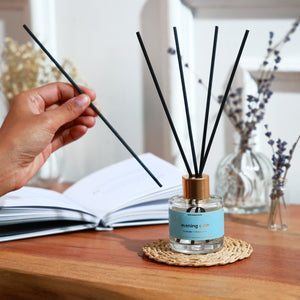


Where it is too impersonal: parents, a spouse, a sibling you speak to weekly, the closest friend. A broadly acceptable bottle is the wrong instrument for a relationship that carries information.
Where it is physically wrong: a one-room flat with a single contested shelf, a home with a crawling child or a cat at grabbing height, and any surface where it would stand near a lit diya — fragrance oil is flammable.
Where it is right: the obligation list. Extended family, colleagues, neighbours, clients, the cousin you see once a year. A 50ml Garden Bloom at ₹799 is the widest-agreement bottle in the range and the one I would buy nine of.
2. Too intrusive: a home you have never been inside. Fragrance fills a space rather than sitting in it. Choosing what someone's living room smells like for the next six weeks, when you have never stood in that living room, is a small imposition. For those names a ceramic dish at ₹664 or an Everyday Beautiful Mug at ₹474 occupies no air at all.
3. Too intrusive: a household that avoids fragranced products, and a home in an unusual season. If somebody has told you they do not use scented things, that is information rather than an objection to be overcome. The same applies to a home with a very new baby or a recent bereavement — that household has enough being decided for it this month.
4. Too safe: the three or four people closest to you. Parents, a spouse, a sibling you speak to every week, the friend of twenty years. A bottle chosen for its broad acceptability is exactly the wrong instrument where you actually hold information about the person. Use what you know. Buy the specific thing.
5. Physically wrong: a one-room flat, a toddler at grabbing height, a surface near a flame. The bottle stands in the open for 6–8 weeks, wants a tray because the oil marks wood and stone, must be kept away from children and pets, and must be kept well clear of any diya or candle, because fragrance oil is flammable.
6. Right for the obligation list, which is most of the names. Extended family, neighbours, colleagues, clients, the cousin you see once a year, the aunt who compares notes with three other aunts. It is non-edible, complete on its own, consumed rather than kept, and rare enough on an Indian gifting table to arrive alone.
7. For anyone who works for you, cash comes first. House help, a driver, security or building staff. Cash is flexible and it is what most people would choose; an object alongside is a courtesy, never a substitute, and the order matters.
Everything is composed and handmade in small batches in Pune, and a portion of every order supports girl-child education through Nanhi Kali.

Part one — the two edges and the physical disqualifiers
Fragrance is unusual among gift categories in failing at both ends of the intimacy scale for opposite reasons. Most gifts get safer as the relationship gets closer; this one gets less appropriate at both extremes and is at its best in the middle, which is a genuinely odd shape and worth understanding rather than memorising.
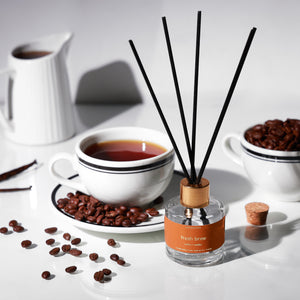
 Fresh Brew₹849 · 50mlEverything that makes Garden Bloom at ₹799 the right choice for nine near-strangers makes it the wrong choice for your mother. You are not short of information about the people closest to you; a widely acceptable gift is what you buy when you have none. Handing one to somebody who knows you well reads, accurately, as a decision that was optimised rather than made. If fragrance genuinely is their thing, the close-relationship version of this gift is a specific one — Fresh Brew ₹849, coffee and vanilla, the most polarising and the strongest in the range, chosen because you know they like it and not despite the risk. Or a 130ml at ₹1,249–₹1,349 for the room you have sat in. Otherwise, buy the thing only you would have thought of, and leave the safe bottle for the list.
Part two — the verdict, relationship by relationship
Seven relationships from an ordinary Diwali list, scored on both risks at once. A gift can fail for being too intrusive, for being too safe, or occasionally for neither and simply being wrong for the flat. The last column is what I would actually put in the bag instead, and no price is given for any category outside our own range.
| The relationship | Too intrusive? | Too safe? | Verdict | What I would give instead |
|---|---|---|---|---|
| The obligation list — aunts, neighbours, colleagues ★ | No | No — safe is the point here | Yes, and it is close to the best answer | Nothing — buy Garden Bloom ₹799, nine times |
| A cousin you see once a year | No — annual contact carries no expectation | No | Yes. Buy 50ml, not 130ml | — |
| A parent, a spouse, a sibling you speak to weekly | No | Yes — you hold information and did not use it | No, unless you know the scent is right | Something specific. If fragrance, a 130ml ₹1,349 you chose |
| A home you have never been inside | Yes — you are deciding about their air | No | No | Mug ₹474 or Cloud dish ₹664 |
| A household that avoids fragranced things | Yes, and they have already said so | No | No, without qualification | Mug ₹474, or a ribbed mug ₹569 |
| A one-room flat, or a home with a crawling child | Not intrusive, but physically wrong | No | No — the flat decides, not the relationship | Jar candle ₹379, used up in an evening |
| Someone who works for you | No | No | Only alongside cash, never instead of it | Cash first. Then a Sandalwood jar ₹449 if you wish |
| The honest caveat: I sell the product this table repeatedly rules out, so read the "no" rows with that in mind rather than the "yes" ones. The pattern underneath is simple and holds for most gift categories: a gift that fills a shared space needs either permission or distance, and the middle of a Diwali list supplies distance in abundance. The people at the top of your list deserve a decision; the people in the middle deserve a good default; and the two are not the same purchase. | ||||
 Garden Bloom · the widest agreement₹799Shop →
 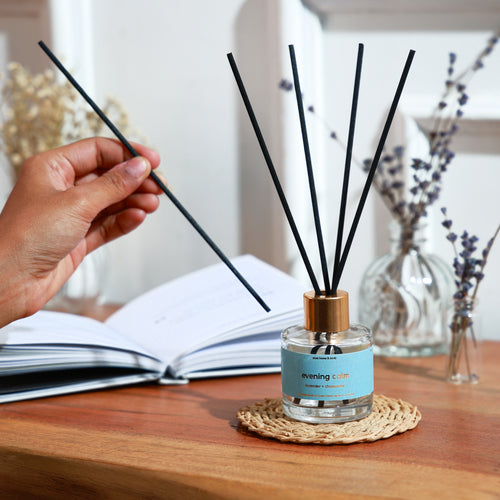 Evening Calm · softest, for a small flat₹799Shop →
  Cozy Corner · lit when they choose₹379Shop →
Part three — why the middle of the list is where it belongs
Having spent three sections arguing against my own product, let me make the case where it holds. The middle of a Diwali list is a set of people you are obliged rather than delighted to buy for, whom you know slightly, who will receive a dozen other things in the same fortnight, and whose homes you cannot audit. That set of constraints eliminates most categories. Food assumes a diet you cannot verify. Decor demands permanent shelf space and a taste judgement. Anything perishable needs fridge space during the one week there is none. A sealed glass bottle survives a car boot, a crowded doorway and three days stacked unopened, and it functions the moment it is stood up.
The property that matters most, though, is that it ends. A gift with a stated life — 6–8 weeks at 50ml, 14–18 at 130ml — discharges itself. Nobody has to display it when you visit, nobody has to explain in March where it went, and nobody owes you a reciprocal ornament. On a list of obligation gifts that repeats every year, that is worth more than beauty. It is also, quietly, the reason I would not push you towards the 130ml for these names: a bigger bottle is not a stronger one, it simply lasts longer, and on a distant relationship a gift that outstays the season is closer to decor than to a courtesy.
One further point that belongs in a page about appropriateness rather than in a product description. A diffuser gifted at Diwali is a gift for the fortnight after the festival, not for the night of it. A house at Diwali is already at maximum fragrance — lamps, incense, flowers, a kitchen running for days, and a great many people. Nothing you send will be noticed in that, and a bottle does not mask, cancel or clean anything; it sits alongside whatever else is in the air. The honest framing is that you are giving somebody the quiet week that follows, once the guests have gone and the house is being put back together. That is a smaller claim than most gift copy makes and it happens to be true.
Part four — read the home, then choose
Seven households, described by what the room is like rather than by who lives in it, because the flat decides this more often than the relationship does. If you cannot answer the first column for a given name, that is itself the answer: choose something that occupies no air.
| What the home is like | Verdict | The pick | Price |
|---|---|---|---|
| A normal 2BHK, adults only, a console by the door ★ | Yes — this is the case it was designed for | Garden Bloom 50ml | ₹799 |
| A small flat, one shared shelf, everything on it | Only the softest, and only 50ml | Evening Calm 50ml | ₹799 |
| A one-room flat with nowhere out of reach | No | Everyday Beautiful Mug | ₹474 |
| A crawling child, or a cat that walks the shelves | No — an open oil vessel is wrong here | Misty Mornings jar candle, put away between uses | ₹379 |
| A home you have genuinely never visited | No — you are guessing about their air | Cloud trinket dish | ₹664 |
| A home you have sat in, whose taste you know | Yes, and you may be specific | Fresh Brew 130ml, 14–18 weeks | ₹1,349 |
| A large open living-dining beyond roughly 300 sq ft | Honestly, reeds are the wrong tool past that | A Sukoon — but only for someone who wants a machine | ₹1,899 |
Versailles
The first Diwali we sold properly, I watched people buy one bottle for every name on a list of fourteen and I was pleased about it for roughly a week. Then the questions started arriving. A one-room flat with nowhere to stand it. A household that had not used anything fragranced in years. A grandmother who had been sent something bright and green when everything else in her home was quiet. None of those were product failures. They were a failure to ask what the room was like before choosing what it would smell like.
What I settled on is the shape you have just read. This is a middle-of-the-list product. It is very good at the job of being correct for someone you know slightly, and it is not the right answer for the people you know best, which surprises buyers because they expect the good gift to scale upward with closeness. It does not. Closeness deserves specificity, and specificity is not something I can sell you from a category page.
I will not tell you that any bottle will be appreciated or remembered; I have no way of knowing that and neither does anyone who writes gift copy. I can tell you what it does, how long it lasts, what it needs from a home, and the six situations in which I would tell you to buy something else — including two where I would tell you to buy nothing from me at all. Everything is made in Pune in small batches, and a part of every order funds a girl's classroom through Nanhi Kali.
Frequently asked questions
- What not to gift — the four failure modes, SOSA included.
- Gifting someone who doesn't celebrate and gifting your boss.
- How much to spend — by relationship distance rather than by category.
- The Diwali gifting etiquette guide — direction, distance and visibility, end to end.
- Brand: the SOSA founder story.
SOSA range & prices used in this guide (verified from the live store, 27 August 2026): Reed diffusers — alcohol-free, phthalate-free, paraben-free, IFRA-compliant compositions on a heat-stable coconut-derived (CCT) carrier, in a refillable glass bottle with six fibre reeds; 50ml lasts 6–8 weeks, 130ml lasts 14–18 weeks. Morning Freshness 50ml ₹749 · 130ml ₹1,249; Garden Bloom ₹799 · ₹1,299; Evening Calm ₹799 · ₹1,299; Fresh Brew ₹849 · ₹1,349; Mountain Breeze ₹849 · ₹1,349. Duo sets: Day & Night ₹1,498, Fresh & Grounded ₹1,548, Warmth & Bloom ₹1,598 (2 × 50ml); ₹2,498–₹2,598 (2 × 130ml). Oil-only refills 300ml ₹2,399 · 500ml ₹3,499 (vessel and reeds not included). The least expensive SOSA reed diffuser is ₹749 — no reed diffuser exists below that price in any size. Below it: scented jar candles from ₹379 (roughly 15–18 hours), Sandalwood or Smoked Oudh jar candle ₹449, wax melts ₹474 (a burner is needed and is not included), ceramic mugs ₹474, ribbed and face mugs and taper candles ₹569, Amber Rose candle ₹599, ceramic trinket dish ₹664, candle two-pack ₹664 (roughly 30–36 hours). Machines: Boond 300ml ₹899 · Sukoon 500ml ₹1,899 · Megh 6L ₹3,499 (~215 sq ft, a runtime and humidity machine rather than a coverage upgrade) · waterless Vaayu ₹11,999 · Safar car and travel diffuser ₹3,999. The water-based Hotel Collection (15ml ₹299 · 100ml ₹999 · 300ml ₹1,799) is a fragrance for an ultrasonic machine, not a standalone gift. SOSA publishes no bulk or corporate gifting terms — there is no discount slab, no minimum order quantity, no stated GST-invoicing arrangement, no custom branding service and no published lead time — and SOSA sells no gift card, gift hamper, gift box or curated gift set. Larger orders should be discussed with SOSA directly through the contact page before committing. Gift wrapping, gift notes, direct-to-recipient shipping and delivery timing are unconfirmed — check at checkout rather than assuming them; no delivery date is promised anywhere in this guide. Per-head and total costs shown are arithmetic on the listed prices, not quotations. Fragrance adds scent to a room; it does not clean air, remove cooking or smoke smells, or change how anyone feels. Fragrance oil is flammable — keep any diffuser away from diyas, candles and open flame. Composed and handmade in small batches in Pune, India; tested through 45°C summer heat and 85% monsoon humidity. Free shipping above ₹499. A portion of every order supports girl-child education through Nanhi Kali. Prices subject to change — see the live product pages.