


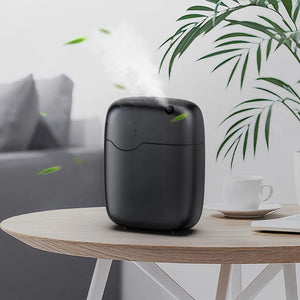
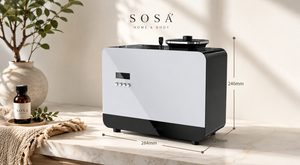
The hardware: three Sukoons at ₹5,697 and a Boond at ₹899, or the hybrid with a Vaayu at ₹17,696.
The discipline: low levels, and every tank done on one circuit a week.
2. The lower floor is the arrival, so it gets the signature. The first four seconds after your front door opens is what the whole house is judged on, and in a duplex that volume is the living, dining, kitchen mouth and foot of the stairs as one body of air. The Ritz-Carlton-inspired — white tea, bergamot and cedar — held permanently, because repetition is what turns a scent into an identity.
3. Let the staircase carry the transition, and give it somewhere to arrive. The stairwell is lifting the ground-floor character upward all evening whether you planned it or not. A Boond at ₹899 on the landing, running that same downstairs bottle and set back from the balustrade, turns a fade into an arrival.
4. Change the character behind every bedroom door above. Three Sukoons at ₹5,697 arrive with nine 15ml Hotel Collection bottles, so the master can hold amber, violet and woods while another room runs cedarwood and vetiver, and each person has their own switch and their own 2H timer.
5. Hold every floor below the level anybody comments on. Downstairs steady or on the 4H timer while people are home; bedroom units on low with the 2H timer, at least 1.5m from the pillow. A hotel that smells strong smells cheap, and so does a house.
A portion of every order supports girl-child education through Nanhi Kali.
What a hotel does that a duplex can copy exactly
Most homes trying to smell like a hotel copy the fragrance and miss the structure, which is the part that actually produces the effect. A hotel is a vertical building with a public ground floor, a transition upward, and private rooms at the top — and its scenting follows that shape rather than fighting it. A flat can approximate this with a corridor. A duplex does not have to approximate anything: it already has the lobby, the stairs and the rooms, in that order, which makes it the closest thing in Indian housing to the building the method was designed for.
The sequence, from the front door to the landing
The method as a walk through the house, in the order a guest experiences it and in the order I would set it up. Copy the settings; the reasoning in the last column travels between houses and the furniture does not.
| Step | What to do | Setting | Why it works |
|---|---|---|---|
| 0. The air itself | Extractor while cooking, ventilated shoe cupboard, dry floors, ten minutes of morning air through both storeys | Free | Every hotel does this before it scents anything, and in a duplex the stairwell will carry whatever you failed to deal with straight up to the landing |
| 1. The open floor below ★ | One signature held permanently — the Ritz-Carlton-inspired, white tea, bergamot and cedar — across the living, dining, kitchen mouth and entrance as one volume, at 90–120cm, central, away from the foot of the stairs | Steady or the 4H timer while people are home; app-scheduled from six in the evening on a Vaayu | The first four seconds after the door opens is what the whole house is judged on, and repetition is what turns a scent into an identity |
| 2. The staircase | Nothing on it at all, and nothing at the foot of it | — | It is a route rather than a room, and anything placed there is placed in the strongest draught in the house. The climb is meant to thin the ground-floor character, not restate it |
| 3. The landing | A Boond at ₹899 running the downstairs bottle, set back from the balustrade on the bedroom-door wall | Low | It is where the two storeys meet and where a guest arrives after climbing. Continuing the ground floor here turns a fade into an arrival |
| 4. The master bedroom above | The St. Regis-inspired — amber, violet, woods — on the far side of the room from the landing door, across from the pillow and at least 1.5m away | Low, 2H timer | Richness is comfortable behind your own door because you are conscious there for two hours rather than sixteen. The threshold change is what makes the house read as a sequence |
| 5. The other bedrooms and any guest room | Whatever their occupants choose — 1 Hotels-inspired for anybody who finds sweetness heavy; Westin-inspired where a guest sleeps, switched on the day they arrive | Low, 2H timer | Three machines is three people choosing, which no central system offers at any price. A guest cannot leave the room, so that one is scented for them rather than by you |
 Hotel Collection · the charactersfrom ₹299Shop → Vaayu · the arrival floor₹11,999Shop →
  Sukoon · one per bedroom above₹1,899Shop →
Autonomy, neutrality and a refill circuit with stairs in it
The first thing a duplex can do that a hotel cannot is give the people upstairs rooms that smell like something each of them chose. A hotel gives every room the same character because it must; you do not have to, and this is where the analogy stops being an analogy and becomes better than the original. Three Sukoons at ₹5,697 arrive with nine 15ml Hotel Collection bottles of the buyer's choice, and each machine carries its own remote, its own steady, 2H and 4H timers and its own output setting — so the master runs amber, violet and woods on low at eleven at night, a teenager runs cedarwood, vetiver and green leaves because they find florals unbearable, and nobody has to negotiate. Two rules make this work rather than merely possible. Let people genuinely choose, including the choice of nothing at all, because an unscented room somebody has chosen is better than a beautiful one they did not — and in my experience the most common request from teenagers and visiting parents is for less rather than more. And keep each room's bottle in that room, which in a two-storey house is a practical matter rather than a tidiness one: nobody should be carrying fragrance up and down stairs to find out which character belongs where. Autonomy is the one luxury a hotel cannot sell you, and upstairs in a duplex it costs nothing extra, because the bottles arrive with the machines.
The second discipline is neutrality, and in a duplex it applies to a room that may be on either floor. A guest bedroom is not scented for you; it is scented for somebody who cannot leave it, did not choose what is in it and has no polite way to say they dislike it. So it takes the quietest thing in the range rather than your favourite — Westin-inspired, white tea, aloe and cedar — on low with the 2H timer, switched on the day somebody arrives rather than run into an empty room for a fortnight beforehand. Many duplexes put that room downstairs off the open floor, which adds a second consideration: it opens onto the volume carrying your ground-floor signature, so anything loud in there will meet the signature at the doorway rather than replacing it. Quiet is doubly right in that position. And if the room is used four times a year, do not put a machine in it at all — a reed diffuser from ₹749, a 130ml bottle at ₹1,299 or the duo set at ₹1,598 keeps it looked-after with no socket, no tank and no weekly routine, and a scented candle from ₹379 handles the evening somebody actually arrives, giving light as well as fragrance, which is closer to what a hotel does than any amount of hardware. The same restraint governs strength everywhere in the house: a hotel holds its fragrance just below the level at which a guest would consciously notice it, because the moment you notice a building's scent as an object you have started evaluating it.
The third discipline decides whether any of this survives past March, and in a two-storey home it has a staircase in the middle of it. Three or four 500ml tanks want emptying, rinsing and a wipe at the misting plate on a regular morning, with filtered or RO water in hard-water cities. Done as one deliberate circuit — collect the upstairs tanks, come down once, do them all at the sink, carry a jug back up rather than a full tank — that is about ten minutes and a habit. Done reactively, whenever a machine happens to run dry, it becomes a rota nobody owns, and the failure mode is not a badly scented house but two machines standing quietly dry by March while the household concludes that home fragrance is fussy work. Three rules make the circuit survivable. Place every unit at 90–120cm on a clear hard surface you can lift from one-handed, because cool mist is denser than room air and descends as it spreads, so height improves coverage and reachability at once. Never layer a new character onto a half-rinsed tank. And buy the running cost properly: a 300ml 300ml refill at ₹1,799 is roughly ₹6 per ml against about ₹20 per ml in 15ml bottles, and one bottle of the ground-floor signature supplies the downstairs tank and the Boond on the landing for months. Which brings the honest hardware question, because the machine generating most of that work is the one at the bottom of the stairs — it runs the longest hours, empties fastest and belongs to nobody. If the weekly circuit is what puts you off, that half of the house has a tank-free answer: a waterless Vaayu at ₹11,999 holds the open lower floor with no tank, no added humidity, under 38dB and a Bluetooth app that scents the arrival volume from six in the evening whether or not anybody is home, while the Sukoons stay upstairs — ₹17,696 all in, ₹15,797 with two bedroom machines, and ₹18,595 with the Boond on the landing as well. It runs undiluted oil rather than the water-based bottles, so check its live product page for what feeds it. And if three Sukoons and a Boond at ₹6,596 is where your budget sits, that is still a house that reads as one designed building, and I would rather you did that well than did the expensive version half-heartedly.
The SOSA duplex edit
The method as a shopping list, with the free steps at the top where they belong. Two of the first three lines cost nothing at all, and the last row is the habit that undoes the whole effect.
| Buy or do | What it does | When it earns its place | Price |
|---|---|---|---|
| 1. Clean air, then height and distance from the stairs ★ | Extraction while cooking, ventilated shoe cupboard, dry floors, morning air through both storeys — then every unit at 90–120cm on a hard surface and as far from the stairwell as the furniture allows | Before anything is bought. It is free and it outranks every product below it | Free |
| 2. Three Sukoons — one below, two above | The arrival floor on one signature and two bedrooms each on a character its occupant chose, with nine 15ml Hotel Collection bottles between them | First hardware purchase, on any budget | ₹5,697 |
| 3. Boond 300ml on the landing, on the downstairs bottle | The top of the climb given somewhere to arrive — the single detail that makes two storeys read as one building | Immediately after the second machine. ₹6,596 for the whole method | ₹899 |
| 4. Vaayu for the open floor below | The arrival volume held evenly with no tank, no added humidity, under 38dB and app scheduling from six in the evening — the storey that generates most of the weekly work | Once upstairs is running, and only after height and central placement have been tried — ₹17,696 in total | ₹11,999 |
| 5. 300ml refill of the ground-floor signature | The scent the front door opens into, never rationed, at roughly ₹6 per ml across the downstairs tank and the landing | After a month, once one of the nine included bottles has clearly won | ₹1,799 |
| Not this: turning everything up | High output makes the air near the machine heavier, feeds the stairwell faster and drops runtime from 16–18 hours to 9–12 on the same 500ml fill | Never. If you have stopped noticing it, that is the effect working | Free to avoid |
Versailles
The duplexes that get closest to this are almost never the ones that spent the most. They are the ones that understood that they already owned the hardest part of a hotel's layout and only had to stop fighting it. I have walked into two-storey houses with beautiful machines on both floors and a shoe cupboard nobody had opened in a month, with the stairwell dutifully carrying that up to the landing all evening. And I have walked into duplexes with two Sukoons, a ₹899 unit at the top of the stairs and windows opened every morning, that smelled better than anything I could have sold them.
Clean the air, hold one character on the floor people arrive onto, let the staircase thin it, give the landing somewhere to arrive, and change the character behind every door above. That is the method, and the hardware only carries it out — ₹6,596 does it honestly, and the hybrid at ₹17,696 does it with far less weekly work in the half of the house that generates most of it. Where I will talk you out of something is strength. Almost every home that asks me why it does not smell like a hotel is running its machines too high, and in a duplex that is worse than elsewhere, because everything extra you produce downstairs goes straight up the stairs and collects where nobody wanted it. Turn it down, and let the building do the work it was already doing.
Everything is made and supported from Pune, and a part of every order funds girl-child education through Nanhi Kali. You get a home that smells like somewhere you chose; a girl gets a classroom. That equation has always felt right to me.
Frequently asked questions
- Best upstairs and downstairs fragrance combination for a duplex — which character on which floor.
- Should different floors of a duplex have different signature scents? — the two-signature rule.
- Where should you place Sukoons in a two-storey home? — height, distance and the landing.
- The complete SOSA Sukoon and Vaayu buying guide for duplex homes — the pillar guide.
- Brand: the SOSA founder story.
Facts verified August 2026: SOSA Sukoon — 500ml tank, 2.4MHz ultrasonic cool mist, 270–320 sq ft coverage, 16–18 hours runtime on low and 9–12 on high, 30–50 ml/h mist output, 7-colour LED, remote and steady/2H/4H timers, BPA-free ABS with auto shut-off and overheat protection, ~17cm high — ₹1,899, including three 15ml Hotel Collection fragrances of your choice. Boond 300ml ₹899; Megh 6-litre ₹3,499. Hotel Collection water-based fragrance 15ml ₹299, 100ml ₹999, 300ml ₹1,799, Pack of 7 × 15ml ₹1,799; 100ml and 300ml refills from ₹999. Seven scents: The Ritz-Carlton-inspired (white tea, bergamot, cedar), Westin-inspired (white tea, aloe, cedar), 1 Hotels-inspired (cedarwood, vetiver, green leaves), The St. Regis-inspired (amber, violet, woods), Shangri-La-inspired (jasmine, green tea, white tea), Four Seasons-inspired (citrus, floral, sandalwood), W Hotels-inspired (citrus, pepper, amber). Waterless systems for larger and connected spaces: Vaayu ₹11,999 (up to 1000m³), Aangan ₹25,999 (8,000–10,000 sq ft), Meenar ₹38,500 (12,000–18,000 sq ft). The Hotel Collection scents are SOSA's own interpretations; SOSA is not affiliated with or endorsed by any hotel brand. Prices subject to change — see the live product pages.