


In the practice hall? Never. Deliberate breathing is the worst audience for ambient scent.
So where? The entrance, reception and corridor — the arrival that precedes relaxation — off at the first Om.
2. It works on the transition. Relaxation starts at the threshold, so that is where a scent can help — the arrival, not the practice.
3. It stays out of the hall. A room of people breathing deliberately is the worst place for ambient fragrance; the Vaayu (₹11,999) runs before class and off at the first Om.
4. It is gentle. A relaxed arrival is quiet, not perfumed — a trace, not a cloud.
5. It compounds, it does not sedate. Scent supports a calm environment; the relaxation itself is the practice’s work, and a clean, aired room comes first.
A portion of every order supports girl-child education through Nanhi Kali.
Relaxation is a descent, and it starts at the door
It is tempting to imagine relaxation as something that switches on when a student sits on the mat, and therefore to reach for anything — a scent, a sound — to trigger it in the practice hall. But that is not how a nervous system unwinds. Relaxation is a gradual descent out of the day’s alertness, and for most students that descent begins the instant they leave the street and cross your threshold. The traffic falls away, the light softens, the air changes. By the time they reach the mat, the settling should already be underway — the practice deepens it; it does not start it from scratch.
This is the key to using fragrance honestly for relaxation. You are not trying to sedate a room; you are trying to smooth the transition that carries a person from outside to inside, from busy to still. A calm, clean note met at the door is a signal to the body that it has arrived somewhere safe, and the body answers that signal below the level of thought. Scent, placed at the arrival, is one of the gentlest ways to help a student begin letting go before they have consciously decided to.
Scent the arrival, not the practice
Here is the distinction that separates a studio that uses scent well from one that undermines its own classes: you scent the arrival that precedes relaxation, never the relaxation itself. The arrival is a public, transitional space — the entrance, the shoe rack, the reception, the corridor — where a considered smell does real, gentle work. The practice is a private, internal act, and the last thing it needs is an external smell competing for the attention a student is trying to turn inward. Fragrance prepares the ground for relaxation; it must then get out of the way and let the breath take over.
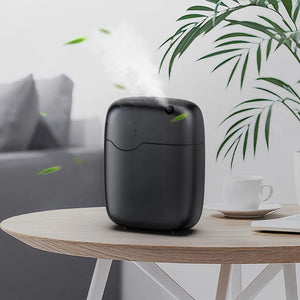
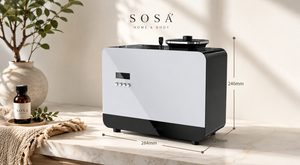
In practice this means running the Vaayu across the threshold before and between classes, with only a trace reaching the changing rooms via a small Boond, and nothing in the hall. Waterless nebulising is the right technology here because it adds no humidity to a space you want cool and clean, and because its timer makes the on-before-doors, off-at-the-Om rhythm effortless. The student walks through a prepared arrival, settles as they change and wait, and steps into a hall that belongs entirely to their breath.
| Zone | Scent level | What it does for relaxation |
|---|---|---|
| Entrance & reception | Signature, gentle | Cues the down-shift on arrival |
| Corridor | A soft trace | Carries the calm toward the changing room |
| Changing rooms | A trace (Boond) | Keeps the settled feeling as they prepare |
| Practice hall | None | Leaves the breath undisturbed — the practice does the work |
Vaayu · the threshold₹11,999Shop → Boond · changing rooms₹799Shop →
 Hotel Collection · the note₹299Shop →
Why the hall must stay clean
It is worth being blunt about why the practice hall stays unscented, because the instinct to “add a relaxing aroma” to the room where relaxation happens is so natural. A yoga hall is a room engineered around breath. Students are asked to breathe slowly, deeply and with attention, often through the nose, sometimes with the eyes closed. An ambient fragrance introduced into that room does not read as calming; it reads as a foreign presence in the exact channel the student is trying to keep clear. At best it distracts. At worst — in a warm room, a crowded class, or for someone sensitive — it can make a person faintly unwell, which is the opposite of relaxed.
Hot yoga makes the rule absolute. At 35 to 40 degrees, fragrance amplifies and behaves unpredictably, and a scented hot room is a genuine risk to how students feel. So the hot room, like every practice hall, stays completely clean; you scent the changing rooms and corridor with a small Boond and put your money into extraction and a proper air-out between classes. Across every style, the logic is the same: relaxation is protected by clean, well-ventilated air in the hall, and helped by a gentle, prepared arrival outside it. The threshold carries the scent; the hall yields to the breath.
The SOSA commercial edit
Put the scent where the calm begins and none where the breath happens. A Vaayu prepares the threshold, a Boond keeps the changing rooms to a trace, and the hall stays clean — with budget spent on ventilation, not diffusion, inside it.
| System | Best for | Why it works | Price |
|---|---|---|---|
| Boond | Changing rooms, washrooms, shoe racks | Small, water-based, keeps side rooms to a trace | ₹799 |
| Sukoon + Hotel Collection | A single small studio reception | Gentle ultrasonic diffusion for one enclosed lobby | ₹1,799 + ₹299 |
| SOSA Vaayu ★ | Reception, entrance, corridor, shoe rack | Waterless, app + timer, up to ~1000m³, under 38dB | ₹11,999 |
| SOSA Aangan | Whole wellness centre via ducting, 8,000–10,000 sq ft | One signature front-of-house, halls on their own zone | ₹25,999 |
| SOSA Meenar | Flagship properties, 12,000–18,000 sq ft | HVAC nebulising for the largest floor plates | ₹38,500 |
| Hotel Collection refills | Keeping the studio running | The real running cost, low and predictable | from ₹999 |
Versailles
The most common request I turn down is “a calming scent for the yoga room itself”. I understand the impulse entirely — it feels generous to fill the room where people come to unwind with something lovely. But I have sat in enough classes to know that a scented hall is a distracted hall.
What works is quieter and, honestly, more elegant. Prepare the arrival so beautifully that a student is already softening before they sit, then give them a hall that is nothing but clean air and their own breath. The scent did its part at the door and had the grace to stop there.
That restraint is the craft. Help the descent begin, then get out of its way. Your students get a practice that stays theirs; a girl gets a classroom through Nanhi Kali.
Frequently asked questions
- Why students remember studios that smell amazing — the arrival, remembered.
- The role of fragrance in luxury wellness studios — restraint as luxury.
- SOSA Vaayu — the waterless threshold standard with a timer.
- Brand: the SOSA founder story.
Facts verified August 2026: the evidence on ambient scent is that effects on mood, dwell and perceived calm are real but moderate, that scent-environment congruence matters more than intensity, and that no fragrance improves an unclean or poorly ventilated space — which is why the practice hall stays clean and the scent lives at the threshold. SOSA systems and prices as stated: Boond ₹799, Sukoon ₹1,799, Megh ₹3,499, Vaayu ₹11,999, Aangan ₹25,999, Meenar ₹38,500, Hotel Collection scents from ₹299, refills from ₹999. The Hotel Collection scents are SOSA’s own interpretations inspired by the world’s finest hotels; SOSA is an independent Indian fragrance house, not affiliated with or endorsed by any hotel brand. Prices subject to change.