


Where the identity goes: the porch and entrance hall, the stair hall, the corridors between wings, the lift lobby, the cloakroom approach. These are transit volumes with no inherited smell to damage, and they are what a member walks through between every other room.
Where it does not go: the library and reading room, the card and billiards rooms, the panelled committee room, the dining rooms and the bar counter, the spa treatment rooms and the gym floor. In an old club that list is longer than in a new one, and that is the point.
The machine: waterless cold-air nebulising, because it adds no water to a building that is usually already holding too much. Vaayu at ₹11,999 covers up to 1000 m³ per unit and has a key-lock, which in a heritage club is the single most useful feature on the specification sheet.
The honest gap: if the brief is “fragrance throughout the club”, no supplier should sell you that, and I would rather place one machine than five. SOSA also publishes no purchasable refill oil for the waterless commercial machines — that fragrance is specified and quoted per property through the contact page.
2. Put the identity in the circulation and nowhere else. The entrance hall, the stair hall, the corridors and the lift lobby have no inherited character to lose. They are also, conveniently, the only spaces every member passes through on every visit, which means a fragrance placed there is experienced more often than one placed in any single room. This is the whole trick: maximum exposure, zero damage.
3. Understand that a closed door is a genuine boundary. This is why the method works at all. Two rooms with a door between them are two olfactory zones, however close they are. An open-plan floor is one volume however irregular its shape. A library with a door that is normally shut can sit twenty feet from a fragranced corridor and remain entirely itself. A library with its door hooked open cannot, and the first thing to specify is not a machine but a door closer.
4. Let the contrast do the work. Perceived strength is set by the step between two spaces rather than by the level in either. A member who walks a faintly fragranced corridor and then opens the library door experiences the library’s own smell more vividly than they did before the scheme existed, because it now arrives as a change. Leaving the character rooms alone does not make them olfactorily invisible. It makes them the most distinctive rooms in the building.
5. Buy transport, set it low, and lock it. Waterless cold-air nebulising — Vaayu ₹11,999 for a zone, Aangan ₹25,999 on the air handling — shatters undiluted oil into a dry nano-mist with no water, no dilution, no added humidity and no residue, which matters more in an old building than in a new one. Set the intensity once, turn the key-lock, and write the setting into the house rules. Alcohol-free, phthalate-free, IFRA-compliant, composed in Pune, and a portion of every order supports girl-child education through Nanhi Kali.

The smell audit: character, neutral, problem
Nothing in this method works until somebody has walked the building with a notebook and written down, room by room, what it actually smells of. This takes an hour and it is free, and it is the single most valuable hour anybody will spend on the project. Do it early in the morning before the building has been opened up and aired, because that is when each room is most itself — whatever a space has been holding overnight is what it releases first. Take the general manager, the head housekeeper and, if you can, a member who has been coming for thirty years, because they will name things the staff have long since stopped registering.
Then sort every room into three columns. Character is a smell the club would miss if it vanished: the dry paper and cloth binding of a reading room, the beeswax and old timber of a panelled corridor, the faint chalk and baize of a billiards room, the particular note a hundred years of pipe smoke has left in plaster that nobody will ever be able to reproduce. Neutral is a space that smells of nothing in particular — most entrance halls, most stair halls, most corridors, most lift lobbies. Problem is a smell that is damp, sour, closed or stale, and it belongs to a different project entirely. Fragrance laid over a problem smell produces a mixture, and the mixture is reliably judged worse than the original because it now reads as concealment. The order there is fixed: find the source, deal with the moisture, get the air changing, clean the absorbent surfaces, and only then consider fragrance.
What usually surprises a committee is how few rooms land in the character column and how many land in neutral. A typical old club has four or five genuine character rooms and fifteen spaces that smell of nothing at all. That is an encouraging result, because it means the scheme has plenty of room to work in without going anywhere near the rooms that matter. It also disposes of the fear that drives most of these conversations: nobody is proposing to perfume the library. Nobody should ever propose to perfume the library.
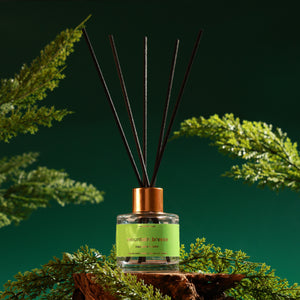
 Mountain Breeze₹849The library, the reading room, the card room, the billiards room and the old committee room are where a club keeps its accumulated self, and the reason they smell the way they do is physical rather than sentimental. Soft and porous mass — paper, cloth, leather, wool carpet, underlay, curtain lining, unsealed timber — takes up odour over years and releases it slowly afterwards, which is why a room can still smell of a habit that stopped two decades ago. That mass is also why these rooms are vulnerable: the same porosity that stored the character will store anything new you introduce, and it will hold it for a long time. A fragrance dosed lightly into a library is not a light decision; it is a permanent one, because the books will keep it.
 Vaayu₹11,999The porch, the entrance hall, the stair hall, the corridor between wings and the lift lobby have three properties that make them ideal. They have no inherited smell to damage. Nobody stands in them long enough to adapt, so a modest level stays perceptible instead of disappearing after ten minutes. And every member passes through them several times a visit, which means a single machine in a corridor is experienced more often than a machine in the club’s best room. Place it in the airflow path rather than the sightline, and never behind the porter’s desk — that position puts the machine among the one group of people who have been breathing it since seven in the morning and can no longer judge it, and it is usually out of the moving air as well.
Aangan₹25,999Every preservation scheme I have seen fail has failed the same way, and it is never a fragrance failure. Two years later a different secretary, a new housekeeper and a well-meaning committee member arrive, nobody remembers why the library has no machine, somebody assumes it was an oversight, and a bottle appears on the windowsill. A scenting scheme only becomes a system when it is written down: the fragrance, the machine positions, the intensity setting, the schedule, the refill cadence, the list of rooms that are deliberately unscented and the reason for each, and one named person who owns the document. The unscented list is the part that needs the reason written beside it, because a rule without a reason is the first thing a new committee deletes.
Vaayu₹11,999The porch, the entrance hall, the stair hall, the corridor between wings and the lift lobby have three properties that make them ideal. They have no inherited smell to damage. Nobody stands in them long enough to adapt, so a modest level stays perceptible instead of disappearing after ten minutes. And every member passes through them several times a visit, which means a single machine in a corridor is experienced more often than a machine in the club’s best room. Place it in the airflow path rather than the sightline, and never behind the porter’s desk — that position puts the machine among the one group of people who have been breathing it since seven in the morning and can no longer judge it, and it is usually out of the moving air as well.
Aangan₹25,999Every preservation scheme I have seen fail has failed the same way, and it is never a fragrance failure. Two years later a different secretary, a new housekeeper and a well-meaning committee member arrive, nobody remembers why the library has no machine, somebody assumes it was an oversight, and a bottle appears on the windowsill. A scenting scheme only becomes a system when it is written down: the fragrance, the machine positions, the intensity setting, the schedule, the refill cadence, the list of rooms that are deliberately unscented and the reason for each, and one named person who owns the document. The unscented list is the part that needs the reason written beside it, because a rule without a reason is the first thing a new committee deletes.
Why the circulation is the right place to spend
There is a practical argument for the circulation as well as a preservation one, and it is the argument that usually wins committee votes. Corridors, halls and stairs are the cheapest square footage in the building to treat and the most frequently occupied. A member who visits twice a week and sits in the lounge for three hours each time spends perhaps six hours a week in that lounge — but they cross the entrance hall four times, walk the corridor eight times and use the stair a dozen times. The fragrance in the corridor is therefore encountered far more often than the fragrance in the lounge, and encountered with a nose that has not adapted, because nobody stands still in a corridor. You are buying frequency and freshness at the same time.
There is also a perceptual argument that matters more in an old building than a new one. The nose reports change rather than constancy: an unvarying smell stops being registered while it is still physically arriving. A member who walks from a still, cool, faintly fragranced corridor into a library that smells of paper does not experience the library as neutral. They experience it as a distinct place, because the step between the two spaces is what the nose is built to notice. Scenting the circulation and protecting the character rooms is therefore not a compromise between two goals. It is a single arrangement in which each half makes the other more legible.
One caution, because it comes up in every one of these projects. An old club very often has an open stair well or a light well at the centre of the plan, and those behave as chimneys: warm air rises through them and carries fragrance to floors nobody intended to treat. If your library is on the first-floor gallery above a fragranced hall, and the stair is open, the door is not a boundary at all — the air is coming up past the door frame. In that plan the machine goes on the corridor away from the stair, or into a return that serves the ground floor only, and you test it with the doors in their normal positions before anything is fixed permanently. Reasoning in volume rather than floor area matters here too: a galleried hall with a stair open to the floor above is one tall volume, not two modest ones, and it consumes coverage that a square-foot figure hides entirely.
The old club, room by room
This is the table I would take to a house committee in a heritage property. It is organised by whether the room has a smell worth keeping, because in an old building that question decides more than function or footfall does. The unscented rows are not a caveat at the bottom — they are half the scheme, and a proposal that lists only what it wants to install is a quotation rather than advice.
| Space | What it already smells of | Classification | What to do | What serves it |
|---|---|---|---|---|
| Porch, entrance hall, stair hall ★ | Usually nothing in particular | Neutral | The signature, clearly legible for fifteen seconds | Vaayu in the airflow path, or an HVAC return |
| Corridors between wings, lift lobby | Carpet, and whatever the nearest room releases | Neutral | Same identity, light and continuous | The best value in the whole scheme |
| Cloakroom approach, washrooms | Cleaning products | Neutral | Clean and bright rather than woody | Reeds are genuinely right at this scale |
| Members’ lounge, drawing room | Upholstery, carpet, decades of use | Partly character | Same identity, below the level anyone would name | Aangan on the air system, or a zone unit set low |
| Library, reading room | Paper, cloth binding, dry timber | Character | Nothing. Carry the identity in the corridor outside | A door closer, not a machine |
| Card room, billiards room | Baize, chalk, timber, a century of plaster | Character | Nothing | Air change on the days it is used |
| Panelled committee room | Wax, timber, old textile | Character, and a captive audience | Unscented by default | The corridor outside does the work |
| Dining rooms, private dining, bar counter | The kitchen, correctly | Leave neutral | Unscented | Nothing. The chef and the sommelier are right |
| Gym floor, spa treatment rooms | Exertion; the therapist’s own oils | Problem, and character | Unscented | Air change on the gym; nothing in treatment |
| Rooms that smell damp or sour | Moisture in absorbent material | Problem | Building work, in the fixed order | No fragrance until it is resolved |
Hall and corridor · Vaayu₹11,999See it → Air system · Aangan₹25,999See it → Larger property · Meenar₹38,500See it →
What is specifiable, and what has to be quoted
Three mechanisms exist and they are not grades of the same thing. A reed diffuser is a passive capillary device: oil climbs six fibre reeds and evaporates, with no energy used and no air moved, which makes it a fragrant zone roughly a couple of metres across rather than a fragranced room. On a hall console or in a cloakroom of an old club that is exactly the right instrument, and it has the additional virtue of being visibly removable if a member objects. In a large panelled lounge it is not underperforming; it is doing what a passive device does, and ten bottles produce ten small hills with valleys between them rather than one plateau. An ultrasonic machine — Sukoon ₹1,899 at 270–320 sq ft, Boond ₹899 at up to about 150 sq ft — disperses oil diluted in water, so it covers a real room but adds humidity and can leave a fine white mineral deposit. In a heritage building with timber panelling, paper and textiles, adding airborne water is the last thing the fabric needs, and I would not specify it in a character room under any circumstances.
Waterless cold-air nebulising is the commercial answer, and in an old building it is also the conservation-friendly one. Pressurised air shatters undiluted oil into a dry nano-mist that the building’s own airflow carries; there is no water, no dilution, no added humidity and no residue, and the tank is sealed, which is what makes a machine safe to mount near joinery and electrics. Vaayu at ₹11,999 is the zone machine, rated to up to 1000 m³, with a Bluetooth app and onboard buttons, run windows of 1h, 4h, 8h or 24h, day selection, adjustable intensity, auto-stop and a key-lock, under 38 dB, a 400ml tank lasting up to about 90+ days depending on intensity and hours, and CE, RoHS and SGS certification. Aangan at ₹25,999 is the building machine, rated to up to 3,000 m³ when connected into the HVAC or air handling unit, with an 800ml reservoir, under 42 dB, DC 12V at 14W, a metal body of 3.9 kg at 284 × 125 × 246 mm, black or white, one-year warranty, imported, and an intelligent programmable board with work and pause cycles and daily schedules rather than a phone application. Meenar at ₹38,500 is the larger-property option and is specified on enquiry.
Two things to settle before a specification meeting, because both save an argument later. The connection to an air handling unit is a genuine mechanical integration: the machine introduces its mist into air the building is already moving. It is not a digital integration, and none is offered on any SOSA machine — there is no building-management interface, no automation protocol and no smart-home connection of any kind, and it is better to say so now than at commissioning. And on the fragrance itself: no purchasable refill oil is published for the waterless commercial machines. The composition is specified and quoted per property through the contact page, which in a heritage club is an advantage rather than an evasion, because the brief in an old building is genuinely specific — it has to sit beside timber and paper without competing with either.
The scheme in buying order — and the two gaps
If a heritage club asked me to write the order of work, this is the sequence, and the first two lines cost nothing. There are also two things this range does not contain that come up in nearly every heritage conversation, and they belong in the table rather than in a footnote at the end.
| Step | What it is | Why it comes here in the order | Cost |
|---|---|---|---|
| 1. Walk the building and write the audit ★ | Room by room, early morning: character, neutral or problem | Because you cannot protect a smell nobody has written down | No purchase |
| 2. Fix anything in the problem column | Source, moisture, air change, cleaning of absorbent surfaces | Fragrance over a damp smell produces a mixture that reads as a cover-up | No purchase |
| 3. Write the unscented list, with reasons | Library, card room, billiards, committee room, dining, bar, gym, treatment rooms | A rule without a reason beside it is what the next committee deletes | No purchase |
| 4. Door closers on the character rooms | A closed door is the only real olfactory boundary in the building | The protection is joinery before it is fragrance, and it is cheaper | Not a SOSA supply |
| 5. Vaayu in the entrance and stair hall | Up to 1000 m³, in the airflow path or an HVAC return, key-locked after setting | The circulation carries the whole identity, and this is often the only machine needed | ₹11,999 |
| 6. Aangan only if the circulation is one air system | Up to 3,000 m³ on HVAC, 800ml, programmable work and pause cycles and daily schedules | Worth it only where the air handling genuinely serves the corridors and not the protected rooms | ₹25,999 |
| No leather, and no listed commercial refill: the honest gaps | SOSA publishes no leather fragrance in any format, and no tobacco or smoky fragrance for any diffuser — the two directions heritage clubs ask for most. No purchasable refill oil is listed for the waterless machines either; that fragrance is specified and quoted per property | Said plainly, because a house committee will check both, and because in an old building the better answer was never an imitation of the timber and leather already in the room | Quoted |
Versailles
The oldest club I have worked in had a reading room on the first floor with a bay window, twelve hundred books, and a smell I could have described from memory a year later. The committee had asked me to propose a signature scent for the whole property, and the first thing I did was ask whether they had ever considered that the reading room was already the best-smelling room in the building. There was a long pause, and then the club secretary said that nobody had ever thought of it as a smell at all. That is the usual position. A smell you have known for thirty years stops being a smell and becomes the room.
What we did was put one machine in the entrance hall, nothing in the corridor for the first two months, and nothing upstairs at all. The reading room door, which had been propped open with a brass wedge since before anyone could remember, got a closer. Members noticed the hall. Two of them told the secretary the reading room seemed to smell stronger than it used to, which was the whole point and was also not true — nothing had changed in that room except that they were now arriving into it from somewhere else.
The part I would press on a committee is the writing down. Whoever sets the intensity will be a member of staff who has been in the building since early morning and stopped registering the fragrance before the doors opened; the signal is still arriving, the brain has simply stopped reporting it. So set it once, turn the key-lock, write the setting into the house file, and check it only by walking in from outside with somebody who has not been in the building that day. Write the unscented rooms down in the same document with a sentence of reasoning beside each one, because the rule you do not explain is the rule your successor removes. Everything we make is composed in Pune, and a part of every order funds a girl’s classroom through Nanhi Kali.
Frequently asked questions
- What a heritage club should smell like — the family pillar, and the character worth keeping.
- Wood, leather and books and the four directions examined — what exists, and what does not.
- Musty versus aged — the distinction, and the moisture work that separates them.
- Heritage versus contemporary and the hundred-year-old club — how much age really changes.
- The modern social club, marble, glass and metal, and architecture as the driver.
- Brand: the SOSA founder story.
SOSA commercial scenting — facts verified August 2026: Vaayu ₹11,999, waterless cold-air nebulising, coverage up to 1000 m³ ≈ 2,000–3,000 sq ft, 400ml refillable sealed tank lasting up to about 90+ days depending on intensity and hours, Bluetooth app plus onboard buttons, run windows of 1h / 4h / 8h / 24h, day selection, adjustable intensity, auto-stop and key-lock, under 38 dB, freestanding, wall-mounted or HVAC-return mounting, DC 12V / 1A at 5W, CE, RoHS and SGS, black and white. Aangan ₹25,999, HVAC or AHU connection or standalone wall-mount or lay-flat, coverage up to 3,000 m³ ≈ 8,000–10,000 sq ft, 800ml reservoir, under 42 dB, DC 12V at 14W, intelligent PCB with programmable work and pause cycles and daily schedules, metal body 3.9 kg at 284 × 125 × 246 mm, black or white, one-year warranty, imported; it has no app and no Bluetooth, and no certifications are published for it. Meenar ₹38,500 is the larger-property option and is specified on enquiry; no coverage figure is published for it here. Ultrasonic machines: Sukoon ₹1,899 at 270–320 sq ft, Boond ₹899 at up to about 150 sq ft, Megh ₹3,499 with a six-litre tank and around 100 hours of runtime but only about 215 sq ft of coverage. Reed diffusers ₹749–₹849 for 50ml lasting 6–8 weeks and ₹1,249–₹1,349 for 130ml lasting 14–18 weeks, six fibre reeds, alcohol-free, phthalate-free, paraben-free, IFRA-compliant, 0 ppm formaldehyde, heat-stable CCT carrier, refillable glass bottle, tested at 45°C and 85% RH, composed in Pune. The Hotel Collection fragrance oils are water-based and ultrasonic-only at 15ml ₹299, 100ml ₹999 and 300ml ₹1,799; they are not for reed diffusers and not for the waterless commercial machines. No purchasable refill oil is listed for the waterless commercial machines — that fragrance is specified and quoted per property. SOSA publishes no leather fragrance in any format and no tobacco or smoky fragrance for any diffuser. SOSA sells no air purifier, no dehumidifier and no room spray for interiors, and makes no health, air-quality, VOC or mould claim. No dealer programme, reseller margin, trade price, territory or service contract is published. Free shipping above ₹499. A portion of every order supports girl-child education through Nanhi Kali. SOSA is an independent Indian fragrance house; the Hotel Collection scents are SOSA’s own interpretations inspired by the world’s finest hotels, and SOSA is not affiliated with or endorsed by any hotel brand. Prices subject to change — see the live product pages.