


Next: bin specification and emptying frequency, AC filter and drain pan, damp under basins, a laundering rota for toys and cushions that actually happens.
Then the visual work: lamp temperature and glare, an uncluttered desk, seating arranged so parents are not knee-to-knee, and a wait time somebody says out loud.
Tenth: a light dry note at the desk — reception only, nothing clinical.
2. Fix the bins, not the smell of the bins. In a paediatric clinic the two odour sources that matter most are the nappy-change bin and the sharps and dressing waste in the injection room. Both need a lidded bin sized so it is emptied because it is full, not because someone remembered; a liner changed at every empty; and a frequency written into the housekeeping schedule rather than left to judgement. A bin emptied twice a day and wiped down once is a different building from a bin emptied at closing.
3. Wash the AC filter and clear the drain pan. Air conditioning cools; it does not ventilate. It recirculates the same air through a filter and across a cold coil that condenses water into a pan, and both the filter and the pan are common odour sources once they have been left. The characteristic smell of a clinic that gets worse ten minutes after the AC starts is almost always this. Put filter cleaning on a schedule with a date written on the unit, and have the drain checked at the same time.
4. Deal with the damp you have stopped noticing. Under the washbasins, behind the water cooler, around the floor trap in the treatment room, and the corner of the play mat that gets mopped daily and never dries. Damp is a slow, low-level odour source that staff adapt to completely and visitors register within seconds. A torch and ten minutes on a Saturday finds most of it.
5. Then, and only then, the visible work — and the fragrance last. Change the lamps to a warmer, lower-glare temperature and a child’s skin stops looking drained to an anxious parent. Clear the desk of everything that is not needed in the next hour. Rearrange the seating so families are not knee-to-knee with strangers and prams have somewhere to go. Launder the toys and cushions on a rota that is written down. Tell people how long the wait will actually be. Ambient fragrance is the tenth item on this list, and it only works once the first nine are done.
Made in India, composed by an ISIPCA Versailles-trained perfumer — and a portion of every order supports girl-child education through Nanhi Kali.
Why the cheap changes beat the bought ones, every time
The reason is mechanical rather than moral. Almost everything on the first half of this list removes something: airing removes accumulated air, emptying removes the bin, washing the filter removes what is growing on it, laundering removes what the cushions have absorbed. Fragrance does the opposite — it is additive, contributing pleasant molecules while removing none of the unpleasant ones. In a room with a live odour source, a diffuser does not replace the smell; it joins it. Parents then experience disinfectant and fragrance, or nappy bin and fragrance, which almost everyone likes less than either on its own. That is why the ordering here is not a matter of taste. It is the order in which the physics allows the changes to work.
The second reason is that most of what parents call premium is not olfactory at all. Walk a parent into a reception and the judgements form in the first few seconds: is the light flattering or fluorescent, is the desk clear or buried, is there somewhere to put a pram, does anyone acknowledge me, do I know how long I am going to be here. Those judgements are made before a scent has been consciously registered, and they are the ones that get repeated to other parents afterwards. Fragrance operates in a narrower band: it can quietly confirm the impression the room has already made, and it can loudly contradict it, but it cannot create it. Scent is a finishing move, not an opening one, which is exactly why it sits at the bottom of a list you work through in order.
The ten changes, grouped by what they cost you
 Do these first₹0One: air the clinic for an hour before opening, windows and doors, every day, and again at lunch if the building allows it. Two: empty the nappy-change and injection-room bins on a written frequency rather than on judgement, with a liner change each time. Three: clear the reception desk of everything not needed in the next hour — files, samples, a dead plant, three pens in a cup. Four: have someone say out loud how long the wait will be, and update it. These four cost nothing and are the difference between a clinic that reads as run and one that reads as merely open.
Zone by zone, for a clinic upgrading without builders
Most of the work in this table is not fragrance at all. The rows marked no are not compromises — they are where the cheap non-olfactory changes do all of the lifting.
| Area of the clinic | Scented? | Why | What we would use |
|---|---|---|---|
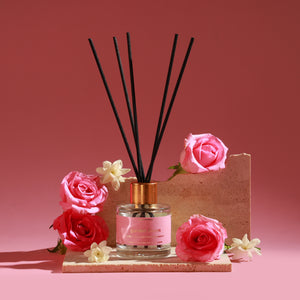
| Entrance and reception desk ★ | Yes, low — last | A clear desk, warm light and aired air do most of it; a reed finishes it | Reed ₹749, or Sukoon ₹1,899 for a larger room |
| Waiting seating | Only at minimum | Layout, light and laundered cushions matter far more here than any scent | Shared with reception; rearrange the chairs first |
| Play area and toy corner | No | Soft furnishings are odour reservoirs — the fix is a laundering rota, not a diffuser | Nothing — wash the toys weekly |
| Consultation and examination rooms | No | Clinicians rely on their own sense of smell; ventilation and surface cleaning are the upgrade here | Nothing |
| Vaccination, injection and nebulisation rooms | Never | Respiratory patients, and the risk of a scent becoming associated with an injection | Nothing |
| Nappy-change, WC and neonatal follow-up | Never | Bin specification, extract fan and emptying frequency — an odour source, not a scent slot | Nothing — fix extraction |
| Before any of this: work the list in order. Airing, bins, filter, drain and damp come before anything is bought, because each of them removes an odour and fragrance removes none. | |||
Small reception · no power neededFrom ₹749Shop →  Mid reception · has an off switch₹1,899Shop →
 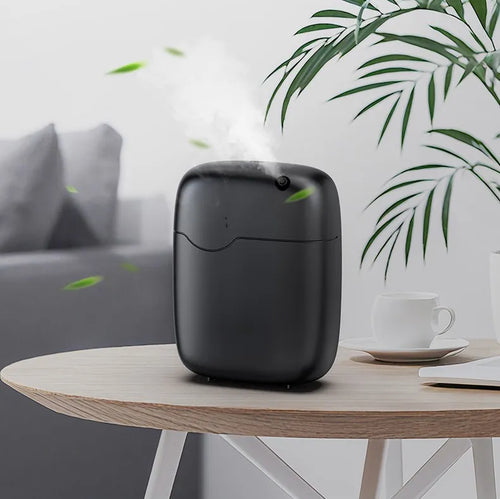 Large lobby · timed, dialable₹11,999Shop →
If you get to number ten: how to keep it in tenth place
Buy the smallest thing that reaches the room. A reception desk and a small waiting bank is a reed on three reeds, not six — reeds are the only control a passive diffuser has, and three is the clinic setting. A reception of roughly 270 to 320 sq ft is a Sukoon at ₹1,899 on three drops in intermittent mode. Nothing larger belongs in a clinic that has not first justified it by volume; a machine rated for a large lobby will spend its life being turned down.
Set it once, with a nose that has been outside for thirty minutes, and record the setting. Olfactory adaptation is essentially complete within about twenty minutes, so nobody who has been in the building since morning can judge this — and because they cannot smell it, they ask for more. That is the commonest route from a light, correct installation to an over-scented reception. Write the drop count on a card next to the unit. Re-check a fortnight later, from outside, and reduce rather than increase if there is any doubt.
Keep it in reception, keep it switchable, and tell people. Nothing in a consultation, examination, vaccination, injection, nebulisation, neonatal, procedure or isolation area, and no second unit in the play corner. A plainly worded line at the desk saying that reception carries a light fragrance and staff will switch it off on request turns a possible complaint into evidence that the clinic thinks carefully. And take the decision through your own clinical governance, infection-control and housekeeping leads — this is guidance on ambience, not clinical advice.
What we would actually install
If you have reached item ten, this is the whole shopping list. It is deliberately small, and the final row is here because for a well-aired, well-cleaned clinic it remains the right answer.
| Option | Suits | Control you get | Price |
|---|---|---|---|
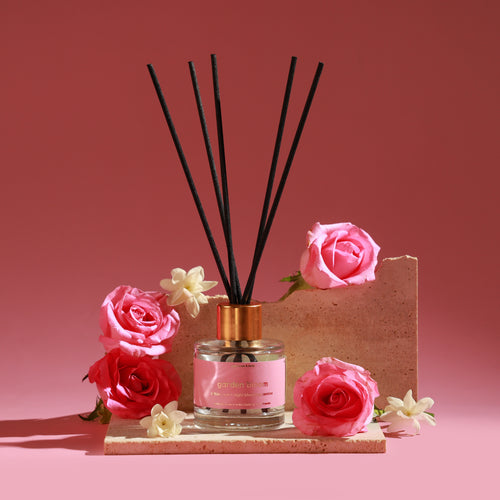
| Reed diffuser ★ | A small reception desk — a reception desk or a room up to about 150 sq ft; three reeds, no power, no settings to creep upwards | Reed count only — no switch, no timer | from ₹749 |
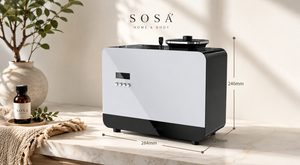
| Sukoon 500ml | A reception up to ~320 sq ft — a reception of roughly 270 to 320 sq ft; three drops, intermittent, and an off switch anyone can reach | On/off, intermittent mode, you control the drops | ₹1,899 |
| Vaayu | A large lobby or a zoned duct — a large reception past ~600 sq ft, where a passive source genuinely cannot hold an even level | Duty cycle in seconds, timer, app scheduling | ₹11,999 |
| Aangan | Whole-facility HVAC — a 8,000–10,000 sq ft facility whose ducting is zoned well enough to exclude every clinical room | Zone-level control, but only if the ducting is zoned | ₹25,999 |
| Nothing at all | Any clinic that has just done items one to nine properly — very often the room no longer needs anything, and that is a result, not a failure | Complete — and the correct answer more often than the trade admits | ₹0 |
Versailles
The Monday-morning version of this question is the one I remember. A clinic owner in a genuinely nice reception, asking me which fragrance to buy, with a bin four feet away that had not been emptied since Friday and an AC that had been off for thirty-six hours. Nothing I sell would have improved that room as much as opening the windows for an hour. I told her so, and she was, to her credit, not offended.
The unglamorous items are the ones that work, and they are unglamorous precisely because they remove things rather than add them. Airing removes yesterday’s air. Emptying removes the bin. Washing the filter removes whatever is living on it. Laundering the toys removes what a hundred children have left in them. Fragrance cannot do any of that, and a supplier who lets you believe otherwise is selling you a second smell on top of your first one.
When the list is genuinely done — and it takes a fortnight, not a renovation — a light dry note at the desk is a real and worthwhile detail. Not a signature, not something a parent can name; just a clean, quiet finish on a room that has already earned it. Keep it out of every clinical area, keep it below the level anyone remarks on, be willing to switch it off for a family who asks, and put the decision through your own governance people rather than through me. A portion of every order funds a girl’s classroom through Nanhi Kali.
Frequently asked questions
- Improving a first impression without renovating — the reception-desk version.
- Better ambience without strong fragrance — what to change instead.
- Why the clinic smells stale at opening — air changes, and the fix.
- Do toys and cushions hold odour? — yes — and what to do about it.
- Brand: the SOSA founder story.
SOSA products & prices (verified August 2026): Hotel Collection water-based ultrasonic diffuser fragrance 15ml ₹299 · 100ml ₹999 · 300ml ₹1,799 · Pack of 7 (15ml, all fragrances) ₹1,799; refills 100ml from ₹999. Seven scents: The Ritz-Carlton-inspired (white tea · bergamot · cedar), Westin-inspired (white tea · aloe · cedar), 1 Hotels-inspired (cedarwood · vetiver · green leaves), The St. Regis-inspired (amber · violet · woods), Shangri-La-inspired (jasmine · green tea · white tea), Four Seasons-inspired (citrus · floral · sandalwood), W Hotels-inspired (citrus · pepper · amber). Diffusers: Boond 300ml ₹899 · Sukoon 500ml ₹1,899 · Megh 6L ₹3,499. Water-based, phthalate-free, composed to IFRA standards for home diffusion; 3–6 drops per tank. Made in India, Pune. The Hotel Collection scents are SOSA's own interpretations inspired by the world's finest hotels; all hotel names are trademarks of their respective owners and are used only to describe the scent style — SOSA is an independent Indian fragrance house, not affiliated with or endorsed by any hotel brand. Prices and availability subject to change — see the live product pages.