




The six white florals are: jasmine, tuberose, gardenia, orange blossom/neroli, ylang-ylang, and magnolia/champa. They are one family because they share a chemistry, not a colour.
The honest gap: SOSA makes one of the six. There is no tuberose, gardenia, ylang-ylang, magnolia or champa reed diffuser in this range, and none is planned in the scope of this guide. We would rather make one white floral properly than five thin ones.
If you want the softness rather than the headiness: Evening Calm at ₹799, the gentlest thing we make at 8.9.
- The straight answer
- What a white floral is — the chemistry, and the first three flowers
- The other three: orange blossom, ylang-ylang, magnolia and champa
- The six white florals, compared
- Buying the five we do not make — and running the one we do
- The white floral edit, and the honest gap
- A note from Sonal
- FAQs
2. The family is defined by a molecule, not by a colour. The six white florals are the indolic flowers — jasmine, tuberose, gardenia, orange blossom, ylang-ylang, magnolia and champa. Indole and its heavy relatives are what make all of them read creamy, warm and faintly animalic rather than green and transparent. Lily of the valley is white and is not in this family; champa is not white at all and is.
3. The same chemistry is why every one of them is difficult in an Indian room. Heavy molecules evaporate faster as temperature rises, so a white floral does not fade in summer the way a citrus does — it grows, and then it tips. Garden Bloom is formulated with indole held below the threshold at which it turns, which is the whole reason a buyer in Bengaluru can write that it stayed floral through an April she expected it to ruin.
4. Use fewer reeds than you think. White florals amplify in small warm rooms in a way that no other family does. Three reeds in a bedroom, two in a bathroom, five or six only in a hall or a living room. This is free, it takes thirty seconds, and it prevents most of the complaints people make about white florals being overwhelming.
5. If you want a different one of the six, buy it knowingly. Gardenia and tuberose are the two most heavily reconstructed materials in home fragrance. An inexpensive one is almost certainly synthetic — which is not disqualifying, and some reconstructions are lovely, but it is worth knowing before you pay a natural price for it.
Alcohol-free, phthalate-free, made in Pune. A portion of every order supports girl-child education through Nanhi Kali.

What a white floral actually is — and the first three of the six
Buyers use the term constantly and almost nobody defines it, which produces a peculiar situation: a phrase that reliably describes a smell, used by people who could not tell you which flowers are in it. So here is the definition I work to. White floral is not a colour, it is a chemistry. The flowers in this family are the indolic ones — they are unusually rich in indole and in a handful of related heavy, slightly animalic molecules that plants produce to attract night-flying pollinators. That is not decoration; it is the whole reason the family exists as a category. Indole smells floral and alive at low concentration and frankly fecal above a threshold, and every white floral is a negotiation with that fact.
This chemistry explains three things at once, which is why it is worth learning. It explains why the six smell alike in a way that has nothing to do with their note lists: creamy, heady, warm, closer to skin than to a garden. It explains why they behave alike in a room — heavy molecules move slowly, sit at nose height and grow rather than fade as the air warms, so a white floral in a shut Indian bedroom in May is a different object from the same bottle in December. And it explains the pattern I see in every customer conversation: people who love one white floral almost always love several, because what they are responding to is not jasmine or tuberose specifically but the indolic register itself. Somebody who tells me they adore mogra and cannot bear lily is not being inconsistent. They are describing the family line precisely.
There are six in practice. The first three are the ones people mean most often when they say the phrase, so those get the cards below; the other three follow in the next section.
 Garden Bloom₹799Jasmine sambac is the white floral this country actually lives with — strung in garlands, worn in hair, sold at temple gates by the arm's length, and opening at dusk rather than in the morning. It is creamier and warmer than the grandiflorum jasmine used in French perfumery, less green at the top, with a faint tea-like dryness underneath the richness. It is also the most forgiving of the six in a warm room, provided the indole is controlled; uncontrolled, it is the flower that gives the whole family its bad reputation, because the same molecule that makes it smell alive at dusk makes it smell like something died when the room hits 34°C. This is the one SOSA makes, in Garden Bloom at ₹799 for 50ml and ₹1,299 for 130ml, paired with a British garden rose rather than left to stand alone.
The other three — orange blossom, ylang-ylang, magnolia and champa
Orange blossom and neroli are two different materials from the same tree, which is the single most common confusion in the whole family. The bitter orange tree gives neroli when its flowers are steam-distilled — bright, green-honeyed, slightly metallic, the freshest thing in the white floral family — and orange blossom absolute when they are solvent-extracted, which is a heavier, sweeter, more honeyed and considerably more indolic material. Sold as a home fragrance the two behave very differently: neroli holds its shape in heat about as well as any white floral does, while orange blossom absolute grows and sweetens and can turn cloying in a shut room. It is a large enough subject that it has its own page in the citrus and orange blossom guides, where we cover the distinction in full. The short version for this page: SOSA's reed line contains no orange blossom and no neroli.
Ylang-ylang is the tropical one, and the one most likely to catch a person out. It is custardy and banana-like at the top — genuinely banana, not a poetic approximation, because it shares esters with the fruit — over a rubbery, faintly medicinal floral body and a soft sweetness that lingers. Of the six it is the most likely to read as suntan lotion in a warm Indian room, because monoi and tiare compositions lean on it heavily and your nose learned it there first. That association is not a flaw in the flower; it is a fact about where you met it. Ylang is also, unusually for this family, generally the real thing rather than a reconstruction, because it distils readily and cheaply in Madagascar and the Comoros. SOSA makes no ylang-ylang reed diffuser.
Magnolia and champa sit at the family's green edge, and are the ones I would suggest to somebody who finds the other five oppressive. Magnolia is lemony and creamy at once, with a clean citral lift over the indolic body — the closest a white floral gets to fresh without leaving the family. Champa, the frangipani-adjacent Indian flower most people know from temple garlands and agarbatti, is warmer and slightly more powdery but shares that same greener, more lifted quality. Both are more forgiving in heat than tuberose or orange blossom absolute, because the citral component reads as cool and offsets the weight. Champa in particular is very often a reconstruction in home fragrance, and a heavily perfumed one. SOSA makes neither a magnolia nor a champa reed diffuser, and neither is planned in the scope of this guide.
The six white florals, compared honestly
The whole family in one table — what each flower smells like, how it behaves specifically in an Indian room, how often the version you will be sold is genuinely natural, and whether SOSA makes it. One row of six says yes. I would rather print that table than pretend otherwise.
| Flower | Character | In an Indian room | How often it is natural | Does SOSA make it? |
|---|---|---|---|---|
| Jasmine (sambac / mogra) | Creamy, warm, night-blooming, tea-dry underneath | Holds if the indole is controlled; turns badly if it is not | Often genuinely natural — sambac is available, if costly | Yes — Garden Bloom ₹799 / ₹1,299 |
| Tuberose | Buttery and waxy, almost mentholated at the top; the loudest flower there is | Amplifies hardest of the six — the one that becomes "too much" | Rarely — one of the two most reconstructed materials in home fragrance | No — and none planned in this guide's scope |
| Gardenia | Creamy with a savoury, mushroomy green edge | Goes flat or sour in heat when built cheaply | Almost never — the absolute is prohibitively difficult | No — and none planned in this guide's scope |
| Orange blossom / neroli | Two materials, one tree: honeyed and indolic, or bright and green | Neroli holds its shape; the absolute sweetens and can cloy | Both genuinely available as naturals | No — and none planned in this guide's scope |
| Ylang-ylang | Banana-like, custardy, tropical, faintly rubbery | Most likely of the six to read as suntan lotion | Usually natural — it distils readily and inexpensively | No — and none planned in this guide's scope |
| Magnolia & champa | Lemony-creamy, greener than the rest — the family's fresh edge | The most forgiving of the six; the citral lift offsets the weight | Mixed — champa especially is often a reconstruction | No — and none planned in this guide's scope |
Jasmine · Garden Bloom₹799Shop → 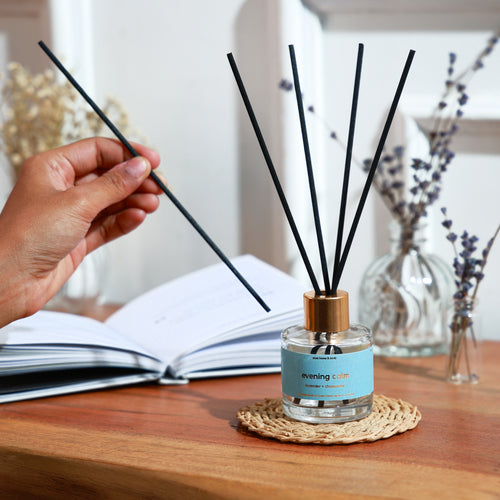 Softness · Evening Calm₹799Shop →
  Greener · Shangri-La-inspired₹299Shop →
Buying the five we do not make — and running the one we do
Since this range answers one of six questions, the useful thing I can do is tell you how to buy the other five well. Start with the reconstruction question, because it decides the price you should be willing to pay. Gardenia and tuberose are the two most heavily reconstructed materials in home fragrance — gardenia because the absolute is close to unobtainable at any sensible cost, tuberose because the absolute is real but so expensive that almost nobody uses it in a diffuser. So an inexpensive gardenia or tuberose is, with near certainty, a synthetic reconstruction. That is not disqualifying and I want to be clear about it: a well-built reconstruction can be more stable, more consistent and better behaved in an Indian summer than a natural would be. What is objectionable is paying a natural price for one, or being told that a ₹600 bottle contains an absolute that costs several times that per gram.
The second thing to check is what the flower has been given to stand on. A white floral alone in a bottle is a soliflore, and a soliflore in a warm room is the shortest route to the too-much problem, because there is nothing in the composition to hold the indolic material down as it starts to expand. Look for a supporting note — a wood, a tea, a musk, a green material — named on the label. The third thing is the carrier, which almost nobody thinks about and which decides whether your diffuser survives May. Most reed diffusers sit on DPG, which cracks and goes bitter above roughly 40°C; every SOSA reed sits on a heat-stable CCT base, coconut-derived, tested through 45°C heat soak and 85% monsoon humidity. If you are buying elsewhere, ask. A beautiful white floral on a poor carrier is a fragrance with an expiry date you were not told about.
And then the part that costs nothing at all. White florals amplify in small warm rooms, and they need fewer reeds than you expect. Every SOSA bottle ships with six fibre reeds — fibre rather than rattan, because rattan clogs in Indian humidity — and six is a hall setting, not a default. Use three in a bedroom, two in a bathroom, and five or six only in a hall, an entryway or a living room. Two or three reeds in a 50 sq ft bathroom will make a 50ml bottle last close to three months. Flip them every five to seven days for Garden Bloom, which gives you a lift without buying anything. Keep the bottle away from a running split AC, which strips the top off and leaves you sitting in the base — and with a white floral, the base is precisely the part you want least of on its own. More white florals are judged unfairly for being overwhelming than for being badly made, and the fix is usually pulling three sticks out of a bottle.
The white floral edit, in buying order — and the gap
Here is what I would actually buy, in order, for somebody who arrived at this page wanting a white floral home. It is a short list because the honest answer is short. SOSA makes one of the six white florals as a reed diffuser; the last row of this table is the other five, stated plainly rather than covered by stretching Garden Bloom to stand for a family it is only one member of.
| Buy | What it is | When it is the right answer | Price |
|---|---|---|---|
| 1. Garden Bloom 50ml ★ | Real night-blooming sambac over British rose, soft musk drydown, 8.9 | First, for anyone who wants jasmine or white-floral warmth at home | ₹799 |
| 2. Garden Bloom 130ml | The same composition, sized for above 150 sq ft — 14–18 weeks | Halls, entryways and living rooms, where a white floral belongs | ₹1,299 |
| 3. Evening Calm 50ml | Kashmir lavender and chamomile — the softest thing we make at 8.9 | If what you actually want is the softness rather than the headiness | ₹799 |
| 4. Shangri-La-inspired 15ml + a machine | Jasmine, green tea and white tea — water-based, ultrasonic only. Needs a Sukoon ₹1,899 or Boond ₹899 | For a greener, more transparent white floral than any reed here gives | ₹299 + machine |
| 5. 300ml refill | Tops up the Garden Bloom bottle and reeds you already own | Once jasmine is clearly the white floral you keep going back to | ₹2,399 |
| No tuberose, gardenia, ylang-ylang, magnolia or champa: the honest gap | SOSA makes one of the six white florals as a reed diffuser. Five of them do not exist in this range and none is planned in the scope of this guide. Garden Bloom is a jasmine, not a stand-in for a family | Said plainly rather than stretched to fit | — |
Versailles
I am asked several times a month why a brand founded in India, by someone trained in Versailles, does not make a tuberose. The answer is that I would rather make one white floral that survives an Indian May than five that do not. Every flower in this family is a negotiation with indole, and the negotiation has to be conducted separately for each one, in the actual heat, over more than one summer. We have done that once. Doing it badly five more times would be a larger catalogue and a worse brand.
The work in Garden Bloom was mostly a question of how much indole to leave in. Too little and the jasmine stops smelling alive — it becomes a pretty, hollow, slightly soapy thing that could be any flower. Too much and it is beautiful in December and unbearable in April. The threshold is not a number you look up; it is found by keeping bottles at 45°C and smelling them week after week. What I am proudest of on that product page is not a note list. It is a verified buyer in Bengaluru writing that she expected it to turn awful by April and it hasn't.
If you came here for one of the other five, I hope this page is still worth your time — the reconstruction warning in particular, because gardenia and tuberose are the two places where home fragrance most often lets people pay a natural price for something that was never going to be natural. And take the reed count with you. Three sticks in a bedroom, two in a bathroom. Everything is composed in Pune, and a part of every order funds a girl's classroom through Nanhi Kali.
Frequently asked questions
- Jasmine in India and A jasmine home — real sambac, and the indole problem, and where to put the one bottle.
- Bedrooms and Living rooms — night-blooming jasmine at three reeds, and jasmine, dinner and the third smell.
- Not too sweet and Sophisticated white florals — why cheap jasmine goes syrupy, and restraint, and the indole threshold.
- Jasmine versus the rest — a straight comparison.
- The decision tree — one bottle, no reading, if you want one bottle and no argument.
- The complete jasmine guide — every decision in one place.
- Brand: the SOSA founder story.
SOSA reed diffusers — facts verified August 2026: Five scents, all alcohol-free, on a heat-stable CCT (caprylic/capric triglyceride) base, phthalate-free, paraben-free, IFRA-compliant, 0 ppm formaldehyde, six fibre reeds in a refillable glass bottle, composed and made in Pune, India. Garden Bloom (British rose · night-blooming jasmine, sambac/mogra · soft musk drydown) 50ml ₹799 · 130ml ₹1,299 · 8.9 on the SOSA strength scale · indole held below the fecal threshold so the jasmine stays floral above 30°C · 45 days to two months on the 50ml, 14–18 weeks on the 130ml · 4.9 from 138 verified buyers. Evening Calm (Kashmir lavender · chamomile · soft musk) 50ml ₹799 · 130ml ₹1,299 · 8.9, the softest in the range. Morning Freshness (Malabar lemon · peppermint · eucalyptus globulus) 50ml ₹749 · 130ml ₹1,249 · 9.0. Mountain Breeze (Himalayan pine · sage · Indian cedar) 50ml ₹849 · 130ml ₹1,349 · 9.4. Fresh Brew (Coorg coffee · Kerala vanilla · caramel) 50ml ₹849 · 130ml ₹1,349 · 9.5, the deepest in the range. Duos: Day & Night ₹1,498, Fresh & Grounded ₹1,548, Warmth & Bloom ₹1,598 (50ml × 2). Refills 300ml ₹2,399 · 500ml ₹3,499. Climate-tested through 45°C heat and 85% RH monsoon humidity. Of the six white florals, the reed line contains jasmine only: there is no tuberose, gardenia, ylang-ylang, magnolia or champa reed diffuser, and no orange blossom or neroli; the range also contains no oud, sandalwood, vetiver, amber or aquatic accord. Where this guide is asked for one of those it says so rather than stretching the nearest scent to cover it. Reed diffuser oil and the water-based, ultrasonic-only Hotel Collection are separate products and are not interchangeable in either direction; there is no hotel-inspired reed diffuser. Hotel Collection 15ml ₹299 · 100ml ₹999 · 300ml ₹1,799. Machines: Sukoon ₹1,899 (500ml, 270–320 sq ft, 16–18 hours on low) and Boond ₹899 (300ml, up to 150 sq ft, about six hours). Free shipping above ₹499. A portion of every order supports girl-child education through Nanhi Kali. SOSA is an independent Indian fragrance house; the Hotel Collection scents referenced here are SOSA's own interpretations inspired by the world's finest hotels and SOSA is not affiliated with or endorsed by any hotel brand. Prices subject to change — see the live product pages.