




The mechanism: skin lipids transfer into fibre, sit at body temperature and oxidise. Porous fill has a huge internal surface area, and nothing washes through it.
The fix that matters most: a washable protector on the pillow and the mattress. It puts a launderable barrier at the boundary where the un-launderable part begins.
2. Because the chemistry needs no dirt to run. Skin lipids transfer onto and into the fibre continuously through the night. Held at body temperature, pressed into fabric, in contact with air, they oxidise, and the products of that reaction are what people describe as a warm, slightly sour, slept-in note. This happens on freshly showered skin. It is not a hygiene failure and you cannot wash yourself out of it — you can only remove the fabric it is sitting in more often.
3. Because the pillow is a point source at your face. Everything else in the room contributes to a room average. The pillow does not. It sits a few inches from your nose for eight hours, and what you experience from it is the concentration in that small boundary layer rather than the concentration in the room. It is also in contact with the scalp and hair, which are a heavier lipid source than most of the body, and it is the item almost nobody launders.
4. Because the mattress can never be washed and holds the most. It receives everything the sheet lets through, plus the water vapour a body releases all night, and it never leaves the room. Left uncovered it accumulates for years. This is exactly why a mattress protector exists, and why it is a more useful purchase than any fragrance you could put in the same room.
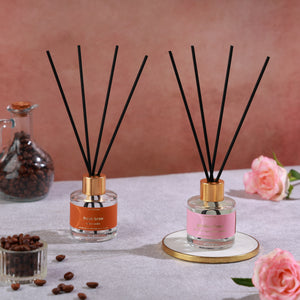
5. And it is why fragrance goes in the room, never on the bed. Fabric cannot tell your fragrance from your problem — it stores both and returns both. Keep scent in the air: a reed diffuser across the room, or a Sukoon you switch off at bedtime.
Made in India, composed by an ISIPCA Versailles-trained perfumer — and a portion of every order supports girl-child education through Nanhi Kali.

Why the layer that carries the most is the layer nobody launders
Line the bed up as a stack and the pattern is immediate. The pillowcase and sheet sit on top: thin, easily removed, and — if you are running a sensible routine — washed weekly. Below them is the pillow itself: dense porous fill, in the closest contact of anything in the house with skin, hair and scalp, and washed almost never, because many pillows are foam and cannot be washed at all. Below that, the inside face of the duvet, which is loaded every night and laundered when someone remembers. At the bottom, the mattress: the largest absorbent object you own, receiving whatever the sheet lets through plus eight hours of body moisture, and never washed in its life. Loading increases with every layer down. Cleaning frequency decreases with every layer down. Those two curves crossing is the whole of this article.
That is also why the familiar experience of "clean sheets, and it is back within two days" happens. Fresh linen removes the top layer of the stack and nothing beneath it. For a night or two the clean fabric masks what is underneath simply by being between you and it. Then the sheet warms up, the pillow beneath it goes on re-releasing what it absorbed over months, and the room returns to where it was. People conclude the washing "did not work" when in fact it worked perfectly on the one layer it touched. The answer is not to wash the sheets more often. It is to insert something washable at the layer below, which is what a protector is for, and to give the whole stack air and sunlight when you can.
The four layers, top to bottom
 Step fourFrom ₹749Weekly is the right cycle for a single sleeper and a firm floor for two — a shared bed on a fortnightly cycle is putting the same total load through the fabric as one person on a monthly one. Wash at the warmest temperature the fabric allows, dry it properly rather than leaving it half dry in a heap, and get it into sunlight when the weather permits, because UV and heat drive absorbed volatiles out of fibre faster than shade does. Strip the bed rather than making it on wash day, so the layers underneath get a few hours of open air while the linen is out.
Symptom to cause: reading the stack
These rows are arranged by depth, because the layer a smell is coming from determines what will fix it. Smell each layer directly and at close range — this is one diagnosis where the nose does work, as long as you compare against something freshly laundered.
| What you notice | Most likely cause | How to confirm it | What actually fixes it |
|---|---|---|---|
| Strongest with your face in the pillow, mild elsewhere ★ | The pillow — the deepest layer in direct contact with skin, hair and scalp | Smell it against a pillow taken from the cupboard, not from memory | Washable protector under the case, washed monthly; sun the pillow; replace when tired |
| Fresh sheets fix it for two days, then it returns | The layer below the sheet re-releasing — pillow and duvet, not the linen | Change only the sheet and see how long the improvement lasts | Protectors on pillow and mattress; wash the duvet cover; air the whole stack |
| Only noticeable when you strip the bed | The mattress, which holds the most and is never laundered | Put your face to the bare mattress in the morning after the sheet comes off | Washable mattress protector each season; vacuum; stand it up to air; sun where possible |
| Bed and linen fine, but the room still reads slept-in | Accumulation in the air rather than the fabric — no exit for eight hours | Cross-ventilate window and bedroom door for ten minutes on waking | Daily morning purge; keep the en-suite door shut overnight |
| Damp, cold patch or marks where the mattress meets an external wall | Condensation and possible mould — a health matter, not an odour | Pull the bed away from the wall and inspect both surfaces in daylight | Move the bed off the wall, find the moisture source, remove any growth. |
| Sharp drain note in the room that the bedding cannot explain | A dry P-trap in an en-suite — plumbing, not fragrance | Pour a mug of water down each drain and see whether it goes for a week | Refill traps weekly; get the seal checked if it comes back. |
| If none of these fit: borrow a pillow from a spare room for two nights and change nothing else. If those two mornings are different, you have found your layer without spending anything. | |||
Reeds · always-on roomsFrom ₹749Shop →  Sukoon · when you want a switch₹1,899Shop →
  Hotel Collection · the scentFrom ₹299Shop →
The bedding routine that actually changes the room
Start with the two protectors, because they are structural rather than habitual. A washable pillow protector under the pillowcase, laundered monthly, and a washable mattress protector laundered each season. Everything else on this list is something you have to remember; those two work whether you remember or not, and between them they cover the layers you can otherwise never clean. In a shared bed, both pillows. If a pillow is fibre-filled, wash the pillow itself every few months and dry it thoroughly — a half-dry pillow is worse than the one you started with. If it is foam and cannot be washed, give it a few hours in direct sun when the weather allows and replace it when it stops holding shape.
Then the weekly and daily habits. Sheets and pillowcases weekly, duvet cover fortnightly to monthly, and dry everything properly rather than leaving it folded damp. Every morning, throw the duvet fully back rather than making the bed — a made bed seals the night's warmth and moisture into the whole stack for the next fifteen hours, and the single most useful thing you can do for a mattress is let it dry out during the day. Run the ceiling fan over the open bed for an hour while you get ready; moving air is what dries fabric, not time. Once a season, strip everything, stand the mattress on its side, vacuum it with the upholstery attachment, and let both faces breathe. Sunlight where you can get it, because UV and heat clear absorbed volatiles out of fibre faster than shade.
And then fragrance, in the room and not on the bed. This is the one point in this cluster where I will be blunt about a product category: do not spray scent onto pillows, sheets or a mattress. Fabric stores a fragrance in exactly the way it stores an odour, releases it slowly over days, and you have no way of taking it back out — and you will be lying with your face against it for eight hours. Reed diffuser oil in particular should never go near fabric. Put the fragrance in the air instead: a reed diffuser from ₹749 on three or four of the six reeds, on a dresser or shelf across the room from the bed and away from an AC vent. Reed count is the volume control. If you would rather have a switch, the Sukoon at ₹1,899 takes 3–6 drops of the water-based Hotel Collection from ₹299 and covers roughly 270–320 sq ft. The two liquids are not interchangeable.
What to do, in order
Two protectors and a laundry habit will change this room more than anything you can buy from me. The fragrance step is real and worth making, but it is fourth, and it goes in the air.
| Step | What to do | When | Cost |
|---|---|---|---|
| 1. Remove the source | Washable protectors on pillow and mattress; wash the pillow itself if the fill allows; sun what you can | Before anything else | ₹0 |
| 2. Move the air | Duvet thrown fully back each morning, window and bedroom door open together for ten minutes | Daily, five to ten minutes | ₹0 |
| 3. Deal with what holds it | Sheets and cases weekly, duvet cover monthly, protectors monthly and seasonally, mattress vacuumed and aired | Weekly to monthly | ₹0 |
| 4. Then the always-on layer ★ | A SOSA reed diffuser — a quiet background in the air of the room on three or four reeds — never sprayed on fabric | 50ml 6-8 weeks · 130ml 14-18 | from ₹749 |
| 5. Or the on-demand layer | Sukoon with a Hotel Collection scent — scent while you read and silence at lights out; covers roughly 270–320 sq ft | Run it when you want it | ₹1,899 |
Versailles
If you buy one thing after reading this, I would rather it was a pillow protector than a bottle of anything I make. It is the cheapest intervention in this entire cluster and the only one that fixes the structural problem, which is that the object carrying the heaviest load in your bedroom has no way of being washed. A protector solves that for the price of a coffee, and it goes on working whether or not you are in the mood to be thorough.
The second thing I want to say is a warning about my own category. People spray fragrance on pillows. Please do not. Fibre stores what you put into it and hands it back for days, so a scent you liked in the bottle becomes a scent you cannot escape, at the distance of your own face, all night. Fabric cannot distinguish between a fragrance and a problem. It simply keeps both. Reed oil especially has no business anywhere near a pillowcase.
Keep the fragrance in the air and keep it small. Three reeds, across the room from the bed. What you actually want from a bedroom is a room that smells of nothing in particular with a faint character underneath it, and you get most of the way there with clean linen, an open duvet and ten minutes of window. A portion of every order funds a girl's classroom through Nanhi Kali.
Frequently asked questions
- Why fresh bedsheets change the room instantly — the reservoir you can carry out.
- Two people in one bedroom — why the fabric load doubles too.
- Fine at night, weird by morning — the eight-hour accumulation curve.
- Clean and expensive rather than sweet — why dry notes read better in a bedroom.
- Brand: the SOSA founder story.
SOSA products & prices (verified August 2026): Hotel Collection water-based ultrasonic diffuser fragrance 15ml ₹299 · 100ml ₹999 · 300ml ₹1,799 · Pack of 7 (15ml, all fragrances) ₹1,799; refills 100ml from ₹999. Seven scents: The Ritz-Carlton-inspired (white tea · bergamot · cedar), Westin-inspired (white tea · aloe · cedar), 1 Hotels-inspired (cedarwood · vetiver · green leaves), The St. Regis-inspired (amber · violet · woods), Shangri-La-inspired (jasmine · green tea · white tea), Four Seasons-inspired (citrus · floral · sandalwood), W Hotels-inspired (citrus · pepper · amber). Diffusers: Boond 300ml ₹899 · Sukoon 500ml ₹1,899 · Megh 6L ₹3,499. Water-based, phthalate-free, composed to IFRA standards for home diffusion; 3–6 drops per tank. Made in India, Pune. The Hotel Collection scents are SOSA's own interpretations inspired by the world's finest hotels; all hotel names are trademarks of their respective owners and are used only to describe the scent style — SOSA is an independent Indian fragrance house, not affiliated with or endorsed by any hotel brand. Prices and availability subject to change — see the live product pages.