


What stops: ventilation. Nobody opens a window in a room they are not using, so it sits at 0.2–0.5 air changes an hour indefinitely.
The counter-intuitive result: the least-used room in the flat is often the worst smelling one, because nothing ever dilutes what accumulates in it.
2. Because ventilation is a human behaviour and there was no human. Windows get opened because someone is in the room and wants air. Fans get switched on for the same reason. Doors get left open because people walk through. Remove the occupant and every one of those stops, and the room settles at the bottom of the 0.2–0.5 air changes an hour range and stays there for as long as you leave it alone.
3. Because unused drains dry out precisely because they are unused. A floor drain or basin in or beside a room nobody uses has a P-trap holding a small amount of water as a seal against the drainage system. If nothing runs down it, that water evaporates, the seal is lost, and the room is connected to the drain. This is a plumbing condition, not an odour problem, and the fix is a mug of water down every unused drain weekly rather than anything you spray.
4. Because furniture and finishes emit for months. New upholstery, plywood, laminates, polish, varnish and leather all release volatile compounds for a long time after they arrive, and a formal room is exactly where the newest and least-used furniture tends to live. In a ventilated space you never notice; in a sealed one it accumulates into the flat, faintly chemical smell people describe in a room that is otherwise immaculate.
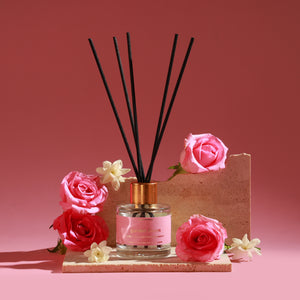
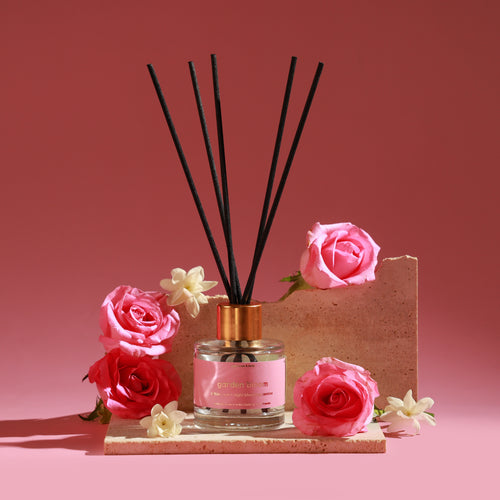
5. And fragrance in a sealed room simply joins the queue. Add scent to a room nobody opens and you have a sealed room with one more thing in it. Put the room on a ventilation schedule first, sort the drain and the fabric, and then let a reed diffuser hold a background — it is the only format that works somewhere nobody is standing.
Made in India, composed by an ISIPCA Versailles-trained perfumer — and a portion of every order supports girl-child education through Nanhi Kali.
Why a room fills up with nobody in it
The intuition behind this question is that a room is a container that people put smells into, so an empty container should stay clean. It is a reasonable model and it is wrong in one specific way: most of what a room smells of is not being emitted by people in real time, it is being re-emitted by materials on a delay of hours to days. Porous surfaces take odour molecules into the fibre and let them out slowly afterwards, and that process has no idea whether anyone is sitting on the sofa. It runs on temperature and time. A closed room on a warm afternoon is the ideal condition for it: the fabric is warm, so release speeds up, and the air is still, so nothing carries it away. You are not smelling today. You are smelling the last week, delivered slowly into air that has not been replaced.
The second half is behavioural, and it is the part that makes unused rooms worse than busy ones rather than better. Ventilation in a home is almost entirely a side effect of occupancy — someone finds it warm and opens a window, someone walks through and leaves the door open, someone switches the fan on. A room nobody enters gets none of those. It holds at the closed-flat rate of roughly 0.2 to 0.5 air changes an hour, indefinitely, while its contents keep contributing. That is why the guest bedroom, the formal sitting room and the front living room of a flat where everybody actually lives at the back are so often the worst-smelling spaces in the building despite being the cleanest. Nothing dilutes what accumulates, so it accumulates to a higher level than a busy room ever reaches — and then arrives in one breath when the door opens.
What keeps working with nobody there
 Step four50ml ₹799A living room usually holds the largest textile area in the flat outside the bedrooms: full-length curtains, a sofa, cushion covers, a rug, sometimes a fabric-covered ottoman. All of it absorbed cooking air, monsoon damp and general household odour over previous weeks, and all of it is giving that back slowly. It does not stop because the room is unoccupied, and it speeds up between roughly two and five in the afternoon when the room is warmest. Wash cushion covers monthly, curtains at least seasonally, and vacuum the sofa with the brush attachment rather than only the floor. Direct sunlight on a rug does more in an afternoon than a week of airing in shade.
Symptom to cause: reading an unused room
Open the door, stand still and take one breath before you touch anything — that first breath is the most informative reading an unused room offers, and it is gone within a minute or two of standing in it.
| What you notice | Most likely cause | How to confirm it | What actually fixes it |
|---|---|---|---|
| A flat, closed puff when the door opens, clearing within minutes ★ | Straightforward accumulation at 0.2–0.5 air changes an hour with no dilution | Open the room fully for ten minutes daily for a week and repeat the door test | Put the room on a ventilation schedule even when nobody uses it |
| Worse than the rooms you actually live in | No occupancy means no incidental airing, so it reaches a higher steady level | Compare the first breath in the guest room against the room you sit in every evening | Daily door-and-window opening; leave the internal door open when the flat is aired |
| Sharp or sewer-like, strongest near the floor | A dry P-trap in an unused drain — plumbing, not an odour problem | Pour a mug of water down every drain in and beside the room and check again tomorrow | Weekly water down unused drains; if it persists, that is a plumber's job. |
| Faintly chemical, like new furniture or polish | Outgassing from plywood, laminate, foam, leather or varnish in a sealed room | Open a cupboard door or sniff close to a new piece and compare with the room air | Ventilate daily and give it time; this fades with air exchange, not with cleaning |
| A dusty smell the moment the ceiling fan goes on | Settled dust and its organic content being lifted back into still air | Switch the fan on with the windows shut, then repeat with them open | Dust and vacuum before airing, and always run the fan with the windows open |
| Musty and earthy, worst on an outside wall or behind a cupboard | Damp ingress or mould — a health issue rather than a smell | Move furniture away from external walls and inspect in daylight | Find the moisture source and remove the growth. Do not fragrance this. |
| If none of these fit: close the room for two days deliberately, then open it and smell. Isolating a space and testing the first breath is the most reliable way to identify what a room contributes on its own. | |||
Reeds · always-on roomsFrom ₹749Shop →  Sukoon · when you want a switch₹1,899Shop →
  Hotel Collection · the scentFrom ₹299Shop →
Putting an unused room on a schedule
First, give it thirty seconds of attention a day. Open the door and the window, switch the ceiling fan on, and walk away. Ten minutes is plenty, and it converts the room from a sealed pocket at 0.2–0.5 air changes an hour into part of the flat. If you are cross-ventilating the rest of the home anyway, simply include this room in the path: open its door and its window so the draught runs through it rather than past it. The whole cost of this fix is remembering it exists, which is genuinely the hard part with a room nobody uses.
Second, work the two sources that do not need people. Run a mug of water down every drain in and beside the room once a week — that keeps the P-trap seal intact and prevents the most common sharp smell in an unused space. Then handle the textiles: cushion covers monthly, curtains seasonally, sofa vacuumed with the brush attachment, rugs into direct sunlight when the weather allows. Open the cupboards and any storage in the room while it is airing, because a closed cupboard inside a closed room is a stagnant volume within a stagnant volume. If dust is part of it, dust and vacuum before you switch the fan on, not after.
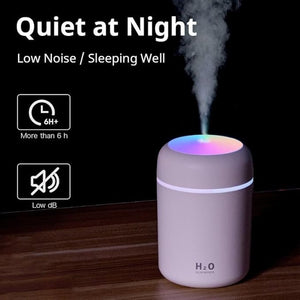
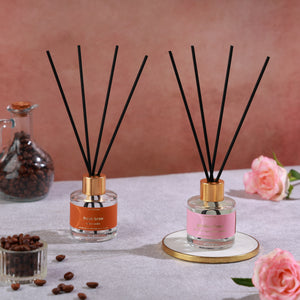
Third, choose a format that does not need somebody in the room. This is the one place in the cluster where the product decision is genuinely determined by the physics rather than by taste. An ultrasonic machine needs a person to switch it on, and there is no person. A reed diffuser from ₹749 runs on capillary wicking with no electricity and nothing to operate, which is exactly what an unattended room needs, and it covers a room of up to roughly 150 sq ft on six reeds. It will also last longer here than elsewhere, because still, cool air evaporates fragrance more slowly than a warm draughty hallway does — a 50ml runs 6–8 weeks and a 130ml from ₹1,249 runs 14–18 as a general guide, and an unused room sits at the longer end of both. If the room is a formal living room that you do use for guests, the Sukoon at ₹1,899 with a Hotel Collection scent from ₹299 is worth having as well, run for the hour before people arrive. Neither removes anything from the air.
What to do, in order
An unused room needs almost no work — it needs a small amount of work on a schedule, which is a different problem. Build the habit first, then add the layer that runs without you.
| Step | What to do | When | Cost |
|---|---|---|---|
| 1. Remove the source | A mug of water down every drain in and beside the room, weekly — this is the single commonest cause here | Before anything else | ₹0 |
| 2. Move the air | Ten minutes of door, window and ceiling fan every day, and include the room in the flat's ventilation path | Daily, five to ten minutes | ₹0 |
| 3. Deal with what holds it | Cushion covers monthly, curtains seasonally, sofa vacuumed, rugs sunned, cupboards opened while it airs | Weekly to monthly | ₹0 |
| 4. Then the always-on layer ★ | A SOSA reed diffuser — the only format that works with nobody present — no electricity, no switch, nothing to remember | 50ml 6-8 weeks · 130ml 14-18 | from ₹749 |
| 5. Or the on-demand layer | Sukoon with a Hotel Collection scent — a formal room used for guests: an hour of scent before people arrive, covering roughly 270–320 sq ft | Run it when you want it | ₹1,899 |
Versailles
The rooms people apologise for when I visit are almost always the ones they never use. A guest bedroom kept immaculate for visitors who come twice a year, or a front sitting room that is dusted weekly and entered monthly. Cleanliness was never the variable. Nobody has opened that window since March.
The drain is the detail I would check before anything else, because it is so counter-intuitive. People assume a drain smells because it is dirty. An unused drain smells because it is dry — the water in the trap is the seal, and if nothing goes down the pipe it evaporates. A mug of water once a week costs nothing and prevents the whole thing. And if water does not fix it, please call a plumber rather than reaching for a diffuser; that is not a job fragrance can do, and covering it just removes the signal.
When you get to the fragrance step, the format follows from the situation rather than from preference. There is nobody in the room to switch on a machine, so a reed is the answer — it simply runs. It will also last longer than the label suggests in a still, closed room, because evaporation depends on heat and airflow and an unused room has little of either. Six reeds for a living room, four if it is a small guest bedroom. A portion of every order funds a girl's classroom through Nanhi Kali.
Frequently asked questions
- Why does my house smell stale even though I clean it every day? — the general case, in order.
- Windows open and it still smells closed — why one opening is not ventilation.
- A guest bathroom that only smells when unused — the drying P-trap.
- How do I find the source of a stale smell? — the room-by-room method.
- Brand: the SOSA founder story.
SOSA products & prices (verified August 2026): Hotel Collection water-based ultrasonic diffuser fragrance 15ml ₹299 · 100ml ₹999 · 300ml ₹1,799 · Pack of 7 (15ml, all fragrances) ₹1,799; refills 100ml from ₹999. Seven scents: The Ritz-Carlton-inspired (white tea · bergamot · cedar), Westin-inspired (white tea · aloe · cedar), 1 Hotels-inspired (cedarwood · vetiver · green leaves), The St. Regis-inspired (amber · violet · woods), Shangri-La-inspired (jasmine · green tea · white tea), Four Seasons-inspired (citrus · floral · sandalwood), W Hotels-inspired (citrus · pepper · amber). Diffusers: Boond 300ml ₹899 · Sukoon 500ml ₹1,899 · Megh 6L ₹3,499. Water-based, phthalate-free, composed to IFRA standards for home diffusion; 3–6 drops per tank. Made in India, Pune. The Hotel Collection scents are SOSA's own interpretations inspired by the world's finest hotels; all hotel names are trademarks of their respective owners and are used only to describe the scent style — SOSA is an independent Indian fragrance house, not affiliated with or endorsed by any hotel brand. Prices and availability subject to change — see the live product pages.