


Burst versus continuous: an aerosol peaks in seconds and decays over minutes. The source keeps producing. The ratio moves against you fast.
Sulphur is stubborn: drain compounds are perceptible at very low levels and are not buried by volume.
And it lands: droplets settle onto the wet surfaces already in the room.
2. Because a burst decays and a source does not. This is the timing problem, and it is the one most people notice without being able to name. An aerosol puts a large quantity of fragrance into the air in two seconds. Its concentration then falls steadily as it disperses, settles and ventilates away. Meanwhile a drain, a biofilm or a damp mat carries on producing at a constant rate. Within ten minutes the mixture has shifted back towards the bad smell, and what you are left with is the original problem plus a sweetish residue.
3. Because some molecules simply refuse to be outnumbered. The sulphur compounds behind a drain smell are detectable at extremely low concentrations, which is exactly why they work so well as a warning. Volume does not bury them. You can put a great deal of fragrance into a small bathroom and still smell the drain underneath it, which is why people end up spraying more and more and liking the result less and less.
4. Because the spray lands on things. An aerosol is droplets, and droplets fall. In a bathroom they fall onto tile, grout, the top of the cistern, the mat and the shower screen — all of which are already damp. The fragrance and its carrier then sit on those wet surfaces, mix with the soap film and skin residue already there, and contribute to the same sticky layer you are trying to clean off. Over months this is genuinely part of the problem.
5. And because you stop smelling it and everyone else does not. Olfactory adaptation to your own spray is essentially complete in about twenty minutes, so you experience the peak and then nothing. A guest walking in an hour later gets the composite at full strength with none of the adaptation. You are the only person in the building who cannot smell what your bathroom actually smells like.
Made in India, composed by an ISIPCA Versailles-trained perfumer — and a portion of every order supports girl-child education through Nanhi Kali.
Why your nose blends instead of subtracting
The everyday model of odour that most of us carry around is a cancellation model: a bad smell is a thing, a good smell is another thing, and enough of the second makes the first go away. It is a comfortable model and it is not how the sense works. Olfaction is a pattern-recognition system operating on whatever mixture of molecules reaches the receptors, and what it returns is a single unified impression of that mixture. Two odours presented together produce a third percept whose character is genuinely new, sometimes surprisingly so, and there is no mechanism by which the presence of one reduces the physical concentration of the other. Fragrance is additive and never subtractive — that sentence is not a caveat we put in the small print, it is the whole physics of the thing, and it applies equally to a ₹99 aerosol and to anything we sell.
There is a second layer that is about learning rather than chemistry. The specific composite of sweet, simple floral or fruity fragrance layered over a sour or sulphurous base is not a neutral smell to an Indian adult; it is the smell of a railway station toilet, an old cinema, a poorly kept public convenience. We have all met it hundreds of times and we have learned exactly what it signifies, which is that somewhere here there is a problem and somebody sprayed at it. That association arrives instantly and it is doing a lot of the work when a guest winces at a bathroom you have just freshened. It also explains a genuinely counter-intuitive result: a plain, honest, unscented bad smell often reads better to a visitor than a sprayed one, because the first says "there is a fault here" and the second says "there is a fault here and it is being hidden from me".
Three things a spray does that a continuous scent does not
 A level, not a peakFrom ₹749Two seconds of aerosol puts a large dose into a small room, and that dose then disperses, settles and ventilates away over the following minutes. The source of your bad smell does none of those things: a drain, a film or a damp mat produces at a steady rate all day. So the mixture you experience changes continuously — overwhelming fragrance for a minute, an uneasy blend for five, and then the original smell with a sweet ghost over it for the rest of the hour. A continuous low-level source holds one ratio instead of sweeping through all of them, which is why it reads as a room having a character rather than a room having been treated.
Symptom to cause: what the mixture is telling you
The character of the blend is a reasonably good guide to what is underneath it. Work down until something matches, and note that the fix is always at the source rather than in the choice of fragrance.
| What you notice | Most likely cause | How to confirm it | What actually fixes it |
|---|---|---|---|
| Sweet on top, sour or sulphurous underneath ★ | A live source plus fragrance — classic blending, not a bad product | Stop all fragrance for two days and smell the room bare | Find and remove the source; then a low continuous level rather than bursts |
| Strong for a minute, worse than before after ten | Aerosol decay curve against a continuously producing source | Time it: note the smell at one minute, ten minutes and thirty | Stop spraying; deal with the source; use a steady low background instead |
| A sticky, perfumed background that survives cleaning | Months of settled aerosol droplets in the surface film | Wipe the cistern top with a dry white cloth and look at it | Degrease horizontal surfaces properly; stop spraying at the room |
| Guests notice it and you cannot smell it at all | Olfactory adaptation — you are adapted, they are not | Leave for thirty minutes and judge your first breath back in | Reduce the dose; judge by arrival, not by standing in the room |
| Eggy or sewer-like under everything you add | A failed water seal in a P-trap — plumbing, not fragrance | Pour a mug of water into every drain and reassess after an hour | Refill the traps; if it recurs, plumber and vent check. Never scent this. |
| Earthy and musty under everything you add | Growth on damp grout, silicone or a mat — sometimes mould | Feel the grout four hours after a shower; smell the mat away from the room | Fix the drying and remove the growth. Fragrance is not the tool. |
| If none of these fit: stop all fragrance in the bathroom for forty-eight hours, then walk in from outside and take one breath. That is the only unmasked measurement available to you, and it is the number every decision on this page depends on. | |||
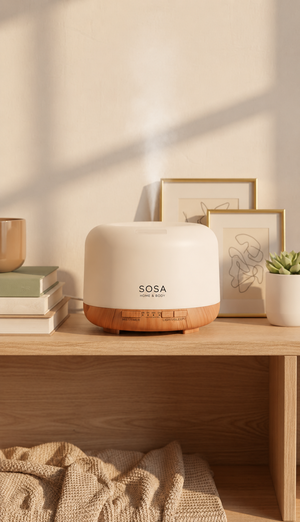
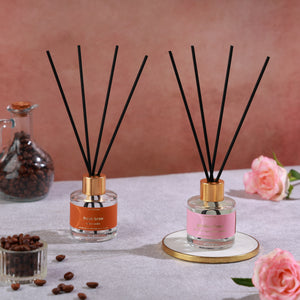
Reeds · always-on roomsFrom ₹749Shop → 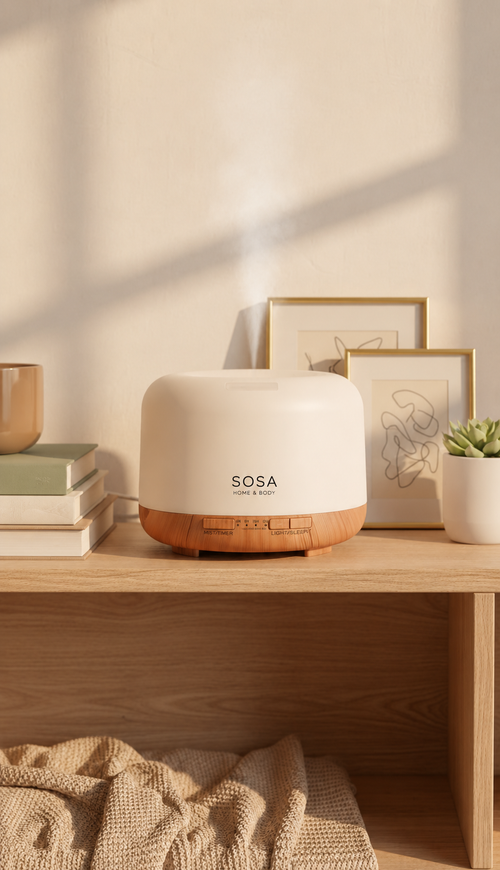 Sukoon · when you want a switch₹1,899Shop →
  Hotel Collection · the scentFrom ₹299Shop →
What to do instead of spraying
First, stop all fragrance for two days and find out what you actually have. No spray, no gel, no block, no diffuser. Then leave the flat for half an hour and walk into the bathroom with an unadapted nose. What you get in that first breath is the real problem, and it will fall into one of three families: sulphurous, which is a failed water seal and a plumbing job; sour or cheesy, which is biofilm inside the waste pipe and under the WC rim; or earthy and musty, which is growth on surfaces that never dry. Each has a completely different fix and none of them is a fragrance.
Second, fix that source, because nothing on this page works until you do. For a sulphurous smell: two mugs of water into every drain including the floor trap, and a plumber if it returns within days. For a sour one: brush physically inside the floor trap and the basin waste, clear the hair catcher, and get an angled brush up into the WC rim channel. For a musty one: run the extract fan for fifteen to twenty minutes after every shower rather than switching it off with the light, squeegee the walls, and dry the mat outside the room. All three of those are free or nearly free, and all three do what no fragrance can.
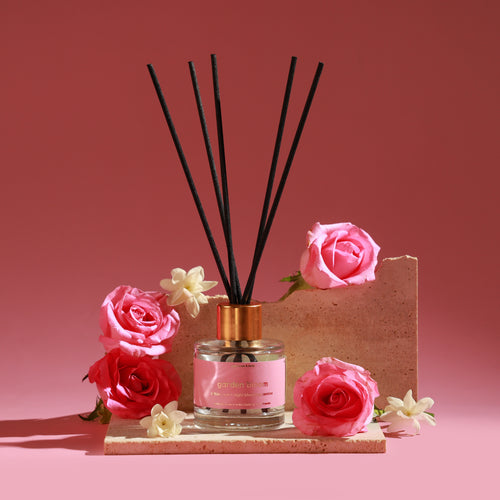
Third, replace the burst with a level. Once the room is genuinely neutral, the goal is a low, constant, unchanging background rather than intermittent peaks — which is precisely what a spray cannot do and what a reed diffuser does by default. A reed diffuser at 50ml from ₹749 runs 6–8 weeks on capillary action with no electricity, and in a small bathroom you should run it at two or three of its six reeds. Reed count is the volume dial: six is a living room, four a bedroom, two or three a small wet room. Place it away from the extract grille so the fan is not pulling it out through the duct. If you want a switchable option for a larger bathroom or the dressing area beside it, the Sukoon at ₹1,899 takes 3–6 drops of the water-based Hotel Collection from ₹299 and covers roughly 270–320 sq ft — run it for an hour, not all day. Neither of them removes anything; both of them hold a steady level, which is the thing a can of aerosol structurally cannot.
What to do, in order
The order matters more here than in almost any other bathroom question, because spraying is an active obstacle to diagnosis. Take the fragrance away first; you cannot measure anything through it.
| Step | What to do | When | Cost |
|---|---|---|---|
| 1. Remove the source | Stop all fragrance for two days, then judge the room on your first breath in from outside, and fix what you find | Before anything else | ₹0 |
| 2. Move the air | Extract fan for fifteen to twenty minutes after every shower, door ajar, rather than off with the light | Daily, five to ten minutes | ₹0 |
| 3. Deal with what holds it | Brush inside the drains, angled brush into the WC rim, squeegee the walls, dry the mat outside the room | Weekly to monthly | ₹0 |
| 4. Then the always-on layer ★ | A SOSA reed diffuser — a steady low level instead of a peak and a decay, at two or three reeds in a small bathroom | 50ml 6-8 weeks · 130ml 14-18 | from ₹749 |
| 5. Or the on-demand layer | Sukoon with a Hotel Collection scent — an occasional switchable layer for a larger bathroom or dressing area; covers roughly 270-320 sq ft | Run it when you want it | ₹1,899 |
Versailles
The sentence I would most like to remove from Indian bathrooms is "it will cover the smell". Nothing covers a smell. Your nose adds everything in the air together and hands you one answer, so the best a spray can do is change what the answer is made of. Over a live drain or a damp mat, that answer is worse than the one you started with, and everybody except you can tell.
I am also fairly hard on aerosols specifically, and not because they compete with us. It is the shape of the delivery. A two-second burst into a small room is a peak followed by a decay, and you are chasing it all day. A reed diffuser is dull by comparison and that is the entire point — it holds one quiet level, all day, with no events in it. Rooms that smell expensive smell the same at nine in the morning and nine at night.
And do the thirty-minute test before you do anything else. Take everything scented out of the bathroom for two days, go out, come back, and take one breath. Most people find something specific and fixable, and about half of them find they never needed to buy anything at all. When you do get to the fragrance step, two or three reeds in a bathroom, never six. A portion of every order funds a girl's classroom through Nanhi Kali.
Frequently asked questions
- Should I use a diffuser on a drain smell? — no, and here is the sequence instead.
- Still smells right after cleaning — the drain, the rim and the grout.
- How hotels avoid that smell — low continuous scent and constant extraction.
- Keeping a bathroom good permanently — the routine and the reed count.
- Brand: the SOSA founder story.
SOSA products & prices (verified August 2026): Hotel Collection water-based ultrasonic diffuser fragrance 15ml ₹299 · 100ml ₹999 · 300ml ₹1,799 · Pack of 7 (15ml, all fragrances) ₹1,799; refills 100ml from ₹999. Seven scents: The Ritz-Carlton-inspired (white tea · bergamot · cedar), Westin-inspired (white tea · aloe · cedar), 1 Hotels-inspired (cedarwood · vetiver · green leaves), The St. Regis-inspired (amber · violet · woods), Shangri-La-inspired (jasmine · green tea · white tea), Four Seasons-inspired (citrus · floral · sandalwood), W Hotels-inspired (citrus · pepper · amber). Diffusers: Boond 300ml ₹899 · Sukoon 500ml ₹1,899 · Megh 6L ₹3,499. Water-based, phthalate-free, composed to IFRA standards for home diffusion; 3–6 drops per tank. Made in India, Pune. The Hotel Collection scents are SOSA's own interpretations inspired by the world's finest hotels; all hotel names are trademarks of their respective owners and are used only to describe the scent style — SOSA is an independent Indian fragrance house, not affiliated with or endorsed by any hotel brand. Prices and availability subject to change — see the live product pages.